


26 Sep Tamil Nadu Minister Backs Transpreneurs with ₹1.5 Trillion Goal Support
✎ The Transgender Persons (Protection of Rights) Act, 2019, and Tamil Nadu’s Transgender Welfare Board are foundational frameworks for protecting the rights of transgender persons, including provisions for non-discrimination in…
Subject Relevance — Where This Topic Fits
- GS Paper II — Social Justice (Vulnerable Sections) | GS Paper III — Indian Economy (MSMEs, Startups, and Entrepreneurship)
- Prelims: Transgender Persons (Protection of Rights) Act, 2019, Transgender Persons (Protection of Rights) Rules, 2020, MSMEs and Startup Ecosystem, Formalisation of Micro Food Processing Enterprises (FME) Scheme, Scheduled Caste Sub-Plan (SCSP) and Tribal Sub-Plan (TSP) in State Budgets, National Portal for Transgender Persons
- Essay: Inclusivity as a Catalyst for National Development: The Case of Transgender Entrepreneurship, Balancing Economic Growth and Social Equity: Lessons from Tamil Nadu’s Transpreneur Initiative
Quick Revision: The Transgender Persons (Protection of Rights) Act, 2019, and Tamil Nadu’s Transgender Welfare Board are foundational frameworks for protecting the rights of transgender persons, including provisions for non-discrimination in employment and access to welfare schemes.
Why is this in the news?
The Transpreneur Summit 2026 in Madurai, organised by StartUp TN and the Transgender Resource Centre, marked a significant milestone in India’s journey toward inclusive entrepreneurship. The event highlighted the intersection of social justice and economic empowerment, with Tamil Nadu’s MSME Minister pledging institutional support for transgender entrepreneurs. This summit underscores the evolving policy landscape for marginalised communities and the role of state-led initiatives in fostering equitable growth within the MSME and startup ecosystem.
Background
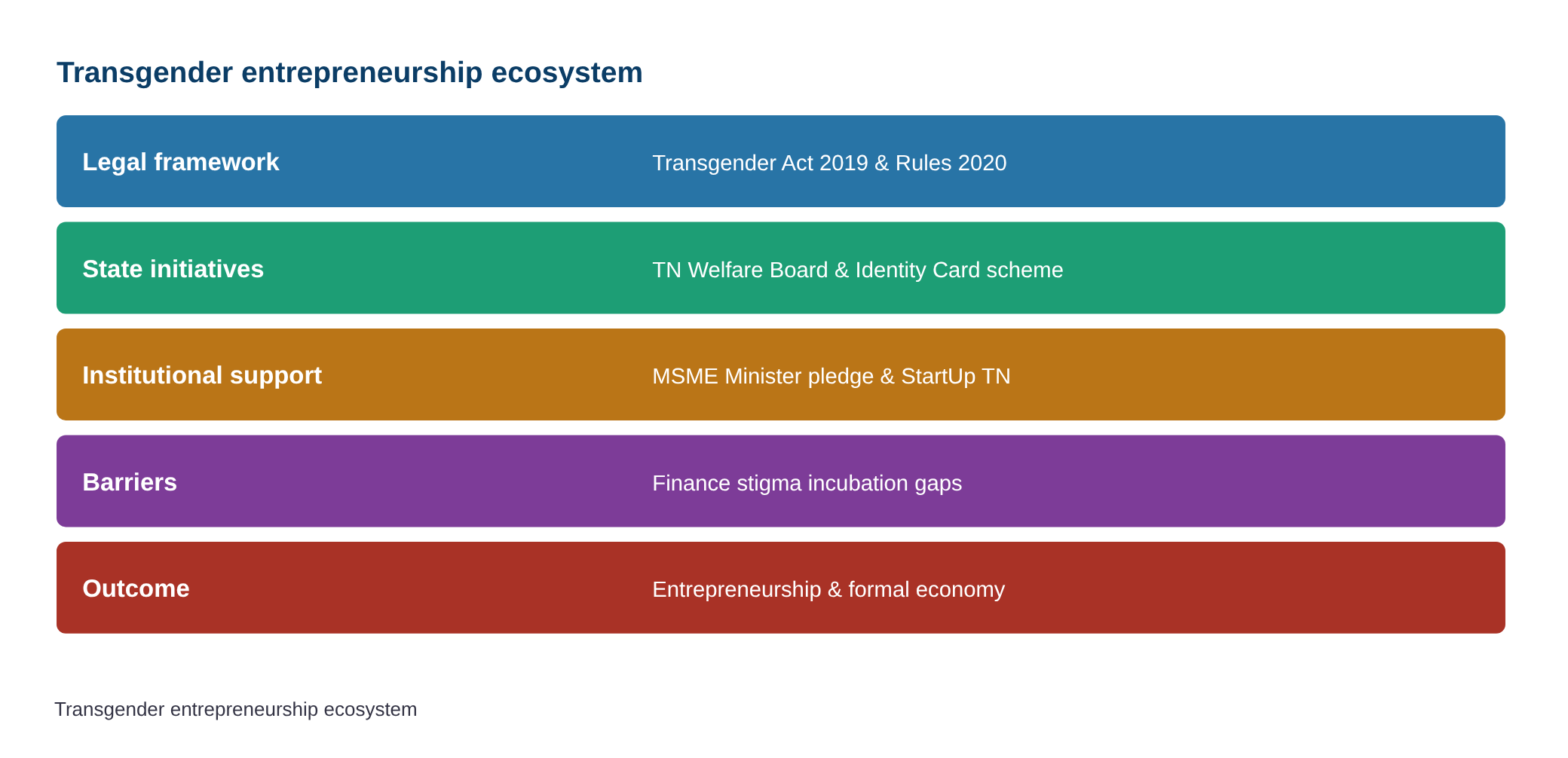
- The Transgender Persons (Protection of Rights) Act, 2019, and its subsequent Rules in 2020, provided a legal framework for the protection of rights and welfare of transgender persons in India, including provisions for non-discrimination in employment and access to welfare schemes.
- Tamil Nadu has been a pioneer in implementing progressive policies for transgender persons, including the establishment of the Tamil Nadu Transgender Welfare Board in 2019 and the launch of the ‘Transgender Identity Card’ scheme to facilitate access to benefits.
- India’s startup ecosystem has grown exponentially, with Tamil Nadu ranking among the top states in terms of startup density. However, systemic barriers persist for transgender entrepreneurs, including access to finance, social stigma, and lack of incubation support.
- The summit’s theme—‘empower, connect, collaborate, and elevate’—reflects a broader global trend toward integrating marginalised communities into the formal economy through targeted policy interventions.
What is a Transpreneur Summit?
- A Transpreneur Summit is a specialised platform designed to foster entrepreneurship among transgender individuals by providing networking opportunities, mentorship, access to finance, and incubation support.
- Such summits are typically organised by government agencies, NGOs, or private sector stakeholders in collaboration with transgender-led organisations to address systemic barriers faced by the community in business ventures.
- [‘The primary objectives include: (a) Empowering transgender persons to overcome socio-economic challenges through entrepreneurship; (b) Facilitating access to finance, including loans and subsidies, under government schemes; (c) Creating a supportive ecosystem through mentorship, incubation, and skill development; and (d) Promoting collaboration between the government, private sector, and civil society to drive inclusive economic growth.’]
- The Transpreneur Summit 2026 in Madurai is the first of its kind in India, signalling a shift toward recognising transgender entrepreneurship as a viable pathway to economic independence and social integration.
- Key stakeholders at such summits include government officials, financial institutions, investors, incubation centres, and transgender entrepreneurs themselves, who share experiences and best practices.
- The summit also serves as a platform for signing Memorandums of Understanding (MoUs) between government agencies, NGOs, and private entities to formalise support mechanisms for transgender-led enterprises.
- The event in Madurai featured an expo showcasing 22 products and services developed by transgender entrepreneurs, demonstrating the potential of the community in sectors such as manufacturing, services, and food processing.
- Institutional support, such as the Prime Minister’s Formalisation of Micro Food Processing Enterprises (FME) Scheme, plays a critical role in providing financial assistance to transgender entrepreneurs, as evidenced by the loan disbursement to a transwoman during the summit.
Key Features
| Feature | Significance |
|---|---|
| Transpreneur Summit 2026 in Madurai | First-of-its-kind national platform for transgender entrepreneurs, fostering visibility, networking, and collaboration among stakeholders. |
| Government assurance of support | Explicit commitment by the Tamil Nadu MSME Minister to facilitate business ventures of transgender persons, signalling policy prioritisation. |
| MoU with StartUp TN, TSOM Incubation Association, and Solaimalai Foundation | Institutional partnerships to provide incubation, mentorship, and funding pathways for transgender-led startups. |
| Display of 22 products/services by transpersons | Showcasing tangible economic contributions of the transgender community, validating their entrepreneurial potential. |
| Prime Minister’s Formalisation of Micro Food Processing Enterprises Scheme (PMFME) support | Direct financial inclusion mechanism for a transwoman entrepreneur, demonstrating scheme utilisation for marginalised groups. |
Why it Matters
Economic Empowerment
- Demonstrates the integration of marginalised communities into formal economic structures through entrepreneurship, aligning with inclusive growth objectives.
- Highlights the role of state-led initiatives (e.g., MSME support, incubation) in reducing barriers to entry for transgender persons in business.
- Showcases Tamil Nadu’s proactive stance in leveraging the transgender demographic as a productive economic resource.
Social Inclusion
- Provides a platform for transgender persons to articulate challenges (e.g., societal discrimination, funding constraints) and seek solutions through policy engagement.
- Reinforces the principle of non-discrimination in economic participation, as enshrined in constitutional and statutory frameworks.
- Promotes role models within the community, potentially altering societal perceptions and reducing stigma.
Policy Implementation
- Illustrates the operationalisation of schemes (e.g., PMFME) at the grassroots level, with tangible benefits accruing to marginalised groups.
- Demonstrates inter-departmental coordination (MSME, StartUp TN, District Administration) in executing inclusive economic policies.
- Signals the potential for scaling such initiatives nationally, contingent on replication of institutional mechanisms.
Institutional Collaboration
- Bridges the gap between government, civil society (Transgender Resource Centre), and private incubators (TSOM, Solaimalai Foundation) for holistic support.
- Highlights the role of incubation centres in nurturing transgender-led ventures, particularly in manufacturing and services sectors.
- Sets a precedent for public-private partnerships in addressing socio-economic disparities.
Challenges
1. Systemic Discrimination in Access to Finance
- Transgender persons face disproportionate rejection rates in loan applications due to perceived risks, lack of collateral, or societal biases.
- Even viable projects may be denied credit due to institutionalised scepticism, necessitating targeted interventions like relaxed collateral norms.
- Banks and financial institutions require sensitisation to mitigate unconscious bias in lending decisions.
UPSC Link: GS2: Social Justice – Vulnerable Sections
2. Legal and Administrative Barriers
- Absence of gender-neutral identity documentation can impede business registration, taxation, and compliance processes.
- Delays in obtaining identity proofs (e.g., Aadhaar updates) may restrict access to schemes like PMFME or subsidies.
- Lack of standardised grievance redressal mechanisms for transgender entrepreneurs in government schemes.
UPSC Link: GS2: Governance – E-governance
3. Socio-Cultural Stigma
- Widespread societal prejudice may deter family or community support for transgender-led ventures, increasing vulnerability.
- Workplace discrimination and harassment in corporate or informal sectors limit professional growth and networking opportunities.
- Psychological barriers, including internalised stigma, may hinder self-confidence and risk-taking in entrepreneurship.
UPSC Link: GS1: Social Issues – Marginalisation
4. Capacity Building Gaps
- Limited access to business mentorship, skill development, and market linkages for transgender entrepreneurs.
- Inadequate representation in industry associations or chambers of commerce restricts advocacy and policy influence.
- Need for tailored incubation programmes addressing unique challenges faced by transgender founders.
UPSC Link: GS3: Economic Development – Entrepreneurship
5. Policy Fragmentation
- Overlap or gaps between central and state schemes (e.g., PMFME vs. Tamil Nadu’s MSME policies) may create confusion or exclusion.
- Lack of a unified national framework for transgender economic inclusion, leading to inconsistent implementation.
- Monitoring and evaluation mechanisms for schemes targeting transgender persons are often weak or absent.
UPSC Link: GS2: Governance – Policy Implementation
Challenges — UPSC Perspective
| Issue | Concern |
|---|---|
| Identity Documentation | Lack of gender-neutral IDs delays business registration and scheme access. |
| Collateral Requirements | Strict collateral norms exclude transgender persons from formal credit systems despite viable projects. |
| Workplace Discrimination | Stigma in hiring and retention limits professional growth and networking. |
| Mentorship Gaps | Absence of tailored business guidance restricts entrepreneurial success rates. |
| Policy Coordination | Fragmented schemes between centre and state create access barriers. |
| Sensitisation Deficit | Institutional biases among bank officials and bureaucrats hinder equitable service delivery. |
Government Initiatives — Must-Memorise for Prelims
- Prime Minister’s Formalisation of Micro Food Processing Enterprises Scheme (PMFME)
- Tamil Nadu MSME Policy Framework
- Startup TN Incubation Programme
Way Forward
- Establish gender-neutral identity certification processes to streamline business registration and compliance.
- Mandate relaxed collateral norms for transgender entrepreneurs in government-backed credit schemes, subject to project viability.
- Launch targeted incubation programmes in partnership with civil society organisations to address mentorship and skill gaps.
- Sensitise bank officials and financial institutions through periodic training on transgender-inclusive lending practices.
- Create a centralised grievance redressal portal for transgender entrepreneurs to report discrimination or delays in scheme access.
- Integrate transgender economic inclusion metrics into the performance audit of MSME and StartUp schemes.
- Expand public procurement quotas for transgender-led enterprises to enhance market access and revenue stability.
- Conduct periodic impact assessments of schemes like PMFME to identify and rectify exclusionary practices.
UPSC Value Addition
Keywords for Mains Answer-Writing
Transgender Persons (Protection of Rights) Act, 2019 · Transgender Persons (Protection of Rights) Rules, 2020 · National Portal for Transgender Persons · PM Formalisation of Micro Food Processing Enterprises (PMFME) Scheme · StartUp India initiative · MSME sector in India · Social empowerment through entrepreneurship · Inclusive growth and gender justice · Constitutional provisions for equality (Article 14, 15, 16) · Scheduled Castes and Scheduled Tribes (Prevention of Atrocities) Act, 1989 · Right to Livelihood under Article 21 · Gender identity and self-determination · Institutional support for marginalised communities
Constitutional & Policy Linkages
- Article 14 – Equality before law and equal protection of laws
- Article 15(1) – Prohibition of discrimination on grounds of religion, race, caste, sex, or place of birth
- Article 16(1) – Equality of opportunity in matters of public employment
- Article 21 – Right to life and personal liberty (including livelihood)
Concept Flow
Systemic discrimination → Exclusion from formal economy → Limited access to finance and markets → Transgender persons seek entrepreneurship as alternative livelihood → Challenges in project viability due to societal and institutional barriers → Need for targeted policy interventions → Government initiatives (e.g., PMFME, MSME support) → Institutional partnerships (incubation, mentorship) → Economic empowerment and social inclusion → Replication and scaling of successful models.
Prelims Practice Questions
Q1. Consider the following statements regarding the Transgender Persons (Protection of Rights) Act, 2019:
1. The Act defines a transgender person as one whose gender does not match the gender assigned at birth.
2. It mandates the establishment of a National Council for Transgender Persons.
3. The Act provides for reservation in educational institutions and government jobs for transgender persons.
4. The Act criminalises begging by transgender persons.
How many of the above statements are correct?
- Only one
- Only two
- Only three
- All four
Answer: Only three — Statements 1 and 2 are correct as per the Act. Statement 3 is incorrect because the Act does not provide for reservation in jobs or education. Statement 4 is incorrect as the Act does not criminalise begging by transgender persons.
Q2. Assertion (A): The PM Formalisation of Micro Food Processing Enterprises (PMFME) Scheme is a centrally sponsored scheme aimed at supporting micro food processing units in India.
Reason (R): The scheme provides financial assistance, technology upgradation, and training to micro food processing enterprises to enhance their competitiveness and market access.
In the context of the above two statements, which one of the following is correct?
- Both A and R are true, and R is the correct explanation of A
- Both A and R are true, but R is NOT the correct explanation of A
- A is true, but R is false
- A is false, but R is true
Answer: Both A and R are true, but R is NOT the correct explanation of A — Both the Assertion (A) and Reason (R) are factually accurate. The PMFME Scheme is indeed a centrally sponsored initiative, and the Reason correctly explains its objectives and components.
Q3. Match the following initiatives with their respective objectives:
Column I
A. StartUp India
B. PMFME Scheme
C. National Portal for Transgender Persons
D. Transgender Persons (Protection of Rights) Act, 2019
Column II
1. Provides a platform for transgender persons to apply for identity certificates and avail welfare schemes
2. Aims to promote entrepreneurship and ease of doing business for startups
3. Focuses on formalising and supporting micro food processing enterprises
4. Enacts legal provisions for the protection of rights and welfare of transgender persons
Select the correct match:
- A-2, B-3, C-1, D-4
- A-1, B-2, C-3, D-4
- A-3, B-1, C-4, D-2
- A-4, B-3, C-2, D-1
Answer: A-2, B-3, C-1, D-4 — The correct pairing is: A (StartUp India) with 2, B (PMFME Scheme) with 3, C (National Portal for Transgender Persons) with 1, and D (Transgender Persons (Protection of Rights) Act, 2019) with 4.
Mains Practice Question
✍ The State of Tamil Nadu has taken a pioneering step by organising the Transpreneur Summit 2026 to empower transgender entrepreneurs. In this context, critically examine the constitutional and statutory framework governing the rights of transgender persons in India. Also, analyse the role of institutional mechanisms in ensuring their socio-economic inclusion. (15 Marks)
Approach: MODEL-ANSWER SKELETON:
1. **Constitutional Framework**:
– Article 14 (Right to Equality), Article 15 (Prohibition of Discrimination), Article 16 (Equality of Opportunity), and Article 21 (Right to Life and Personal Liberty) as the foundational legal basis for transgender rights.
– Judicial precedents: NALSA v. Union of India (2014) – recognition of self-identified gender and right to identity; Justice K.S. Puttaswamy (Retd.) v. Union of India (2017) – right to privacy and dignity.
2. **Statutory Framework**:
– Transgender Persons (Protection of Rights) Act, 2019: Key provisions – definition of transgender persons, prohibition of discrimination, welfare measures, and establishment of the National Council for Transgender Persons.
– Transgender Persons (Protection of Rights) Rules, 2020: Operational guidelines for identity certificates, welfare schemes, and grievance redressal.
– National Portal for Transgender Persons: Digital platform for self-identification and access to welfare schemes.
3. **Institutional Mechanisms**:
– Role of State Governments: Tamil Nadu’s Transgender Welfare Board, Madurai’s Transgender Resource Centre, and StartUp TN’s initiatives.
– Institutional support for entrepreneurship: PMFME Scheme, StartUp India, and MSME sector policies.
– Challenges: Lack of awareness, bureaucratic hurdles, and societal stigma.
4. **Socio-Economic Inclusion**:
– Entrepreneurship as a tool for empowerment: Case studies from Tamil Nadu’s Transpreneur Summit 2026.
– Need for financial inclusion: Access to credit, incubation support, and market linkages.
– Way forward: Strengthening institutional mechanisms, awareness campaigns, and policy integration.
5. **Conclusion**:
– Balancing constitutional guarantees with ground-level implementation.
– The role of state-led initiatives in fostering inclusive growth.
Source: The Hindu
Tamil Nadu PCS (TNPSC) — State PCS Practice
Prelims: Which of the following statements is correct regarding the recent ‘Transpreneur Summit’ held in Madurai, as per the Tamil Nadu government’s initiatives for transgender persons?
- The Minister assured 100% reservation in government jobs for transgender persons in Tamil Nadu.
- The Minister announced a dedicated ‘Transpreneur Cell’ under the Social Welfare Department to support transgender entrepreneurs.
- The Minister declared Tamil Nadu as the first state to provide monthly pensions to all transgender persons above 40 years.
- The Minister launched a new scheme ‘Thozhil Seithi’ exclusively for transgender persons in rural areas.
Answer: The Minister announced a dedicated ‘Transpreneur Cell’ under the Social Welfare Department to support transgender entrepreneurs. — The Minister announced the establishment of a ‘Transpreneur Cell’ under the Social Welfare Department to provide support and resources for transgender entrepreneurs.
Mains: Critically discuss the significance of the Tamil Nadu government’s initiatives for transgender persons, as highlighted in the recent ‘Transpreneur Summit’ in Madurai. Suggest measures to ensure effective implementation of these initiatives.
Generated by AanyaAi for educational purpose.
Related guides on our sites
- Best economics services coaching
- Anthropology VS PSIR
- Best PSIR optional coaching
- Best PSIR optional coaching online

- PM Modi Praises Youth-Led Nasha Mukt Yuva Abhiyan Momentum - September 27, 2026
- राजनाथ सिंह का बड़ा बयान: भारत किसी की ज़मीन कब्ज़ा नहीं करेगा, लेकिन सुरक्षा पर होगा कठोर - September 27, 2026
- Exercise Tarang Shakti 2026: India’s Mega Multi-Nation Air Power Showcase - September 27, 2026

No Comments