


11 Aug Tamil Nadu’s ₹11,000 Crore Pension Scheme: Centre’s Nod Awaited
✎ The Tamil Nadu Assured Pension Scheme (TAPS) awaits Union government sanction for a ₹11,000 crore borrowing limit under Article 293(3) of the Constitution, highlighting the interplay between state welfare initiatives and central…
Subject Relevance — Where This Topic Fits
- GS Paper II — Federalism, Cooperative and Competitive | GS Paper III — Indian Economy and Issues Relating to Planning, Mobilisation of Resources, Growth, Development and Employment, Government Budgeting
- Prelims: Assured Pension Scheme (APS), Fiscal Responsibility and Budget Management (FRBM) Act, State Borrowing Limits, Revenue Deficit, Gross State Domestic Product (GSDP), State Own Tax Revenue (SOTR), Debt-to-GSDP Ratio, White Paper on State Finances, Union-State Financial Relations, Interim Payouts
- Essay: Fiscal Federalism in India: Balancing Autonomy and Accountability, The Role of State Governments in Social Sector Expenditure: Challenges and Opportunities
Quick Revision: The Tamil Nadu Assured Pension Scheme (TAPS) awaits Union government sanction for a ₹11,000 crore borrowing limit under Article 293(3) of the Constitution, highlighting the interplay between state welfare initiatives and central fiscal oversight.
Why is this in the news?
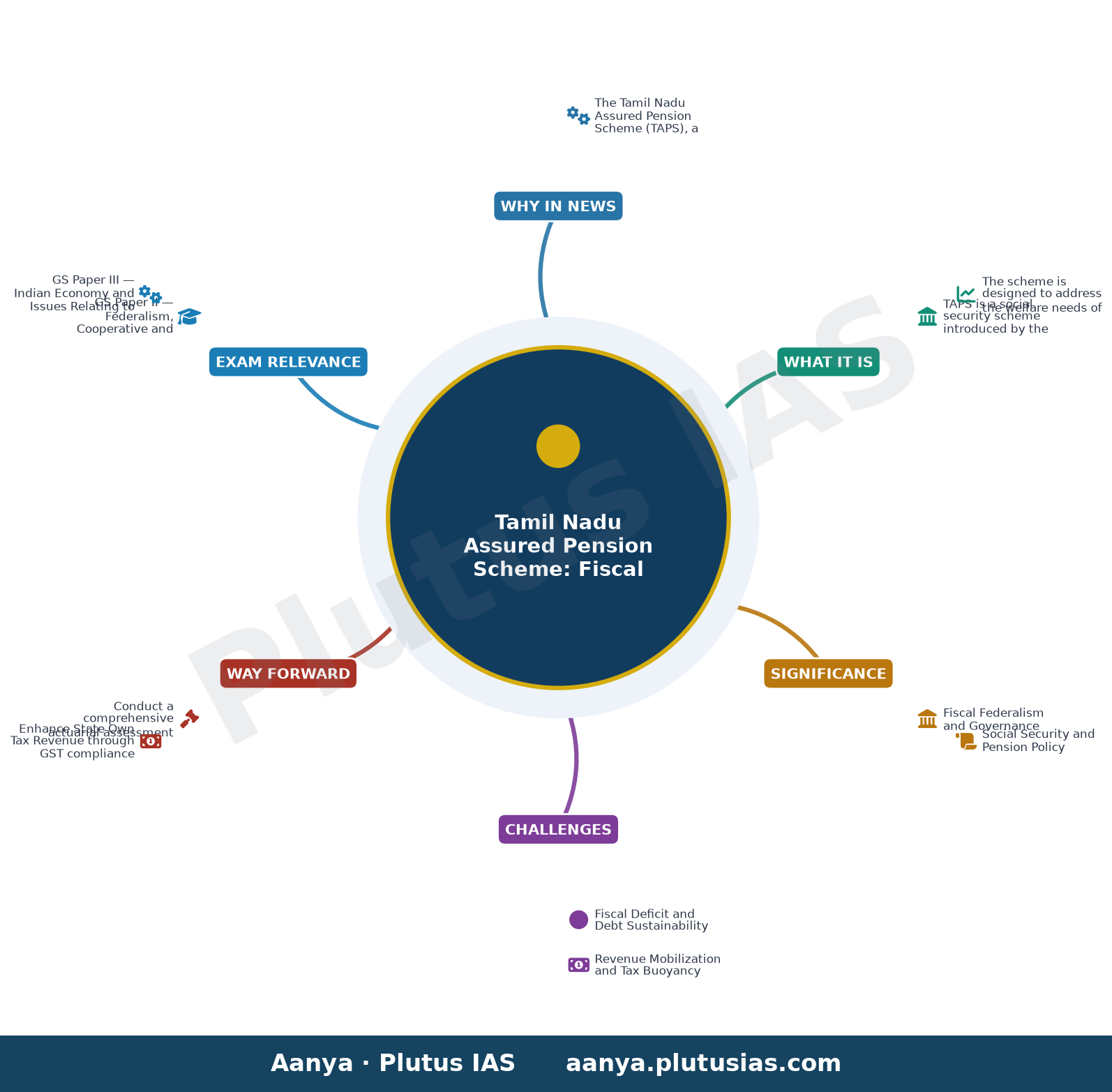
The Tamil Nadu Assured Pension Scheme (TAPS), a flagship social security initiative introduced by the Tamil Nadu government, remains pending implementation due to the requirement of Union government sanction for a ₹11,000 crore borrowing limit. The Finance Minister of Tamil Nadu, Marie Wilson, has clarified that the scheme will be operationalised only upon receipt of this sanction, while announcing an interim payout for retirees from January 1, 2026, pending full implementation. This development underscores the fiscal federalism challenges in India, where state-level social welfare schemes often hinge on central approvals for borrowing, particularly in the context of strained state finances.
Background
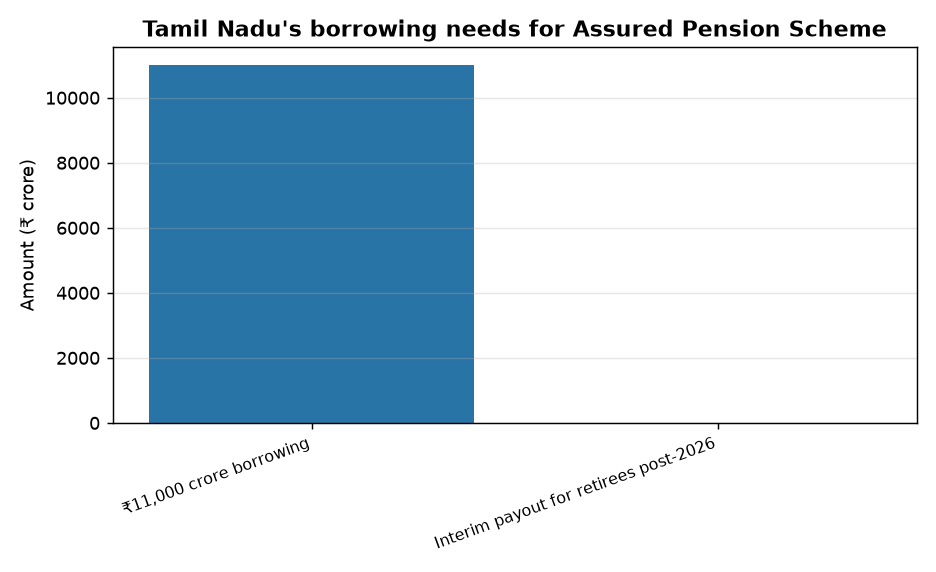
- The scheme’s implementation is contingent upon the Union government’s approval for an additional borrowing limit of ₹11,000 crore, reflecting the constitutional provisions under Article 293(3) of the Constitution of India, which mandates central approval for state borrowings exceeding prescribed limits.
- Tamil Nadu’s fiscal situation has been marked by a rising revenue deficit, declining State Own Tax Revenue (SOTR), and a contraction in Gross State Domestic Product (GSDP) growth, as highlighted in the state’s White Paper on Finances, which provides a comprehensive assessment of the state’s economic challenges.
- The state’s debt-to-GSDP ratio has been a subject of debate, with the Finance Minister asserting that the current borrowing levels (0.51% of GSDP) are lower than the previous government’s (0.54% of GSDP), despite an absolute increase in borrowings.
- The interim payout announced for retirees from January 1, 2026, is a temporary measure to address immediate welfare needs while awaiting the central sanction for the full scheme implementation.
- The Union-State financial relations in India are governed by the Finance Commission recommendations, the FRBM Act, and the constitutional framework, which collectively influence the borrowing and expenditure autonomy of state governments.
What is the Tamil Nadu Assured Pension Scheme (TAPS)?
- TAPS is a social security scheme introduced by the Tamil Nadu government to provide assured pensions to eligible retirees, ensuring financial security in old age.
- The scheme is designed to address the welfare needs of retired government employees and other eligible beneficiaries, aligning with the state’s commitment to social justice and inclusive growth.
- Implementation of TAPS is contingent upon the Union government’s approval for an additional borrowing limit of ₹11,000 crore, as per the constitutional provisions under Article 293(3) of the Constitution of India.
- The scheme’s pending status highlights the fiscal federalism challenges in India, where state-level social welfare initiatives often require central approvals for borrowing, particularly in fiscally strained states.
- The interim payout announced for retirees from January 1, 2026, is a temporary measure to address immediate welfare needs while awaiting the central sanction for full implementation.
- The scheme reflects Tamil Nadu’s efforts to enhance social security coverage, particularly for vulnerable sections such as the elderly and retired government employees.
- The fiscal constraints faced by Tamil Nadu, including a rising revenue deficit and declining SOTR, underscore the need for balanced fiscal management while implementing welfare schemes.
- The scheme’s design and implementation are influenced by the state’s fiscal capacity, borrowing limits, and the broader macroeconomic environment, including GSDP growth trends.
Key Features
| Feature | Significance |
|---|---|
| Tamil Nadu Assured Pension Scheme (TAPS) | A state-level social security initiative guaranteeing a minimum pension to eligible retired government employees, ensuring financial stability post-retirement. |
| Interim Payout Mechanism | A temporary financial relief measure for retirees from January 1, 2026, pending full implementation of TAPS, addressing immediate pension needs. |
| Borrowing Sanction Requirement | The Union government’s approval for ₹11,000 crore borrowing is a prerequisite for TAPS implementation, highlighting fiscal federalism and inter-governmental coordination. |
| Revenue Deficit Trend (2021-22 to 2025-26) | Demonstrates fiscal stress with revenue deficit increasing from ₹46,538 crore to ₹78,324 crore, underscoring the need for calibrated fiscal measures. |
| State Own Tax Revenue Decline | Decline from 5.93% to 5.45% of GSDP indicates weakening revenue mobilization, necessitating structural reforms in tax administration. |
| GSDP Growth Rate Decline | Reduction from 1.79% to 1.44% reflects economic slowdown, impacting fiscal capacity and pension liabilities. |
| Debt-to-GSDP Ratio Control | Borrowing at 0.51% of GSDP (TVK) vs. 0.54% (DMK) shows efforts to manage debt sustainability despite fiscal pressures. |
Why it Matters
Fiscal Federalism and Governance
- The Union government’s role in sanctioning state borrowings underlines the constitutional framework of cooperative federalism (Article 293).
- TAPS implementation hinges on Centre-state fiscal coordination, a critical aspect of India’s federal structure.
- State borrowing limits and fiscal discipline reflect the balance between developmental needs and macroeconomic stability.
Social Security and Pension Policy
- TAPS represents a state-led expansion of social security, complementing central schemes like the National Pension System (NPS).
- Guaranteed pensions reduce post-retirement income insecurity, aligning with Sustainable Development Goal 1 (No Poverty).
- Interim payouts mitigate immediate hardships, demonstrating adaptive policy design in response to fiscal constraints.
State Fiscal Health and Policy Priorities
- Escalating revenue deficits and declining tax revenues highlight structural fiscal challenges in Tamil Nadu.
- The state’s fiscal trajectory necessitates reforms in tax buoyancy, expenditure rationalization, and debt management.
- Policy announcements (e.g., Vettri Budget) reflect efforts to address voter expectations while maintaining fiscal prudence.
Economic Growth and Revenue Mobilization
- Declining GSDP growth rate (1.79% to 1.44%) signals economic slowdown, impacting tax collections and pension liabilities.
- Weakening State Own Tax Revenue (5.93% to 5.45%) underscores the need for tax policy reforms and compliance enhancement.
- Fiscal stress may constrain the state’s ability to fund developmental schemes without compromising debt sustainability.
Challenges
1. Fiscal Deficit and Debt Sustainability
- Revenue deficit growth (₹46,538 crore to ₹78,324 crore) threatens fiscal stability and long-term debt management.
- High debt levels may constrain future borrowing capacity, limiting policy flexibility.
- Balancing developmental expenditure with fiscal consolidation remains a critical challenge for the state government.
UPSC Link: Economic Survey: Fiscal Deficit and Debt Management
2. Revenue Mobilization and Tax Buoyancy
- Decline in State Own Tax Revenue (5.93% to 5.45%) reflects weak tax administration and compliance issues.
- Over-reliance on central transfers increases vulnerability to fiscal shocks and conditionalities.
- Structural reforms in GST compliance, property tax, and industrial incentives are essential for revenue enhancement.
UPSC Link: Taxation: GST and State Revenue
3. Pension Liabilities and Intergenerational Equity
- Expanding pension commitments (TAPS) without commensurate revenue growth may burden future generations.
- Actuarial assessments are needed to ensure the long-term viability of pension schemes.
- Interim payouts, while necessary, are fiscally unsustainable without a clear roadmap for TAPS implementation.
UPSC Link: Social Security: Pension Reforms
4. Economic Slowdown and Growth Constraints
- Declining GSDP growth (1.79% to 1.44%) indicates structural economic challenges, including industrial stagnation and job creation deficits.
- Agricultural and informal sector slowdowns exacerbate revenue pressures and social sector demands.
- Policy measures to boost investment, innovation, and human capital are critical for reversing the trend.
UPSC Link: Growth and Development: Inclusive Growth
5. Centre-State Fiscal Coordination
- State borrowing for social sector schemes requires Union approval, creating delays and uncertainty in implementation.
- Divergent fiscal priorities between Centre and states may lead to policy misalignment and implementation gaps.
- Strengthening institutional mechanisms (e.g., Finance Commission recommendations) can improve fiscal coordination.
UPSC Link: Federalism: Centre-State Relations
Challenges — UPSC Perspective
| Issue | Concern |
|---|---|
| Revenue Deficit Growth | Escalating deficits (₹46,538 crore to ₹78,324 crore) threaten fiscal stability and debt sustainability. |
| State Own Tax Revenue Decline | Weak tax administration and compliance reduce the state’s fiscal autonomy and policy space. |
| GSDP Growth Slowdown | Economic stagnation (1.79% to 1.44%) limits revenue generation and pension liabilities. |
| Pension Liabilities Expansion | TAPS commitments without revenue growth may burden future generations and constrain developmental expenditure. |
| Centre-State Borrowing Coordination | Union approval for state borrowings (₹11,000 crore) introduces delays and uncertainty in scheme implementation. |
| Economic Structural Weaknesses | Agricultural and informal sector slowdowns exacerbate revenue pressures and social sector demands. |
Government Initiatives — Must-Memorise for Prelims
- Interim Payout Mechanism for Retirees (2026 onwards)
Way Forward
- Conduct a comprehensive actuarial assessment of TAPS to ensure long-term fiscal sustainability and intergenerational equity.
- Enhance State Own Tax Revenue through GST compliance reforms, property tax rationalization, and industrial incentives.
- Strengthen Centre-State fiscal coordination via pre-emptive consultations on borrowing proposals to reduce implementation delays.
- Implement structural reforms to boost GSDP growth, including investment in infrastructure, skill development, and ease of doing business.
- Adopt a phased rollout of TAPS, prioritizing retirees with the greatest financial vulnerability to manage fiscal strain.
- Publish a detailed fiscal roadmap outlining revenue augmentation, expenditure rationalization, and debt management strategies.
- Establish a dedicated fiscal monitoring unit to track revenue trends, pension liabilities, and debt metrics in real-time.
- Engage with stakeholders (retirees, unions, economists) to build consensus on pension reforms and fiscal priorities.
UPSC Value Addition
Keywords for Mains Answer-Writing
Tamil Nadu Assured Pension Scheme (TAPS) · State government borrowing for welfare schemes · Interim pension payouts · Revenue deficit in Tamil Nadu · Fiscal federalism · State-UT financial relations · Public finance management · GSDP growth rate · State Own Tax Revenue (SOTR) · Debt-GSDP ratio · Welfare state obligations · Centre-State fiscal coordination · Pension schemes for government employees · Fiscal consolidation · White Paper on State finances
Constitutional & Policy Linkages
- Article 293: Borrowing by States (Union government’s role in sanctioning state borrowings)
Concept Flow
State Own Tax Revenue decline → Weakens fiscal capacity → Increases reliance on central transfers → Raises revenue deficit → Constrains developmental expenditure → Delays social sector schemes like TAPS → GSDP growth slowdown → Reduces tax buoyancy → Limits state’s borrowing capacity → Requires Union approval for borrowing → Introduces implementation delays → Necessitates interim payouts for retirees → Revenue deficit escalation → Threatens debt sustainability → Raises borrowing costs → Compromises future fiscal flexibility → Undermines long-term pension commitments → Centre-State fiscal coordination → State proposes borrowing (₹11,000 crore) → Union sanctions borrowing → Scheme implementation begins → Pension liabilities accrue → Fiscal strain emerges → Reforms in tax administration and growth policies become essential
Prelims Practice Questions
Q1. Consider the following statements about the Tamil Nadu Assured Pension Scheme (TAPS):
1. The scheme requires the Union government to sanction borrowing of ₹11,000 crore for its implementation.
2. The scheme provides an interim payout to retirees from January 1, 2026, pending Centre’s sanction.
3. The scheme was introduced by the AIADMK government in Tamil Nadu.
How many of the above statements are correct?
- Only one
- Only two
- All three
- None
Answer: Only two — Statement 1 and 2 are correct as per the news report. Statement 3 is incorrect because the scheme was introduced by the DMK government.
Q2. Assertion (A): The Tamil Nadu Finance Minister stated that the State’s debt-GSDP ratio has declined under the current government.
Reason (R): The debt-GSDP ratio for the DMK government was 0.54%, while for the current government it is 0.51%.
- Both A and R are true, and R is the correct explanation of A
- Both A and R are true, but R is NOT the correct explanation of A
- A is true but R is false
- A is false but R is true
Answer: Both A and R are true, but R is NOT the correct explanation of A — Both the assertion and reason are factually correct, but the reason does not directly explain the assertion as it only provides comparative data without linking it to the decline in debt-GSDP ratio.
Q3. Match the following columns related to Tamil Nadu’s fiscal situation:
Column I (Fiscal Indicator) | Column II (Value/Year)
—————————|—————————
A. Revenue Deficit (2021-22) | 1. 5.45%
B. Revenue Deficit (2025-26) | 2. ₹46,538 crore
C. State Own Tax Revenue (2025-26) | 3. 1.44%
D. GSDP Growth Rate (2025-26) | 4. ₹78,324 crore
Answer: ? — A-2, B-4, C-1, D-3. The values correspond to the fiscal indicators reported in the news.
Mains Practice Question
✍ Critically examine the constitutional and fiscal challenges in the implementation of the Tamil Nadu Assured Pension Scheme (TAPS), with reference to the doctrine of fiscal federalism and the role of the Union government. Also, analyse the implications of the State’s revenue deficit and declining GSDP growth rate on such welfare schemes. (15 Marks)
Approach: MODEL-ANSWER SKELETON:
1. **Introduction (2 marks)**: Define the Tamil Nadu Assured Pension Scheme (TAPS) and its objectives. Briefly introduce the concept of fiscal federalism in India (Article 293, 131, 282) and the constitutional framework governing Centre-State financial relations.
2. **Fiscal Federalism and Centre-State Coordination (3 marks)**:
– Explain the doctrine of fiscal federalism (K. C. Wheare, Granville Austin) and its relevance in India.
– Discuss the constitutional provisions: Article 293 (borrowing by States), Article 131 (original jurisdiction of Supreme Court in disputes), and Article 282 (grants-in-aid).
– Highlight the need for Centre’s sanction for State borrowings under Article 293(3) and its implications for State autonomy.
3. **Challenges in Implementation of TAPS (4 marks)**:
– **Revenue Deficit**: Explain the reported increase in revenue deficit from ₹46,538 crore (2021-22) to ₹78,324 crore (2025-26) and its impact on fiscal sustainability.
– **Declining GSDP Growth Rate**: Discuss the decline in GSDP growth rate from 1.79% to 1.44% and its implications for State revenue generation.
– **State Own Tax Revenue (SOTR)**: Explain the decline in SOTR from 5.93% to 5.45% and its impact on the State’s ability to fund welfare schemes.
– **Debt-GSDP Ratio**: Analyse the reported decline in debt-GSDP ratio (0.54% to 0.51%) and its significance.
4. **Welfare State Obligations vs. Fiscal Constraints (3 marks)**:
– Discuss the tension between the State’s obligation to provide welfare (Directive Principles of State Policy, Article 38, 39) and the need for fiscal prudence.
– Reference the White Paper on State finances and the State’s commitment to fiscal consolidation.
5. **Conclusion (3 marks)**:
– Summarise the key challenges and propose a balanced approach that aligns welfare commitments with fiscal sustainability.
– Highlight the need for Centre-State cooperation to address fiscal imbalances while ensuring the implementation of welfare schemes.
Source: The Hindu
Generated by AanyaAi for educational purpose.

- KWML’s Feasibility Reports for Water Metro in 18 Cities: UPSC & PCS Insights - October 3, 2026
- ओडिशा में वन्यजीव अनुसंधान अनुदान कार्यक्रम शुरू, सिमिलिपाल में 300 कैमरे और बढ़ेंगे - October 3, 2026
- India Summons Pakistan High Commission Official Over Violation - October 3, 2026

No Comments