


07 Aug Tamil Nadu’s Cess on Liquor Sales: UPSC Exam Perspective Explained
✎ The Environmental and Social Welfare Cess on liquor sales in Tamil Nadu exemplifies the 'Polluter Pays Principle' by internalising environmental and social costs of alcohol consumption through a targeted fiscal measure, funding…
Subject Relevance — Where This Topic Fits
- GS Paper II — Governance, Transparency and Accountability | GS Paper III — Environment and Pollution Control, Public Finance and Taxation
- Prelims: Environmental Cess, Sin Tax, Value Added Tax (VAT), Liquor Policy, Social Welfare Fund, Polluter Pays Principle, Extended Producer Responsibility (EPR), De-addiction Programmes
- Essay: The role of fiscal policies in addressing public health crises, Balancing economic growth with environmental and social sustainability
Quick Revision: The Environmental and Social Welfare Cess on liquor sales in Tamil Nadu exemplifies the ‘Polluter Pays Principle’ by internalising environmental and social costs of alcohol consumption through a targeted fiscal measure, funding sustainable waste management and public health interventions.
Why is this in the news?
On August 7, 2026, the Tamil Nadu government introduced a legislative amendment to the Tamil Nadu Value Added Tax Act, 2006, proposing an Environmental and Social Welfare Cess on the sale of alcoholic liquor. This initiative aims to address the dual challenges of environmental degradation caused by discarded liquor containers and the social costs of alcohol addiction through targeted revenue generation and welfare interventions.
Background
- The consumption of alcoholic beverages generates significant environmental externalities, particularly through the improper disposal of glass and plastic containers, which contribute to landfill overflow, soil and water pollution, and harm to wildlife.
- Tamil Nadu, like other Indian states, has historically regulated liquor sales through state-controlled outlets under the Tamil Nadu State Marketing Corporation (TASMAC), which manages distribution and sales to mitigate public health and social risks.
- The proposed cess aligns with the global ‘Polluter Pays Principle,’ which advocates for the internalisation of environmental costs by the polluters—here, the liquor industry and consumers—through fiscal measures.
- The Environmental Protection Act, 1986, and the Solid Waste Management Rules, 2016, mandate state governments to adopt measures for sustainable waste management, including Extended Producer Responsibility (EPR) for recyclable materials.
- Several Indian states, including Kerala and Punjab, have previously introduced ‘sin taxes’ on tobacco and alcohol to discourage consumption and fund health initiatives, though Tamil Nadu’s approach uniquely combines environmental and social objectives.
What is the Environmental and Social Welfare Cess on Liquor Sales?
- The cess is a supplementary tax levied on the sale of alcoholic liquor in Tamil Nadu, proposed under the Tamil Nadu Value Added Tax (Amendment) Bill, 2026, to address environmental and social harms associated with alcohol consumption.
- The revenue generated from the cess will be earmarked for specific purposes, including the recycling, safe disposal, and reuse of liquor bottles and containers, thereby reducing ecological degradation.
- Funds will also support rehabilitation and de-addiction programmes for individuals affected by alcohol addiction.
- The policy includes welfare measures and livelihood assistance for families impacted by alcohol addiction, recognising the broader socio-economic consequences of substance abuse.
- Public awareness campaigns will be conducted to educate citizens on the harmful effects of alcohol consumption and the environmental hazards posed by improper disposal of liquor containers.
- A portion of the revenue will be allocated to the protection and restoration of forests, wildlife, and broader ecological systems, integrating environmental conservation with fiscal policy.
- The cess is structured to internalise the external costs of liquor consumption, making the pricing reflect not only the economic value but also the environmental and social costs, thereby promoting sustainable consumption.
- The legislative framework ensures transparency and accountability by mandating the utilisation of cess proceeds for the stated purposes, with periodic audits and reporting to the state legislature.
Key Features
| Feature | Significance |
|---|---|
| Environmental and Social Welfare Cess | A fiscal instrument to internalise the externalities of alcohol consumption, aligning economic policy with ecological and public health objectives. |
| Revenue earmarking for recycling and safe disposal | Directs funds to mitigate environmental degradation caused by discarded liquor containers, addressing a documented public health and ecological hazard. |
| Rehabilitation and de-addiction programmes | Targets the social cost of alcohol addiction, aligning fiscal policy with the Directive Principles of State Policy under Article 47. |
| Public awareness campaigns on harmful effects of alcohol | Supports preventive healthcare measures, contributing to the realisation of the Right to Health under Article 21. |
| Livelihood assistance for affected families | Provides social security to households impacted by alcohol addiction, reinforcing the welfare mandate of the state under Article 38. |
Why it Matters
Economic
- Introduces a Pigouvian tax to correct market failure by pricing the environmental and social costs of liquor consumption.
- Generates earmarked revenue for environmental restoration and social welfare, enhancing fiscal federalism by empowering state-level policy innovation.
- May influence consumer behaviour through price signals, potentially reducing alcohol consumption and associated externalities.
- Demonstrates the use of fiscal policy as a tool for behavioural economics in public health governance.
Environmental
- Addresses the ecological damage from improper disposal of liquor containers, particularly glass and plastic waste.
- Supports circular economy principles by funding recycling and reuse initiatives for hazardous waste streams.
- Aligns with the National Green Tribunal’s directives on solid waste management and extended producer responsibility.
Social
- Targets the public health burden of alcohol addiction through de-addiction and rehabilitation programmes.
- Provides livelihood support to families affected by alcoholism, mitigating intergenerational poverty.
- Enhances preventive healthcare by funding awareness campaigns on the harms of alcohol consumption.
Governance
- Reflects the state’s role in balancing economic activity with social and environmental justice.
- Demonstrates fiscal federalism by allowing Tamil Nadu to design and implement a state-specific policy within its legislative competence.
- Highlights the use of legislative amendments to existing fiscal statutes for targeted policy outcomes.
Challenges
1. Revenue Collection and Compliance
- Risk of tax evasion or underreporting by liquor vendors, necessitating robust audit mechanisms.
- Potential administrative burden on the state exchequer due to enforcement costs.
- Interstate disparities in liquor taxation may lead to cross-border smuggling or tax arbitrage.
UPSC Link: Taxation and Fiscal Federalism
2. Policy Coherence and Overlap
- Possible duplication with existing central or state schemes for de-addiction or environmental protection.
- Need for coordination with the National Alcohol Policy Framework to avoid conflicting objectives.
UPSC Link: Centre-State Relations
3. Public Acceptance and Behavioural Resistance
- Risk of public backlash due to perceived moral policing or increased financial burden on consumers.
- Challenges in ensuring behavioural change despite fiscal incentives.
UPSC Link: Public Policy and Governance
4. Environmental Monitoring and Impact Assessment
- Difficulty in quantifying the environmental benefits of the cess due to lack of baseline data on liquor waste.
- Need for a robust monitoring framework to evaluate the efficacy of funded programmes.
UPSC Link: Environmental Governance
5. Legal and Constitutional Scrutiny
- Potential challenges under Article 14 (equality) if the cess is perceived as discriminatory against liquor consumers.
- Need to ensure the cess does not violate the principles of fiscal federalism under the Constitution.
UPSC Link: Constitutional Law
Challenges — UPSC Perspective
| Issue | Concern |
|---|---|
| Tax Evasion | Risk of underreporting by liquor vendors, undermining revenue collection and policy effectiveness. |
| Administrative Costs | High enforcement costs may offset the net revenue generated from the cess. |
| Interstate Smuggling | Tax differentials may incentivise cross-border liquor trade, reducing the policy’s impact. |
| Public Backlash | Perceived moral policing could erode political capital and public support for the initiative. |
| Data Gaps | Lack of baseline data on liquor waste may hinder accurate impact assessment of funded programmes. |
| Policy Overlap | Possible duplication with existing de-addiction or environmental schemes, leading to inefficiencies. |
Way Forward
- Constitute a multi-departmental task force comprising the Commercial Taxes Department, Environment Department, and Health Department to design and implement the cess with clear accountability.
- Develop a robust data collection mechanism to track liquor waste generation, recycling rates, and de-addiction programme outcomes.
- Launch a phased public awareness campaign in collaboration with NGOs and local bodies to ensure behavioural change and policy acceptance.
- Strengthen interstate coordination to prevent tax arbitrage and smuggling through bilateral agreements or GST Council consultations.
- Pilot the cess in select districts with high liquor consumption to assess feasibility and refine enforcement mechanisms before statewide rollout.
- Integrate the cess-funded programmes with existing national schemes such as the National Action Plan for Drug Demand Reduction (NAPDDR) for synergy.
- Establish an independent monitoring and evaluation framework to assess the environmental and social impact of the cess within two years of implementation.
- Explore the use of digital platforms for real-time tax collection and compliance monitoring to reduce administrative burdens.
UPSC Value Addition
Keywords for Mains Answer-Writing
Tamil Nadu Value Added Tax (Amendment) Bill, 2026 · Environmental and Social Welfare Cess · Liquor taxation policy · Sustainable waste management · Alcohol de-addiction programmes · Polluter Pays Principle · Revenue earmarking for ecological restoration · State-level fiscal measures · Public health governance · Fiscal federalism in India
Concept Flow
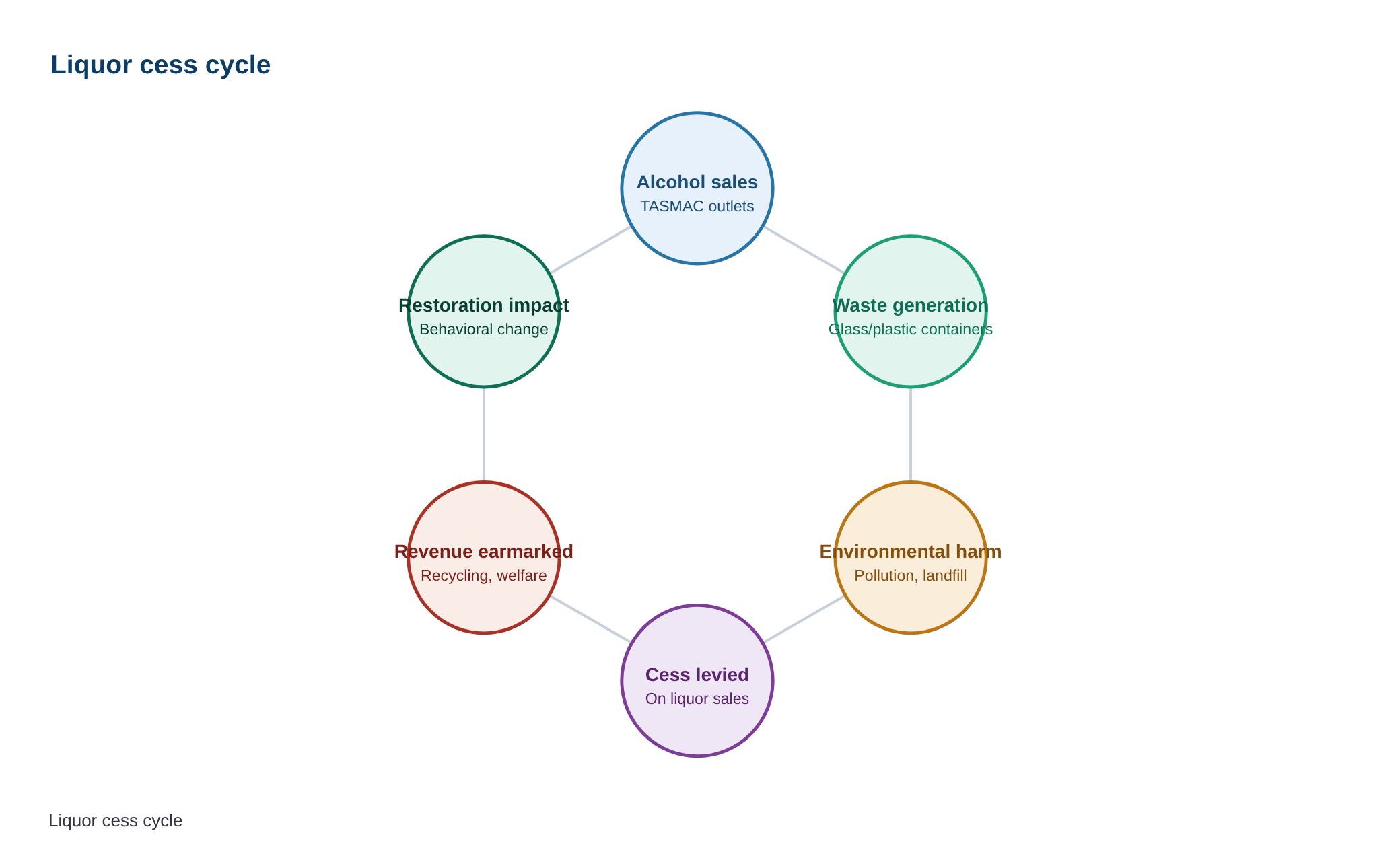
Alcohol consumption → Generation of hazardous waste (glass/plastic containers) → Environmental degradation and public health risks → State intervention via cess to internalise externalities → Revenue earmarked for recycling, de-addiction, and awareness → Behavioural change and ecological restoration → Long-term reduction in social and environmental costs of alcohol consumption
Prelims Practice Questions
Q1. Consider the following statements regarding the Environmental and Social Welfare Cess proposed in Tamil Nadu:
1. The cess is levied on the sale of alcoholic liquor under the Tamil Nadu Value Added Tax Act, 2006.
2. The revenue generated will exclusively fund forest conservation projects.
3. The cess aims to address environmental degradation caused by improper disposal of liquor containers.
How many of the above statements are correct?
- Only one
- Only two
- All three
- None
Answer: All three — Statements 1 and 3 are correct as the cess is proposed under the Tamil Nadu Value Added Tax Act, 2006 and targets environmental degradation from liquor waste. Statement 2 is incorrect because the revenue is earmarked for multiple purposes including de-addiction programmes and social welfare, not exclusively forest conservation.
Q2. Assertion (A): The Environmental and Social Welfare Cess in Tamil Nadu exemplifies the application of the ‘Polluter Pays Principle’.
Reason (R): The cess is levied on the sale of alcoholic liquor, a product whose consumption and waste generation impose environmental and social costs.
Options:
A. Both A and R are true, and R is the correct explanation of A.
B. Both A and R are true, but R is not the correct explanation of A.
C. A is true, but R is false.
D. A is false, but R is true.
- A
- B
- C
- D
Answer: A — The assertion (A) is correct as the cess targets the environmental and social costs of liquor consumption and waste. The reason (R) correctly explains this by linking the cess to the ‘Polluter Pays Principle’, where the cost of pollution is internalised by the polluter (liquor consumers).
Q3. Which of the following initiatives is NOT funded by the Environmental and Social Welfare Cess proposed in Tamil Nadu?
1. Rehabilitation and de-addiction programmes for alcohol addiction.
2. Safe disposal and recycling of liquor bottles and containers.
3. Subsidised distribution of alcoholic beverages to economically weaker sections.
4. Public awareness campaigns on the harmful effects of alcohol consumption.
Select the correct answer using the code below:
- 1 and 2
- 3 only
- 1, 2, and 4
- 2 and 4
Answer: 3 only — The cess funds initiatives 1, 2, and 4 as per the Bill. Subsidised distribution of alcoholic beverages (option 3) is not mentioned and is contrary to the stated objectives of the cess.
Mains Practice Question
✍ Critically examine the constitutional and fiscal dimensions of Tamil Nadu’s proposal to levy an Environmental and Social Welfare Cess on liquor sales. How does this measure align with the principles of fiscal federalism and sustainable development? (15 Marks)
Approach: MODEL-ANSWER SKELETON:
1. **Constitutional Basis**:
– Entry 54 of the State List (7th Schedule) empowers states to levy taxes on the sale of goods, including alcoholic liquor (State List, Item 54).
– Article 265 of the Constitution prohibits taxation except by authority of law, satisfied by the legislative process in the Tamil Nadu Assembly.
2. **Fiscal Federalism**:
– **Revenue Autonomy**: The measure enhances state fiscal autonomy by introducing a new revenue stream tied to local environmental and social priorities.
– **Cooperative Federalism**: Aligns with the cooperative model by addressing a state-specific issue (alcohol-related harm and waste) through state-level fiscal policy.
– **Vertical Fiscal Imbalance**: Mitigates VFI by generating earmarked funds for local public goods (de-addiction, waste management) rather than relying solely on general tax revenue.
3. **Sustainable Development and Polluter Pays Principle**:
– **Environmental Justice**: The cess operationalises the ‘Polluter Pays Principle’ by internalising the externalities of liquor consumption (waste, health costs).
– **Circular Economy**: Funds recycling and safe disposal, promoting a circular economy for liquor containers.
– **Public Health**: Supports de-addiction and rehabilitation, aligning with SDG 3 (Good Health and Well-being) and SDG 12 (Responsible Consumption and Production).
4. **Critique and Challenges**:
– **Regressive Impact**: Liquor taxation is regressive; the burden may disproportionately affect lower-income groups. Mitigation requires progressive social welfare measures.
– **Earmarking Constraints**: Earmarked cess revenue may reduce fiscal flexibility for the state government in addressing other priorities.
– **Implementation Hurdles**: Effective waste management and de-addiction programmes require robust institutional capacity and inter-departmental coordination.
5. **Comparative Perspective**:
– **Kerala Model**: Kerala’s ‘Green Tax’ on plastic and other environmentally harmful products offers a comparative example of state-level fiscal measures for sustainability.
– **Global Precedents**: Similar cess models exist in countries like Denmark (plastic tax) and Sweden (alcohol tax earmarked for health programmes).
6. **Conclusion**:
– The measure is a progressive step toward sustainable development and fiscal federalism but requires careful design to balance equity, efficiency, and implementation feasibility.
Source: The Hindu
Generated by AanyaAi for educational purpose.

- गृह मंत्री ने मध्य प्रदेश में गौपालक सम्मेलन का किया उद्घाटन, नए अपराध कानूनों पर प्रदर्शनी का किया शुभारंभ - October 3, 2026
- Jal Arpan: 1850+ Gram Panchayats Join Hands for Rural Water Supply - October 3, 2026
- भारत ने किया 5.56 किमी मुक्त अंतरिक्ष क्वांटम की वितरण लिंक का सफल परीक्षण - October 3, 2026

No Comments