


09 Aug Tamil Nadu’s Contingency Plans for Super El Niño Impact on Agriculture
✎ District Agricultural Contingency Plans are district-specific, climate-resilient frameworks developed by agricultural universities to mitigate the impacts of extreme weather events on agriculture, ensuring timely interventions…
Subject Relevance — Where This Topic Fits
- GS Paper III — Agriculture, Environment and Disaster Management | GS Paper III — Indian Economy and Issues Relating to Planning, Mobilisation of Resources
- Prelims: Super El Niño, Kuruvai season, District Agricultural Contingency Plans, PMFBY, food grain production targets, Tamil Nadu Agriculture Budget 2026
- Essay: Climate resilience in Indian agriculture: Balancing productivity and sustainability, The role of fiscal policy in mitigating climate-induced agricultural risks
Quick Revision: District Agricultural Contingency Plans are district-specific, climate-resilient frameworks developed by agricultural universities to mitigate the impacts of extreme weather events on agriculture, ensuring timely interventions and alternative strategies for farmers.
Why is this in the news?
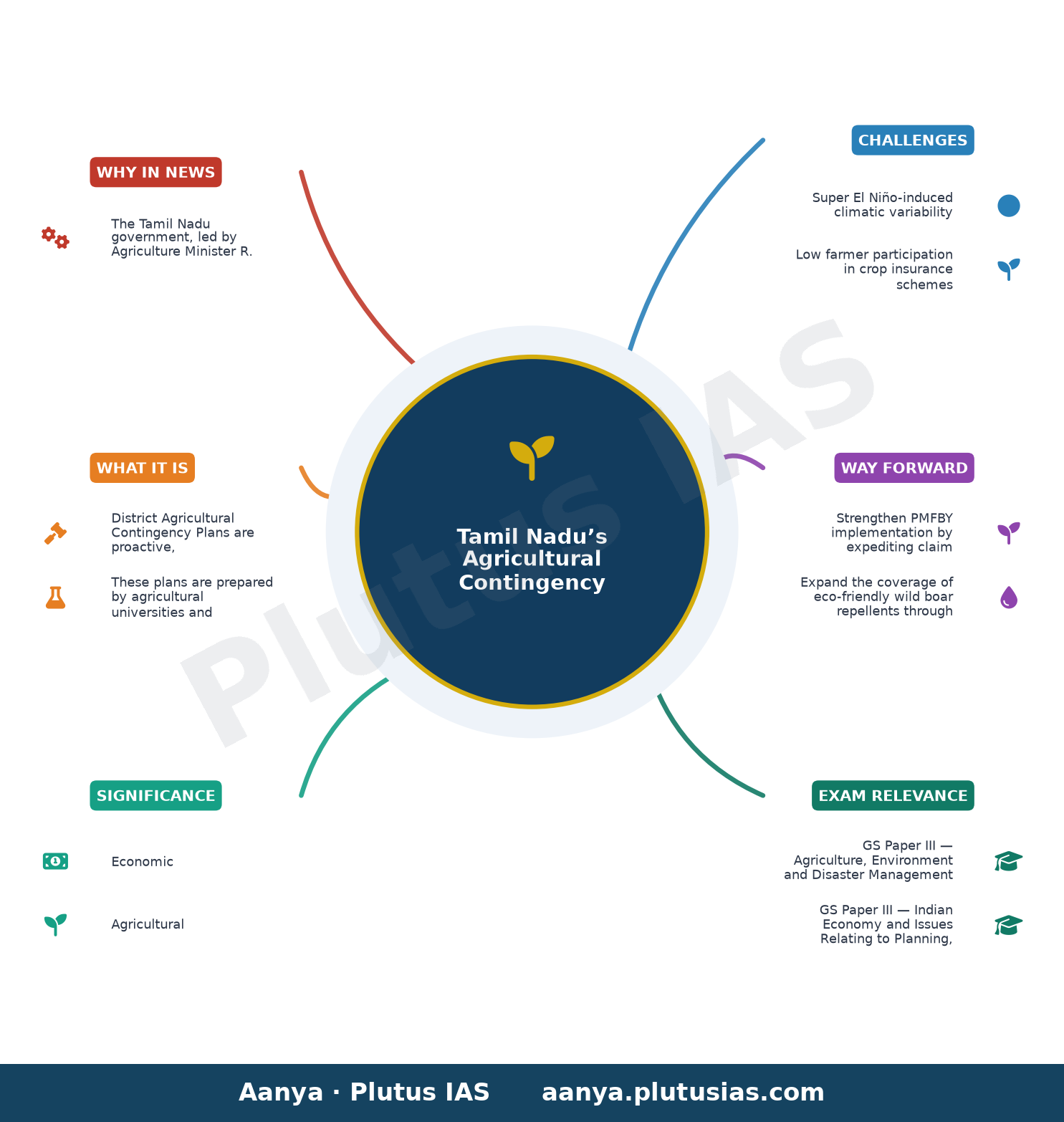
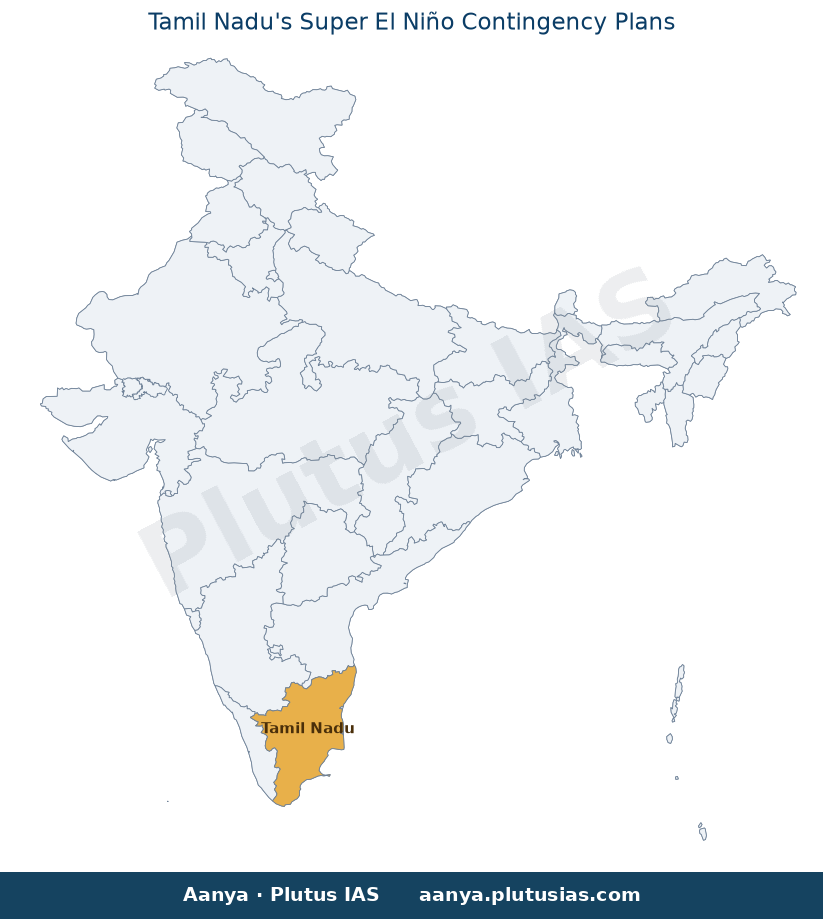
The Tamil Nadu government, led by Agriculture Minister R. Vinoth, presented the State’s Agriculture Budget for 2026-27 with a pronounced focus on climate resilience, particularly in anticipation of severe impacts from a Super El Niño event. The budget outlines contingency measures for 12 districts, the expansion of crop insurance coverage under PMFBY to 37 districts, and ambitious food grain production targets over the next five years. This initiative is noteworthy for its integration of climate adaptation strategies with agricultural policy, reflecting a proactive approach to mitigating climate-induced risks in a state highly vulnerable to extreme weather events.
Background
- Tamil Nadu is one of India’s most agriculturally productive states, with a significant share of its GDP derived from agriculture and allied sectors.
- The state is highly vulnerable to climate variability, particularly droughts and erratic monsoons, which are exacerbated during El Niño events.
- The Kuruvai (June–September) and Samba (October–January) seasons are critical for Tamil Nadu’s agricultural calendar, with rice being the dominant crop.
- The Pradhan Mantri Fasal Bima Yojana (PMFBY), launched in 2016, is India’s flagship crop insurance scheme aimed at reducing farmers’ financial risks due to crop failure.
- Agricultural contingency plans are pre-prepared strategies to address climate-induced risks such as drought, flood, or pest attacks, tailored to district-specific vulnerabilities.
What are District Agricultural Contingency Plans (DACPs)?
- District Agricultural Contingency Plans are proactive, district-level frameworks designed to mitigate the adverse impacts of extreme weather events on agriculture.
- These plans are prepared by agricultural universities and research institutions in collaboration with state agriculture departments, incorporating meteorological forecasts and historical climate data.
- The primary objective is to provide farmers with alternative crop and resource management strategies during periods of climatic stress, such as drought or excess rainfall.
- Key components include: (i) identification of vulnerable districts and crops, (ii) recommended alternative crop varieties, (iii) water conservation and irrigation management techniques, (iv) pest and disease control measures, and (v) financial support mechanisms.
- The plans are dynamic and updated annually or biennially based on evolving climate patterns and technological advancements.
- Tamil Nadu Agricultural University (TNAU) has been instrumental in developing and disseminating these plans across the state’s districts.
- The implementation of DACPs is coordinated by District Collectors, who ensure that contingency measures are communicated to farmers and local agencies.
- These plans are part of a broader national strategy under the National Mission for Sustainable Agriculture (NMSA) and the National Initiative on Climate Resilient Agriculture (NICRA).
Key Features
| Feature | Significance |
|---|---|
| District Agricultural Contingency Plans (DACP) | Ensures pre-emptive, district-specific responses to Super El Niño-induced climatic shocks, reducing agricultural vulnerability and enhancing resilience through tailored interventions. |
| Pradhan Mantri Fasal Bima Yojana (PMFBY) coverage expansion | Provides comprehensive crop insurance to 36 lakh acres across 37 districts, mitigating financial risks for 15 lakh farmers and stabilising rural incomes during climate-induced crop failures. |
| ₹648.55 crore allocation for PMFBY | Demonstrates fiscal commitment to climate adaptation in agriculture, ensuring sufficient funds for premium subsidies and claim settlements under the scheme. |
| 131 lakh metric tonnes food grain production target | Aligns with national food security objectives, ensuring self-sufficiency and nutritional security for Tamil Nadu’s population over the next five years. |
| Eco-friendly liquid repellent for wild boar mitigation | Addresses human-wildlife conflict, protecting crops and reducing farmer distress in areas where wild boar populations threaten agricultural productivity. |
Why it Matters
Economic
- Mitigates agricultural losses through climate-proofing strategies, preserving farm incomes and rural economic stability during Super El Niño events.
- Enhances agricultural productivity via insurance coverage, reducing dependency on ad-hoc disaster relief and stabilising market supply chains.
- Supports the State’s long-term goal of 100% crop insurance coverage, aligning with national agricultural policy frameworks.
Agricultural
- Strengthens adaptive capacity of Tamil Nadu’s agriculture sector to extreme weather events, particularly in vulnerable Kuruvai and Samba seasons.
- Promotes diversification towards pulses, vegetables, and fruits, improving nutritional security and reducing monoculture risks.
- Facilitates timely interventions through district-level contingency plans, minimising yield losses in 12 severely affected districts.
Policy and Governance
- Demonstrates proactive governance by integrating climate resilience into agricultural budgeting, setting a precedent for other States.
- Leverages PMFBY to institutionalise risk mitigation, reducing the fiscal burden on State exchequer during climate disasters.
- Ensures inter-departmental coordination between agricultural universities, district administrations, and financial institutions for effective implementation.
Social
- Protects livelihoods of 15 lakh farmers through crop insurance, reducing distress migration and rural poverty.
- Enhances food security for the State’s population, aligning with Sustainable Development Goals (SDG 2: Zero Hunger).
- Supports marginalised farmers by ensuring equitable access to insurance schemes and contingency measures.
Challenges
1. Super El Niño-induced climatic variability
- Prolonged droughts or excessive rainfall during Kuruvai/Samba seasons disrupt crop cycles, leading to yield losses and economic instability.
- Increases pest and disease outbreaks due to altered temperature and humidity patterns, exacerbating agricultural risks.
- Exacerbates water scarcity in 12 severely affected districts, threatening irrigation-dependent agriculture.
UPSC Link: GS-III: Climate Change & Agriculture
2. Low farmer participation in crop insurance schemes
- Historical scepticism towards PMFBY due to delayed claim settlements and bureaucratic hurdles deters enrolment.
- Lack of awareness among small and marginal farmers about scheme benefits and enrolment processes.
- Inadequate digital infrastructure in rural areas limits access to insurance portals and grievance redressal mechanisms.
UPSC Link: GS-III: Agricultural Marketing & Insurance
3. Human-wildlife conflict (wild boar menace)
- Causes significant crop damage, particularly in districts bordering forests, leading to financial losses for farmers.
- Traditional deterrents (e.g., fencing) are often ineffective, necessitating innovative, eco-friendly solutions.
- Lack of integrated wildlife management policies exacerbates the issue, requiring multi-stakeholder coordination.
UPSC Link: GS-III: Environment & Biodiversity
4. Achieving food grain production targets
- Dependence on monsoon variability and climate change impacts may hinder the 131 lakh metric tonnes target.
- Soil degradation and declining water tables in Tamil Nadu reduce long-term agricultural productivity.
- Limited availability of high-yielding, climate-resilient crop varieties restricts diversification efforts.
UPSC Link: GS-III: Food Security & Agriculture
5. Fiscal constraints in State budget allocation
- Allocation of ₹648.55 crore for PMFBY may strain State finances, necessitating efficient fund utilisation.
- Competing demands from other sectors (e.g., health, education) may limit further allocations for agricultural resilience.
- Need for innovative financing mechanisms (e.g., climate bonds) to sustain long-term climate adaptation efforts.
UPSC Link: GS-III: Public Finance & Agriculture
Challenges — UPSC Perspective
| Issue | Concern |
|---|---|
| Delayed claim settlements under PMFBY | Erodes farmer trust in the scheme, leading to low participation rates and reduced financial protection. |
| Inadequate district-level implementation of DACP | Lack of trained personnel and resources may hinder the execution of contingency measures in vulnerable districts. |
| Climate-induced pest outbreaks | Increased use of chemical pesticides may harm soil health and biodiversity, counteracting sustainability goals. |
| Water scarcity in 12 districts | Over-extraction of groundwater and poor irrigation efficiency exacerbate the crisis, threatening Rabi season crops. |
| Limited adoption of eco-friendly wild boar repellents | Farmers may prefer traditional (and often harmful) methods due to lack of awareness or access to alternatives. |
| Data gaps in agricultural insurance enrolment | Incomplete farmer databases and digital illiteracy impede accurate targeting and scheme delivery. |
Government Initiatives — Must-Memorise for Prelims
- Pradhan Mantri Fasal Bima Yojana (PMFBY)
- District Agricultural Contingency Plans (DACP)
- Tamil Nadu’s State Agricultural Budget 2026-27 allocations for climate resilience
Way Forward
- Strengthen PMFBY implementation by expediting claim settlements and enhancing digital literacy among farmers for seamless enrolment.
- Expand the coverage of eco-friendly wild boar repellents through subsidised distribution and farmer training programs in affected districts.
- Invest in climate-resilient crop varieties and drought-resistant seeds to mitigate yield losses during Super El Niño events.
- Enhance water-use efficiency through micro-irrigation (e.g., drip, sprinkler) and revival of traditional water bodies in 12 vulnerable districts.
- Conduct regular capacity-building workshops for district officials and farmers on DACP implementation and climate-smart agriculture.
- Promote public-private partnerships to develop innovative financing mechanisms (e.g., climate insurance pools) for long-term resilience.
- Integrate real-time weather monitoring systems with agricultural advisory services to enable proactive decision-making.
- Establish a State-level Climate Adaptation Fund to supplement budgetary allocations for agricultural resilience initiatives.
UPSC Value Addition
Keywords for Mains Answer-Writing
Super El Niño · Tamil Nadu Agriculture Budget 2026-27 · District Agricultural Contingency Plans · Pradhan Mantri Fasal Bima Yojana (PMFBY) · Kuruvai season · Food security in Tamil Nadu · Crop insurance coverage · Climate-resilient agriculture · Agricultural contingency measures · Tamil Nadu Agricultural University
Concept Flow
Super El Niño conditions → Disrupted monsoon patterns → Reduced rainfall in Kuruvai/Samba seasons → Water scarcity & crop failure in 12 districts → Increased farmer distress & food insecurity → Super El Niño conditions → Altered temperature/humidity → Pest outbreaks & disease spread → Additional yield losses → Higher insurance claims under PMFBY → Super El Niño conditions → Human-wildlife conflict intensifies (wild boar menace) → Crop damage → Financial losses for farmers → Need for eco-friendly mitigation strategies → District Agricultural Contingency Plans (DACP) → Tailored interventions (e.g., drought-resistant crops, water conservation) → Reduced agricultural losses → Stabilised rural incomes → PMFBY coverage expansion → Risk mitigation for 15 lakh farmers → Reduced dependency on State relief funds → Enhanced agricultural productivity & food security → State Agricultural Budget allocations → Fiscal commitment to climate resilience → Implementation of DACP & PMFBY → Long-term agricultural sustainability & food security
Prelims Practice Questions
Q1. Consider the following statements regarding the impact of Super El Niño on Indian agriculture:
1. Super El Niño events typically lead to deficient rainfall during the South-West Monsoon season.
2. Tamil Nadu is expected to face severe climatic impacts during the Kuruvai season due to Super El Niño.
3. The Pradhan Mantri Fasal Bima Yojana (PMFBY) is designed to mitigate the financial losses of farmers exclusively during drought conditions.
How many of the above statements are correct?
- Only one
- Only two
- All three
- None
Answer: Only two — Statement 1 is correct as Super El Niño is associated with below-normal rainfall during the South-West Monsoon. Statement 2 is correct as per the Tamil Nadu Agriculture Budget 2026-27. Statement 3 is incorrect because PMFBY covers losses due to multiple risks including floods, droughts, and pests, not exclusively drought.
Q2. Assertion (A): The Tamil Nadu government has allocated ₹648.55 crore from its State funds to implement the Pradhan Mantri Fasal Bima Yojana (PMFBY) during 2026-27.
Reason (R): The allocation aims to cover all notified crops during the Kuruvai, Samba, and Rabi seasons, benefiting 15 lakh farmers across 36 lakh acres of cultivated land.
Options:
A. Both A and R are true, and R is the correct explanation of A.
B. Both A and R are true, but R is not the correct explanation of A.
C. A is true, but R is false.
D. A is false, but R is true.
Answer: ? — Both Assertion (A) and Reason (R) are factually correct, and R correctly explains A as the allocation is specifically for PMFBY coverage during the mentioned seasons.
Q3. Match the following agricultural seasons in Tamil Nadu with their corresponding characteristics:
Column I (Season) | Column II (Characteristics)
1. Kuruvai | A. Post-monsoon season primarily for rice cultivation
2. Samba | B. Summer season with high temperatures and low rainfall
3. Rabi | C. Major rice-growing season coinciding with the South-West Monsoon
Options:
A. 1-C, 2-A, 3-B
B. 1-B, 2-C, 3-A
C. 1-A, 2-B, 3-C
D. 1-C, 2-B, 3-A
- A
- B
- C
- D
Answer: A — Kuruvai (1) is the major rice-growing season coinciding with the South-West Monsoon (C). Samba (2) is the post-monsoon season primarily for rice cultivation (A). Rabi (3) is the summer season with high temperatures and low rainfall (B).
Mains Practice Question
✍ Critically examine the preparedness of the Tamil Nadu government to mitigate the adverse impacts of Super El Niño on agriculture, with particular reference to the District Agricultural Contingency Plans and the Pradhan Mantri Fasal Bima Yojana (PMFBY). Also, assess the adequacy of the allocated funds for ensuring food security in the State. (15 Marks)
Approach: MODEL-ANSWER SKELETON:
I. Introduction (1 mark): Define Super El Niño and its expected impact on Tamil Nadu’s agriculture, particularly during the Kuruvai season.
II. District Agricultural Contingency Plans (4 marks):
– Explain the objective and components of the District Agricultural Contingency Plans prepared by Tamil Nadu Agricultural University.
– Discuss how these plans are communicated to District Collectors and implemented, citing the 12 districts identified as severely affected.
– Evaluate the effectiveness of such contingency measures in addressing climate variability.
III. Pradhan Mantri Fasal Bima Yojana (PMFBY) (4 marks):
– Outline the key features of PMFBY, including coverage of notified crops and seasons (Kuruvai, Samba, Rabi).
– Highlight the allocation of ₹648.55 crore for 2026-27, covering 36 lakh acres and benefiting 15 lakh farmers.
– Critically assess whether this coverage is sufficient to address the financial risks posed by Super El Niño.
IV. Food Security Measures (3 marks):
– Discuss the State’s target of producing 131 lakh metric tonnes of food grains over five years, with a 2026-27 target of 125 lakh metric tonnes.
– Evaluate the measures proposed to increase production of pulses, vegetables, and fruits for nutritional security.
– Assess the adequacy of these targets and measures in ensuring food security amid climatic uncertainties.
V. Conclusion (3 marks):
– Summarise the strengths and limitations of Tamil Nadu’s preparedness.
– Provide a balanced view on whether the State’s strategies are likely to mitigate the impacts of Super El Niño effectively.
Source: The Hindu
Generated by AanyaAi for educational purpose.

- KWML’s Feasibility Reports for Water Metro in 18 Cities: UPSC & PCS Insights - October 3, 2026
- ओडिशा में वन्यजीव अनुसंधान अनुदान कार्यक्रम शुरू, सिमिलिपाल में 300 कैमरे और बढ़ेंगे - October 3, 2026
- India Summons Pakistan High Commission Official Over Violation - October 3, 2026

No Comments