


10 Sep Tamil Nadu’s Private Universities Amendment Bill: A Game-Changer for UPSC 2026
✎ The Tamil Nadu Private Universities (Amendment) Bill, 2026, reduces land and endowment fund requirements to attract world-class private universities, aiming to enhance higher education infrastructure and align it with industry…
Subject Relevance — Where This Topic Fits
- GS Paper II — Governance, Administration and Challenges | GS Paper III — Issues Relating to Development and Management of Social Sector/Services relating to Education
- Prelims: Tamil Nadu Private Universities Act, 2019, Private Universities (Amendment) Bill, 2026, Land requirement norms for private universities, Endowment fund requirements for higher education institutions, Integrated education model, Higher Education Department, Tamil Nadu, Greater Chennai Corporation (GCC) limits, Placement officers conclave, World-class universities, Curriculum and faculty standards
- Essay: The role of state policy in shaping educational excellence: A case study of Tamil Nadu’s higher education reforms, Balancing accessibility and quality in higher education: Lessons from Tamil Nadu’s private university regulations
Quick Revision: The Tamil Nadu Private Universities (Amendment) Bill, 2026, reduces land and endowment fund requirements to attract world-class private universities, aiming to enhance higher education infrastructure and align it with industry needs.
Why is this in the news?
The Tamil Nadu government recently amended the Tamil Nadu Private Universities Act, 2019, reducing the minimum land and endowment fund requirements for establishing private universities. This amendment aims to attract world-class private universities to the state, aligning with its historical role as an education hub and addressing the growing demand for skilled talent in emerging sectors such as manufacturing and IT services. The policy shift underscores the state’s strategy to enhance higher education infrastructure through private sector participation while maintaining governance standards.
Background
- Tamil Nadu has a long-standing reputation as an education hub in India, hosting institutions like the University of Madras (established 1857) and the Indian Institute of Technology Madras (IIT-M).
- The Tamil Nadu Private Universities Act, 2019, was enacted to regulate the establishment and functioning of private universities in the state, ensuring compliance with academic and infrastructural standards.
- The state government’s decision to amend the Act follows a broader trend of states competing to attract private investment in higher education, particularly from international institutions.
- The amendment is part of Tamil Nadu’s integrated education model, which seeks to align academic curricula with industry requirements through internships, industrial visits, and employment linkages.
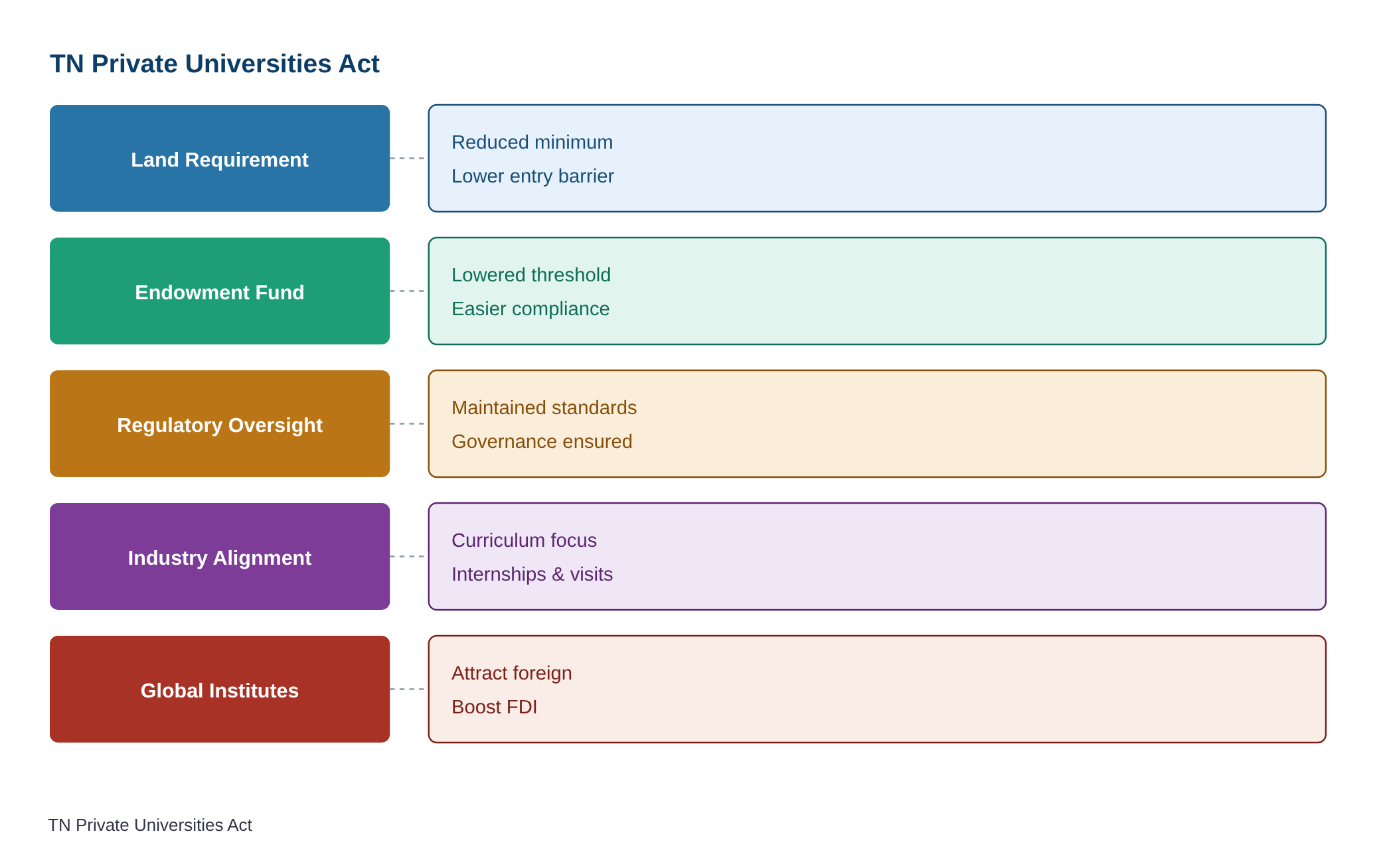
- The reduction in land and endowment requirements is intended to lower entry barriers for foreign and domestic private universities while maintaining oversight through regulatory frameworks.
What is the Tamil Nadu Private Universities (Amendment) Bill, 2026?
- The Tamil Nadu Private Universities (Amendment) Bill, 2026, is a legislative proposal to amend the Tamil Nadu Private Universities Act, 2019, with the objective of attracting world-class private universities to the state.
- Key amendments include the reduction of the minimum contiguous land requirement: 12 acres within Greater Chennai Corporation (GCC) limits, 18 acres in other municipal corporations and councils, and 25 acres for the rest of the state.
- The permanent endowment fund requirement has been reduced to ₹25 crore, easing financial entry barriers for private universities.
- The amendment introduces the concept of ‘integrated universities,’ which are expected to offer high-quality syllabi, curricula, faculty, and infrastructure comparable to global standards, such as those of the University of Oxford.
- The policy shift is not aimed at enabling existing colleges to expand into universities but rather at inviting new private universities with superior facilities and academic standards.
- The Higher Education Department plans to organise a conclave of placement officers to integrate internships, industrial visits, and employment opportunities into the academic framework of these universities.
- The amendment aligns with Tamil Nadu’s broader strategy to position itself as a destination for higher education, leveraging its historical strengths and emerging economic opportunities.
Key Features
| Feature | Significance |
|---|---|
| Reduction in minimum contiguous land requirement | Facilitates establishment of private universities in urban and semi-urban areas by lowering land constraints, particularly in Greater Chennai Corporation (12 acres), municipal corporations (18 acres), and other regions (25 acres). |
| Lowering of permanent endowment fund to ₹25 crore | Reduces financial barriers for new entrants, enabling smaller and emerging institutions to qualify as private universities while maintaining academic standards. |
| Focus on integrated universities with global benchmarks | Aims to emulate foreign university models (e.g., Oxford) by integrating syllabus, curriculum, faculty, and infrastructure to attract international academic institutions. |
| Industry-academia linkage through placement conclaves | Proposes systematic collaboration with multinational companies (MNCs) in manufacturing and IT services for internships, industrial visits, and employment opportunities. |
| State’s historical role as an education hub | Leverages Tamil Nadu’s existing reputation in higher education to position the state as a destination for world-class private universities and skilled talent pipelines. |
Why it Matters
Economic
- Enhances Tamil Nadu’s attractiveness as an investment destination for global educational institutions, potentially boosting foreign direct investment (FDI) in the education sector.
- Strengthens the state’s human capital base by attracting top-tier universities, which can produce a skilled workforce aligned with industry demands in manufacturing and IT services.
- May stimulate ancillary economic activities such as real estate, hospitality, and local services around university campuses.
Social
- Promotes equitable access to high-quality higher education by diversifying the ecosystem beyond government-run institutions.
- Encourages innovation in curriculum design and pedagogical practices through exposure to global academic standards.
- Could reduce migration of students to other states or countries by providing comparable educational opportunities within Tamil Nadu.
Governance
- Demonstrates the state’s proactive approach to regulatory reform to align with evolving educational and economic needs.
- Highlights the role of state-level legislation in complementing central initiatives (e.g., National Education Policy 2020) to foster a competitive higher education landscape.
- Raises questions about the balance between attracting private investment and ensuring accountability in academic and financial governance.
Strategic
- Positions Tamil Nadu as a knowledge hub in South India, competing with states like Karnataka and Maharashtra in the higher education sector.
- Aligns with national objectives of making India a global education destination under initiatives like Study in India.
- May serve as a model for other states considering similar amendments to their private university acts.
Challenges
1. Quality Assurance and Accreditation Risks
- Lowering land and endowment thresholds may dilute academic standards if not accompanied by robust accreditation mechanisms.
- Risk of proliferation of substandard institutions that fail to meet global benchmarks despite relaxed norms.
- Potential for commercialisation of education, prioritising profit over academic excellence and research output.
UPSC Link: NEP 2020 – Quality Assurance Framework
2. Land Acquisition and Regulatory Hurdles
- Urban areas face high land costs and regulatory complexities, which may offset the benefits of reduced land requirements.
- Displacement of existing land uses or environmental concerns in peri-urban regions where universities are proposed.
- Need for transparent land-use policies to prevent speculative acquisitions or misuse of relaxed norms.
UPSC Link: Land Acquisition Act, 2013 – Section 2
3. Financial Sustainability and Endowment Management
- A ₹25 crore endowment fund may be insufficient for long-term sustainability of world-class institutions, especially in high-cost urban centres.
- Risk of mismanagement or diversion of funds if governance mechanisms are weak.
- Dependence on private funding may lead to conflicts of interest or undue influence by corporate sponsors.
UPSC Link: UGC (Institutions Deemed to be Universities) Regulations, 2019
4. Equity and Access Concerns
- Elite private universities may cater primarily to affluent students, exacerbating socio-economic disparities in higher education.
- Lack of clear provisions for reserved seats or scholarships for marginalised sections, risking exclusion.
- Potential for brain drain if local talent is absorbed by global-standard institutions without contributing to local development.
UPSC Link: Right to Education Act, 2009 – Higher Education
5. Industry-Academia Misalignment
- Placement conclaves may not guarantee meaningful industry linkages if curricula are not industry-relevant.
- Risk of universities becoming mere training centres for MNCs rather than centres of holistic learning and research.
- Over-reliance on MNCs may marginalise domestic industries or sectors not aligned with global recruitment trends.
UPSC Link: National Skill Development Corporation (NSDC) – Higher Education Interface
6. Regulatory and Jurisdictional Ambiguities
- Overlap between state-level amendments and central regulatory bodies (e.g., UGC, AICTE) may create compliance conflicts.
- Lack of clarity on the role of state governments in monitoring academic standards post-establishment.
- Need for a harmonised framework to prevent regulatory arbitrage or exploitation of relaxed norms.
UPSC Link: Concurrent List – 7th Schedule
Challenges — UPSC Perspective
| Issue | Concern |
|---|---|
| Quality dilution | Risk of substandard institutions due to relaxed land and endowment norms. |
| Land scarcity in urban areas | High costs and regulatory barriers may undermine the purpose of reduced land requirements. |
| Endowment fund adequacy | ₹25 crore may be insufficient for long-term sustainability of global-standard universities. |
| Equity in access | Potential exclusion of marginalised sections if scholarships and reserved seats are not mandated. |
| Industry linkage sustainability | Placement conclaves may not translate into meaningful, long-term collaborations. |
| Regulatory conflicts | Possible clashes between state amendments and central regulatory bodies like UGC. |
Way Forward
- Establish a state-level accreditation body with stringent criteria to evaluate new private universities, ensuring alignment with global benchmarks.
- Introduce mandatory provisions for scholarships, reserved seats, and need-based financial aid to promote equitable access.
- Develop a transparent land-use policy to prevent speculative acquisitions and ensure sustainable campus development.
- Create a dedicated fund to supplement the endowment requirements for universities in high-cost urban areas.
- Formalise industry-academia partnerships through legally binding agreements, ensuring curricula are co-designed with industry needs.
- Harmonise state amendments with central regulations (e.g., UGC norms) to avoid jurisdictional conflicts and ensure compliance.
- Monitor and evaluate the impact of the amendment on academic quality, industry linkages, and socio-economic outcomes annually.
- Encourage research collaboration between new private universities and existing public institutions to foster innovation and knowledge sharing.
UPSC Value Addition
Keywords for Mains Answer-Writing
Tamil Nadu Private Universities (Amendment) Bill, 2026 · Tamil Nadu Private Universities Act, 2019 · Higher education governance · Private universities in India · Land and endowment norms for universities · Integrated education model · World-class universities · Tamil Nadu Higher Education Department · University establishment criteria · Regulatory framework for higher education · Industrial-academia collaboration · Placement and internship integration · State-level higher education policy
Concept Flow
State government identifies the need to enhance Tamil Nadu’s higher education ecosystem to attract global institutions. → Tamil Nadu Private Universities Act, 2019 is amended to reduce land and endowment requirements for new private universities. → Relaxed norms aim to position Tamil Nadu as a competitive destination for world-class universities and skilled talent. → Potential influx of private universities triggers concerns over quality assurance, equity, and regulatory conflicts. → State and central regulatory bodies must collaborate to establish robust monitoring and accreditation mechanisms. → Long-term outcomes depend on the balance between attracting investment, ensuring academic standards, and promoting inclusive access.
Prelims Practice Questions
Q1. Consider the following statements regarding the Tamil Nadu Private Universities (Amendment) Bill, 2026:
1. The Bill reduces the minimum contiguous land requirement for universities in Greater Chennai Corporation (GCC) limits to 12 acres.
2. The Bill increases the permanent endowment fund requirement to ₹50 crore.
3. The Bill aims to attract existing colleges to expand and become universities rather than inviting new world-class universities.
How many of the above statements are correct?
- Only one
- Only two
- All three
- None
Answer: Only two — Only statement 1 is correct. Statement 2 is incorrect as the Bill reduces the permanent endowment fund requirement to ₹25 crore. Statement 3 is incorrect as the Minister clarified that the aim was to invite fresh universities with world-class facilities, not to expand existing colleges.
Q2. Assertion (A): The Tamil Nadu Private Universities (Amendment) Bill, 2026, aims to integrate industrial visits and internships into the university curriculum.
Reason (R): The Bill seeks to establish integrated universities with world-class facilities to enhance employability and industrial collaboration.
Options:
A. Both A and R are true, and R is the correct explanation of A.
B. Both A and R are true, but R is not the correct explanation of A.
C. A is true, but R is false.
D. A is false, but R is true.
Answer: ? — Both A and R are true, and R correctly explains A. The Bill’s emphasis on integrated education models includes weaving internships, industrial visits, and employment opportunities into the curriculum.
Q3. Match the following columns related to the Tamil Nadu Private Universities (Amendment) Bill, 2026:
Column I (Requirement) Column II (Amended Value)
1. Minimum contiguous land in GCC limits A. ₹25 crore
2. Minimum contiguous land in municipal corporations B. 12 acres
3. Minimum contiguous land in other areas C. 18 acres
4. Permanent endowment fund requirement D. 25 acres
Options:
A. 1-B, 2-C, 3-D, 4-A
B. 1-A, 2-B, 3-C, 4-D
C. 1-D, 2-C, 3-B, 4-A
D. 1-C, 2-D, 3-A, 4-B
Answer: ? — The correct match is: 1-B (12 acres for GCC limits), 2-C (18 acres for municipal corporations), 3-D (25 acres for other areas), and 4-A (₹25 crore permanent endowment fund).
Mains Practice Question
✍ Critically examine the rationale behind the Tamil Nadu Private Universities (Amendment) Bill, 2026, in the context of higher education governance and its potential implications for the quality and accessibility of private universities in India. (15 Marks)
Approach: MODEL-ANSWER SKELETON:
1. **Introduction (2 Marks)**
– Briefly state the provisions of the Tamil Nadu Private Universities (Amendment) Bill, 2026: reduction in land and endowment norms, and emphasis on integrated education models.
– Contextualise within the broader framework of higher education governance in India, highlighting the role of state-level policies in shaping private university establishment.
2. **Rationale for Amendments (4 Marks)**
– **Attracting World-Class Universities**: Discuss the government’s stated objective of inviting foreign and domestic universities with superior infrastructure, curriculum, and faculty (e.g., Oxford-like models).
– **Industrial Collaboration**: Explain the emphasis on integrating internships, industrial visits, and employment opportunities to align with Tamil Nadu’s industrial growth (e.g., manufacturing and IT sectors).
– **Historical Context**: Tamil Nadu’s legacy as an education hub (e.g., IIT Madras, Anna University) and the need to reclaim its global competitiveness.
– **Economic Incentives**: Highlight the potential for multinational companies to establish recruitment hubs in Tamil Nadu, leveraging the state’s skilled workforce.
3. **Critique of the Amendments (5 Marks)**
– **Quality vs. Quantity Trade-off**: Assess whether lowering land and endowment norms risks compromising academic standards, infrastructure, and faculty quality. Compare with UGC norms for private universities (e.g., UGC (Establishment and Regulation of Universities) Regulations, 2018).
– **Regulatory Oversight**: Discuss the challenges in ensuring accountability and quality control in the absence of stringent norms. Reference the role of bodies like the UGC and state-level higher education councils.
– **Accessibility vs. Equity**: Evaluate whether the amendments disproportionately benefit urban and affluent regions (e.g., GCC limits) over rural areas, potentially exacerbating regional disparities in higher education.
– **Sustainability Concerns**: Examine the long-term financial viability of universities established with reduced endowment funds, particularly in the context of rising operational costs.
4. **Potential Implications (4 Marks)**
– **Positive Outcomes**: Potential for increased foreign direct investment in education, enhanced employability of graduates, and improved global rankings for Tamil Nadu’s higher education institutions.
– **Negative Outcomes**: Risk of commercialisation of higher education, dilution of academic rigor, and exploitation of regulatory loopholes.
– **Comparative Perspective**: Contrast with other states’ policies (e.g., Karnataka’s Private Universities Act, 2007) and the central government’s initiatives (e.g., National Education Policy 2020).
5. **Conclusion (1 Mark)**
– Summarise the need for a balanced approach that prioritises both accessibility and quality, while ensuring robust regulatory mechanisms to safeguard academic standards.
Source: The Hindu
Tamil Nadu PCS (TNPSC) — State PCS Practice
Prelims: Which of the following is the primary objective of the ‘Private Universities Amendment Bill’ introduced by the Higher Education Minister of Tamil Nadu?
- To attract world-class private universities to Tamil Nadu
- To regulate the fees of private universities in Tamil Nadu
- To merge existing private universities with government institutions
- To restrict admissions to private universities in Tamil Nadu
Answer: To attract world-class private universities to Tamil Nadu — The bill aims to amend existing regulations to facilitate the establishment of world-class private universities in Tamil Nadu.
Mains: Discuss the potential socio-economic impacts of attracting world-class private universities to Tamil Nadu, with a focus on accessibility, affordability, and regional development.
Generated by AanyaAi for educational purpose.
Related guides on our sites
- Best PSIR optional coaching for upsc
- Best PSIR optional teacher for upsc
- Best teacher of PSIR optional for upsc
- Best PSIR optional coaching in delhi for UPSC

- Tamil Nadu’s Private Universities Amendment Bill: A Game-Changer for UPSC 2026 - September 10, 2026
- Tamil Nadu’s Private University Bill 2026: Teachers Protest Commercialisation Risks - September 10, 2026
- तेलंगाना सरकार ने कर्मचारियों के लिए बनाया 240 करोड़ रुपये का स्वास्थ्य कोष - September 10, 2026

No Comments