


02 Sep Telangana HC Stays Order Halting Kalyana Lakshmi & Shaadi Mubarak Schemes
✎ The Kalyana Lakshmi and Shaadi Mubarak schemes are state-sponsored welfare initiatives implemented through executive orders, and their constitutional validity is currently under judicial scrutiny in the Telangana High Court.
Subject Relevance — Where This Topic Fits
- GS Paper II — Constitutional and Non-Constitutional Bodies (Judiciary) | GS Paper II — Functions and Responsibilities of the Union and the States | GS Paper III — Welfare Schemes for Vulnerable Sections of the Population
- Prelims: Kalyana Lakshmi Scheme, Shaadi Mubarak Scheme, Telangana High Court, Writ Petition, Government Orders (GOs), Constitutional Validity, Judicial Review, Interim Stay, Advocate General, CAG Audit Reports
- Essay: The Role of Judiciary in Ensuring Welfare Governance, Balancing Executive Discretion and Constitutional Safeguards in Social Welfare Schemes
Quick Revision: The Kalyana Lakshmi and Shaadi Mubarak schemes are state-sponsored welfare initiatives implemented through executive orders, and their constitutional validity is currently under judicial scrutiny in the Telangana High Court.
Why is this in the news?
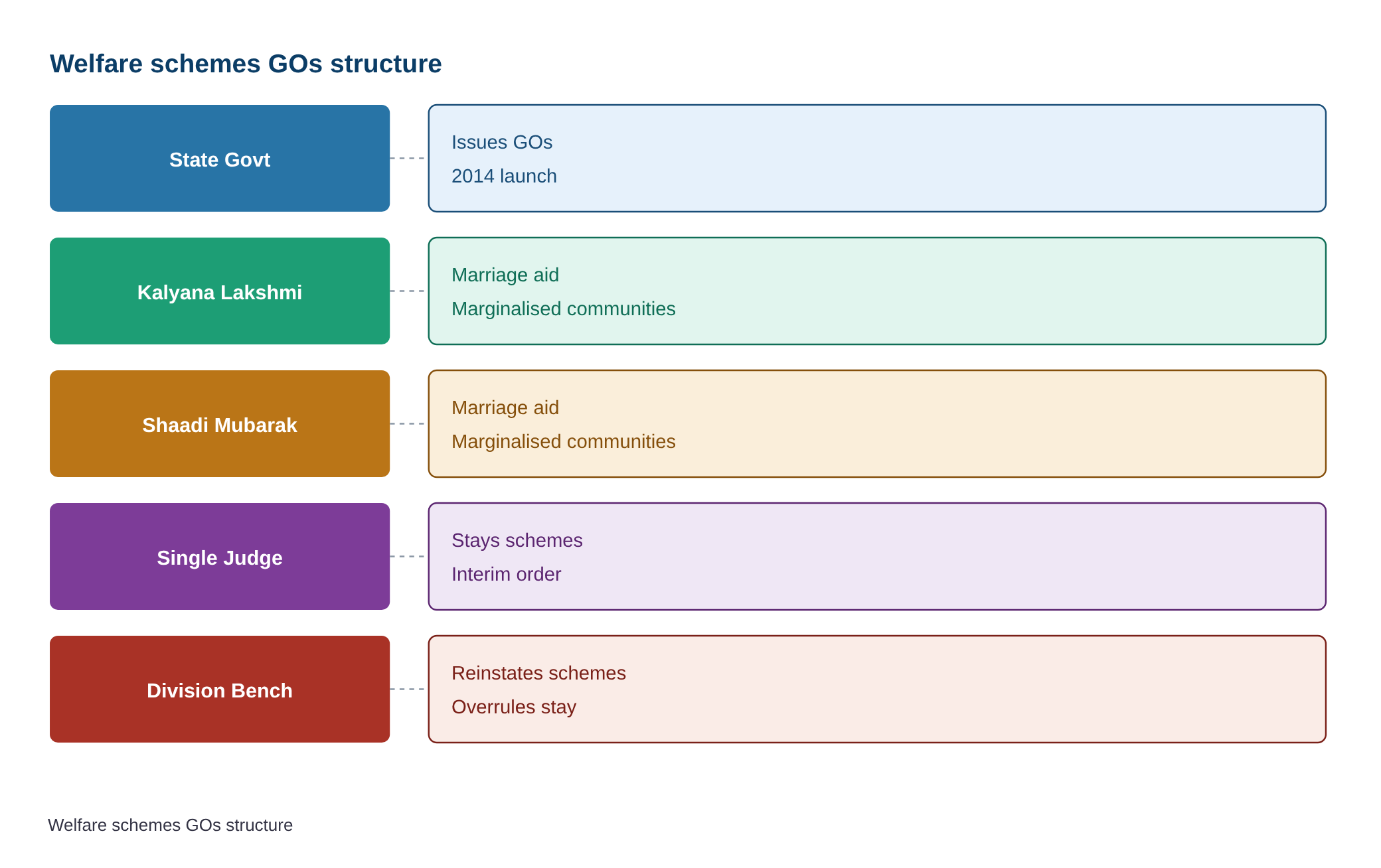
The Telangana High Court’s division bench stayed a single judge’s order that had stalled the implementation of the Kalyana Lakshmi and Shaadi Mubarak schemes, thereby reinstating these state-sponsored welfare initiatives. The case raises critical questions about the constitutional validity of schemes implemented through executive orders, the scope of judicial review in welfare governance, and the procedural propriety of interim judicial interventions in policy matters.
Background
- The Kalyana Lakshmi and Shaadi Mubarak schemes are flagship welfare programmes launched by the Government of Telangana in 2014 to provide financial assistance to marginalised communities for marriage-related expenses.
- The schemes are implemented through Government Orders (GOs) issued by the state government, without explicit legislative backing, raising questions about their constitutional validity under Articles 14, 15, and 21 of the Constitution.
- A practicing advocate filed a writ petition challenging the legal sanctity of the schemes, contending that their implementation through executive orders lacked constitutional or legislative validity and had significant fiscal implications.
- The single judge, in an interim order, directed the stay of the schemes, prompting the state government to file an appeal before the division bench of the High Court.
- The state government argued that the schemes have been in operation since 2014 and have benefited a significant section of the population, including unmarried women from marginalised communities.
- The Advocate General highlighted that the Supreme Court has, in previous judgments, lauded state governments for implementing welfare schemes aimed at uplifting marginalised sections.
What are the Kalyana Lakshmi and Shaadi Mubarak Schemes?
- Launched by the Government of Telangana in 2014, these schemes aim to provide financial assistance to economically weaker sections for meeting marriage-related expenses.
- The schemes are implemented through Government Orders (GOs) issued by the state government, which delegate authority to district collectors for disbursement of funds.
- The schemes are part of Telangana’s broader social welfare framework, which includes other initiatives like the KCR Kit, Aasara pensions, and Rythu Bandhu.
- The financial outlay for these schemes is borne by the state exchequer, with allocations made annually in the state budget.
- The schemes are designed to address socio-economic disparities and promote gender equity by reducing the financial burden on marginalised families during marriage ceremonies.
- The implementation of these schemes is monitored through a digital platform to ensure transparency and prevent leakages.
Key Features
| Feature | Significance |
|---|---|
| Kalyana Lakshmi Scheme | A conditional cash transfer scheme providing financial assistance to the parents of unmarried girls belonging to backward classes, scheduled castes, scheduled tribes, minorities, and other economically weaker sections in Telangana. |
| Shaadi Mubarak Scheme | A financial assistance scheme for the marriage of Muslim girls from economically weaker sections in Telangana, aimed at reducing financial burden on families. |
| Government Orders (GOs) | Executive orders issued by the Telangana government to operationalise the schemes, detailing eligibility criteria, quantum of assistance, and administrative procedures. |
| Writ Petition | A legal recourse under Article 226 of the Constitution, filed by a practicing advocate challenging the constitutional validity of the schemes’ implementation through executive orders. |
| Division Bench Stay Order | An interim judicial direction by the Telangana High Court’s division bench, suspending the single judge’s order that had stalled the schemes’ implementation pending final adjudication. |
Why it Matters
Social Welfare
- The schemes address gender-specific socio-economic vulnerabilities by providing financial support for marriage, particularly for marginalised communities, thereby promoting social equity.
- They exemplify state-led intervention to mitigate financial barriers to marriage, which can otherwise perpetuate cycles of poverty and indebtedness in vulnerable households.
- The schemes align with constitutional objectives under Articles 15(3) and 46, which mandate state action for the advancement of socially and educationally backward classes and weaker sections.
Judicial Process
- The case underscores the interplay between executive discretion and judicial review in welfare governance, particularly concerning the legality of schemes implemented via executive orders.
- It highlights the procedural nuances of writ jurisdiction under Article 226, including the maintainability of petitions and the scope of interim reliefs.
- The division bench’s stay order reflects judicial deference to welfare schemes while ensuring constitutional compliance, balancing immediate relief with long-term legal scrutiny.
Fiscal Governance
- The schemes impose a substantial fiscal burden on the state exchequer, necessitating rigorous financial planning, auditing, and accountability mechanisms to prevent misuse or leakage of funds.
- The challenge to the schemes’ legal sanctity raises questions about the need for legislative backing for large-scale financial schemes, ensuring transparency and parliamentary oversight.
- The Advocate General’s argument that the schemes have been in operation since 2014 without adverse CAG remarks suggests a degree of fiscal prudence, though this does not preempt constitutional scrutiny.
Challenges
1. Constitutional Validity of Executive Orders
- The petitioner contends that the schemes lack legislative backing, raising concerns about the executive’s power to implement welfare schemes with significant fiscal implications through GOs alone.
- This challenges the doctrine of ‘colourable legislation’ and the separation of powers, as large-scale schemes may require parliamentary or state legislative approval for constitutional legitimacy.
- The case tests the boundaries of Article 162 (executive power of states) and Article 226 (writ jurisdiction), particularly when welfare schemes have economic ramifications.
- The division bench’s inquiry into the CAG’s role suggests a need for independent fiscal oversight to validate the schemes’ financial prudence.
UPSC Link: GS-II: Separation of Powers; GS-II: Welfare Schemes
2. Maintainability of Writ Petition
- The petitioner’s locus standi is questioned, as the advocate general argues that the petitioner is neither a beneficiary nor directly affected by the schemes, making the plea non-maintainable.
- This raises questions about who can challenge welfare schemes—whether only direct beneficiaries or any citizen—under public interest litigation (PIL) principles.
- The case tests the limits of PIL, balancing the right to challenge unconstitutional executive actions with the need to prevent frivolous litigation.
- The division bench’s consideration of this argument indicates a cautious approach to PILs, ensuring they do not become tools for political or personal agendas.
UPSC Link: GS-II: Judicial Review; GS-II: Public Interest Litigation
3.
- The petitioner argues that the single judge’s order was an interim direction in an interlocutory application, and thus not appealable, highlighting procedural complexities in judicial review.
- This challenges the hierarchy of judicial orders and the scope of appellate jurisdiction, particularly in cases involving welfare schemes with immediate impact.
- The division bench’s stay order suggests a preference for maintaining the status quo pending final adjudication, ensuring continuity in welfare delivery.
- The case underscores the need for clarity in procedural rules governing interim reliefs in PILs and writ petitions.
UPSC Link: GS-II: Judicial Process; GS-II: Constitutional Remedies
4. Fiscal Sustainability and Audit
- The schemes’ long-term fiscal sustainability is a concern, as large-scale conditional cash transfers can strain state finances, especially in fiscally stressed regions.
- The lack of adverse CAG remarks does not preempt future audits, as fiscal irregularities may emerge over time, necessitating robust monitoring mechanisms.
- The case highlights the need for pre-implementation cost-benefit analyses and post-implementation impact assessments to ensure efficient resource allocation.
- The division bench’s inquiry into the CAG’s role suggests a demand for greater transparency and accountability in fiscal governance of welfare schemes.
UPSC Link: GS-III: Fiscal Policy; GS-III: Resource Mobilisation
5. Equity and Targeting
- The schemes’ targeting of marginalised communities raises questions about equity and inclusion, particularly in ensuring that benefits reach the intended beneficiaries without exclusion errors.
- The lack of legislative backing may lead to ambiguities in eligibility criteria, administrative discretion, and potential exclusion of deserving groups.
- The case tests the effectiveness of conditional cash transfers in achieving social objectives, such as reducing child marriages or improving educational outcomes for girls.
- The division bench’s consideration of the schemes’ social impact suggests a need for evidence-based policymaking in welfare governance.
UPSC Link: GS-II: Social Justice; GS-II: Inclusive Growth
Challenges — UPSC Perspective
| Issue | Concern |
|---|---|
| Legal Sanctity of Executive Orders | Whether large-scale welfare schemes can be implemented solely through Government Orders without legislative backing. |
| Maintainability of Writ Petition | Whether a non-beneficiary can challenge welfare schemes under Article 226, and the limits of Public Interest Litigation. |
| Interim Reliefs and Appeals | The procedural validity of challenging interim orders in writ petitions and the scope of appellate jurisdiction. |
| Fiscal Sustainability | The long-term financial viability of conditional cash transfer schemes and the need for robust audit mechanisms. |
| Equity and Targeting | Ensuring that welfare schemes reach intended beneficiaries without exclusion errors or administrative ambiguities. |
| Judicial Deference to Welfare | Balancing judicial review with the need to uphold welfare schemes pending constitutional scrutiny. |
Way Forward
- The Telangana government should consider introducing legislative backing for the schemes through state assembly approval to ensure constitutional validity and long-term sustainability.
- Conduct a comprehensive impact assessment of the schemes to evaluate their effectiveness in achieving social objectives, such as reducing child marriages or improving educational outcomes for girls.
- Strengthen fiscal governance by mandating pre-implementation cost-benefit analyses and post-implementation audits to ensure transparency and accountability.
- Clarify eligibility criteria and administrative procedures to minimise exclusion errors and ensure that benefits reach the intended beneficiaries without ambiguity.
- Explore the possibility of integrating the schemes with other central or state welfare programmes to enhance synergy and reduce duplication of efforts.
- The division bench should expedite the final adjudication to provide clarity on the constitutional validity of executive orders for welfare schemes, setting a precedent for similar cases.
- Encourage greater public participation in the design and monitoring of welfare schemes to ensure inclusivity and address ground-level concerns.
- Develop a robust grievance redressal mechanism to address beneficiary grievances and ensure timely resolution of disputes.
UPSC Value Addition
Keywords for Mains Answer-Writing
Kalyana Lakshmi Scheme · Shaadi Mubarak Scheme · Telangana High Court · welfare schemes for marginalised sections · executive orders vs legislative backing · constitutional validity of welfare schemes · writ jurisdiction under Article 226 · Government Orders (GOs) · Comptroller and Auditor General (CAG) · State welfare policies and judicial review
Constitutional & Policy Linkages
- {‘article’: ‘Article 15(3)’, ‘note’: ‘Empowers state to make special provisions for women and children’}
- {‘article’: ‘Article 46’, ‘note’: ‘Directs state to promote educational and economic interests of SCs/STs’}
- {‘article’: ‘Article 162’, ‘note’: ‘Defines executive power of state governments’}
- {‘article’: ‘Article 226’, ‘note’: ‘Empowers High Courts to issue writs for enforcement of rights’}
Concept Flow
State government introduces welfare schemes (Kalyana Lakshmi, Shaadi Mubarak) via Government Orders (GOs) to address social and economic vulnerabilities. → Schemes provide conditional cash transfers to marginalised communities, aiming to reduce financial barriers to marriage and improve social equity. → A practicing advocate files a writ petition under Article 226, challenging the schemes’ constitutional validity and legality of implementation via GOs. → Single judge of Telangana High Court issues an interim order stalling the schemes, citing lack of legislative backing and potential constitutional violations. → State government challenges the single judge’s order before a division bench, arguing the schemes’ long-standing operation and social impact. → Division bench stays the single judge’s order, allowing the schemes to continue pending final adjudication, balancing immediate welfare delivery with legal scrutiny. → Case raises broader questions about executive power, judicial review, fiscal governance, and the role of PILs in welfare governance.
Prelims Practice Questions
Q1. Consider the following statements regarding the Kalyana Lakshmi and Shaadi Mubarak schemes:
1. These schemes are implemented through Government Orders (GOs) in Telangana.
2. The schemes provide financial assistance to unmarried women from marginalised sections.
3. The schemes have been in operation since 2014.
4. The schemes are constitutionally guaranteed under Part IV of the Constitution.
How many of the above statements are correct?
- Only one
- Only two
- Only three
- All four
Answer: Only three — Statements 1, 2, and 3 are correct. Statement 4 is incorrect as the schemes are not constitutionally guaranteed but are welfare measures implemented through executive orders.
Q2. Assertion (A): The Telangana High Court stayed a single judge order stalling the implementation of Kalyana Lakshmi and Shaadi Mubarak schemes.
Reason (R): The schemes lacked constitutional validity and legal sanctity as they were implemented through executive orders without legislative backing.
Options:
A. Both A and R are true, and R is the correct explanation of A.
B. Both A and R are true, but R is not the correct explanation of A.
C. A is true, but R is false.
D. A is false, but R is true.
Answer: ? — Both Assertion (A) and Reason (R) are true. The High Court stayed the order primarily because the schemes had been in operation since 2014 and were not constitutionally invalid as argued. The Reason (R) correctly explains the context of the judicial intervention.
Q3. Match the following welfare schemes with their respective states:
Column I
1. Kalyana Lakshmi Scheme
2. Shaadi Mubarak Scheme
3. Kanyashree Prakalpa
4. Mukhyamantri Kanya Vivah Yojana
Column II
A. West Bengal
B. Telangana
C. Uttar Pradesh
D. Madhya Pradesh
Options:
1. 1-B, 2-B, 3-A, 4-C
2. 1-B, 2-A, 3-D, 4-C
3. 1-C, 2-B, 3-A, 4-D
4. 1-D, 2-B, 3-A, 4-C
Answer: ? — 1-B: Kalyana Lakshmi Scheme is implemented in Telangana. 2-B: Shaadi Mubarak Scheme is also implemented in Telangana. 3-A: Kanyashree Prakalpa is a welfare scheme for girls in West Bengal. 4-C: Mukhyamantri Kanya Vivah Yojana is implemented in Uttar Pradesh.
Mains Practice Question
✍ The implementation of welfare schemes such as Kalyana Lakshmi and Shaadi Mubarak through Government Orders (GOs) raises critical questions about the balance between executive discretion and constitutional governance. Critically examine the legal and constitutional dimensions of such welfare schemes in India, with reference to the recent judicial intervention by the Telangana High Court. (15 Marks)
Approach: MODEL-ANSWER SKELETON:
1. **Introduction (2 marks)**: Define welfare schemes for marginalised sections and their significance in Indian governance. Mention the Kalyana Lakshmi and Shaadi Mubarak schemes as examples of State-led welfare measures.
2. **Constitutional Framework (3 marks)**:
– Discuss the role of the State in welfare governance under Directive Principles of State Policy (Articles 38, 39, 41, 42, 46).
– Highlight the distinction between legislative and executive actions in implementing welfare schemes.
– Reference Article 226 (writ jurisdiction) and the scope of judicial review over executive orders.
3. **Judicial Precedents and Recent Intervention (4 marks)**:
– Cite the Telangana High Court’s order staying the single judge’s directive and the reasoning provided by the division bench.
– Discuss the argument regarding the lack of constitutional validity or legislative backing for schemes implemented via GOs.
– Reference the Advocate General’s contention about the schemes being in operation since 2014 and the apex court’s observations on State welfare schemes for marginalised sections.
4. **Executive Discretion vs. Legislative Backing (3 marks)**:
– Examine the executive’s power to implement welfare schemes through GOs and the need for legislative approval.
– Discuss the role of the Comptroller and Auditor General (CAG) in auditing such schemes and the implications of its observations.
– Reference the principle of ‘pith and substance’ in constitutional law to determine the validity of such schemes.
5. **Conclusion and Way Forward (3 marks)**:
– Summarise the need for a balanced approach where welfare schemes are implemented with adequate legislative backing to ensure constitutional validity.
– Suggest measures such as regularising schemes through legislative processes or constitutional amendments to provide legal sanctity.
– Emphasise the role of judicial review in ensuring accountability and transparency in welfare governance.
Source: The Hindu
Generated by AanyaAi for educational purpose.
Related guides on our sites
- Best PSIR optional coaching for upsc
- Best PSIR optional teacher for upsc
- Best teacher of PSIR optional for upsc
- Best PSIR optional coaching in delhi for UPSC

- तेलंगाना का नया एयरोस्पेस और रक्षा नीति 2.0: UPSC के लिए महत्वपूर्ण जानकारी - October 24, 2026
- Agricultural Biological Resources ABS Benefits ₹1.04 Crore for Biodiversity - October 24, 2026
- ‘इंडिया केम-2026’ मुंबई में संपन्न: वैश्विक रसायन केंद्र बनने की ओर भारत - October 24, 2026

No Comments