


25 Sep The Cyclone Conundrum: Typhoon RAGASA’s Trail Across Asia
This article covers “Daily Current Affairs” and Topic details “The Cyclone Conundrum: Typhoon RAGASA’s Trail Across Asia”
SYLLABUS MAPPING
GS–1 – Geography – Natural Hazards and Disasters: Cyclones, Floods, Earthquakes, Tsunamis
FOR PRELIMS
What are the conditions, stages, and consequences of cyclones?
FOR MAINS
Discuss the impact of cyclones on human settlements, agriculture, infrastructure, and ecology in India, and evaluate measures for cyclone management and disaster risk reduction.
Why in the News?
Typhoon RAGASA recently struck the coast of the Philippines, bringing with it strong winds ranging from 150 to 166 km/h, equivalent to a Category 2 hurricane. The storm is currently moving in a west-northwest direction at a speed of approximately 20 km/h. Following its impact on the Philippines, Typhoon RAGASA now poses a significant threat to the northern coast of Vietnam, where it is expected to bring heavy rainfall and strong winds.
What is a Tropical Cyclone?
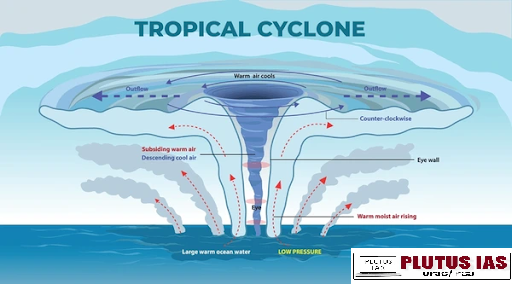
- A rapidly rotating storm system with a low-pressure area, strong winds, spiral thunderstorms, and heavy rainfall.
- Typically 100–2000 km wide, fueled by warm ocean waters.
- Rotate counter-clockwise in the Northern Hemisphere, clockwise in Southern Hemisphere due to Coriolis effect.
- About 80–90 tropical cyclones form yearly, ~50% reach hurricane-force winds.
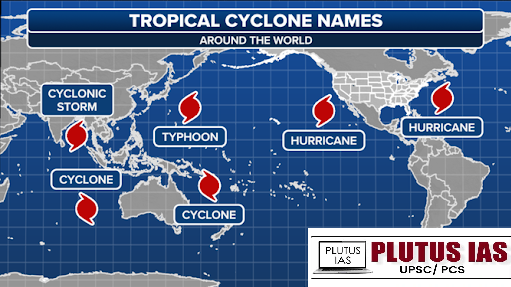
Various Names Of The Tropical Cyclones
Conditions for Tropical Cyclone Formation
| Condition | Explanation | Example (2020–2025) |
|---|---|---|
| Warm Ocean Waters | Sea surface temperature ≥ 26.5 °C up to 50 m depth | Cyclone Amphan (2020) |
| Atmospheric Moisture & Instability | Humid mid-levels + rapid cooling with height | Typhoon Rai / Odette (2021) |
| Low Vertical Wind Shear | Minimal change in wind speed/direction with height | Cyclone Tauktae (2021) |
| Coriolis Effect | Must form ≥ 500 km from equator for rotation | Typhoon Hinnamnor (2022) |
| Pre-existing Disturbance | Low-pressure area acts as seed for storm | Cyclone Biparjoy (2023) |
Stages of Cyclone Formation
| Stage | Processes / Features | Notes / Examples |
|---|---|---|
| 1. Low-Pressure Disturbance / Tropical Disturbance | Warm ocean waters heat air → moist air rises → clusters of thunderstorms form | Initial low-pressure area forms over tropical seas |
| 2. Depression / Cyclonic Storm Formation | Organized thunderstorms; Coriolis effect induces rotation; low vertical wind shear allows intensification | Depression → Deep Depression → Cyclonic Storm (IMD classification) |
| 3. Mature Cyclone / Severe Cyclone | Eye forms (calm, low pressure); Eyewall → strongest winds & rain; Rainbands spiral outward | Can intensify to Severe Cyclonic Storm or Super Cyclone (e.g., Amphan 2020, Tauktae 2021) |
Consequences of Tropical Cyclones
| Consequence | Description | Example (2020–2025) |
|---|---|---|
| Coastal Destruction | Strong winds and storm surges damage houses, ports, and roads | Cyclone Amphan (2020) – $13 bn losses in India & Bangladesh |
| Flooding (River & Inland) | Torrential rainfall overwhelms rivers, dams, and drainage systems | Cyclone Yaas (2021) – severe floods in Odisha & West Bengal |
| Agricultural Losses | Crops destroyed, salinization of farmland | Typhoon Rai / Odette (2021) – rice and coconut farms hit in the Philippines |
| Infrastructure Disruption | Power grids, telecom, and transport were severely affected | Cyclone Tauktae (2021) – massive power outages in Gujarat |
| Humanitarian Crisis | Displacement, casualties, health emergencies | Cyclone Mocha (2023) – 1 million displaced in Myanmar & Bangladesh |
| Ecological Damage | Mangrove loss, coastal erosion, and marine ecosystem stress | Cyclone Biparjoy (2023) – erosion along the Gujarat coast |
| Climate Change Effect | Warmer oceans → longer, stronger cyclones | Cyclone Freddy (2023) – longest-lasting tropical cyclone on record |
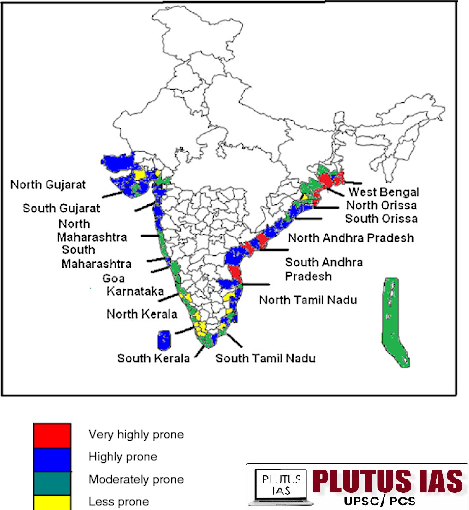
Cyclone Vulnerability Map of India
Structural Measures for Cyclone
| Phase | Structural Measures | Examples / Best Practices |
|---|---|---|
| Pre-Disaster | 1. Construction of cyclone shelters and elevated safe structures.2. Coastal embankments, sea walls, and levees to prevent storm surge.3. Strengthening of power lines, communication towers, and critical infrastructure. | 1. Odisha Cyclone Shelters – 3,000+ shelters built post-Cyclone Phailin (2013).2. Sea walls in Gujarat – Prevented damage from Cyclone Tauktae (2021).3. Reinforced electricity poles in Odisha & Andhra Pradesh – Reduced power outage during Cyclone Amphan (2020). |
| During Disaster | 1. Temporary barriers and sandbags to reduce flooding.2. Emergency power generators and communication facilities in shelters.3. Deployment of rescue boats and helicopters in flood-prone areas. | 1. Sandbagging in Kerala (2022 floods) – Reduced inundation.2. IMD mobile communication units in Odisha shelters – Maintained connectivity during Cyclone Fani (2019).3. Indian Navy & Coast Guard rescues – Cyclone Mocha (2023), Myanmar/Bangladesh. |
| Post-Disaster | 1. Restoration of damaged infrastructure (roads, bridges, power).2. Rehabilitation of housing with cyclone-resistant designs.3. Repair of coastal defenses and drainage systems. | 1. Post-Amphan restoration in West Bengal (2020) – Rapid road & bridge repair.2. Cyclone-resistant rural housing in Odisha – Adopted after Phailin (2013).3. Gujarat embankment repair – Post Tauktae (2021). |
Non-Structural / Adaptive Measures for Cyclone Management
| Phase | Non-Structural / Adaptive Measures | Examples / Best Practices |
|---|---|---|
| Pre-Disaster | 1. Early warning systems and dissemination via IMD alerts.2. Community awareness and preparedness programs.3. Land-use planning and zoning to avoid high-risk areas. | 1. IMD Cyclone Alerts – Advanced warnings for Cyclone Amphan (2020) saved thousands.2. Community Disaster Preparedness in Odisha – Local volunteers trained post-Phailin (2013).3. Coastal zoning in Tamil Nadu & Gujarat – Restricted settlements in high-risk zones. |
| During Disaster | 1. Evacuation of people to shelters.2. Public advisories and real-time information through media and apps.3. Coordination of emergency services and first responders. | 1. Mass evacuation in Odisha – Cyclone Fani (2019) evacuated ~1.2 million people.2. Mobile alerts & TV warnings – Used effectively in Cyclone Tauktae (2021).3. NDMA & NDRF coordination – Efficient rescues in Cyclone Mocha (2023). |
| Post-Disaster | 1. Relief distribution and healthcare services to affected populations.2. Assessment of damage and risk mapping for future planning.3. Community-based adaptation programs and disaster resilience training. | 1. Post-Amphan relief in West Bengal & Odisha – Food, water, medical aid.2. Risk mapping in Odisha – Updated maps post-Phailin for better preparedness.3. Community resilience training in Gujarat & Odisha – Conducted by NGOs & state govt. |
Conclusion
Cyclones are among the most destructive natural hazards, causing widespread loss of life, property, and ecological damage. Understanding the conditions and stages of cyclone formation, coupled with timely forecasting, can significantly reduce their impact. Effective management requires a combination of structural measures, such as cyclone shelters and coastal defenses, and non-structural measures, including early warning systems, community preparedness, and adaptive planning. With climate change increasing the intensity and frequency of cyclones, proactive disaster risk reduction and resilient infrastructure are crucial to safeguard vulnerable communities and minimize humanitarian and economic losses.
Prelims Question
Q. Consider the following statements regarding IMD colour-coded weather warnings for cyclones:
1. Red alert indicates extreme danger and requires immediate action.
2. A green alert means evacuation is mandatory.
Which of the statements given above is/are correct?
(a) 1 only
(b) 2 only
(c) Both 1 and 2
(d) Neither 1 nor 2
Answer: A
Mains Question
Q. Explain the causes, impacts, and mitigation measures for tropical cyclones, with examples from India and the world. (250 words)

- Elderly in India: Population, Challenges, and Government Initiatives - October 29, 2025
- Jal Jeevan Mission (JJM): Ensuring Tap Water to Every Rural Household - October 27, 2025
- National Blockchain Framework: Strengthening Governance through Blockchain Technology - October 25, 2025

No Comments