


26 Sep The Nanoscale Secrets of Ice: A Window into the World of Nanotechnology
This article covers “Daily Current Affairs” and Topic details “The Nanoscale Secrets of Ice: A Window into the World of Nanotechnology”
SYLLABUS MAPPING
GS–3 – Science & Technology – Developments and their Applications and Effects in Everyday Life; Indigenization of Technology and Developing New Technology
FOR PRELIMS
What is nanotechnology and what are its unique properties at the nanoscale?
FOR MAINS
Discuss the potential of nanotechnology in transforming healthcare, agriculture, environment, energy, and industrial sectors with suitable examples.
Why in the News?
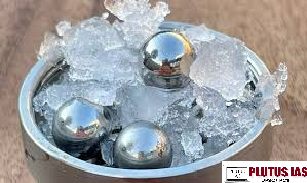
Scientists at the Pacific Northwest National Laboratory (PNNL) have made a groundbreaking discovery about ice: at the nanoscale, it is surprisingly flexible and malleable, despite its rigid hexagonal lattice. Using a novel technique—cryogenic liquid-cell transmission electron microscopy (Cryo-LC-TEM)—researchers directly observed how dissolved gases form, migrate, merge, and dissolve within ice crystals. This is the first-ever molecular-resolution imaging of liquid water freezing into ice, opening new possibilities in fields as diverse as cryogenic medicine, aviation safety, and climate science.
What is Nanotechnology
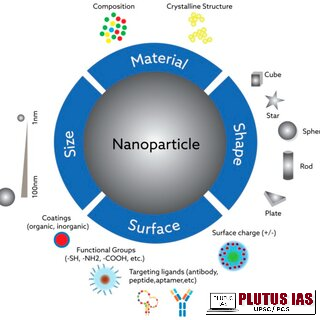
Nanotechnology involves manipulating materials at the nanoscale (1–100 nanometers), where unique physical and chemical properties emerge. At this scale, materials often behave differently compared to their bulk form due to: Quantum effects (e.g., altered conductivity, magnetism), High surface-to-volume ratio (greater reactivity and strength), and Unique structural flexibility. This allows scientists to design materials and devices with extraordinary applications—from targeted drug delivery systems to next-generation electronics and even nano-enabled agriculture.
Core Components and Features of Nanotechnology
| Key Component | Feature/Significance | Examples |
|---|---|---|
| Nanomaterials | Materials engineered at nanoscale with altered properties | Carbon nanotubes, graphene, quantum dots |
| Nanoelectronics | Miniaturized circuits enabling faster and more efficient devices | Transistors in processors, nanosensors |
| Nanomedicine | Medical applications using nanoparticles | Lipid nanoparticles in mRNA vaccines |
| Nanophotonics | Control of light at the nanoscale | Solar cells, advanced imaging |
| Nanostructured surfaces | Surfaces designed for hydrophobicity/strength | Anti-fog glass, self-cleaning coatings |
Applications Across Sectors
| Field | Application | Examples |
|---|---|---|
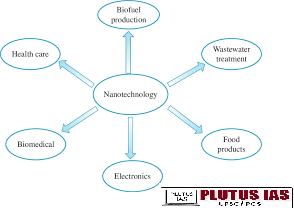
| Medicine & Health | Targeted drug delivery, cancer therapy, diagnostic imaging | Gold nanoparticles for tumor detection; lipid-based COVID-19 vaccines |
| Environment | Water purification, pollution monitoring | Nanofilters removing heavy metals |
| Energy | Efficient solar panels, lightweight batteries | Perovskite nanomaterials for solar cells |
| Agriculture | Nano-fertilizers, pest control, soil monitoring | Smart delivery of nutrients to crops |
| Industry & Aviation | Anti-icing coatings, stronger materials | Nanocoatings for aircraft wings |
| Climate Science | Understanding ice/glacier behavior, carbon capture | Nanoscale ice studies (PNNL research) |
India’s Progress in Nanotechnology
1. National Nanotechnology Mission (2007): The mission focused on basic research, human resource development, international collaborations, and infrastructure creation.
2. Nano Mission Phase II (2017–2022): The second phase accelerated applications in areas such as drug delivery, water purification, sensors, and energy storage systems.
3. Centers of Excellence and Research Hubs: Several premier institutes lead India’s nanotech research:
– Indian Institute of Science (IISc), Bangalore: Strong in nanomaterials and biomedical nanotech.
-IIT Bombay & IIT Delhi: Advanced work in nanoelectronics and nanophotonics
-National Physical Laboratory (CSIR-NPL): Works on nanometrology and material sciences.
4. Medical Innovations: India has been developing nano-based drug carriers to treat diseases like tuberculosis, diabetes, and cancer. The Department of Biotechnology (DBT) has also funded projects on nano-diagnostics and biosensors for rapid disease detection.
5. Industrial Applications: Nanotechnology is increasingly being deployed in India’s industries:
– Asian Paints uses nano-additives for stronger, weather-resistant coatings.
– Textile industries are producing self-cleaning and anti-bacterial fabrics.
– Tata Chemicals has explored nano-enabled water filtration technologies to provide affordable, clean water.
– Startups such as Log 9 Materials are developing nanotechnology-enabled batteries and supercapacitors, crucial for India’s electric vehicle ecosystem.
India vs. Global Leaders in Nanotechnology
| Country/Region | Key Strengths | Funding & Investments | Global Standing |
|---|---|---|---|
| United States | Strong academia–industry linkages; nanomedicine, nanoelectronics | > $1.5 billion annually under the National Nanotechnology Initiative (NNI) | World leader in patents and startups |
| China | Large-scale funding; rapid commercialization; dominance in nanomaterials | Estimated $2 billion+ annually; top in publications | #1 in nanotech publications; fast-growing industry |
| European Union | Focus on sustainable nanotech, safety regulations, and green energy | ~ €1 billion+ annually under Horizon Europe | Leader in green nanotechnology & regulatory frameworks |
| Japan | Advanced nanoelectronics, robotics, materials science | Hundreds of millions in annual R&D; heavy focus on semiconductors | Global leader in nanoelectronics & materials |
| India | Strong academic output; growing applications in healthcare, energy, and textiles | ₹1000 crore (~$120M) allocated in Nano Mission Phase II (2017–22) | Top 3 in publications, but limited in patents & commercialization |
Challenges in Harnessing Nanotechnology
1. High Costs & Infrastructure Needs: Setting up advanced labs for nanotech research requires state-of-the-art instruments like electron microscopes, nanolithography systems, and clean-room facilities. Most of these instruments are imported at high costs, making research heavily dependent on foreign supply chains.
2. Skill Gap: India produces a large number of engineers and scientists, but specialized training in nano-engineering and nano-fabrication remains limited.
3. Regulation & Safety Concerns: Nanoparticles can interact unpredictably with biological systems, leading to health and environmental risks. India currently lacks a comprehensive regulatory framework for nanotech safety, raising concerns about unchecked industrial usage.
4. Technology Transfer Barriers: While India’s academic research output is strong, the conversion of lab research into industrial products remains slow due to weak industry–academia collaboration.
5. Dependence on Imports: Most high-precision nanotech instruments and raw materials are imported. This not only raises costs but also exposes research to supply chain disruptions.
Way Forward
1. Strengthen Research Funding: Expanding the Nano Mission with increased funding and longer tenure will provide stability for large-scale projects.
2. Public–Private Partnerships (PPPs): Encouraging partnerships between industry and academia is crucial. For example, collaborations with pharmaceutical companies can help commercialize nano-based drug delivery systems, while energy startups can work with IITs on next-gen batteries.
3. Regulation Frameworks: India should develop a National Nano-Safety Framework aligned with global practices (like those of the OECD). This would ensure safe usage of nanoparticles in food, medicine, and consumer products.
4. Global Collaboration: International tie-ups will allow India to share expertise, gain access to advanced facilities, and contribute to global projects.
5. Skill Development: Introducing specialized nanotechnology curricula in universities, along with vocational training programs, will create a skilled workforce.
Conclusion
The nanoscale discovery of ice’s flexibility is more than a scientific curiosity—it’s a reminder that nature’s mysteries unfold when observed at the smallest scales. From medical breakthroughs to climate solutions, nanotechnology holds the key to innovations that can shape the future of humanity. For India, embracing this revolution with strong policies, safe practices, and global partnerships will be essential to transform potential into progress.
Prelims Question
Q. With reference to applications of nanotechnology, consider the following statements:
1. Nanoparticles can be used in water purification systems to remove heavy metals and microbes.
2.Nano-fertilizers can improve nutrient use efficiency and reduce environmental pollution.
3. Nano-coatings are being developed to make aircraft wings resistant to ice formation.
4. Nanorobots are being widely used in human surgeries across the world.
Which of the statements given above are correct?
(a) 1 and 2 only
(b) 2 and 3 only
(c) 1, 2 and 3 only
(d) 1, 2, 3 and 4
Answer: C
Mains Question
Q. “Nanotechnology has the potential to act as a transformative force across multiple sectors”. Comment. (250 words)

- Elderly in India: Population, Challenges, and Government Initiatives - October 29, 2025
- Jal Jeevan Mission (JJM): Ensuring Tap Water to Every Rural Household - October 27, 2025
- National Blockchain Framework: Strengthening Governance through Blockchain Technology - October 25, 2025

No Comments