


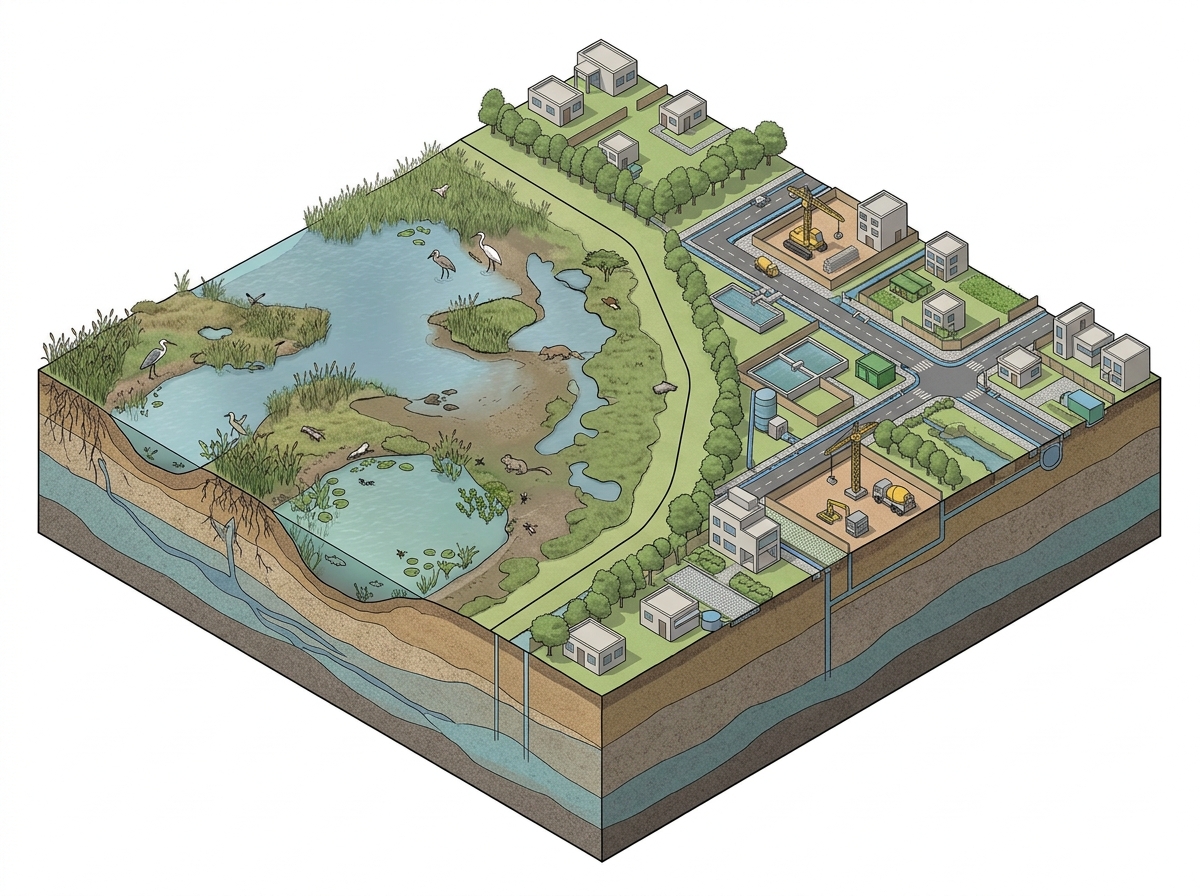
24 Aug TNSWA: Pallikaranai marshland construction can be regulated, not banned
✎ The 'Zone of Influence' (ZoI) around wetlands is a scientifically delineated buffer zone where construction and developmental activities are regulated—not banned—to balance ecological conservation with urban development, as…
Subject Relevance — Where This Topic Fits
- GS Paper II — Governance, Constitution and Polity (Environmental Governance, Judicial Review) | GS Paper III — Environment and Ecology (Wetland Conservation, Sustainable Development)
- Prelims: Wetlands (Conservation and Management) Rules, 2017, Zone of Influence (ZoI), National Green Tribunal (NGT), National Centre for Sustainable Coastal Management (NCSCM), Madras High Court, Pallikaranai Marshland, Wetland Authorities, Sustainable Coastal Management
- Essay: Balancing Development and Environmental Conservation: The Case of Urban Wetlands, Judicial Role in Environmental Governance: Striking the Balance Between Regulation and Prohibition
Quick Revision: The ‘Zone of Influence’ (ZoI) around wetlands is a scientifically delineated buffer zone where construction and developmental activities are regulated—not banned—to balance ecological conservation with urban development, as mandated by the Wetlands (Conservation and Management) Rules, 2017.
Why is this in the news?
The Madras High Court is examining a dispute regarding construction activities around the Pallikaranai marshland in Chennai, where the Tamil Nadu State Wetlands Authority (TNSWA) has submitted a proposed interim ‘Zone of Influence’ (ZoI) prepared by the National Centre for Sustainable Coastal Management (NCSCM). The case challenges a blanket construction ban imposed by the National Green Tribunal (NGT) and highlights the tension between environmental conservation and property rights in urban wetland interfaces.
Background
- The Pallikaranai marshland, spanning 1,247.54 hectares, is one of the last remaining natural wetlands in Chennai and a critical ecological zone for biodiversity and flood mitigation.
- The National Green Tribunal (NGT), in a prior order, imposed a uniform 1 km construction ban around the marshland to protect its ecological integrity, sparking legal challenges from property developers and stakeholders.
- The Tamil Nadu State Wetlands Authority (TNSWA) has now proposed a variable-width ‘Zone of Influence’ (ZoI) around the marshland, prepared by the National Centre for Sustainable Coastal Management (NCSCM), to regulate rather than prohibit construction activities.
- The NCSCM’s report underscores the heterogeneous nature of the wetland-urban interface, advocating a site-specific approach to delineating the ZoI based on hydrological and land-use characteristics.
- The Wetlands (Conservation and Management) Rules, 2017, issued by the Union Ministry of Environment, Forest and Climate Change, provide the legal framework for delineating ZoI and regulating activities in and around wetlands.
- The Madras High Court is adjudicating the matter to determine the appropriate balance between environmental protection and developmental rights, with the interim ZoI map serving as a key reference.
What is the ‘Zone of Influence’ (ZoI) in Wetland Governance?
- The ‘Zone of Influence’ (ZoI) refers to the area surrounding a wetland where developmental activities are regulated to mitigate adverse impacts on the wetland’s ecological functions, such as water retention, biodiversity support, and flood mitigation.
- The ZoI is not a fixed boundary but a dynamic zone whose width and extent are determined by scientific assessments of hydrological, ecological, and land-use factors specific to the wetland and its surrounding urban interface.
- The Wetlands (Conservation and Management) Rules, 2017, define the ZoI as the area where developmental activities must be regulated to ensure the conservation and sustainable management of wetlands, aligning with the Ramsar Convention’s principles of wise use.
- The delineation of ZoI involves multi-disciplinary studies, including hydrological modeling, ecological surveys, and assessments of urban encroachment pressures, to identify areas where construction or other activities could disrupt the wetland’s ecological balance.
- The ZoI framework allows for a graded approach, where stricter regulations apply closer to the wetland boundary, and more flexible norms may be permitted at greater distances, depending on the site-specific conditions.
- The ZoI is distinct from the wetland’s core protected area, which is typically subject to stricter conservation measures, while the ZoI serves as a buffer to manage human activities in the surrounding landscape.
- The ZoI concept is increasingly adopted in urban planning to reconcile developmental pressures with environmental sustainability, particularly in cities where wetlands are encroached upon by infrastructure and real estate projects.
- The ZoI approach is supported by institutions like the National Centre for Sustainable Coastal Management (NCSCM), which provides technical expertise for delineating boundaries based on scientific data and guidelines.
Key Features
| Feature | Significance |
|---|---|
| Interim ‘Zone of Influence’ (ZoI) | Provides a scientifically delineated buffer around Pallikaranai marshland to regulate developmental activities without imposing a uniform ban. |
| Site-specific approach to ZoI width | Recognises heterogeneity of wetland-urban interface; avoids one-size-fits-all regulation, ensuring ecological balance and property rights balance. |
| National Centre for Sustainable Coastal Management (NCSCM) report | Basis for interim ZoI; integrates hydrological and land-use data to inform sustainable urban planning. |
| Guidelines for Wetlands (Conservation and Management) Rules, 2017 | Legal framework underpinning ZoI delineation; ensures compliance with Union Ministry of Environment, Forest and Climate Change directives. |
| Madras High Court intervention | Judicial oversight ensures adherence to scientific evidence and procedural fairness in wetland conservation disputes. |
Why it Matters
Ecological
- Pallikaranai marshland is a critical urban wetland in Chennai, supporting biodiversity, groundwater recharge, and flood mitigation.
- Regulated construction in ZoI mitigates ecological degradation while accommodating sustainable urban development.
- Site-specific ZoI width prevents uniform restrictions that could disproportionately impact urban land use.
Legal and Governance
- Demonstrates the role of scientific agencies (NCSCM) in informing judicial and administrative decisions on environmental governance.
- Highlights the interplay between the National Green Tribunal (NGT), State Wetlands Authority, and judicial review in environmental regulation.
- Emphasises adherence to statutory guidelines (Wetlands Rules, 2017) in wetland conservation and management.
Economic
- Balances ecological conservation with property rights of landowners, avoiding blanket bans that could stall urban development.
- Supports sustainable real estate practices through regulated construction in designated buffer zones.
- Encourages investment in eco-sensitive urban planning and green infrastructure.
Urban Planning
- Illustrates the need for adaptive urban planning frameworks that integrate ecological sensitivity with developmental needs.
- Promotes evidence-based delineation of buffer zones to prevent ad-hoc restrictions on land use.
- Provides a model for managing urban wetlands in rapidly expanding cities.
Challenges
1. Balancing ecological conservation and developmental rights
- Risk of over-regulation stifling urban growth versus under-regulation leading to ecological degradation.
- Need for precise scientific data to justify variable ZoI widths and avoid arbitrary restrictions.
- Coordination challenges between central guidelines, state authorities, and judicial bodies in wetland governance.
UPSC Link: GS-III: Conservation, Environmental Pollution
2. Scientific uncertainty in wetland delineation
- Heterogeneous wetland-urban interfaces complicate uniform regulatory approaches.
- Dependence on interim ZoI maps until final scientific studies are completed introduces procedural delays.
- Ensuring consistency in hydrological and land-use assessments across diverse wetland ecosystems.
UPSC Link: GS-III: Environmental Impact Assessment
3. Judicial vs. administrative roles in environmental governance
- Tension between judicial orders (e.g., NGT) and administrative flexibility in wetland regulation.
- Need for clear demarcation of roles between courts, state authorities, and scientific agencies.
- Ensuring that judicial interventions are grounded in empirical evidence rather than ad-hoc directives.
UPSC Link: GS-II: Separation of Powers
4. Public participation and stakeholder engagement
- Involving local communities, landowners, and developers in wetland conservation planning.
- Addressing grievances of property owners affected by regulatory restrictions.
- Ensuring transparency in scientific assessments and decision-making processes.
UPSC Link: GS-II: Governance
5. Long-term sustainability of wetland ecosystems
- Urban encroachment and pollution remain persistent threats to Pallikaranai marshland.
- Need for integrated urban planning that prioritises wetland conservation in city development.
- Ensuring funding and institutional capacity for ongoing ecological monitoring and restoration.
UPSC Link: GS-III: Sustainable Development
Challenges — UPSC Perspective
| Issue | Concern |
|---|---|
| Uniform ban on construction | Disproportionate impact on property rights and urban development without ecological justification. |
| Site-specific ZoI delineation | Complexity in integrating diverse hydrological and land-use data across heterogeneous interfaces. |
| Interim vs. final ZoI | Temporary measures may lead to prolonged uncertainty for stakeholders and developers. |
| Judicial overreach | Risk of courts imposing blanket restrictions without adequate scientific backing. |
| Stakeholder conflicts | Potential disputes between environmentalists, landowners, and urban planners over land use. |
| Implementation gaps | Ensuring compliance with ZoI regulations across multiple agencies and jurisdictions. |
Way Forward
- Finalise the ZoI delineation through comprehensive hydrological and land-use studies by NCSCM and state authorities.
- Strengthen inter-agency coordination between the National Green Tribunal, TNSWA, NCSCM, and local bodies for effective wetland governance.
- Develop a participatory framework involving landowners, environmentalists, and urban planners to balance conservation and development.
- Enhance transparency in scientific assessments and decision-making processes to build public trust and stakeholder buy-in.
- Integrate Pallikaranai marshland conservation into Chennai’s Master Plan and Urban Development Policies.
- Establish a dedicated monitoring mechanism to track ecological health and construction compliance within the ZoI.
- Promote eco-sensitive urban design and green infrastructure in the ZoI to align developmental activities with ecological sustainability.
- Conduct periodic reviews of ZoI regulations to adapt to changing urban dynamics and scientific advancements.
UPSC Value Addition
Keywords for Mains Answer-Writing
Pallikaranai Marshland · Wetlands (Conservation and Management) Rules, 2017 · Zone of Influence (ZoI) · National Centre for Sustainable Coastal Management (NCSCM) · National Green Tribunal (NGT) · Tamil Nadu State Wetlands Authority (TNSWA) · Wetland conservation policy · Hydrological characteristics · Site-specific approach · Environmental governance · Madras High Court · Wetland-urban interface
Constitutional & Policy Linkages
- [‘Article 21: Right to Life (includes ecological balance)’, ‘Protection of wetland ecosystems as part of environmental justice.’]
- [‘Article 48A: Directive Principles of State Policy’, ‘State’s duty to protect and improve the environment and safeguard forests and wildlife.’]
- [‘Article 51A(g): Fundamental Duties’, ‘Citizens’ responsibility to protect and improve the natural environment.’]
Concept Flow
Urban expansion encroaches upon Pallikaranai marshland → Ecological degradation and flood risks increase → NGT imposes blanket construction ban → Property owners challenge ban in Madras High Court → TNSWA and NCSCM propose interim ZoI with variable width → Court evaluates scientific basis and legal framework → Balanced regulation emerges through site-specific approach → Sustainable urban planning integrates wetland conservation.
Prelims Practice Questions
Q1. Consider the following statements regarding the Wetlands (Conservation and Management) Rules, 2017:
1. The Rules mandate the delineation of a ‘Zone of Influence’ (ZoI) around wetlands for regulating developmental activities.
2. The ZoI is defined as the area where developmental activities may impact the ecological character of the wetland.
3. The Rules prohibit all construction activities within the ZoI of a wetland.
How many of the above statements are correct?
- Only one
- Only two
- All three
- None
Answer: Only two — Statement 1 and 2 are correct as per Rule 5(1) of the Wetlands (Conservation and Management) Rules, 2017. Statement 3 is incorrect because the Rules allow regulation, not an absolute prohibition, of construction activities in the ZoI.
Q2. Assertion (A): The National Green Tribunal (NGT) imposed a blanket construction ban of 1 km around the Pallikaranai marshland.
Reason (R): The NGT’s decision was based on the Wetlands (Conservation and Management) Rules, 2017, which mandate a uniform 1 km buffer for all wetlands.
Options:
A. Both A and R are true, and R is the correct explanation of A.
B. Both A and R are true, but R is not the correct explanation of A.
C. A is true, but R is false.
D. A is false, but R is true.
- A
- B
- C
- D
Answer: D — Assertion (A) is true as the NGT imposed a blanket ban. However, Reason (R) is false because the Rules do not mandate a uniform 1 km buffer; they require a site-specific ZoI based on scientific studies.
Q3. Which of the following institutions is responsible for preparing the ‘Zone of Influence’ (ZoI) map for wetlands in India, as per the Wetlands (Conservation and Management) Rules, 2017?
1. Central Pollution Control Board (CPCB)
2. National Centre for Sustainable Coastal Management (NCSCM)
3. Ministry of Environment, Forest and Climate Change (MoEFCC)
4. State Wetlands Authorities
Options:
A. 1 and 2 only
B. 2 only
C. 2 and 4 only
D. 1, 3 and 4 only
- A
- B
- C
- D
Answer: C — As per Rule 5(1) of the Wetlands (Conservation and Management) Rules, 2017, the National Centre for Sustainable Coastal Management (NCSCM) is tasked with preparing the ZoI map for wetlands.
Mains Practice Question
✍ The delineation of a ‘Zone of Influence’ (ZoI) around wetlands under the Wetlands (Conservation and Management) Rules, 2017, must balance ecological conservation with developmental aspirations. Critically examine this proposition with reference to the recent interim ZoI proposed for the Pallikaranai marshland by the National Centre for Sustainable Coastal Management (NCSCM). Also, analyse the legal and institutional framework governing wetland conservation in India. (15 Marks)
Approach: MODEL-ANSWER SKELETON:
1. **Introduction (2 marks)**: Define wetlands and their ecological significance (e.g., biodiversity, flood mitigation). State the objective of the Wetlands (Conservation and Management) Rules, 2017, and the need for a ZoI.
2. **Legal and Institutional Framework (4 marks)**:
– Wetlands (Conservation and Management) Rules, 2017: Key provisions (Rule 5(1) on ZoI, Rule 6 on prohibition/restriction of activities).
– Role of the National Centre for Sustainable Coastal Management (NCSCM) in preparing ZoI maps.
– Role of State Wetlands Authorities (e.g., TNSWA) and the National Green Tribunal (NGT) in enforcement.
– Reference to the Guidelines for Implementing the Rules issued by MoEFCC.
3. **Case Study: Pallikaranai Marshland (5 marks)**:
– Background: Ecological significance of Pallikaranai marshland (e.g., one of the last remaining natural wetlands in Chennai, biodiversity hotspot).
– NGT’s blanket ban on construction within 1 km of the marshland and the subsequent challenge by CREDAI-Chennai.
– NCSCM’s interim ZoI proposal: Variable-width approach (0-20m, 20-50m, 50-100m, >100m) based on hydrological and land-use characteristics. Highlight the heterogeneity of the wetland-urban interface.
– Madras High Court’s observation on the need for a site-specific approach rather than a uniform ban.
4. **Balancing Conservation and Development (3 marks)**:
– Arguments for regulation vs. prohibition: Economic implications for property owners, urbanisation pressures, and ecological imperatives.
– The principle of ‘wise use’ under the Ramsar Convention (to which India is a signatory) and its incorporation in the Rules.
– Role of participatory governance (e.g., consultations with stakeholders like CREDAI, environmental groups).
5. **Conclusion (1 mark)**: Reaffirm the need for a nuanced, science-based ZoI that aligns with the Wetlands Rules while addressing developmental concerns. Highlight the importance of long-term scientific studies for final ZoI delineation.
Source: The Hindu
Generated by AanyaAi for educational purpose.
Related guides on our sites
- Anthropology VS PSIR
- Best PSIR optional coaching
- Best PSIR optional coaching online
- Best PSIR optional teacher

- सुप्रीम कोर्ट ने सीबीएसई की तीन-भाषा नीति पर उठाए सवाल, ‘नेटिव’ शब्द पर क्या कहा? - August 24, 2026
- Supreme Court Questions CBSE’s Three-Language Policy: ‘Native’ vs ‘Indigenous’ Debate - August 24, 2026
- उच्च न्यायालय ने पूछा: पुलिस मुठभेड़ में एक गोली, आरोपी के घुटने के नीचे क्यों लगी? - August 24, 2026

No Comments