


08 Oct TRAI’s Mobile Network Quality Assessment in Fazilka, Punjab: Key Findings
✎ TRAI’s Independent Drive Tests (IDTs) objectively assess mobile network quality by measuring parameters like coverage gaps, call drop rates, and data throughput, ensuring regulatory accountability and consumer protection in…
Subject Relevance — Where This Topic Fits
- GS Paper II — Governance, Transparency and Accountability | GS Paper III — Infrastructure: Energy, Ports, Roads, Airports and Telecommunications
- Prelims: Telecom Regulatory Authority of India (TRAI), Licensed Service Area (LSA), Mobile Network Quality, Drive Testing, QoS Parameters, Call Drop Rate, Packet Loss Rate, 5G/4G/3G/2G Coverage, Independent Drive Test (IDT), Telecom Service Providers (TSPs), Consumer Protection
- Essay: The Role of Regulatory Bodies in Ensuring Public Service Quality: A Case Study of TRAI’s Monitoring Mechanisms, Balancing Technological Advancement and Equitable Access: Challenges in India’s Telecommunication Sector
Quick Revision: TRAI’s Independent Drive Tests (IDTs) objectively assess mobile network quality by measuring parameters like coverage gaps, call drop rates, and data throughput, ensuring regulatory accountability and consumer protection in India’s telecom sector.
Why is this in the news?
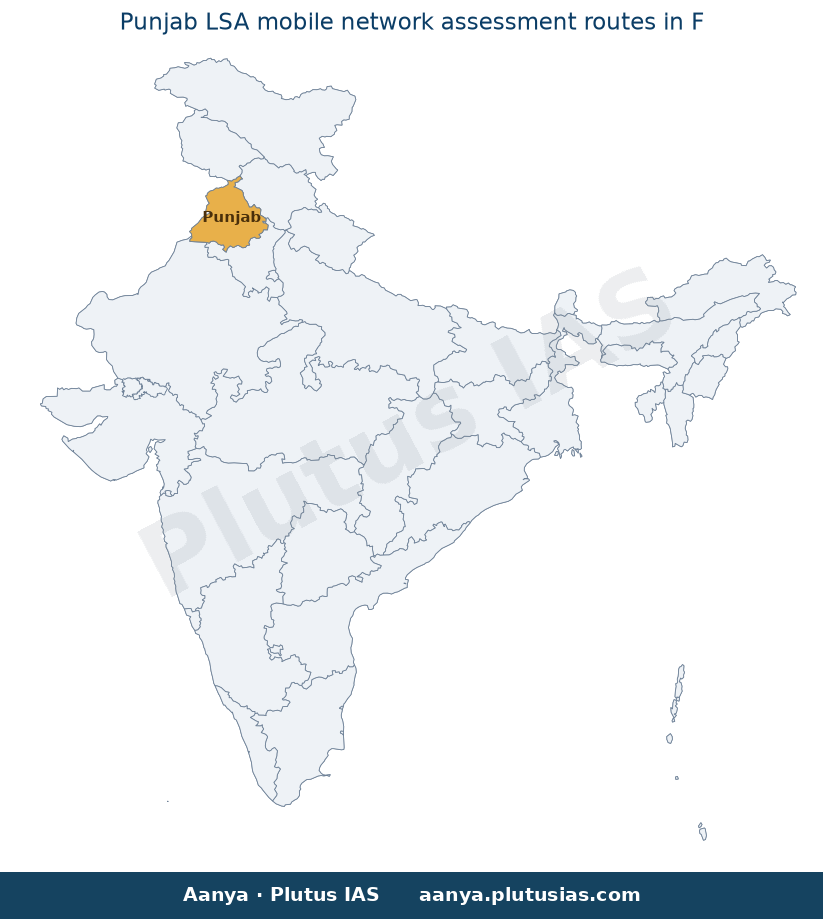
The Telecom Regulatory Authority of India (TRAI) released the findings of its Independent Drive Tests (IDT) conducted in Fazilka city and surrounding areas of Punjab LSA in August 2026. These tests assessed the real-time quality of mobile network services (voice and data) provided by telecom service providers (TSPs) using objective parameters such as coverage gaps, call drop rates, and data throughput. The results, published for consumer awareness, highlight the performance disparities among TSPs and underscore the importance of regulatory oversight in ensuring service quality in India’s telecommunication sector.
Background
- The Telecom Regulatory Authority of India (TRAI) was established under the Telecom Regulatory Authority of India Act, 1997, to regulate telecommunication services, protect consumer interests, and promote competition in the sector.
- TRAI conducts Independent Drive Tests (IDTs) to objectively measure the Quality of Service (QoS) provided by Telecom Service Providers (TSPs) across different Licensed Service Areas (LSAs) in India.
- Fazilka, located in Punjab, is a border district with significant socio-economic importance, necessitating reliable telecommunication infrastructure for governance, commerce, and public safety.
- The IDT methodology involves live testing of voice and data services across 2G, 3G, 4G, and 5G networks using advanced test handsets and real-time monitoring systems to evaluate parameters like coverage, call success rates, and data throughput.
- TRAI’s QoS regulations mandate TSPs to maintain minimum performance standards, and non-compliance can lead to penalties or regulatory interventions.
- Consumer complaints regarding poor network quality, especially in rural and semi-urban areas, have historically driven regulatory scrutiny and policy reforms in India’s telecom sector.
What are Independent Drive Tests (IDTs) and their role in telecommunication governance?
- Independent Drive Tests (IDTs) are field-based assessments conducted by TRAI to evaluate the real-time performance of mobile networks provided by TSPs in designated areas, including cities, highways, and public transport hubs.
- IDTs measure critical Quality of Service (QoS) parameters such as coverage gaps, call setup success rates (CSSR), call drop rates (CDR), packet loss rates, and data throughput (download/upload speeds), ensuring objective and transparent evaluation.
- The tests are conducted using advanced test equipment and software, simulating actual user conditions to capture variations in network performance across different times, locations, and technologies (2G/3G/4G/5G).
- TRAI’s IDT reports are published to inform consumers about network performance disparities among TSPs, enabling informed choices and fostering accountability in the telecom sector.
- IDTs are part of TRAI’s broader mandate to regulate telecom services, protect consumer interests, and ensure fair competition by penalizing non-compliant TSPs and incentivizing service improvements.
- The methodology includes city drives, walk tests, and hotspot evaluations to capture diverse usage scenarios, such as urban congestion, rural coverage gaps, and high-traffic public areas.
- IDT findings are used to identify systemic issues in telecom infrastructure, such as inadequate tower density, spectrum allocation challenges, or interference, guiding policy interventions and infrastructure development.
- TRAI’s regulatory framework for QoS is aligned with global best practices, emphasizing transparency, data-driven decision-making, and continuous monitoring to address the evolving demands of India’s telecom users.
Key Features
| Feature | Significance |
|---|---|
| Coverage Gap | Measures the proportion of test samples where signal strength falls below the minimum threshold for a given technology (2G/3G/4G/5G), indicating areas of poor or absent network connectivity. |
| Call Drop Rate (CDR) | Tracks the percentage of successfully established calls that terminate prematurely, reflecting network reliability and handover efficiency between cell sites. |
| Call Setup Success Rate (CSSR) | Assesses the likelihood of a call being successfully initiated, serving as a proxy for network congestion and infrastructure robustness. |
| Packet Loss Rate | Quantifies the percentage of data packets lost during transmission, directly impacting data service quality, particularly for real-time applications like video calls and streaming. |
| Throughput (Download/Upload) | Evaluates the actual data transfer speeds achieved, distinguishing between consumer experience in data-intensive tasks versus theoretical network capacity. |
Why it Matters
Economic Productivity
- Reliable mobile networks are essential for micro, small, and medium enterprises (MSMEs) in Firozepur district, enabling digital payments, supply chain coordination, and e-commerce access.
- High call drop rates and poor data services increase transaction costs for businesses, particularly in sectors like agriculture, logistics, and local trade.
- Improved network quality can attract investment in Punjab’s border districts by enhancing the ease of doing business and reducing operational inefficiencies.
Digital Inclusion
- Consistent network coverage is a prerequisite for the success of government digital initiatives such as Direct Benefit Transfer (DBT), PM-KISAN, and Ayushman Bharat, which rely on real-time connectivity.
- Poor network quality in rural and peri-urban areas exacerbates the digital divide, limiting access to online education, telemedicine, and government services for marginalised communities.
- 5G readiness, as assessed in the drive test, is critical for future-proofing Punjab’s digital infrastructure to support smart agriculture, IoT applications, and Industry 4.0 technologies.
Public Safety and Governance
- Emergency services (police, fire, and medical) depend on uninterrupted voice and data connectivity; high call drop rates can delay response times in critical situations.
- Effective law enforcement and border management in Punjab’s sensitive districts require robust telecom infrastructure to support surveillance, communication, and data analytics.
- Network reliability is vital for disaster management, enabling real-time coordination during floods, heatwaves, or other natural calamities common in the region.
Regulatory and Consumer Protection
- TRAI’s Independent Drive Tests (IDT) serve as an objective benchmark for telecom service providers (TSPs), ensuring transparency and accountability in service delivery.
- Public dissemination of performance metrics empowers consumers to make informed choices and incentivises TSPs to improve infrastructure in underserved areas.
- The IDT framework aligns with TRAI’s Quality of Service (QoS) Regulations, 2006, which mandate minimum performance standards for telecom operators.
Challenges
1. Geographical and Topographical Constraints
- Firozepur district’s terrain, including undulating plains and proximity to the international border, poses challenges for uniform signal propagation and infrastructure deployment.
- Rural and remote areas may lack the economic viability for TSPs to invest in last-mile connectivity, leading to coverage gaps despite regulatory mandates.
- Extreme weather conditions, such as heatwaves and monsoon floods, can damage telecom infrastructure and degrade network performance.
UPSC Link: Geographical factors affecting telecom infrastructure
2. Technological Fragmentation
- Legacy 2G/3G networks, while still in use, consume spectrum resources that could be repurposed for 4G/5G, limiting the latter’s potential in high-demand areas.
- Interoperability issues between different generations of networks (e.g., 2G to 4G handover failures) contribute to call drops and degraded user experience.
- The transition to 5G requires substantial investment in fibre backhaul, small cell deployment, and spectrum auctions, which may not be uniformly prioritised across TSPs.
UPSC Link: Spectrum management and network evolution
3. Regulatory and Compliance Gaps
- Enforcement of TRAI’s QoS regulations remains uneven, with some TSPs prioritising urban markets over rural and border areas due to higher revenue potential.
- The absence of a unified national telecom policy framework can lead to inconsistencies in licensing, spectrum allocation, and infrastructure sharing across states.
- Consumer grievance redressal mechanisms, while in place, often suffer from delays and lack of standardisation, reducing their effectiveness in addressing network issues.
UPSC Link: Regulatory frameworks for telecom services
4. Economic and Market Dynamics
- High spectrum costs and licence fees deter smaller TSPs from expanding into underserved regions, leading to oligopolistic market structures dominated by a few players.
- Affordability constraints for consumers in low-income areas limit the uptake of higher-generation services (4G/5G), reducing the incentive for TSPs to invest.
- Cross-subsidisation between urban and rural operations is often unsustainable, discouraging TSPs from improving infrastructure in less profitable areas.
UPSC Link: Telecom sector economics and market structure
5. Technical and Operational Bottlenecks
- Inadequate tower infrastructure and backhaul capacity in remote areas result in congestion, particularly during peak usage hours (e.g., evenings or festivals).
- Lack of standardised testing protocols across TSPs can lead to discrepancies in reported QoS metrics, complicating comparative analysis.
- Cybersecurity threats, including signal jamming and data breaches, pose additional risks to network reliability and user trust.
UPSC Link: Telecom infrastructure and cybersecurity
Challenges — UPSC Perspective
| Issue | Concern |
|---|---|
| Coverage gaps in rural areas | Limited access to essential services (healthcare, education, banking) and reduced economic opportunities for local communities. |
| High call drop rates | Disrupted communication, increased transaction costs for businesses, and compromised public safety during emergencies. |
| Low throughput for data services | Poor user experience in video calls, online payments, and cloud-based applications, hindering digital adoption. |
| Packet loss in data transmission | Degraded quality for real-time applications (e.g., video conferencing, online gaming) and increased latency in critical services. |
| Uneven enforcement of QoS norms | Lack of accountability among TSPs, leading to persistent service deficiencies in underserved regions. |
| Spectrum allocation inefficiencies | Underutilisation of available spectrum, limiting the deployment of advanced technologies like 5G in high-demand areas. |
Way Forward
- Enhance last-mile connectivity in Firozepur district by incentivising TSPs to deploy small cells and fibre backhaul in rural and border areas through tax rebates or subsidies.
- Accelerate the phased withdrawal of 2G/3G networks in favour of 4G/5G, with a focus on ensuring backward compatibility for legacy devices to avoid service disruptions.
- Strengthen TRAI’s monitoring mechanisms by integrating real-time analytics from drive tests with consumer feedback portals to identify and address recurring issues promptly.
- Promote infrastructure sharing among TSPs to reduce costs and improve coverage in low-density areas, while ensuring fair competition and consumer choice.
- Invest in local capacity-building for telecom technicians and engineers to support the maintenance and expansion of network infrastructure in Punjab’s border districts.
- Develop a state-specific telecom policy for Punjab, aligning with the National Digital Communications Policy (NDCP) 2018, to address regional challenges and prioritise border-area connectivity.
- Encourage public-private partnerships (PPPs) for deploying community Wi-Fi networks in high-traffic areas such as bus stands, markets, and government offices.
- Conduct periodic awareness campaigns to educate consumers on optimising network usage and reporting service deficiencies, fostering a culture of accountability among TSPs.
UPSC Value Addition
Keywords for Mains Answer-Writing
Telecom Regulatory Authority of India (TRAI) · Quality of Service (QoS) in telecom · Mobile Network Performance Assessment · Independent Drive Test (IDT) · Call Drop Rate (CDR) · Call Setup Success Rate (CSSR) · Packet Loss Rate · Telecom Service Providers (TSPs) · 2G/3G/4G/5G Network Benchmarking · Consumer Protection in Telecom · Telecom Regulation and Governance · Digital Infrastructure and Connectivity
Concept Flow
Telecom service provision → Quality of Service (QoS) regulation → TRAI’s Independent Drive Tests (IDT) → Data-driven performance assessment → Public dissemination of findings → Consumer awareness and choice → Accountability and improvement by TSPs → Enhanced network reliability and digital inclusion.
Prelims Practice Questions
Q1. Consider the following statements regarding the Telecom Regulatory Authority of India (TRAI):
1. TRAI conducts Independent Drive Tests (IDTs) to assess the real-time quality of mobile network services provided by telecom service providers (TSPs).
2. TRAI’s IDTs evaluate parameters such as Call Drop Rate (CDR), Call Setup Success Rate (CSSR), and Packet Loss Rate.
3. TRAI’s IDTs are conducted exclusively for 5G networks and do not cover 2G, 3G, or 4G networks.
How many of the above statements are correct?
- Only one
- Only two
- All three
- None
Answer: Only two — Statements 1 and 2 are correct as TRAI conducts IDTs to assess QoS parameters including CDR, CSSR, and Packet Loss Rate across all network generations (2G/3G/4G/5G). Statement 3 is incorrect because IDTs cover all network generations, not exclusively 5G.
Q2. Assertion (A): The Telecom Regulatory Authority of India (TRAI) is mandated to regulate the quality of telecom services in India.
Reason (R): TRAI was established under the Telecom Regulatory Authority of India Act, 1997, to ensure fair competition and protect consumer interests in the telecom sector.
Options:
A. Both A and R are true, and R is the correct explanation of A.
B. Both A and R are true, but R is not the correct explanation of A.
C. A is true, but R is false.
D. A is false, but R is true.
Answer: ? — Both Assertion (A) and Reason (R) are true. TRAI is indeed mandated to regulate telecom service quality, and it was established under the TRAI Act, 1997, to ensure fair competition and consumer protection. However, R is not the correct explanation of A, as the mandate to regulate QoS is derived from broader regulatory powers, not solely from the establishment purpose.
Q3. Match the following telecom quality parameters with their respective definitions:
Column I (Parameter)
1. Call Drop Rate (CDR)
2. Call Setup Success Rate (CSSR)
3. Packet Loss Rate
4. Signal Coverage Gap
Column II (Definition)
A. Percentage of successfully established calls out of total attempted calls.
B. Percentage of calls that are terminated prematurely due to network issues.
C. Percentage of data packets lost during transmission.
D. Percentage of samples where signal strength falls below the minimum threshold for a given network generation.
Options:
1. A, 2. B, 3. C, 4. D
B. 1. B, 2. A, 3. C, 4. D
C. 1. C, 2. A, 3. B, 4. D
D. 1. D, 2. B, 3. A, 4. C
Answer: ? — The correct match is: 1-B (CDR refers to prematurely terminated calls), 2-A (CSSR refers to successfully established calls), 3-C (Packet Loss Rate refers to lost data packets), and 4-D (Signal Coverage Gap refers to insufficient signal strength).
Mains Practice Question
✍ The Telecom Regulatory Authority of India (TRAI) conducts Independent Drive Tests (IDTs) to assess the quality of mobile network services across India. In this context, critically examine the significance of TRAI’s role in ensuring consumer protection and promoting digital infrastructure development. Also, discuss the implications of sub-optimal network performance on socio-economic development and governance in India. (15 Marks)
Approach: MODEL-ANSWER SKELETON:
1. **Introduction (2 Marks)**: Define TRAI’s mandate under the TRAI Act, 1997, and its role in regulating telecom services. Highlight the purpose of Independent Drive Tests (IDTs) as a tool for QoS assessment.
2. **TRAI’s Role in Consumer Protection (4 Marks)**:
– **Transparency and Accountability**: Explain how IDTs and public reporting of QoS metrics (e.g., CDR, CSSR, Packet Loss Rate) empower consumers to make informed choices and hold TSPs accountable.
– **Regulatory Enforcement**: Discuss TRAI’s powers to penalize TSPs for non-compliance with QoS benchmarks and the role of the Telecom Disputes Settlement and Appellate Tribunal (TDSAT) in dispute resolution.
– **Comparative Benchmarking**: Emphasize how TRAI’s IDTs enable comparative analysis of TSP performance, fostering healthy competition.
3. **Promotion of Digital Infrastructure (4 Marks)**:
– **Bridging the Digital Divide**: Link optimal network performance to India’s Digital India mission, including access to e-governance, digital payments, and online education.
– **Urban-Rural Disparities**: Discuss how IDTs can identify coverage gaps, particularly in rural and remote areas, and inform policy interventions like the Universal Service Obligation Fund (USOF).
– **5G and Future-Readiness**: Highlight the role of IDTs in assessing 5G readiness, which is critical for India’s participation in the global digital economy.
4. **Implications of Sub-Optimal Network Performance (3 Marks)**:
– **Economic Costs**: Discuss the impact of poor network performance on business productivity, foreign direct investment (FDI), and India’s ease of doing business ranking.
– **Governance Challenges**: Explain how unreliable telecom services can hinder real-time data collection, emergency response systems, and public service delivery.
– **Social Inequality**: Link poor QoS to exclusion of marginalized communities from digital services, exacerbating socio-economic inequalities.
5. **Conclusion (2 Marks)**: Summarize the critical need for TRAI’s proactive role in ensuring high QoS standards. Suggest measures such as incentivizing TSPs for rural coverage, leveraging AI for predictive network maintenance, and strengthening consumer grievance redressal mechanisms.
Source: PIB (Press Information Bureau)
Punjab PCS (PPSC) — State PCS Practice
Prelims: Which regulatory body conducted the assessment of mobile network quality in Fazilka city and surrounding areas of Punjab (LSAs)?
- A. Telecom Regulatory Authority of India (TRAI)
- B. Department of Telecommunications (DoT)
- C. Punjab State Electronics Development Corporation (PSEDC)
- D. Punjab State Power Corporation Limited (PSPCL)
Answer: A. Telecom Regulatory Authority of India (TRAI) — TRAI (Telecom Regulatory Authority of India) is the independent regulator overseeing telecom services in India, including network quality assessments.
Mains: Discuss the significance of TRAI’s mobile network quality assessment in Fazilka and its impact on telecom infrastructure development in Punjab. (250 words)
Generated by AanyaAi for educational purpose.
Related guides on our sites
- Prelims test series
- UPSC EPFO Test series
- Anthropology optional test series
- Best PSIR optional test series

- Rajya Sabha Bypoll on November 12: Key Dates & Process Explained - October 22, 2026
- सिम्बेक्स-2026: भारत-सिंगापुर नौसैनिक अभ्यास विशाखापत्तनम में शुरू, जानिए महत्वपूर्ण बिंदु - October 22, 2026
- PM-DAKSH Scheme: Key Features for UPSC & State PCS Aspirants - October 22, 2026

No Comments