


01 Oct Transforming Indian Ports into World-Class Maritime Hubs
This article covers “Daily Current Affairs” and Topic details “Transforming Indian Ports into World-Class Maritime Hubs”
SYLLABUS MAPPING
GS–3 – Economy & Infrastructure – Shipping, Ports, and Shipbuilding Sector
FOR PRELIMS
What is the Shipbuilding Financial Assistance Scheme (SBFAS) and its key features?
FOR MAINS
Discuss the significance of India’s shipbuilding and maritime sector in economic growth, employment generation, and national security.
Why in the News?
The Union Cabinet has approved a comprehensive package worth ₹69,725 crore to strengthen and revitalize India’s shipbuilding and maritime ecosystem. As part of this initiative, the Shipbuilding Financial Assistance Scheme (SBFAS) has been extended till 2036 with a dedicated corpus of ₹24,736 crore to provide sustained support to the sector. In addition, the Cabinet approved the creation of a Maritime Development Fund (MDF) of ₹25,000 crore, which will include a Maritime Investment Fund of ₹20,000 crore to facilitate large-scale infrastructure and innovation in the industry. Further, a new Shipbuilding Development Scheme (SbDS) has been launched with an outlay of ₹19,989 crore aimed at expanding domestic shipbuilding capacity to 4.5 million Gross Tonnage (GT). Collectively, these measures are expected to generate 30 lakh jobs, attract investments worth ₹4.5 lakh crore, and enhance resilience in supply chains, energy, and food security, thereby positioning India as a global leader in the maritime sector.
Statistics on Indian Maritime Sector (as of 2025)
1. 95% of India’s trade by volume and 70% by value handled via maritime routes.
2. India has 12 major ports and 200+ non-major/intermediate ports.
3. Cargo traffic at Indian ports reached 1,500 MTPA in 2024–25.
4. India’s shipbuilding capacity is projected to rise to 4.5 million Gross Tonnage under new schemes.
5. The maritime sector generates over 1.6 crore direct and indirect jobs.
Components of Indian Maritime & Shipping Sector
- Shipbuilding & Ship Repair Industry
- Ports (Major & Non-Major)
- Shipping Companies (Public & Private)
- Inland Water Transport (IWT)
- Logistics & Maritime Infrastructure (Cold Chains, Warehousing)
- Maritime Training & Research (Indian Maritime University, IMU)
- Ship Recycling Industry (Alang, Gujarat is the largest hub globally)
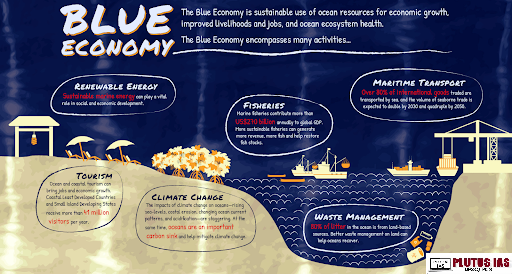
Role of Indian Ports in Socio-Economic Development
1. Trade Facilitation – 95% of trade volume handled through ports ensures smooth global connectivity. Example: JNPT handles 40% of India’s containerized cargo.
2. Employment Generation – Maritime & port activities provide 1.6 crore jobs, directly and indirectly.
3. Regional Development – Port-led growth in Sagarmala clusters has uplifted coastal states.
4. Export Competitiveness – Efficient ports reduce logistics costs (India targets 8% of GDP by 2030 from current 13-14%).
5. Energy Security – Ports handle 80% of India’s crude imports, vital for power and transport sectors.
6. Food Security – Ports enable grain exports and fertilizer imports for agriculture.
7. FDI & Industrial Growth – Ports attract private investments under PPP, boosting SEZs and coastal industrial corridors.
Challenges in India’s Shipbuilding & Maritime Sector
1. Low Share in Global Shipbuilding – India accounts for <1% of global shipbuilding, compared to China (~40%) and South Korea (~25%).
2. High Logistics Costs – Around 13-14% of GDP, compared to global average of 8-9%.
3. Infrastructure Gaps – Limited deep-draft ports; only a few ports can handle mega ships (>18,000 TEUs).
4. Technology Deficit – Dependence on foreign designs, engines, and equipment.
5. Environmental & Safety Issues – Shipbreaking at Alang faces global criticism for pollution and unsafe labor practices.
Way Forward
| Policy/Committee/Act | Focus Area | Status/Impact (2025) |
|---|---|---|
| Sagarmala Programme | Port-led industrial & coastal economic zones | 802 projects; 233 completed |
| Bharatmala & Gati Shakti | Multimodal logistics connectivity | Integrated with port clusters |
| Shipbuilding Financial Assistance Scheme (SBFAS) | Incentives for shipbuilding till 2036 | ₹24,736 crore corpus |
| Major Port Authorities Act, 2021 | Increased autonomy to major ports | Strengthened PPP model |
| Ports Act, 2025 | Replaces archaic Indian Ports Act, 1908 | Rationalises governance, digitalisation |
| National Logistics Policy, 2022 | Reduce logistics cost to global levels | Implementation ongoing |
| Committee on National Maritime Development Programme (NMPT) | Long-term strategy on shipbuilding & shipping | Roadmap aligned with Aatmanirbhar Bharat |
Conclusion
India’s shipbuilding and maritime sector is more than an economic engine—it is a strategic pillar of national security, trade resilience, and Aatmanirbhar Bharat. With the new ₹69,725 crore package, India is poised to script a new maritime renaissance, combining port-led industrialization, shipbuilding capacity expansion, and global competitiveness. Just as railways were the backbone of India’s industrial age, maritime strength will be the foundation of India’s 21st-century growth story.
Prelims Question
Q. With reference to the Ports Act, 2025, consider the following statements:
1. It replaces the Indian Ports Act, 1908.
2. It provides a framework for digitalisation and ease of doing business in ports.
3. It applies only to major ports under the Union List.
Which of the statements given above is/are correct?
(a) 1 and 2 only
(b) 2 and 3 only
(c) 1 and 3 only
(d) 1, 2, and 3
ANSWER: A
Mains Question
Q. India’s maritime and shipbuilding sector is often called the “mother of heavy engineering” and a pillar of strategic security. Discuss its role in India’s economic growth and national security. Critically evaluate the government’s recent initiatives to revitalize this sector. (250 words)

- Elderly in India: Population, Challenges, and Government Initiatives - October 29, 2025
- Jal Jeevan Mission (JJM): Ensuring Tap Water to Every Rural Household - October 27, 2025
- National Blockchain Framework: Strengthening Governance through Blockchain Technology - October 25, 2025

No Comments