


26 Sep Trump Rejects Iran’s Strait of Hormuz Reopening Proposal: UPSC Geography Insights
✎ The Strait of Hormuz is a critical global chokepoint under UNCLOS, through which 20-30% of seaborne oil transits; its closure would disrupt energy markets and test the efficacy of international maritime law and naval deterrence.
Subject Relevance — Where This Topic Fits
- GS Paper II — International Relations — Bilateral, Regional and Global Groupings and Agreements involving India and/or affecting Indian interests | GS Paper II — International Relations — Effect of Policies and Politics of Developed and Developing Countries on India’s interests | GS Paper III — Economy — Infrastructure: Energy, Ports, Roads, Airports, Railways
- Prelims: Strait of Hormuz, Chokepoint, Energy Security, Maritime Trade Routes, Sanctions Regime, Nuclear Non-Proliferation Treaty (NPT), International Atomic Energy Agency (IAEA), United Nations Convention on the Law of the Sea (UNCLOS)
- Essay: Energy security and geopolitical stability: The case of the Strait of Hormuz, The interplay between economic sanctions and international maritime law
Quick Revision: The Strait of Hormuz is a critical global chokepoint under UNCLOS, through which 20-30% of seaborne oil transits; its closure would disrupt energy markets and test the efficacy of international maritime law and naval deterrence.
Why is this in the news?
The rejection by the United States of Iran’s proposal to reopen the Strait of Hormuz, a critical maritime chokepoint through which approximately 20-30% of the world’s seaborne oil passes, underscores the persistent geopolitical tensions in West Asia. This development highlights the intersection of maritime security, energy supply chains, and nuclear diplomacy, with implications for global energy markets and regional stability. For UPSC aspirants, this incident serves as a contemporary case study in the complexities of international maritime law, sanctions regimes, and the role of chokepoints in global trade.
Background
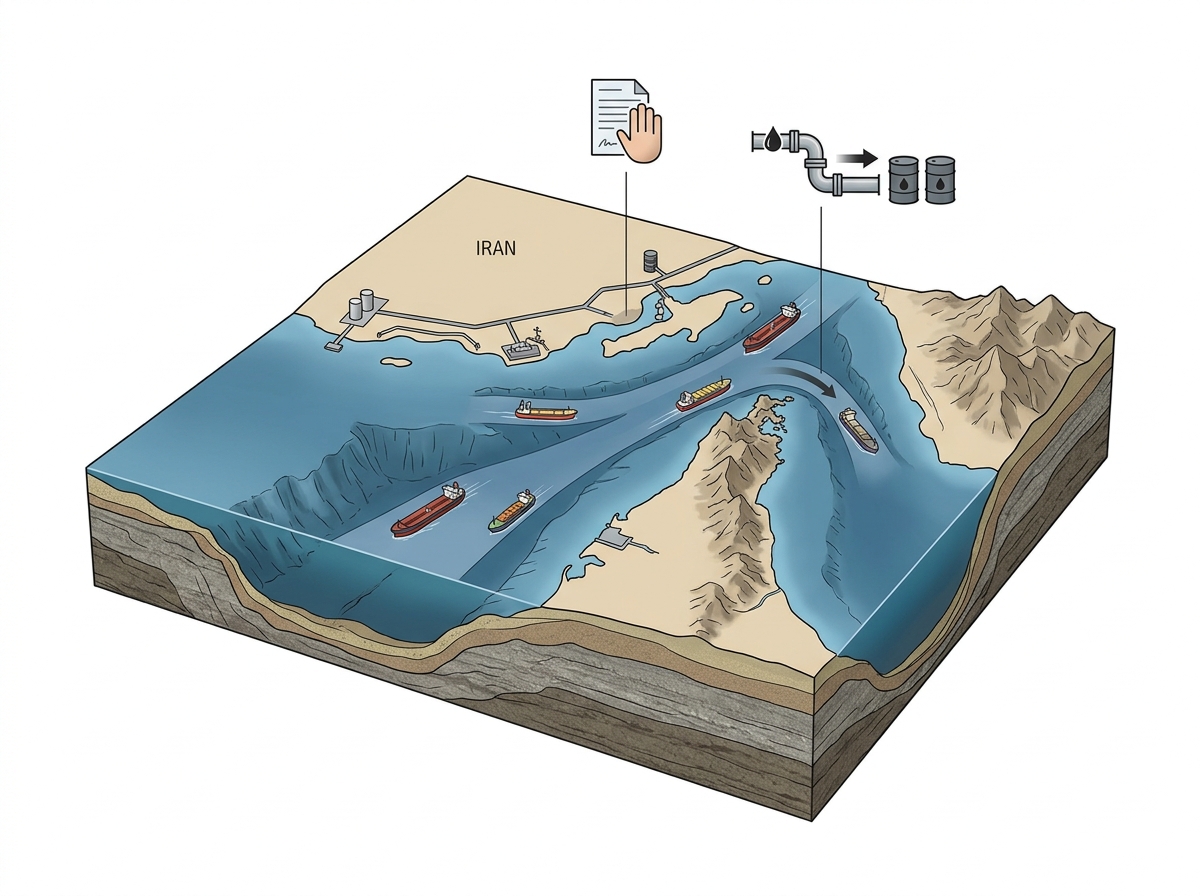
- The Strait of Hormuz, located between Oman and Iran, is a narrow waterway connecting the Persian Gulf to the Gulf of Oman and the Arabian Sea. It is one of the world’s most strategically significant maritime chokepoints, through which a substantial volume of global oil and gas shipments transit annually.
- Historically, the strait has been a flashpoint in West Asian geopolitics, with incidents such as the 1980-1988 Tanker War during the Iran-Iraq War and the 2019 attacks on oil tankers in the region underscoring its vulnerability to conflict and disruption.
- The United States has maintained a naval presence in the Persian Gulf since the 1980s, including through operations such as Operation Earnest Will (1987-1988) and the establishment of the Fifth Fleet, headquartered in Bahrain. This presence is aimed at ensuring freedom of navigation and deterring threats to maritime security.
- Iran has, at various times, threatened to close the strait in response to sanctions, perceived threats, or as a bargaining chip in negotiations, particularly concerning its nuclear programme and regional influence.
- The Joint Comprehensive Plan of Action (JCPOA), commonly known as the Iran Nuclear Deal, was signed in 2015 between Iran and the P5+1 (China, France, Germany, Russia, the United Kingdom, and the United States) to limit Iran’s nuclear activities in exchange for sanctions relief. The U.S. withdrew from the JCPOA in 2018, reimposing sanctions and escalating tensions.
- The International Atomic Energy Agency (IAEA) plays a key role in monitoring Iran’s compliance with nuclear safeguards under the Non-Proliferation Treaty (NPT), though its inspections have been a subject of contention between Iran and Western powers.
What is the Strait of Hormuz?
- The Strait of Hormuz is a narrow, strategically vital maritime passage, approximately 39 km wide at its narrowest point, linking the Persian Gulf to the Gulf of Oman and the Arabian Sea. It is bordered by Iran to the north and the United Arab Emirates and Oman to the south.
- The strait is a critical chokepoint for global energy security, as it facilitates the transit of roughly 20-30% of the world’s seaborne oil and a significant portion of liquefied natural gas (LNG). Disruptions in the strait can have cascading effects on global oil prices and energy markets.
- Under the United Nations Convention on the Law of the Sea (UNCLOS), 1982, coastal states have sovereign rights over their territorial seas (up to 12 nautical miles from the baseline) and exclusive economic zones (up to 200 nautical miles). The strait is classified as a ‘transit passage’ under UNCLOS, meaning vessels of all states enjoy the right of unimpeded transit through international straits used for international navigation.
- The strait’s strategic importance is amplified by the concentration of oil-producing nations in the Persian Gulf, including Saudi Arabia, Iran, Iraq, the UAE, Kuwait, and Qatar. Any disruption to shipping through the strait can trigger supply shocks and price volatility in global energy markets.
- Maritime security in the strait is maintained through a combination of naval patrols, international agreements, and regional cooperation frameworks. The U.S. Fifth Fleet, based in Bahrain, plays a central role in ensuring freedom of navigation and deterring threats such as piracy, smuggling, and military provocations.
- The strait is also a focal point for geopolitical tensions, including disputes over maritime boundaries, nuclear proliferation concerns, and the role of non-state actors in regional conflicts. These dynamics often intersect with broader issues of international law, sanctions, and diplomatic negotiations.
- Historical incidents, such as the 1980-1988 Tanker War and the 2019 attacks on oil tankers in the Gulf of Oman, demonstrate the strait’s vulnerability to conflict and the potential for escalation into broader regional crises.
- For India, the strait is of paramount importance due to its reliance on oil imports from West Asia. Approximately 60% of India’s oil imports transit through the Strait of Hormuz, making energy security and maritime stability in the region a critical national interest.
Key Features
| Feature | Significance |
|---|---|
| Strait of Hormuz | A critical chokepoint for global oil transit, linking the Persian Gulf to the Gulf of Oman, with approximately 20-30% of the world’s seaborne oil passing through it daily. |
| Iran’s Proposal | A conditional offer to reopen the Strait of Hormuz, contingent on the lifting of US naval blockades, waiver of sanctions on Iranian oil sales, and a regional ceasefire including Lebanon. |
| US Rejection | The refusal by the US to accept Iran’s proposal, citing concerns over regional security, compliance with international sanctions, and the absence of verifiable guarantees. |
| Naval Blockade | A maritime enforcement measure restricting the movement of vessels to and from Iranian ports, often justified under international law as a response to perceived threats or violations. |
| Regional Ceasefire | A proposed cessation of hostilities involving multiple state and non-state actors in the Middle East, aimed at stabilising the Strait of Hormuz and broader regional security. |
Why it Matters
Global Energy Security
- The Strait of Hormuz is integral to the uninterrupted flow of crude oil and liquefied natural gas (LNG) to global markets, particularly to Asia, Europe, and the United States.
- Any disruption in the Strait could trigger supply chain disruptions, price volatility, and economic instability across energy-dependent economies.
- The US rejection of Iran’s proposal underscores the geopolitical risks to energy security, with potential implications for India’s energy imports from the Middle East.
International Law and Maritime Governance
- The Strait of Hormuz falls under the regime of transit passage under the United Nations Convention on the Law of the Sea (UNCLOS), which guarantees freedom of navigation for all vessels.
- The US naval blockade, if imposed, must comply with international law, including the principles of proportionality, necessity, and non-discrimination.
- Iran’s proposal invokes the concept of ‘reciprocity’ in maritime governance, where concessions are tied to mutual de-escalation and adherence to international norms.
Regional Geopolitical Dynamics
- The Strait of Hormuz is a focal point for proxy conflicts and power rivalries in the Middle East, involving Iran, the US, Gulf Cooperation Council (GCC) states, and non-state actors.
- The proposal and its rejection highlight the fragility of regional security architectures, particularly in the context of the Joint Comprehensive Plan of Action (JCPOA) and its collapse.
- A ceasefire involving Lebanon suggests the interconnectedness of conflicts in the region, where non-state actors (e.g., Hezbollah) play a pivotal role in shaping maritime security.
Economic and Diplomatic Implications for India
- India, as a major importer of crude oil from the Middle East, is directly affected by disruptions in the Strait of Hormuz, which could impact energy prices and inflation.
- The rejection of Iran’s proposal may constrain India’s diplomatic leverage in balancing its relations with the US and Iran, particularly in the context of the Chabahar Port project.
- India’s adherence to international sanctions on Iran (e.g., US sanctions post-JCPOA withdrawal) complicates its energy diplomacy and strategic autonomy in the region.
Challenges
1. Maritime Security and Freedom of Navigation
- The imposition of naval blockades or restrictions on the Strait of Hormuz risks violating the principle of freedom of navigation under UNCLOS, potentially escalating tensions.
- Non-state actors operating in the region (e.g., armed groups in Yemen or Iraq) could exploit maritime vulnerabilities, leading to piracy or attacks on commercial vessels.
- The lack of a multilateral framework for maritime security in the Persian Gulf exacerbates the challenge, as unilateral actions by states (e.g., US, Iran) dominate the discourse.
UPSC Link: GS-II: International Relations – Maritime Security
2. Sanctions Compliance and Energy Diplomacy
- India’s compliance with US sanctions on Iranian oil (e.g., CAATSA) creates a dilemma between strategic autonomy and economic interests, particularly for energy-dependent economies.
- The waiver of sanctions on Iranian oil sales, as proposed by Iran, would require a delicate balancing act by the US and its allies to avoid undermining the global sanctions regime.
- The absence of a clear sanctions waiver mechanism for third countries (e.g., India) complicates energy diplomacy and could lead to supply chain disruptions.
UPSC Link: GS-II: International Relations – Sanctions and Energy Security
3. Regional Ceasefire and Conflict De-escalation
- A proposed ceasefire involving Lebanon (e.g., Hezbollah) introduces complexities due to the involvement of non-state actors, whose compliance with state-level agreements is often uncertain.
- The lack of a binding enforcement mechanism for ceasefires in the region (e.g., UNSC resolutions) undermines their credibility and longevity.
- The interconnectedness of conflicts (e.g., Syria, Yemen, Iraq) means that a ceasefire in one area may not address underlying grievances, leading to relapse into hostilities.
UPSC Link: GS-II: International Relations – Conflict Resolution
4.
- The US-Iran standoff reflects broader geopolitical rivalries in the Middle East, where alliances (e.g., US-GCC, Iran-Russia, Iran-China) shape maritime security dynamics.
- The absence of a unified stance among Gulf states (e.g., Saudi Arabia, UAE) on Iran’s proposal complicates regional security frameworks and could lead to divergent policies.
- The involvement of external powers (e.g., China, Russia) in the region further complicates the power balance, as their strategic interests may not align with those of the US or Iran.
UPSC Link: GS-II: International Relations – Geopolitics of the Middle East
Challenges — UPSC Perspective
| Issue | Concern |
|---|---|
| Naval Blockades | Potential violation of UNCLOS principles, escalation of tensions, and disruption of global oil supply chains. |
| Sanctions Regime | Risk of undermining international sanctions, complicating energy diplomacy, and creating economic instability for third countries. |
| Ceasefire Proposals | Lack of enforceability, involvement of non-state actors, and interconnectedness of regional conflicts. |
| Maritime Security | Vulnerability to piracy, attacks on commercial vessels, and absence of a multilateral security framework. |
| Geopolitical Rivalries | Divergent interests among Gulf states, involvement of external powers, and lack of unified regional security architecture. |
Way Forward
- Facilitate multilateral dialogue under the aegis of the United Nations to address maritime security concerns in the Strait of Hormuz, ensuring compliance with UNCLOS.
- Encourage the establishment of a regional maritime security framework, involving Gulf Cooperation Council (GCC) states, Iran, and external powers like the US and China.
- Promote confidence-building measures (CBMs) between the US and Iran, such as joint naval exercises or maritime surveillance cooperation, to reduce the risk of miscalculation.
- Strengthen India’s energy diplomacy by diversifying import sources and negotiating long-term supply agreements with alternative suppliers (e.g., Russia, Central Asia).
- Advocate for a clear sanctions waiver mechanism for third countries (e.g., India) to mitigate the impact of US sanctions on Iranian oil imports.
- Support initiatives for conflict de-escalation in Lebanon and other regional hotspots, with a focus on involving non-state actors in peace processes.
- Enhance India’s maritime domain awareness (MDA) capabilities to monitor and respond to threats in the Indian Ocean and the Strait of Hormuz.
- Encourage academic and policy research on the geopolitical implications of the Strait of Hormuz for India’s energy security and strategic autonomy.
UPSC Value Addition
Keywords for Mains Answer-Writing
Strait of Hormuz · maritime security · geopolitical tensions · international straits · freedom of navigation · UN Convention on the Law of the Sea (UNCLOS) · Iran-US relations · maritime blockade · sanctions regime · regional stability · geostrategic chokepoints · maritime governance · diplomatic negotiations · international law · energy security
Concept Flow
Geopolitical tensions in the Middle East → Disruption of maritime trade routes in the Strait of Hormuz → Iran proposes conditional reopening of the Strait → US rejects proposal citing security concerns → Risk of naval blockade and sanctions escalation → Potential global oil supply disruptions → Impact on energy-importing economies like India → Call for multilateral dialogue and regional maritime security frameworks.
Prelims Practice Questions
Q1. Consider the following statements regarding the Strait of Hormuz:
1. It is a narrow waterway connecting the Persian Gulf with the Gulf of Oman.
2. The strait is a critical chokepoint for global oil shipments.
3. Under the UN Convention on the Law of the Sea (UNCLOS), all vessels have the right of innocent passage through straits used for international navigation.
4. Iran has historically claimed sovereignty over the entire Strait of Hormuz.
How many of the above statements are correct?
- Only one
- Only two
- Only three
- All
Answer: Only three — Statements 1 and 2 are correct. The Strait of Hormuz connects the Persian Gulf to the Gulf of Oman and is a critical chokepoint for oil shipments. Statement 3 is correct as UNCLOS guarantees the right of innocent passage through international straits. Statement 4 is incorrect as Iran has not claimed sovereignty over the entire strait but has asserted control over its territorial waters and airspace.
Q2. Assertion (A): The United States has imposed a naval blockade on Iranian ports as part of its sanctions regime.
Reason (R): The blockade is intended to prevent Iran from exporting oil and to curtail its nuclear programme.
Options:
A. Both A and R are true, and R is the correct explanation of A.
B. Both A and R are true, but R is NOT the correct explanation of A.
C. A is true, but R is false.
D. A is false, but R is true.
Answer: ? — Both the assertion and reason are true. The US has imposed a naval blockade on Iranian ports as part of its sanctions regime to restrict Iran’s oil exports and nuclear activities. However, the blockade is not solely explained by the nuclear programme but is part of a broader sanctions strategy.
Q3. Match the following international straits with their respective countries or regions:
Column I (Strait) | Column II (Country/Region)
——————|————————
A. Strait of Hormuz | 1. Indonesia
B. Strait of Malacca | 2. Iran
C. Bab-el-Mandeb | 3. Yemen and Djibouti
D. Dover Strait | 4. United Kingdom
Options:
A. A-2, B-1, C-3, D-4
B. A-1, B-2, C-3, D-4
C. A-2, B-1, C-4, D-3
D. A-3, B-2, C-1, D-4
Answer: ? — The correct matches are: A (Strait of Hormuz) with 2 (Iran), B (Strait of Malacca) with 1 (Indonesia), C (Bab-el-Mandeb) with 3 (Yemen and Djibouti), and D (Dover Strait) with 4 (United Kingdom).
Mains Practice Question
✍ The Strait of Hormuz, a critical chokepoint for global energy security, has become a flashpoint in geopolitical tensions. Critically examine the legal and geostrategic dimensions of the proposal to reopen the Strait of Hormuz, including the implications for freedom of navigation and international law. (15 Marks)
Approach: MODEL-ANSWER SKELETON:
1. **Geostrategic Significance**: Define the Strait of Hormuz (connects Persian Gulf to Gulf of Oman) and its role as a global oil transit chokepoint (e.g., ~20% of global oil supply passes through it). Highlight its status as a ‘strategic chokepoint’ under geopolitical literature.
2. **Legal Framework**:
– **UNCLOS Provisions**: Cite Articles 37-44 (regime of transit passage) and Article 19 (definition of ‘innocent passage’). Emphasise that straits used for international navigation are subject to transit passage, which cannot be suspended.
– **Sovereignty Claims**: Discuss Iran’s assertion of control over its territorial waters (12 nautical miles under UNCLOS) and airspace, and the legal ambiguity regarding the strait’s status as an ‘international strait’.
3. **Proposal Analysis**:
– **Iran’s Proposal**: Outline Iran’s conditions (lifting naval blockade, waiving sanctions, ceasefire including Lebanon) and their implications for sovereignty and sanctions regimes.
– **US Rejection**: Explain the US position in terms of enforcement of sanctions (e.g., secondary sanctions) and the principle of freedom of navigation.
4. **Balance of Interests**:
– **Energy Security**: Link the strait’s closure to global oil price volatility and supply chain disruptions.
– **Regional Stability**: Discuss the risk of escalation (e.g., 2019 attacks on tankers) and the role of multilateral institutions (e.g., International Maritime Organization) in conflict resolution.
5. **Conclusion**: Weigh the primacy of UNCLOS in guaranteeing transit passage against the geopolitical realities of sanctions and regional rivalries. Argue for diplomatic solutions that reconcile sovereignty claims with international law.
Source: orissapost.com
Generated by AanyaAi for educational purpose.
Related guides on our sites
- Current affairs for upsc 2026
- How to prepare for GS paper 1 for UPSC CSE mains exam
- Best UPSC coaching for IFOS exam
- Best geography optional coaching

- Trump Rejects Iran’s Strait of Hormuz Reopening Proposal: UPSC Geography Insights - September 26, 2026
- सीएमआरएल-एक्सालोजिक घोटाले: ईडी ने राज्य पुलिस से एफआईआर दर्ज करने की मांग की - September 26, 2026
- ED Directs Kerala Police to Register FIR in CMRL-Exalogic Payoff Case - September 26, 2026

No Comments