


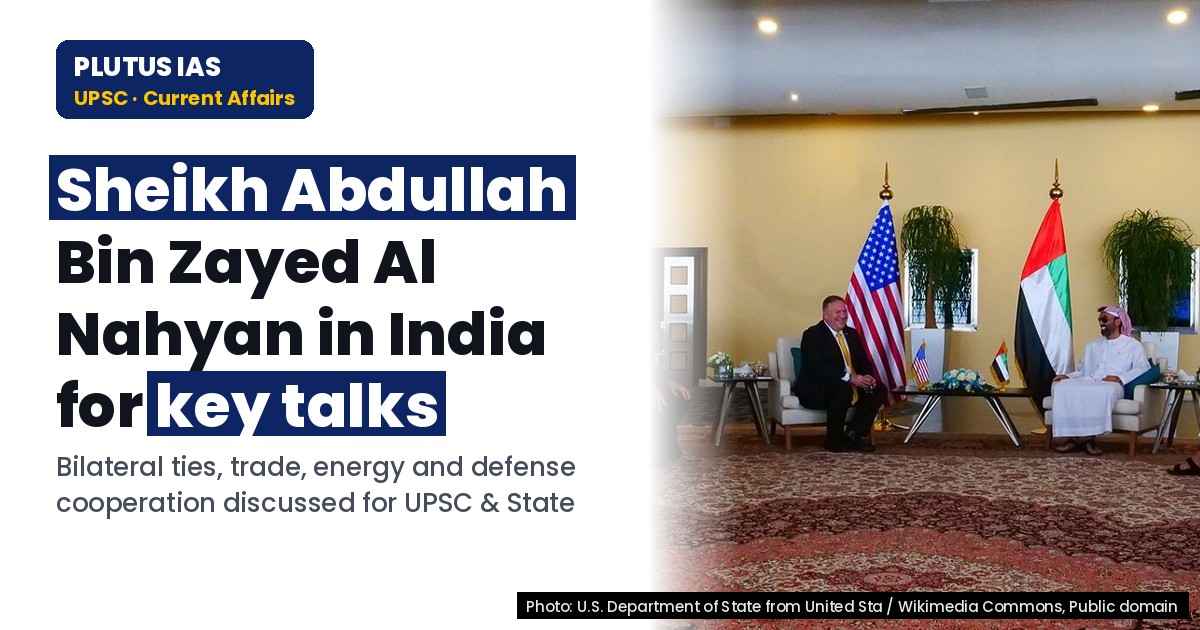
20 Oct UAE FM’s India Visit: Key Outcomes for UPSC & State PCS
✎ The India-UAE Comprehensive Economic Partnership Agreement (CEPA) of 2022 has catalysed bilateral trade, with the UAE emerging as India’s third-largest trading partner and a critical source of energy imports.
Subject Relevance — Where This Topic Fits
- GS Paper II — International Relations — India’s bilateral relations with West Asian countries | GS Paper II — International Relations — India’s neighbourhood policy and strategic partnerships
- Prelims: Comprehensive Economic Partnership Agreement (CEPA), Gulf Cooperation Council (GCC), Chabahar Port, West Asia Quad (I2U2), India-Middle East-Europe Economic Corridor (IMEC)
- Essay: The evolving geopolitical landscape of West Asia and its implications for India, Economic diplomacy as a tool for India’s global engagement
Quick Revision: The India-UAE Comprehensive Economic Partnership Agreement (CEPA) of 2022 has catalysed bilateral trade, with the UAE emerging as India’s third-largest trading partner and a critical source of energy imports.
Why is this in the news?
The visit of the Deputy Prime Minister and Foreign Minister of the United Arab Emirates (UAE), Sheikh Abdullah Bin Zayed Al Nahyan, to India has assumed significance against the backdrop of evolving strategic and economic engagements between the two nations. This high-level interaction underscores the deepening bilateral ties, particularly in the domains of trade, energy security, and regional stability, while also reflecting broader geopolitical shifts in West Asia.
Background
- The UAE is a key partner in India’s West Asia policy, with historical ties rooted in trade, energy, and diaspora linkages.
- The Comprehensive Economic Partnership Agreement (CEPA) between India and the UAE, signed in 2022, has significantly enhanced bilateral trade, which surpassed USD 85 billion in 2022-23.
- The UAE is India’s third-largest trading partner and the second-largest export destination, with energy imports (crude oil and LNG) forming a critical component of bilateral trade.
- India’s engagement with the UAE aligns with its broader strategy of diversifying partnerships in the Gulf region to reduce dependence on traditional partners.
- The visit occurs amid global geopolitical realignments, including the Abraham Accords and the evolving role of the GCC in regional security architectures.
- The I2U2 grouping (India, Israel, UAE, USA) and the proposed India-Middle East-Europe Economic Corridor (IMEC) highlight the strategic convergence between India and the UAE.
What is the Strategic Framework of India-UAE Relations?
- The India-UAE relationship is anchored in the **Comprehensive Strategic Partnership Agreement (CSPA)**, signed in 2017, which elevates bilateral ties beyond trade to include defence, energy, space, and technology cooperation.
- Energy security remains a cornerstone, with the UAE being a major supplier of crude oil and liquefied natural gas (LNG) to India, ensuring energy diversification.
- The **CEPA** (2022) has eliminated tariffs on over 80% of goods, boosting trade in sectors such as gems and jewellery, pharmaceuticals, and engineering goods.
- Defence cooperation includes joint military exercises, defence procurement, and technology transfers, with the UAE being a key partner in India’s maritime security initiatives in the Indian Ocean.
- The **India-UAE Food Security Corridor** aims to address food security challenges by leveraging the UAE’s strategic location and India’s agricultural surplus.
- Cultural and people-to-people ties are strengthened through the large Indian diaspora in the UAE, which contributes significantly to the host country’s economy.
- The **Chabahar Port** project, though primarily an India-Iran collaboration, has implications for regional connectivity and trade routes involving the UAE.
- The **I2U2 grouping** and **IMEC** initiative reflect a shared vision for economic integration, digital infrastructure, and sustainable development in the region.
Key Features
| Feature | Significance |
|---|---|
| Bilateral delegation-level visit | Reinforces diplomatic engagement between India and the UAE at the highest level, signalling strategic priority. |
| Focus on Comprehensive Economic Partnership Agreement (CEPA) | CEPA aims to deepen trade and investment ties, particularly in energy, infrastructure, and technology sectors. |
| Discussions on energy security | UAE is a key supplier of crude oil and LNG to India; dialogues may address supply chain resilience and price stability. |
| Cooperation in food security | Potential agreements on agricultural trade, supply chain diversification, and technology transfer in agri-processing. |
| Defence and maritime security dialogue | Bilateral exercises and maritime domain awareness initiatives to counter non-traditional threats in the Indian Ocean Region. |
Why it Matters
Economic Significance
- The UAE is India’s third-largest trading partner, with bilateral trade exceeding USD 85 billion in 2023-24, primarily driven by energy imports.
- CEPA implementation (effective May 2022) has reduced tariffs on over 90% of traded goods, boosting Indian exports such as pharmaceuticals, textiles, and engineering goods.
- Investment flows: UAE’s sovereign wealth funds (e.g., Mubadala, ADIA) have committed over USD 75 billion in Indian sectors like renewables, logistics, and fintech.
- Diversification of trade basket: Focus on non-oil sectors such as gems and jewellery, chemicals, and IT services to reduce dependency on energy imports.
Strategic and Geopolitical Significance
- India-UAE ties are anchored in the India-Middle East-Europe Economic Corridor (IMEC) initiative, aimed at enhancing trade connectivity via rail and shipping routes.
- Shared interests in countering terrorism, extremism, and maritime piracy, particularly in the Gulf of Aden and Arabian Sea.
- UAE’s role as a mediator in regional conflicts (e.g., Afghanistan, Yemen) aligns with India’s preference for diplomatic solutions over military intervention.
- Energy security: UAE’s Adnoc and India’s Indian Oil Corporation have signed long-term supply agreements, ensuring stable crude oil and LNG deliveries.
Institutional and Diplomatic Significance
- High-level visits, such as this, are critical for maintaining momentum in bilateral mechanisms like the Joint Commission Meeting (JCM) and the High-Level Joint Task Force (HLJTF).
- Strengthening of consular and community welfare mechanisms for the Indian diaspora in the UAE, which numbers over 3.5 million.
- Collaboration in multilateral forums (e.g., UN, IORA, G20) to address global challenges such as climate change, food security, and digital governance.
Cultural and Soft Power Significance
- Promotion of people-to-people ties through initiatives like the India-UAE Cultural Exchange Programme and the establishment of Indian cultural centres in the UAE.
- Collaboration in education and skill development, including the recognition of academic qualifications and joint research programmes.
- Tourism and hospitality: UAE is a top destination for Indian travellers, with over 1.5 million Indian tourists annually, contributing to both economies.
Challenges
1. Trade Imbalance and Protectionist Pressures
- India’s trade deficit with the UAE (USD 21 billion in 2023-24) persists despite CEPA, driven by India’s heavy reliance on crude oil imports.
- UAE’s non-tariff barriers (e.g., technical regulations, sanitary and phytosanitary measures) on Indian agricultural and dairy products.
- Potential for protectionist measures in both countries if domestic industries feel threatened by increased competition.
UPSC Link: WTO Agreements; Balance of Payments
2. Energy Price Volatility and Supply Chain Risks
- Dependence on UAE for 6-8% of India’s crude oil imports exposes India to geopolitical risks and price fluctuations in global oil markets.
- Disruptions in the Strait of Hormuz or regional conflicts could impact LNG and crude oil shipments, affecting India’s energy security.
- Limited storage capacity for strategic petroleum reserves in India, increasing vulnerability to supply shocks.
UPSC Link: Energy Security; Strategic Petroleum Reserves
3. Regulatory and Compliance Divergences
- Differences in regulatory frameworks for financial services, data localisation, and digital payments between India and the UAE.
- Complexity in navigating customs procedures and trade documentation, particularly for small and medium enterprises (SMEs).
- Need for harmonised standards in sectors like food safety, pharmaceuticals, and environmental regulations.
UPSC Link: WTO TBT Agreement; GST Council
4. Maritime Security and Non-Traditional Threats
- Increasing piracy, smuggling, and human trafficking in the Indian Ocean Region (IOR) require coordinated naval patrols and intelligence-sharing.
- Cyber threats targeting critical infrastructure (e.g., ports, energy facilities) necessitating joint cybersecurity frameworks.
- Climate-induced challenges (e.g., rising sea levels, extreme weather) impacting coastal infrastructure and maritime trade routes.
UPSC Link: IORA; UNCLOS
5. Diaspora Welfare and Consular Challenges
- Ensuring the rights and welfare of the Indian diaspora in the UAE, particularly in labour disputes, healthcare, and education.
- Streamlining consular services for visa renewals, repatriation, and legal assistance amid increasing migration flows.
- Addressing issues of overstaying, illegal employment, and human trafficking networks targeting Indian workers.
UPSC Link: Emigration Act, 1983; PIO Card Scheme
Challenges — UPSC Perspective
| Issue | Concern |
|---|---|
| Trade deficit | Persistent imbalance due to energy imports, despite CEPA reducing tariffs on non-oil goods. |
| Regulatory divergence | Differences in standards and compliance requirements hinder seamless trade in goods and services. |
| Energy supply risks | Geopolitical tensions or disruptions in shipping lanes could impact crude oil and LNG imports. |
| Maritime security | Piracy, smuggling, and cyber threats in the IOR require coordinated responses. |
| Diaspora welfare | Labour disputes, healthcare access, and legal protections for Indian workers in the UAE. |
| Climate change impacts | Rising sea levels and extreme weather events threaten coastal infrastructure and trade routes. |
Way Forward
- Accelerate the implementation of CEPA’s remaining tariff reductions and non-tariff barrier eliminations to diversify trade beyond energy.
- Expand strategic petroleum reserves and diversify energy suppliers to mitigate risks from supply chain disruptions.
- Strengthen maritime security cooperation through joint naval exercises, intelligence-sharing, and capacity-building in the IOR.
- Harmonise regulatory frameworks for digital payments, data localisation, and financial services to facilitate cross-border transactions.
- Enhance consular and welfare mechanisms for the Indian diaspora, including streamlined visa processes and legal support.
- Promote joint research and development in renewable energy, agri-technology, and climate-resilient infrastructure.
- Leverage the IMEC initiative to improve trade connectivity and reduce logistics costs between India, the UAE, and Europe.
- Establish a bilateral dispute resolution mechanism for trade and investment conflicts to ensure timely redressal.
UPSC Value Addition
Keywords for Mains Answer-Writing
India-UAE strategic partnership · Comprehensive Economic Partnership Agreement (CEPA) · Gulf Cooperation Council (GCC) · West Asia foreign policy · Chabahar Port · Indian Ocean Region (IOR) security · non-oil trade · bilateral investment · energy security · maritime cooperation · defence logistics · cultural diplomacy · Indian diaspora in Gulf · regional geopolitics · soft power · economic corridors
Constitutional & Policy Linkages
- [‘Article 253: Foreign Policy Coordination’, ‘Empowers Parliament to legislate on matters of international concern.’]
- [‘Article 298: Trade and Commerce with Foreign States’, ‘Permits the Union to enter into agreements for economic cooperation.’]
Concept Flow
High-level diplomatic engagement → Bilateral trade and investment agreements (e.g., CEPA) → Enhanced economic cooperation → Diversification of trade basket beyond energy → Strengthened energy security → Reduced trade deficit and sustainable growth. → Diplomatic visit → Joint Commission Meeting (JCM) → Discussions on maritime security → Signing of defence cooperation agreements → Joint naval exercises → Enhanced regional stability. → Energy import dependence → Geopolitical risks in supply chains → Diversification of suppliers → Expansion of strategic petroleum reserves → Increased energy security. → Trade imbalances → Non-tariff barriers → Regulatory harmonisation talks → Mutual recognition of standards → Reduced compliance costs for businesses. → Indian diaspora in UAE → Consular support mechanisms → Labour welfare policies → Streamlined migration processes → Enhanced people-to-people ties. → Climate change impacts → Joint climate adaptation programmes → Technology transfer in renewable energy → Sustainable infrastructure development → Long-term economic resilience.
Prelims Practice Questions
Q1. Consider the following statements regarding the India-UAE Comprehensive Economic Partnership Agreement (CEPA):
1. The CEPA was signed in February 2022 and came into force in May 2022.
2. The agreement aims to eliminate tariffs on 90% of tariff lines between India and the UAE.
3. The CEPA includes provisions for trade in services, digital trade, and government procurement.
4. The agreement mandates the establishment of a joint committee to oversee its implementation.
How many of the above statements are correct?
- Only one
- Only two
- Only three
- All
Answer: All — Statements 1, 3, and 4 are correct. Statement 2 is incorrect as the CEPA aims to eliminate tariffs on 97% of tariff lines, not 90%.
Q2. Assertion (A): The India-UAE strategic partnership is primarily driven by energy security considerations.
Reason (R): The UAE is one of the top suppliers of crude oil to India, and the partnership includes long-term supply agreements and investment in India’s energy sector.
Options:
A. Both A and R are true, and R is the correct explanation of A.
B. Both A and R are true, but R is not the correct explanation of A.
C. A is true, but R is false.
D. A is false, but R is true.
Answer: ? — Both the assertion and reason are true, and the reason correctly explains the assertion. Energy security is a key pillar of the India-UAE partnership.
Q3. Match the following initiatives with their respective objectives in the context of India-UAE relations:
Column I (Initiative) | Column II (Objective)
——————————————|——————————————
A. India-Middle East-Europe Economic Corridor (IMEC) | 1. Enhance maritime security cooperation
B. Chabahar Port Development | 2. Promote trade and connectivity via rail, road, and sea routes
C. India-UAE CEPA | 3. Facilitate trade and investment by reducing tariffs
D. India-UAE Defence Logistics Agreement | 4. Strengthen defence logistics and interoperability
Options:
A. A-2, B-1, C-3, D-4
B. A-1, B-2, C-3, D-4
C. A-3, B-4, C-2, D-1
D. A-4, B-3, C-1, D-2
Answer: ? — Correct match: A-2 (IMEC promotes trade and connectivity), B-1 (Chabahar Port enhances maritime security), C-3 (CEPA reduces tariffs), D-4 (Defence Logistics Agreement strengthens defence logistics).
Mains Practice Question
✍ The India-UAE strategic partnership has evolved into a comprehensive framework encompassing economic, energy, security, and cultural dimensions. Critically examine the pillars of this partnership and analyse how they contribute to India’s broader foreign policy objectives in West Asia. (15 Marks)
Approach: MODEL-ANSWER SKELETON:
1. **Economic Pillar**:
– Comprehensive Economic Partnership Agreement (CEPA): Tariff elimination (97% of lines), trade in services, digital trade, and government procurement.
– Non-oil trade: UAE is India’s third-largest trading partner; CEPA aims to boost trade to $100 billion by 2030.
– Investment: UAE’s sovereign wealth funds (e.g., ADIA, Mubadala) have invested in India’s infrastructure, energy, and startups.
2. **Energy Security**:
– UAE is a key supplier of crude oil (4th largest source for India) and LNG.
– Long-term supply agreements (e.g., ADNOC’s 60-year LNG deal with India).
– Joint ventures in oil refining and petrochemicals (e.g., HPCL-Mittal Energy Ltd).
3. **Security and Maritime Cooperation**:
– Defence Logistics Agreement: Enables reciprocal access to military facilities for logistics support.
– Maritime security: Collaboration in counter-piracy, anti-terrorism, and HADR (Humanitarian Assistance and Disaster Relief) operations.
– Indian Ocean Region (IOR) stability: UAE’s role in IOR security frameworks.
4. **Connectivity and Infrastructure**:
– India-Middle East-Europe Economic Corridor (IMEC): A multi-modal trade route linking India to Europe via the UAE, Saudi Arabia, Jordan, and Israel.
– Chabahar Port: India’s investment in Iran’s Chabahar Port to bypass Pakistan and access Afghanistan and Central Asia.
5. **Cultural and Soft Power Diplomacy**:
– Indian diaspora in the UAE: Over 3.5 million Indian expatriates contribute to remittances and cultural ties.
– People-to-people exchanges: Yoga, Ayurveda, and educational collaborations (e.g., IIT Delhi’s campus in Abu Dhabi).
6. **Broader Foreign Policy Objectives in West Asia**:
– Diversification of partnerships: Reducing dependence on traditional partners like the US and EU.
– Balancing relations with Gulf states: UAE is a key partner in India’s ‘Look West’ policy.
– Countering China’s influence: Strategic partnerships with Gulf states as part of India’s Indo-Pacific strategy.
7. **Challenges and Criticisms**:
– Geopolitical complexities: Balancing relations with Iran, Saudi Arabia, and UAE.
– Implementation gaps: Slow progress in some infrastructure projects (e.g., IMEC).
– Domestic constraints: Regulatory hurdles in India for foreign investments.
8. **Conclusion**:
– The India-UAE partnership is a model of multi-dimensional diplomacy, aligning economic interests with strategic security and cultural ties.
– It strengthens India’s position in West Asia while contributing to its broader foreign policy goals.
Source: Ministry of External Affairs
Generated by AanyaAi for educational purpose.
Related guides on our sites
- Current affairs for upsc 2026
- Best PSIR optional coaching for upsc
- Best PSIR optional teacher for upsc
- Best teacher of PSIR optional for upsc

- National Unity Day 2026: Key Preparations & Significance for UPSC - October 21, 2026
- 14वां इंडिया केम 2026: मुंबई में वैश्विक रसायन उद्योग का महाकुंभ - October 21, 2026
- डीआरआई ने गुजरात में 19 करोड़ रुपये सोने की तस्करी गिरोह का भंडाफोड़ किया - October 21, 2026

No Comments