


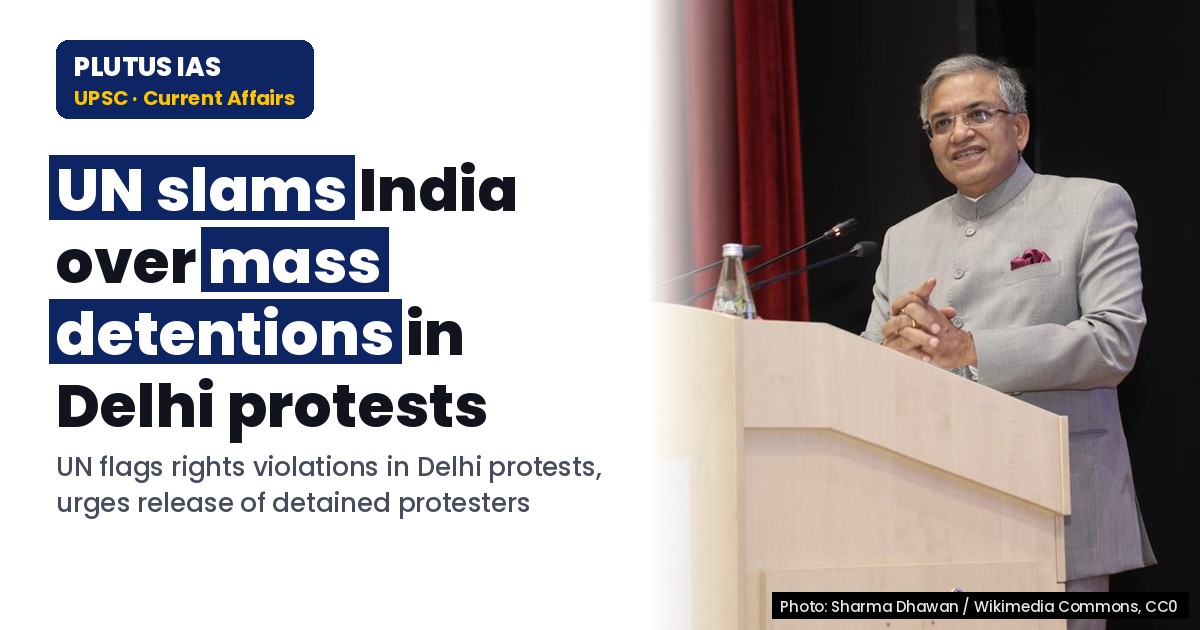
10 Oct UN Slams India Over Mass Detentions in Delhi Protests
✎ The right to peaceful assembly under Article 19(1)(b) is subject to reasonable restrictions in the interest of public order, but mass detentions without individualised justification violate constitutional safeguards and India’s…
Subject Relevance — Where This Topic Fits
- GS Paper II — Polity and Governance: Fundamental Rights and DPSP (Articles 19(1)(a), 19(1)(b), 21, 22) | GS Paper II — International Relations: India’s Commitments under International Human Rights Law
- Prelims: Article 19(1)(a) — Right to Freedom of Speech and Expression, Article 19(1)(b) — Right to Assemble Peacefully and Without Arms, Article 22 — Protection against Arbitrary Arrest and Detention, Special Intensive Revision (SIR) of Electoral Rolls, Jantar Mantar as a notified protest site, UN Human Rights Council and its mechanisms, Proportionality and Necessity in Restrictions on Fundamental Rights
- Essay: The delicate balance between public order and fundamental freedoms: A case study of protest rights in India, Democratic governance and the role of international human rights standards in domestic legal frameworks
Quick Revision: The right to peaceful assembly under Article 19(1)(b) is subject to reasonable restrictions in the interest of public order, but mass detentions without individualised justification violate constitutional safeguards and India’s international human rights obligations.
Why is this in the news?
The United Nations human rights office has expressed concern over the mass detentions of protesters, civil society members, lawyers, and journalists during large-scale demonstrations in Delhi on 10 October 2026. The detentions occurred amid a protest organised by a youth-led movement demanding electoral reforms and the resignation of the Chief Election Commissioner, following allegations of irregularities in the electoral roll revision process. The incident raises critical questions about the adherence to constitutional safeguards for peaceful assembly, the legality of pre-emptive detentions, and India’s obligations under international human rights law.
Background
- The right to peaceful assembly is a fundamental right guaranteed under Article 19(1)(b) of the Constitution of India, subject to reasonable restrictions in the interest of public order.
- India is a signatory to the International Covenant on Civil and Political Rights (ICCPR), which protects the right to peaceful assembly and prohibits arbitrary detention under Articles 9 and 21.
- The Special Intensive Revision (SIR) of electoral rolls is a periodic exercise conducted by the Election Commission of India to remove names of deceased, duplicate, or ineligible voters, as mandated under the Representation of the People Act, 1951.
- The protest was organised by the Gen Z-led ‘Cockroach Janta Party’ (CJP).
- The Election Commission has denied allegations of political interference in the SIR process, asserting that the exercise is conducted in a transparent and non-partisan manner.
Legal and Institutional Framework Governing Peaceful Assembly and Detention in India
- **Constitutional Provisions**: Article 19(1)(b) guarantees the right to assemble peacefully and without arms, while Article 22 provides safeguards against arbitrary arrest and detention, including the right to be informed of grounds of arrest and the right to legal representation.
- **Statutory Framework**: The Code of Criminal Procedure, 1973 (CrPC) governs the process of arrest and detention, requiring that arrests be made in accordance with law and that detainees be produced before a magistrate within 24 hours (Section 57).
- **Judicial Precedents**: The Supreme Court, in *Himat Lal K. Shah v. Commissioner of Police, Ahmedabad* (1973), held that restrictions on the right to assemble must be reasonable and in the interest of public order, and that prior permission for assemblies cannot be arbitrarily denied.
- **International Obligations**: India is bound by the ICCPR, which requires that restrictions on peaceful assembly be necessary, proportionate, and non-discriminatory (Article 21). The UN Human Rights Committee has clarified that pre-emptive restrictions or mass detentions without individualised justification violate these obligations.
- **Election Commission’s Role**: The Election Commission of India, as a constitutional authority under Article 324, is responsible for the conduct of free and fair elections, including the preparation and revision of electoral rolls. Its decisions are subject to judicial review.
- **Police Powers and Restraint**: The Delhi Police, under the Delhi Police Act, 1978, and the Code of Criminal Procedure, has the authority to regulate assemblies and prevent breaches of public order. However, the use of detention must be proportionate and in accordance with the principle of least restrictive means.
- **Arbitrary Detention**: The Supreme Court, in *Nandini Sundar v. State of Chhattisgarh* (2011), has emphasised that detentions must be grounded in law and not used as a tool to suppress dissent or silence critics.
Key Features
| Feature | Significance |
|---|---|
| Mass detentions during protests | Raises questions about the balance between public order and the constitutional right to peaceful assembly under Article 19(1)(a). |
| Restrictions on assembly at Jantar Mantar | Highlights the procedural and administrative constraints on protest locations, governed by the Police Act, 1861, and local regulations. |
| UN Human Rights Office statement | Reinforces India’s obligations under international human rights law, including the International Covenant on Civil and Political Rights (ICCPR), ratified by India. |
| Special Intensive Revision (SIR) of electoral rolls | Examines the statutory framework for electoral roll revision under the Representation of the People Act, 1950, and its potential misuse. |
| Satirical protest movement (CJP) | Illustrates the role of social media in mobilising dissent and the legal recognition of non-registered protest groups under freedom of expression. |
Why it Matters
Constitutional and Legal
- The detentions and restrictions invoke Article 19(1)(a) (freedom of speech and expression) and Article 21 (right to liberty), testing the state’s duty to ensure proportionality in restrictions under Article 19(2).
- The incident underscores the need for clarity in the application of the ‘reasonable restrictions’ doctrine in protest management.
Democratic Governance
- The episode reflects on the state’s obligation to facilitate peaceful dissent while maintaining public order, a core tenet of democratic governance.
- The role of the Election Commission in electoral roll revision is scrutinised for its neutrality and transparency.
International Relations
- The UN’s intervention highlights India’s engagement with global human rights mechanisms, particularly the ICCPR and its reporting obligations.
- The incident may influence perceptions of India’s democratic credentials in international forums.
Institutional Integrity
- The Election Commission’s response to allegations of electoral roll manipulation tests its institutional credibility and public trust.
- The Delhi Police’s actions in restricting assembly points to the need for standardised protocols for protest management.
Challenges
1. Balancing Public Order and Fundamental Rights
- The state must justify restrictions on protests under Article 19(2) with evidence of imminent threat to public order.
- Overbroad restrictions risk undermining democratic dissent and eroding public confidence in institutions.
UPSC Link: GS II: Fundamental Rights
2. Electoral Roll Integrity and Transparency
- Allegations of arbitrary deletions from electoral rolls challenge the credibility of the electoral process.
- The Representation of the People Act, 1950, requires robust grievance redressal mechanisms to address such concerns.
UPSC Link: GS II: Electoral Reforms
3. Protest Management and Law Enforcement
- The use of mass detentions and preemptive arrests raises concerns about the proportionality of state response.
- Standard operating procedures (SOPs) for protest management must align with constitutional and international standards.
UPSC Link: GS III: Internal Security
4. Social Media and Mobilisation of Dissent
- The rise of satirical protest movements via social media challenges traditional frameworks of political participation.
- Legal recognition of such movements requires clarity on their status under electoral and protest laws.
UPSC Link: GS II: Social Media and Governance
5. Institutional Accountability and Public Trust
- The Election Commission and law enforcement agencies must demonstrate transparency to address allegations of bias.
- Public trust in institutions is contingent on their responsiveness to genuine grievances.
UPSC Link: GS IV: Ethics and Integrity
Challenges — UPSC Perspective
| Issue | Concern |
|---|---|
| Preemptive detentions | Risk of arbitrary deprivation of liberty without due process or evidence of unlawful intent. |
| Restrictions on protest locations | Potential misuse of administrative powers to suppress dissent under the guise of maintaining order. |
| Electoral roll deletions | Erosion of electoral integrity and public faith in the electoral process. |
| Satirical protest movements | Lack of legal clarity on the status and rights of non-registered protest groups. |
| UN intervention | Perception of external scrutiny undermining domestic sovereignty in governance matters. |
Way Forward
- Conduct an independent review of detentions during protests to ensure compliance with constitutional and international standards.
- Strengthen grievance redressal mechanisms under the Representation of the People Act, 1950, for electoral roll disputes.
- Develop standardised SOPs for protest management, incorporating principles of necessity and proportionality.
- Enhance transparency in the Special Intensive Revision (SIR) process to address allegations of political interference.
- Foster dialogue between civil society, law enforcement, and protest organisers to build mutual trust.
- Clarify the legal status and rights of satirical or non-registered protest movements under existing laws.
- Uphold the Election Commission’s autonomy and neutrality through institutional safeguards and public accountability.
UPSC Value Addition
Keywords for Mains Answer-Writing
Fundamental Rights under Articles 19 and 21 · Right to peaceful assembly · Right to protest · Procedural safeguards in detention · Judicial review of executive actions · Election Commission of India · Special Intensive Revision (SIR) of electoral rolls · UN Human Rights Council observations · Rule of law and democratic traditions · Proportionality and necessity in restrictions on protests · Arbitrary detention and habeas corpus · Constitutional remedies under Articles 32 and 226 · Civil society and democratic dissent · Freedom of expression and association · Governance and law enforcement accountability
Constitutional & Policy Linkages
- {‘Article 19(1)(a)’: ‘Freedom of speech and expression’}
- {‘Article 19(2)’: ‘Reasonable restrictions on fundamental rights’}
- {‘Article 21’: ‘Right to liberty and due process’}
- {‘Article 22’: ‘Protection against arbitrary arrest and detention’}
- {‘Article 324’: ‘Superintendence, direction, and control of elections by the Election Commission’}
Concept Flow
Social media-driven protest movement emerges → Authorities deny permission for assembly → Heavy security and roadblocks prevent participation → Mass detentions and preemptive arrests occur → UN human rights office raises concerns → Allegations of electoral roll manipulation surface → Institutional credibility of Election Commission is questioned → Broader debate on protest rights and electoral integrity ensues
Prelims Practice Questions
Q1. Consider the following statements regarding the right to peaceful assembly in India:
1. The right to peaceful assembly is guaranteed under Article 19(1)(b) of the Constitution.
2. Restrictions on such assemblies must satisfy the tests of reasonableness under Article 19(2).
3. The Supreme Court has held that prior permission is mandatory for all public assemblies.
4. The right to protest is an absolute right and cannot be restricted by the state.
How many of the above statements are correct?
- Only one
- Only two
- Only three
- All four
Answer: Only two — Statement 1 is correct as Article 19(1)(b) guarantees the right to assemble peaceably and without arms. Statement 2 is correct as restrictions must be reasonable and fall within the grounds specified in Article 19(2). Statement 3 is incorrect as the Supreme Court has held that prior permission is not mandatory for all assemblies; restrictions must be justified. Statement 4 is incorrect as the right to protest is not absolute and can be restricted under Article 19(2).
Q2. Assertion (A): The Election Commission of India (ECI) is a constitutional body that enjoys independence in the conduct of elections.
Reason (R): The ECI derives its powers and functions from Article 324 of the Constitution, which vests it with superintendence, direction, and control over elections.
Options:
A. Both A and R are true, and R is the correct explanation of A.
B. Both A and R are true, but R is not the correct explanation of A.
C. A is true, but R is false.
D. A is false, but R is true.
Answer: ? — Assertion (A) is true as the ECI is a constitutional body with independence in election conduct. Reason (R) is also true and correctly explains the constitutional basis of the ECI’s powers under Article 324.
Q3. Match the following provisions of the Indian Constitution with their respective articles:
Column I (Provision)
1. Right to freedom of speech and expression
2. Right to assemble peaceably and without arms
3. Right to form associations or unions
4. Right to move freely throughout the territory of India
Column II (Article Number)
A. Article 19(1)(a)
B. Article 19(1)(b)
C. Article 19(1)(c)
D. Article 19(1)(d)
Options:
1. 1-A, 2-B, 3-C, 4-D
2. 1-B, 2-A, 3-C, 4-D
3. 1-A, 2-B, 3-D, 4-C
4. 1-C, 2-A, 3-B, 4-D
Answer: ? — 1-A (Article 19(1)(a) guarantees freedom of speech and expression), 2-B (Article 19(1)(b) guarantees the right to assemble peaceably and without arms), 3-C (Article 19(1)(c) guarantees the right to form associations or unions), 4-D (Article 19(1)(d) guarantees the right to move freely throughout the territory of India).
Mains Practice Question
✍ Critically examine the constitutional and statutory framework governing the right to peaceful assembly and protest in India. How does this framework ensure a balance between the right to dissent and the maintenance of public order? Also, analyse the implications of arbitrary detentions during protests in the context of judicial review and democratic traditions. (15 Marks)
Approach: MODEL-ANSWER SKELETON:
1. **Constitutional Basis**:
– Article 19(1)(b) guarantees the right to assemble peaceably and without arms.
– Article 19(2) allows reasonable restrictions on this right in the interests of sovereignty, integrity, public order, morality, or decency.
– Article 21 (right to life and personal liberty) and Article 22 (protection against arbitrary arrest and detention) provide procedural safeguards.
2. **Statutory Framework**:
– The Code of Criminal Procedure (CrPC), 1973, and state-specific police regulations govern the conduct of assemblies.
– Section 144 of the CrPC empowers authorities to prohibit assemblies in specific areas to prevent disorder.
– The Police Act, 1861, and state police manuals outline the duties of law enforcement during protests.
3. **Judicial Precedents**:
– **Himat Lal K. Shah v. Commissioner of Police (1973)**: Held that prior permission for assemblies is not mandatory; restrictions must be reasonable.
– **Mazdoor Kisan Shakti Sangathan v. Union of India (2018)**: Emphasised the need for transparency and accountability in police actions during protests.
– **Ramlila Maidan Incident (2011)**: Highlighted the state’s duty to facilitate peaceful protests while ensuring public order.
4. **Balance Between Dissent and Public Order**:
– The **proportionality principle** (derived from German constitutional law and adopted by the Supreme Court) requires that restrictions on rights must be necessary, proportionate, and least intrusive.
– The **necessity test**: Restrictions must be justified by a compelling public interest.
– The **least restrictive means test**: Alternatives to restrictions (e.g., designated protest zones) must be explored before imposing bans.
5. **Arbitrary Detentions and Judicial Review**:
– **Article 32 and 226**: Provide remedies for arbitrary detentions via habeas corpus petitions and writs.
– **Judicial scrutiny**: Courts examine whether detentions are justified under law and whether procedural safeguards (e.g., recording reasons, informing detainees of grounds) are followed.
– **Consequences of arbitrary detentions**: Erosion of public trust in institutions, chilling effect on dissent, and potential violations of India’s international human rights obligations (e.g., ICCPR, to which India is a signatory).
6. **Democratic Traditions and UN Observations**:
– The UN Human Rights Council has repeatedly urged India to respect the right to peaceful assembly and ensure that restrictions meet strict tests of necessity and proportionality (as in the 2026 statement).
– Democratic traditions require that law enforcement exercise restraint and that detentions are not used as a tool to suppress dissent.
7. **Conclusion**:
– The framework is robust but requires consistent judicial oversight to prevent executive overreach.
– Arbitrary detentions undermine democratic governance and must be addressed through stricter adherence to constitutional and statutory safeguards.
**Key Takeaways for Answer**:
– Name the constitutional articles (19(1)(b), 19(2), 21, 22, 32, 226).
– Cite 2-3 landmark judgments (Himat Lal K. Shah, Mazdoor Kisan Shakti Sangathan, Ramlila Maidan).
– Reference the proportionality principle and necessity test.
– Link to UN observations and India’s international obligations.
– Discuss the consequences of arbitrary detentions on democratic traditions.
Source: orissapost.com
Generated by AanyaAi for educational purpose.
Related guides on our sites
- Best PSIR optional coaching in delhi
- Best PSIR optional coaching in delhi for UPSC
- Anthropology VS PSIR
- Best PSIR optional coaching online

- NAMASTE Scheme: Enhancing Sanitation Workers’ Livelihoods & Safety - November 14, 2026
- एमएसएमई का विशेष अभियान 6.0: स्वच्छता और लंबित मामलों का निपटारा - November 14, 2026
- Sea Vigil-26: Coastal Defence Drills Off Visakhapatnam - November 14, 2026

No Comments