


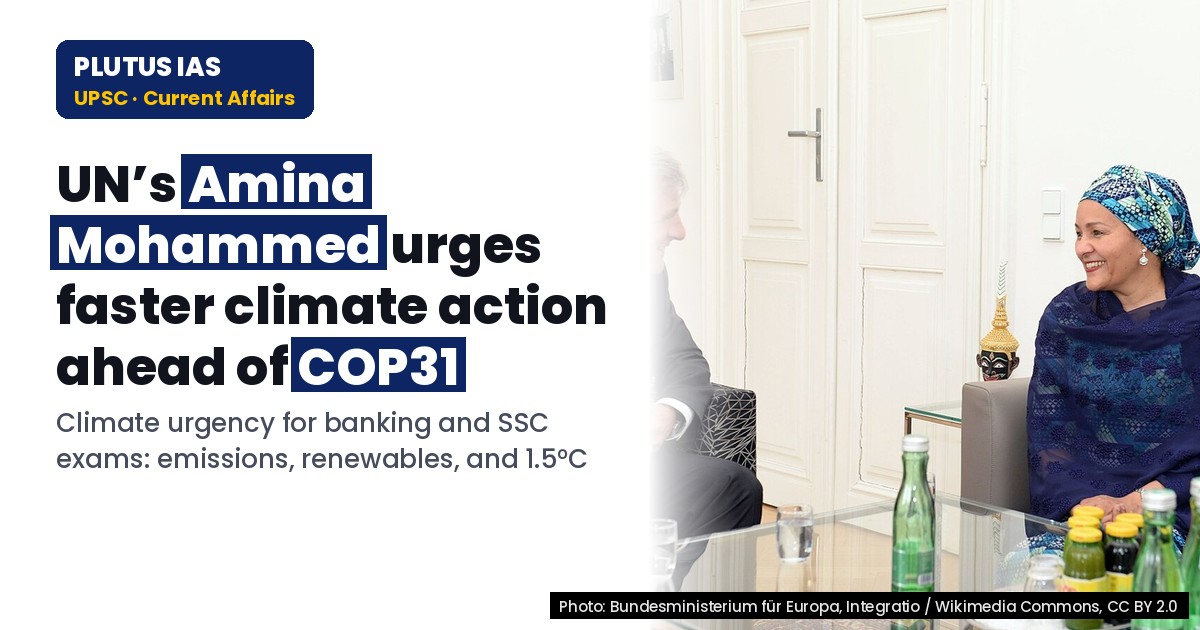
09 Oct UN urges accelerated climate action ahead of COP31 for 1.5°C target
✎ The 1.5°C target is a legally anchored climate goal under the Paris Agreement, whose achievement demands immediate emissions cuts, renewable energy transitions, resilient infrastructure, and accessible climate…
Subject Relevance — Where This Topic Fits
- GS Paper II — International Organisations and Summits | GS Paper III — Environment, Climate Change and Disaster Management
- Prelims: Paris Agreement 2015, COP31, UNFCCC, 1.5°C target, Climate Finance, El Niño, Energy Transition, Early Warning Systems, Marine Ecosystem Restoration
- Essay: Climate justice and equity: Bridging the divide between developed and developing nations, The paradox of growth and sustainability: Can economic progress coexist with environmental stewardship?
Quick Revision: The 1.5°C target is a legally anchored climate goal under the Paris Agreement, whose achievement demands immediate emissions cuts, renewable energy transitions, resilient infrastructure, and accessible climate finance—particularly for vulnerable nations facing existential threats from rising temperatures and sea levels.
Why is this in the news?
The United Nations has emphasised the urgency of limiting global warming to 1.5°C despite projected overshoot. This follows record-breaking climatic events, including unprecedented El Niño patterns and devastating floods, underscoring the existential threats faced by vulnerable nations such as Tuvalu and Fiji. The UN’s emphasis on equitable climate finance, renewable energy transitions, and resilient infrastructure aligns with India’s domestic and international climate commitments, making this a critical governance and policy discourse for UPSC aspirants.
Background
- The Paris Agreement (2015) established the global goal of limiting temperature rise to well below 2°C, with efforts to cap it at 1.5°C above pre-industrial levels, recognising the severe risks posed by exceeding this threshold.
- COP (Conference of the Parties) summits are annual gatherings under the United Nations Framework Convention on Climate Change (UNFCCC), where member states negotiate and review climate action plans, commitments, and financial mechanisms.
- The 2023 COP28 in Dubai marked a pivotal moment with the ‘Global Stocktake’ and commitments to transition away from fossil fuels, triple renewable energy capacity, and double energy efficiency by 2030.
- Pacific island nations, particularly Tuvalu and Fiji, are among the most vulnerable to climate change due to rising sea levels, intensifying cyclones, and coastal erosion, necessitating urgent adaptation and mitigation measures.
- The El Niño phenomenon, a periodic warming of the central and eastern tropical Pacific Ocean, disrupts global weather patterns, exacerbating droughts, floods, and heatwaves, thereby amplifying climate vulnerabilities.
What is the 1.5°C Target and Why Does It Matter?
- The 1.5°C target, enshrined in the Paris Agreement, represents the maximum permissible global temperature rise above pre-industrial levels to avert catastrophic climate impacts, including extreme weather events, ecosystem collapse, and socio-economic disruptions.
- Scientific assessments, including those by the Intergovernmental Panel on Climate Change (IPCC), indicate that exceeding 1.5°C could trigger irreversible tipping points, such as the collapse of ice sheets, loss of coral reefs, and heightened risks of food and water insecurity.
- Despite global commitments, current trajectories project a warming of approximately 2.5–2.9°C by 2100 under existing policies, necessitating immediate and scaled-up mitigation efforts to bridge the ’emissions gap’.
- The concept of ‘overshoot’ refers to a temporary exceedance of the 1.5°C threshold, followed by efforts to return temperatures to safer levels. The UN stresses that overshoot is not a justification for inaction but a rationale for accelerated decarbonisation.
- Achieving the 1.5°C target requires a triad of actions: rapid reduction of greenhouse gas emissions, large-scale deployment of renewable energy, and robust adaptation measures to protect vulnerable communities and ecosystems.
- The transition to renewable energy not only mitigates climate change but also enhances energy security by reducing dependence on volatile fossil fuel markets, particularly in energy-deficient regions.
- Adaptation strategies, such as early warning systems, resilient infrastructure, and ecosystem restoration, are critical to reducing the human and economic toll of climate-related disasters, especially in Small Island Developing States (SIDS).
- Equitable climate finance is indispensable for enabling developing nations to implement mitigation and adaptation measures, ensuring that the burden of climate action does not disproportionately fall on the most vulnerable.
Key Features
| Feature | Significance |
|---|---|
| Paris Agreement (2015) 1.5°C target | Establishes a legally binding global framework to limit anthropogenic warming to 1.5°C above pre-industrial levels, guiding national climate policies and international cooperation. |
| COP31 (2026) in Türkiye | Serves as a critical multilateral platform for renegotiating and strengthening Nationally Determined Contributions (NDCs) under the Paris Agreement, with enhanced focus on overshoot mitigation. |
| Pre-COP Ministerial Meeting in Tuvalu/Fiji | Facilitates preparatory negotiations among climate-vulnerable nations to consolidate positions, prioritise adaptation funding, and align on emission reduction pathways ahead of COP31. |
| UN Deputy Secretary-General’s advocacy on ‘keeping 1.5 alive’ | Reinforces the urgency of accelerating decarbonisation while acknowledging overshoot scenarios, framing climate action as a developmental imperative for vulnerable regions. |
| Early Warning Systems (EWS) for disaster risk reduction | Provides timely alerts for cyclones, floods, and heatwaves, reducing mortality and economic losses in climate-vulnerable communities, particularly Small Island Developing States (SIDS). |
Why it Matters
Geopolitical and Multilateral
- Reaffirms the principle of Common but Differentiated Responsibilities (CBDR) under the UNFCCC, emphasising differentiated obligations between developed and developing nations in climate finance and technology transfer.
- Highlights the role of Small Island Developing States (SIDS) as moral and legal advocates in global climate negotiations due to their disproportionate vulnerability to climate impacts.
- Demonstrates the evolving architecture of climate governance, where pre-COP meetings in vulnerable regions shape negotiation agendas and mobilise political will.
- Underscores the intersection of climate action with broader UN Sustainable Development Goals (SDGs), particularly SDG 7 (Affordable and Clean Energy), SDG 13 (Climate Action), and SDG 14 (Life Below Water).
Economic
- Links climate mitigation to energy security by advocating for a rapid transition to renewables, reducing exposure to volatile fossil fuel markets and geopolitical supply chain disruptions.
- Emphasises the economic rationale for climate adaptation investments, particularly in resilient infrastructure and early warning systems, which yield high returns in avoided disaster losses.
- Stresses the need for predictable and accessible climate finance, including concessional loans and grants, to support developing nations in implementing mitigation and adaptation measures without exacerbating debt burdens.
Environmental
- Reinforces the scientific consensus on the irreversible impacts of exceeding 1.5°C warming, including sea-level rise, biodiversity loss, and increased frequency of extreme weather events.
- Highlights the dual imperative of mitigation (emission reductions) and adaptation (resilience-building) to address both current and future climate risks.
- Promotes ecosystem-based adaptation strategies, such as mangrove restoration and coastal protection, which provide co-benefits for carbon sequestration and biodiversity conservation.
Social
- Prioritises equitable access to clean energy, particularly for the 655 million people without electricity, ensuring that climate action contributes to poverty alleviation and social justice.
- Emphasises intergenerational equity, framing climate action as essential for ensuring that future generations inherit a habitable planet, as articulated in the UN Deputy Secretary-General’s remarks on children in the Pacific Islands.
- Advocates for inclusive governance in climate decision-making, ensuring that marginalised communities, including indigenous peoples and women, are represented in adaptation and mitigation planning.
Challenges
1. Overshoot of 1.5°C Warming
- Current trajectories suggest global temperatures may exceed 1.5°C by the early 2030s, leading to irreversible tipping points such as ice sheet collapse and coral reef die-off.
- Overshoot scenarios require rapid deployment of Carbon Dioxide Removal (CDR) technologies and negative emissions strategies, which are currently underdeveloped and contentious.
- The psychological and political challenge of maintaining ambition despite overshoot risks undermining public and institutional support for climate action.
UPSC Link: UNFCCC Article 2 (Objective)
2. Climate Finance Mobilisation
- Developed nations have repeatedly failed to meet the $100 billion annual climate finance pledge (2009–2025), creating a trust deficit among developing countries.
- The Baku to Belém Roadmap’s $1.3 trillion annual target by 2035 faces significant implementation hurdles, including political resistance, bureaucratic delays, and lack of innovative financing mechanisms.
- Accessibility barriers persist, with small island states and Least Developed Countries (LDCs) struggling to navigate complex funding application processes for concessional finance.
UPSC Link: UNFCCC Article 4.3 (Financial Resources)
3. Fossil Fuel Transition and Energy Security
- Global dependence on fossil fuels remains entrenched, with coal, oil, and gas accounting for ~80% of primary energy supply despite renewable energy growth.
- Transitioning away from fossil fuels requires phasing out subsidies (estimated at $7 trillion globally in 2022), which is politically contentious due to vested interests and energy poverty concerns.
- Energy security trade-offs arise as nations seek to balance decarbonisation with the need for reliable and affordable energy, particularly in regions with limited grid infrastructure.
UPSC Link: SDG 7 (Affordable and Clean Energy)
4. Adaptation and Resilience Gaps
- Current adaptation finance flows are insufficient, with only ~20% of climate finance allocated to adaptation despite increasing climate impacts, particularly in vulnerable regions.
- Resilient infrastructure and early warning systems require long-term investment, but many developing nations lack the technical and financial capacity to implement them effectively.
- Maladaptation risks arise when adaptation measures, such as seawalls or water management systems, are poorly designed or exacerbate socio-economic inequalities.
UPSC Link: SDG 13.1 (Strengthen resilience)
5. Geopolitical Fragmentation
- Divergent national interests and priorities among major emitters (e.g., China, USA, EU) hinder collective action, as seen in the slow progress of the Global Stocktake under the Paris Agreement.
- Climate negotiations are increasingly influenced by geopolitical tensions, including trade wars, sanctions, and competition for critical minerals, which divert attention from climate cooperation.
- The principle of CBDR faces challenges as emerging economies (e.g., India, Brazil) resist binding emission reduction targets, citing developmental priorities.
UPSC Link: UNFCCC Preamble (Common but Differentiated Responsibilities)
Challenges — UPSC Perspective
| Issue | Concern |
|---|---|
| Exceedance of 1.5°C target | Irreversible climate tipping points and heightened risks for vulnerable ecosystems and communities |
| Inadequate climate finance flows | Persistent trust deficit and inability of developing nations to implement mitigation/adaptation measures |
| Fossil fuel lock-in | Economic and political barriers to rapid decarbonisation despite renewable energy advancements |
| Adaptation deficit | Insufficient investment in resilient infrastructure and early warning systems in climate-vulnerable regions |
| Geopolitical fragmentation | Divergent national interests undermining collective climate action and burden-sharing |
Way Forward
- Strengthen and operationalise the Global Stocktake (GST) mechanism under the Paris Agreement to ensure NDCs are revised upwards in line with the latest climate science, including overshoot scenarios.
- Accelerate the phase-out of fossil fuel subsidies while simultaneously expanding social safety nets to protect vulnerable populations from energy price shocks.
- Establish a loss and damage fund with simplified access procedures, ensuring rapid disbursement of concessional finance to Small Island Developing States (SIDS) and Least Developed Countries (LDCs).
- Scale up investment in early warning systems and resilient infrastructure, particularly in coastal and disaster-prone regions, with a focus on community-based adaptation.
- Enhance international cooperation on Carbon Dioxide Removal (CDR) technologies, including standards for measurement, reporting, and verification (MRV) to ensure environmental integrity.
- Promote just transition frameworks in fossil fuel-dependent economies to manage socio-economic impacts while ensuring energy access for all.
- Expand South-South and triangular cooperation to facilitate technology transfer and capacity-building in climate-vulnerable nations.
- Integrate climate risk assessments into national development plans and disaster management frameworks to ensure long-term resilience.
UPSC Value Addition
Keywords for Mains Answer-Writing
Paris Agreement 2015 · 1.5°C temperature threshold · Climate overshoot · COP31 · Climate finance · Baku to Belém Roadmap · Energy transition · Renewable energy capacity · Fossil fuel phase-out · Climate adaptation · Early warning systems · Climate justice · Loss and damage · Energy security · Pacific Island nations · Sustainable Development Goals (SDGs) · Global climate governance
Concept Flow
Anthropogenic greenhouse gas emissions → Global temperature rise → Exceedance of 1.5°C target → Irreversible climate impacts (e.g., sea-level rise, extreme weather) → Vulnerability of Small Island Developing States (SIDS) → Moral and legal advocacy in climate negotiations → Pre-COP and COP processes → Nationally Determined Contributions (NDCs) revision → Climate finance mobilisation → Accelerated mitigation and adaptation measures → Achievement of Paris Agreement goals
Prelims Practice Questions
Q1. Consider the following statements regarding the Paris Agreement and its temperature targets:
1. The Paris Agreement aims to limit global temperature rise to well below 2°C above pre-industrial levels, with efforts to limit it to 1.5°C.
2. The term ‘climate overshoot’ refers to the temporary exceedance of the 1.5°C threshold before temperatures are brought back down.
3. The 2023 COP28 in Dubai did not make any commitments regarding the phase-out of fossil fuels.
How many of the above statements are correct?
- Only one
- Only two
- All three
- None
Answer: Only two — Statement 1 is correct as the Paris Agreement explicitly sets the 1.5°C target. Statement 2 is correct as ‘climate overshoot’ is defined as temporary exceedance of the 1.5°C threshold. Statement 3 is incorrect as COP28 did commit to transitioning away from fossil fuels.
Q2. Assertion (A): The Baku to Belém Roadmap aims to mobilise at least $1.3 trillion annually in climate finance for developing countries by 2035.
Reason (R): Developed countries are expected to take the lead in climate finance under the principles of Common but Differentiated Responsibilities (CBDR) and respective capabilities.
Options:
A. Both A and R are true, and R is the correct explanation of A.
B. Both A and R are true, but R is not the correct explanation of A.
C. A is true, but R is false.
D. A is false, but R is true.
Answer: ? — Both Assertion (A) and Reason (R) are correct. The Baku to Belém Roadmap indeed targets $1.3 trillion annually by 2035, and the principle of CBDR underpins the expectation that developed countries lead in climate finance.
Q3. Match the following climate commitments with their respective COP summits:
Column I (Commitment) | Column II (COP Summit)
1. Transition away from fossil fuels | A. COP26, Glasgow
2. Global goal on adaptation | B. COP27, Sharm El-Sheikh
3. Loss and Damage Fund operationalisation | C. COP28, Dubai
4. Paris Agreement adoption | D. COP21, Paris
Answer: ? — 1-C (COP28, Dubai), 2-A (COP26, Glasgow), 3-B (COP27, Sharm El-Sheikh), 4-D (COP21, Paris).
Mains Practice Question
✍ The United Nations has emphasised that ‘overshoot is not a reason to surrender’ in the context of the 1.5°C temperature threshold under the Paris Agreement. Critically examine the implications of climate overshoot for global climate governance, energy transition, and climate justice. (15 Marks)
Approach: MODEL-ANSWER SKELETON:
1. **Definition and Context of Climate Overshoot**
– Define ‘climate overshoot’ as temporary exceedance of the 1.5°C threshold.
– Reference the Paris Agreement’s long-term temperature goal (Article 2.1(a)) and its 1.5°C aspirational target.
2. **Implications for Global Climate Governance**
– **UN Framework Convention on Climate Change (UNFCCC) and COP Process**: Role of COP31 (Türkiye) in addressing overshoot; pre-COP meetings (e.g., Tuvalu and Fiji) as platforms for negotiation.
– **Baku to Belém Roadmap**: Mobilising $1.3 trillion annually by 2035 for climate finance; challenges in accessing concessional finance for Small Island Developing States (SIDS).
– **Common but Differentiated Responsibilities (CBDR)**: Tension between developed and developing nations on finance and mitigation responsibilities.
3. **Energy Transition Imperatives**
– **Fossil Fuel Phase-out**: COP28 commitment to ‘transition away’ from fossil fuels; tripling renewable energy capacity and doubling energy efficiency by 2030.
– **Renewable Energy Expansion**: Link to energy security (655 million without electricity); benefits of decentralised renewable energy (e.g., solar microgrids in Pacific Islands).
– **Technological and Economic Challenges**: Need for rapid scaling of green hydrogen, battery storage, and grid modernisation; stranded asset risks in fossil fuel-dependent economies.
4. **Climate Justice and Adaptation**
– **Vulnerability of SIDS and Developing Nations**: Tuvalu and Fiji as case studies; existential threats from sea-level rise and extreme weather events.
– **Early Warning Systems**: Role of UN’s Early Warnings for All initiative (2022); importance of resilient infrastructure and ecosystem restoration.
– **Loss and Damage**: Operationalisation of the Loss and Damage Fund (COP27); challenges in equitable distribution and governance.
5. **Balancing Mitigation and Adaptation**
– **Trade-offs**: Prioritising mitigation vs. adaptation in resource-constrained contexts.
– **Intergenerational Equity**: Ensuring children born today in Pacific Islands can live sustainably (UN Deputy Secretary-General’s statement).
6. **Way Forward**
– **Short-term Actions**: Accelerating NDC updates (2025 deadline); phasing down coal and oil; scaling up climate finance.
– **Long-term Strategies**: Carbon dioxide removal (CDR) technologies; just transition frameworks for workers and communities.
– **Institutional Reforms**: Strengthening UNFCCC compliance mechanisms; integrating climate resilience into national development plans (e.g., India’s National Action Plan on Climate Change).
**Key Thinkers/Frameworks**:
– **CBDR Principle** (UNFCCC Article 3.1)
– **Intergenerational Equity** (Brundtland Commission, 1987)
– **Just Transition** (ILO Guidelines, 2015)
**Recent Developments**:
– COP28 outcomes (2023)
– Early Warnings for All initiative (2022)
– Loss and Damage Fund operationalisation (COP27, 2022)
Source: news.un.org
Generated by AanyaAi for educational purpose.
Related guides on our sites
- Anthropology VS PSIR
- Best PSIR optional coaching
- Best PSIR optional coaching online
- Best geography optional coaching

- NAMASTE Scheme: Enhancing Sanitation Workers’ Livelihoods & Safety - November 14, 2026
- एमएसएमई का विशेष अभियान 6.0: स्वच्छता और लंबित मामलों का निपटारा - November 14, 2026
- Sea Vigil-26: Coastal Defence Drills Off Visakhapatnam - November 14, 2026

No Comments