


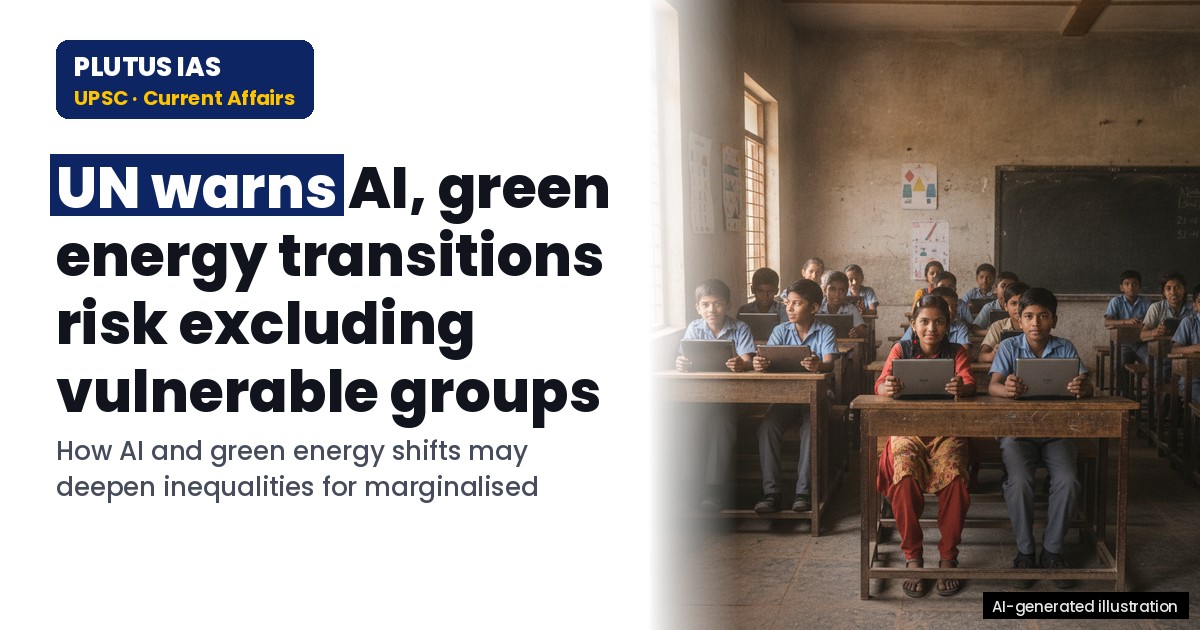
16 Oct UN Warns AI & Green Energy Transitions Risk Leaving Vulnerable Groups Behind
✎ Inclusive development must be embedded in economic transitions driven by AI, green energy, and digitalisation to prevent deepening inequalities, requiring targeted policies, reskilling initiatives, and equitable financing…
Subject Relevance — Where This Topic Fits
- GS Paper II — International Organisations and Reports | GS Paper III — Indian Economy and Issues Relating to Planning, Mobilisation of Resources, Growth, Development and Employment | GS Paper III — Environment and Sustainable Development | GS Paper III — Science and Technology — Developments and their Applications and Effects in Everyday Life | GS Paper IV — Ethics, Integrity and Aptitude — Human Values
- Prelims: Digital divide, Just transition, Social inclusion, UN DESA, Doha Political Declaration on Social Development, Sevilla Commitment on Financing for Development, Debt distress, Renewable energy workforce transition, AI-driven labour market changes, Multidimensional poverty index
- Essay: The paradox of progress: How technological and green transitions can deepen inequalities if equity is not prioritised, Inclusive growth as the cornerstone of sustainable development: Balancing efficiency with social justice
Quick Revision: Inclusive development must be embedded in economic transitions driven by AI, green energy, and digitalisation to prevent deepening inequalities, requiring targeted policies, reskilling initiatives, and equitable financing mechanisms.
Why is this in the news?
A report by the United Nations Department of Economic and Social Affairs (UN DESA) warns that rapid transformations driven by artificial intelligence, digital technologies, renewable energy adoption, and demographic shifts risk exacerbating socio-economic inequalities, particularly for marginalised groups such as women, young people, older persons, persons with disabilities, migrants, Indigenous Peoples, and low-income communities. The report underscores the urgent need for governments to adopt inclusive policies to ensure these transitions benefit all segments of society, highlighting the economic and moral imperatives of social inclusion in the context of global development.
Background
- The global economy is undergoing unprecedented transformations driven by technological advancements, particularly in artificial intelligence (AI) and digitalisation, alongside a paradigm shift towards renewable energy and sustainable practices.
- The COVID-19 pandemic exposed and exacerbated existing inequalities, highlighting the vulnerability of marginalised communities to systemic disruptions in labour markets, education, and healthcare.
- The International Labour Organisation (ILO) estimates that AI and automation could displace millions of jobs globally, with low-skilled and informal workers being the most affected.
- The global transition to renewable energy, while essential for mitigating climate change, poses significant challenges for communities dependent on fossil fuel industries, necessitating just transition frameworks.
- The UN Sustainable Development Goals (SDGs), particularly SDG 8 (Decent Work and Economic Growth), SDG 10 (Reduced Inequalities), and SDG 13 (Climate Action), emphasise the need for inclusive and sustainable economic transitions.
- The Doha Political Declaration on Social Development (2025) and the Sevilla Commitment on Financing for Development (2025) reflect international commitments to address social and economic inequalities through equitable financing and policy reforms.
What is the UN DESA Report on Social Inclusion in Economic Transitions?
- The report, titled *Inclusive Development in a Time of Transformation*, is published by the United Nations Department of Economic and Social Affairs (UN DESA) and examines the socio-economic impacts of rapid technological, energy, and demographic transitions.
- It highlights that while these transitions create opportunities for economic growth and innovation, they also risk deepening inequalities if marginalised groups are excluded from the benefits of progress.
- The report identifies key vulnerable groups, including women, young people, older persons, persons with disabilities, migrants, Indigenous Peoples, and low-income communities, who face heightened risks of exclusion due to structural barriers in access to education, technology, and employment.
- It argues that social inclusion is not merely a moral obligation but an economic necessity, as expanding opportunities to marginalised groups enhances human capital, fosters innovation, and strengthens labour market resilience.
- The report recommends that governments adopt a multi-pronged approach to ensure inclusive transitions, including continuous reskilling and upskilling programmes for workers displaced by AI and automation, just transition policies for fossil fuel-dependent communities, and targeted investments in digital infrastructure and affordable internet access.
- It critiques the over-reliance on GDP as a sole measure of progress, advocating instead for a broader set of indicators that capture poverty reduction, access to education and healthcare, employment security, inequality reduction, and environmental sustainability.
- The report also addresses the financial constraints faced by developing countries, noting that nearly half of the world’s poorest nations are either in or at high risk of debt distress, which could impede their ability to invest in inclusive transitions.
- It calls for reforms in international financial institutions to better represent and serve developing countries, ensuring that global financial systems support equitable and sustainable development.
Key Features
| Feature | Significance |
|---|---|
| Artificial Intelligence (AI) and digital technologies | Reshapes labour markets by automating tasks, creating demand for new skills while displacing traditional roles, exacerbating digital divide for disadvantaged groups. |
| Renewable energy transitions | Reduces reliance on fossil fuels but disrupts employment in carbon-intensive sectors; necessitates retraining and social safety nets for affected communities. |
| Demographic shifts (ageing, youth bulge) | Alters workforce composition, increasing pressure on social security systems and necessitating inclusive education and healthcare policies. |
| Social inclusion as economic imperative | Expands productive workforce, enhances human capital, fosters innovation, and ensures equitable distribution of productivity gains. |
| Multi-dimensional progress metrics | Advocates replacing GDP-centric growth assessments with indicators like poverty reduction, education access, healthcare, employment security, and environmental sustainability. |
Why it Matters
Economic
- AI and green energy transitions can drive long-term productivity and sustainability but risk widening income inequality if marginalised groups lack access to opportunities.
- Inclusive growth models enhance aggregate demand, labour productivity, and innovation, contributing to stable macroeconomic outcomes.
- Financial constraints in developing nations may hinder equitable transitions, necessitating international cooperation and debt relief mechanisms.
Social
- Vulnerable groups (women, youth, older persons, persons with disabilities, migrants, Indigenous Peoples, low-income communities) face heightened risks of exclusion in fast-evolving economies.
- Social protection systems must adapt to support displaced workers, ensuring dignity and reducing long-term socio-economic disparities.
- Digital and energy transitions require targeted interventions to prevent intergenerational inequities and preserve social cohesion.
Environmental
- Renewable energy adoption is critical for climate mitigation but must incorporate just transition frameworks to avoid exacerbating energy poverty.
- Sustainable development goals (SDGs) 8 (Decent Work), 10 (Reduced Inequalities), and 13 (Climate Action) are interlinked in this context.
- Environmental degradation disproportionately affects vulnerable communities, necessitating inclusive climate adaptation strategies.
Governance
- Policy coherence between labour, education, energy, and digital governance is essential to align economic transitions with social equity.
- International financial institutions must reform to address debt vulnerabilities in developing nations and facilitate inclusive financing.
- Monitoring frameworks should integrate multi-dimensional metrics to assess progress beyond GDP.
Challenges
1. Digital Divide and Skill Gaps
- Disparities in access to digital infrastructure and training exacerbate inequalities in AI-driven economies.
- Workers in informal sectors and rural areas face higher risks of obsolescence due to limited reskilling opportunities.
- Public-private partnerships are required to scale digital literacy programmes and affordable internet access.
UPSC Link: GS3: Science & Tech, GS2: Governance
2. Just Transition in Energy Sector
- Fossil fuel-dependent communities risk economic marginalisation during renewable energy transitions without targeted support.
- Policy frameworks must balance decarbonisation goals with employment security and regional development.
- Social dialogue involving workers, unions, and communities is critical for designing inclusive transition pathways.
UPSC Link: GS3: Environment, GS2: Governance
3. Financial Constraints in Developing Nations
- High debt burdens limit fiscal space for investing in inclusive transitions, particularly in low-income countries.
- Debt restructuring and concessional financing are essential to enable developing nations to prioritise social and green investments.
- Reforms in international financial architecture are needed to enhance representation and responsiveness to developing country needs.
UPSC Link: GS2: International Relations, GS3: Economy
4. Measurement and Policy Coherence
- Over-reliance on GDP growth metrics obscures distributional inequities and environmental externalities.
- Lack of integrated policy frameworks across sectors (labour, education, energy) risks fragmented and inequitable outcomes.
- Data systems must be strengthened to track multi-dimensional progress, including inequality and environmental indicators.
UPSC Link: GS2: Governance, GS3: Economy
5. Social Protection System Adaptation
- Existing social security systems may be ill-equipped to address the scale and nature of disruptions caused by AI and green transitions.
- Universal social protection floors need expansion to cover informal workers and gig economy participants.
- Targeted interventions are required for vulnerable groups, including persons with disabilities and Indigenous Peoples.
UPSC Link: GS2: Governance, GS1: Social Issues
Challenges — UPSC Perspective
| Issue | Concern |
|---|---|
| Digital divide | Exclusion of disadvantaged groups from AI-driven economic opportunities due to lack of access and skills. |
| Fossil fuel phase-out | Economic hardship for communities reliant on carbon-intensive industries without adequate transition support. |
| Debt distress in developing nations | Limited fiscal capacity to invest in inclusive transitions, exacerbating global inequalities. |
| GDP-centric growth metrics | Failure to capture distributional inequities and environmental costs of economic growth. |
| Social protection gaps | Inadequate safety nets for workers displaced by technological and structural changes. |
| Policy fragmentation | Lack of coordination between labour, education, energy, and digital governance domains. |
Way Forward
- Formulate national strategies for inclusive AI and green energy transitions, integrating labour market reforms, digital literacy, and social protection.
- Establish multi-stakeholder platforms involving governments, private sector, civil society, and academia to design just transition pathways.
- Expand public investment in reskilling and upskilling programmes, targeting vulnerable groups and informal workers.
- Reform international financial institutions to enhance concessional financing and debt relief for developing nations.
- Develop multi-dimensional progress indicators that incorporate poverty reduction, inequality, employment security, and environmental sustainability.
- Strengthen social protection systems to cover gig workers, informal sector employees, and marginalised communities.
- Promote regional cooperation for technology transfer, digital infrastructure sharing, and capacity-building in developing nations.
- Enhance data systems to monitor progress on inclusive transitions, ensuring evidence-based policymaking.
UPSC Value Addition
Keywords for Mains Answer-Writing
Inclusive growth · Digital divide · Green energy transition · Socio-economic inequality · Vulnerable communities · Reskilling and upskilling · Sustainable Development Goals (SDGs) · Social inclusion · Renewable energy workforce · Marginalised groups · UN DESA report · Artificial Intelligence and labour markets · Just transition · Financial constraints in development · International financial institutions reform
Constitutional & Policy Linkages
- Article 21 (Right to Life and Personal Liberty) – Ensuring dignity and access to opportunities for vulnerable groups.
- Article 38 (Directive Principles of State Policy) – Promoting welfare and reducing inequalities.
- Article 39 (Directive Principles of State Policy) – Ensuring equitable distribution of resources and opportunities.
- Article 41 (Right to Work and Public Assistance) – Safeguarding livelihoods during economic transitions.
Concept Flow
Technological and energy transitions → Disruption in labour markets and traditional industries → Risk of exclusion for vulnerable groups → Widening socio-economic inequalities → Need for inclusive policies and social protection → Multi-dimensional growth metrics → Sustainable and equitable development.
Prelims Practice Questions
Q1. Consider the following statements regarding the socio-economic impacts of Artificial Intelligence (AI) and green energy transitions:
1. AI-driven automation is expected to disproportionately affect low-skilled workers in developing economies.
2. The transition to renewable energy will eliminate all jobs in the fossil fuel sector without creating new opportunities.
3. The UN report highlights that social inclusion is both a moral imperative and an economic necessity.
How many of the above statements are correct?
- Only one
- Only two
- All three
- None
Answer: Only two — Statement 1 is correct as AI-driven automation is likely to impact low-skilled workers more severely. Statement 2 is incorrect because the UN report emphasises retraining and alternative employment opportunities rather than elimination of jobs. Statement 3 is correct as the report underscores social inclusion as both a moral and economic necessity.
Q2. Assertion (A): The UN report recommends that governments should prioritise GDP growth over poverty reduction and access to education to measure economic progress.
Reason (R): The report argues that GDP growth alone cannot reflect the inclusivity of economic development and calls for a broader assessment of progress.
- Both A and R are true, and R is the correct explanation of A.
- Both A and R are true, but R is not the correct explanation of A.
- A is true, but R is false.
- A is false, but R is true.
Answer: ? — Assertion (A) is false because the UN report explicitly states that GDP growth alone is insufficient and calls for assessing progress through poverty reduction, education, healthcare, and inequality. Reason (R) is true as it correctly reflects the report’s stance on inclusive growth.
Q3. Match the following vulnerable groups with the key recommendations of the UN report for their inclusion in economic transitions:
Column I (Vulnerable Groups)
A. Women
B. Persons with disabilities
C. Migrants
D. Indigenous Peoples
Column II (Recommendations)
1. Expand affordable access to internet and digital infrastructure
2. Provide retraining and alternative employment opportunities in renewable energy sectors
3. Ensure access to continuous training and reskilling programmes
4. Strengthen social protection and inclusive policies in labour markets
- A-1, B-4, C-2, D-3; A-4, B-1, C-3, D-2; A-3, B-4, C-1, D-2; A-2, B-3, C-4, D-1
- answer_options_indexes_and_pairs_str_for_json_only_keep_it_as_is_but_no_other_text_just_the_indexes_and_pairs_inside_the_array_so_it_will_be_used_in_code_to_display_correctly_inside_the_q_text_in_actual_exam_environment_so_keep_it_as_a_list_of_pairs_in_the_exact_format_asked_above_but_here_in_JSON_it_will_be_just_the_list_of_pairs_as_an_array_of_strings_so_we_can_use_it_in_code_like_this_[‘A-1, B-4, C-2, D-3’] etc.
Answer: ? — Women require strengthened social protection and inclusive labour policies (A-4). Persons with disabilities need expanded digital access and infrastructure (B-1). Migrants benefit from continuous training and reskilling (C-3). Indigenous Peoples require retraining and alternative employment in renewable energy (D-2).
Mains Practice Question
✍ The rapid adoption of Artificial Intelligence and green energy transitions, while offering substantial economic benefits, risks exacerbating socio-economic inequalities if not managed inclusively. Critically examine the challenges posed by these transitions to vulnerable communities and evaluate the policy measures recommended by the UN to ensure a just and inclusive transformation. (15 Marks)
Approach: MODEL-ANSWER SKELETON:
1. **Introduction (2 Marks)**
– Define inclusive growth and its significance in the context of AI and green energy transitions.
– Briefly state the UN report’s core warning about the risks of exclusion.
2. **Challenges to Vulnerable Communities (5 Marks)**
– **Digital Divide**: Lack of access to digital infrastructure and skills entrenches inequality (cite ITU data on global internet penetration disparities).
– **Labour Market Disruptions**: AI-driven automation threatens low-skilled and informal workers; green energy transitions may displace fossil fuel-dependent communities (reference ILO reports on just transition).
– **Structural Barriers**: Women, persons with disabilities, migrants, and Indigenous Peoples face compounded vulnerabilities due to systemic discrimination and limited access to resources.
– **Financial Constraints**: Developing nations face debt distress (cite UN DESA data on debt-to-revenue ratios), limiting their capacity to invest in inclusive policies.
3. **UN-Recommended Policy Measures (5 Marks)**
– **Reskilling and Upskilling**: Continuous training programmes for workers at risk of displacement (reference India’s Skill India Mission and Germany’s ‘Energiewende’ workforce transition model).
– **Social Protection**: Expand safety nets, such as conditional cash transfers and unemployment insurance, to cushion transitions (cite Brazil’s Bolsa Família or India’s MGNREGA as examples).
– **Digital Inclusion**: Universal access to affordable internet and digital literacy programmes (reference India’s BharatNet and Digital India initiatives).
– **Just Transition Frameworks**: Policy frameworks that link renewable energy adoption with local job creation and community benefits (cite South Africa’s Just Transition Framework).
– **Alternative Metrics for Growth**: Move beyond GDP to measure progress via SDG indicators (e.g., poverty reduction, inequality reduction, and environmental sustainability).
4. **Critical Evaluation and Way Forward (3 Marks)**
– **Implementation Challenges**: High costs, institutional capacity gaps, and political economy constraints in developing nations.
– **Role of International Institutions**: Reform of global financial architecture (e.g., IMF quotas, World Bank lending practices) to address debt vulnerabilities and mobilise climate finance.
– **Balancing Efficiency and Equity**: The need for market-driven innovation while ensuring equitable outcomes (reference Amartya Sen’s capability approach).
– **Conclusion**: Emphasise that inclusive transitions are not only morally imperative but also economically rational for sustainable growth.
Source: news.un.org
Generated by AanyaAi for educational purpose.
Related guides on our sites
- Best economics services coaching
- Anthropology VS PSIR
- Best PSIR optional coaching
- Best PSIR optional coaching online

- UNEP Report 2026 Warns: Paris 1.5°C Target Slipping Away - October 23, 2026
- पूर्व आईएएस अधिकारी हत्या मामले में आईएएस एसोसिएशन की मुख्यमंत्री से मुलाकात - October 23, 2026
- UPSC Exam: Rare Glimpse of Ritwik Ghatak’s Cinematic Legacy at 4-Day Festival - October 23, 2026

No Comments