


26 Sep UN Warns of Escalating Conflict in Northern Ethiopia: A Threat to Regional Stability
✎ The resurgence of conflict in northern Ethiopia threatens to reverse the gains of the 2022 accord, with renewed violence, drone strikes, and humanitarian access restrictions posing grave risks to civilian populations and regional…
Subject Relevance — Where This Topic Fits
- GS Paper II — International Relations — Regional and global groupings and agreements involving India and/or affecting India’s interests | GS Paper II — International Relations — Effect of policies and politics of developed and developing countries on India’s interests | GS Paper III — Internal Security — Challenges to internal security through communication networks | GS Paper III — Disaster and Disaster Management — Role of international agencies in disaster response
- Prelims: Tigray conflict, African Union (AU), Intergovernmental Authority on Development (IGAD), El Niño and its global impacts, Humanitarian access and protection of civilians, UN Security Council, Eritrea, Ethiopia’s federal structure, Internal displacement, Airstrikes and drone warfare, Mobile banking disruptions
- Essay: The role of regional organisations in conflict resolution: A case study of the Horn of Africa, Humanitarian crises and the failure of international law: Lessons from Ethiopia
Quick Revision: The resurgence of conflict in northern Ethiopia threatens to reverse the gains of the 2022 accord, with renewed violence, drone strikes, and humanitarian access restrictions posing grave risks to civilian populations and regional stability.
Why is this in the news?
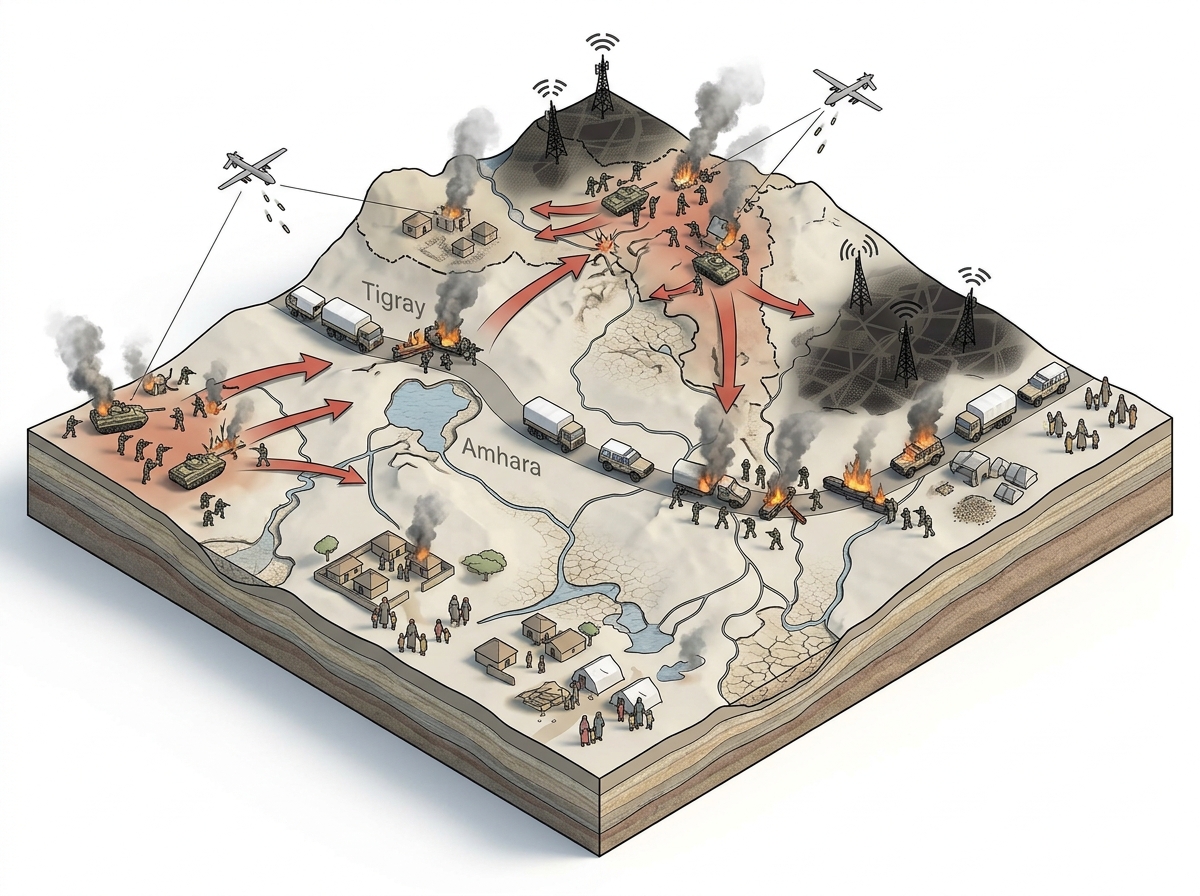
The United Nations has expressed grave concern over the recent escalation of fighting across northern Ethiopia, which threatens to undermine the fragile peace established by the 2022 accord. Reports of drone strikes, attacks on civilians, and disruptions to humanitarian operations—including the targeting of food aid convoys—highlight the deteriorating security situation. The crisis is exacerbated by internet blackouts, which disrupt critical services such as mobile banking, and by adverse weather conditions linked to El Niño, intensifying food insecurity. The situation underscores the fragility of peace processes in conflict-affected regions and the urgent need for renewed diplomatic efforts to prevent a return to full-scale war.
Background
- The Tigray conflict, which erupted in November 2020, was a civil war between the Ethiopian federal government and the Tigray People’s Liberation Front (TPLF), the former ruling party of the Tigray region.
- The conflict expanded beyond Tigray, involving Eritrean forces on the side of the Ethiopian government and spreading to neighbouring regions such as Amhara and Afar, leading to widespread civilian casualties and documented human rights violations.
- The war resulted in severe humanitarian crises, including famine-like conditions, mass displacement, and the destruction of critical infrastructure, prompting international condemnation and calls for accountability.
- Despite the agreement, implementation has been slow and uneven, with persistent tensions and sporadic violence, raising concerns about the durability of the peace process.
- The current escalation follows a period of relative calm but has rapidly deteriorated, with reports of renewed clashes, airstrikes, and drone attacks, particularly in Tigray, Amhara, and Afar regions.
What is the current crisis in northern Ethiopia?
- The crisis refers to the resurgence of armed conflict in northern Ethiopia, primarily in the Tigray, Amhara, and Afar regions, following a period of relative stability post-2022 accord.
- Fighting has spread across multiple fronts, involving government forces, regional militias, and armed groups, with reports of drone strikes and airstrikes targeting civilian and humanitarian infrastructure.
- Humanitarian operations are severely constrained by insecurity, road closures, and the seizure of aid vehicles, exacerbating pre-existing food and water shortages in a region already grappling with displacement and adverse weather conditions.
- Internet and communication blackouts in Tigray have disrupted essential services, including mobile banking and emergency response coordination, further isolating affected populations.
- The United Nations and other international actors have condemned the escalation, emphasising the need for all parties to exercise restraint and prioritise dialogue to prevent a return to full-scale war.
- The African Union and IGAD are actively engaged in diplomatic efforts to de-escalate tensions and facilitate a resumption of the peace process under the 2022 agreement.
- The crisis is compounded by environmental factors, including below-average rainfall linked to El Niño, which threatens to worsen food insecurity and humanitarian needs in the region.
- Protection of civilians remains a critical concern, with reports of attacks on schools, food aid convoys, and displacement sites, violating international humanitarian law.
Key Features
| Feature | Significance |
|---|---|
| Escalation of armed conflict | Threatens to reverse the 2022 peace accord, risking renewed full-scale war in northern Ethiopia with regional spillover. |
| Humanitarian access constraints | Delays and disruptions to aid delivery exacerbate famine-like conditions, particularly in Tigray, Amhara, and Afar regions. |
| Civilian harm and infrastructure damage | Reports of drone strikes and attacks on civilian targets, including schools, intensify risks to non-combatants and violate international humanitarian law. |
| Internet and communication blackout | Disrupts banking, mobile transactions, and coordination of relief operations, compounding economic and humanitarian crises. |
| Regional mediation efforts | UN Special Envoy for the Horn of Africa and AU-IGAD coordination aim to restore dialogue under the 2022 peace framework. |
Why it Matters
Regional Security Implications
- Renewed conflict risks destabilising the Horn of Africa, a geopolitically critical sub-region with implications for maritime security and counter-terrorism cooperation.
- Potential for cross-border displacement and resource competition, particularly in Ethiopia’s border regions with Sudan and Eritrea.
- Eritrea’s reported involvement in past conflicts underscores the need for regional de-escalation mechanisms to prevent proxy dynamics.
Humanitarian Crisis
- Over 2 million internally displaced persons (IDPs) in Tigray alone face heightened risks due to aid blockades and extreme weather linked to El Niño.
- Below-average rainfall and drought conditions worsen food insecurity, aligning with pre-2022 famine warnings.
- Healthcare disruptions, including damage to ambulances and health centres, exacerbate vulnerability to disease outbreaks.
International Law and Human Rights
- Violations of international humanitarian law (IHL) through attacks on civilians, schools, and humanitarian convoys may trigger ICC or AU accountability mechanisms.
- UN High Commissioner for Human Rights’ intervention highlights the obligation of parties to protect civilian populations under Geneva Conventions.
Economic Disruptions
- Collapse of digital financial infrastructure (mobile banking, ATMs) deepens economic hardship, particularly in conflict-affected urban centres.
- Trade disruptions along key routes, including the Addis Ababa–Djibouti corridor, threaten Ethiopia’s economic recovery and regional integration.
Challenges
1. Humanitarian Access and Aid Delivery
- Armed groups’ seizure of humanitarian vehicles and road closures obstruct critical aid routes, violating UN Security Council Resolution 2175 (2014) on humanitarian access.
- Delayed or suspended operations in Tigray, Amhara, and Afar regions risk mass civilian casualties from starvation and disease.
UPSC Link: GS-II: Humanitarian Law
2. Civilian Protection in Asymmetric Warfare
- Use of drones and airstrikes in populated areas contravenes the principle of distinction under IHL, increasing civilian fatalities.
- Lack of accountability for past atrocities (e.g., 2020–2022 Tigray war) emboldens further violations.
UPSC Link: GS-II: International Humanitarian Law
3. Regional Mediation and Peace Process
- Slow implementation of the 2022 peace accord and renewed hostilities undermine AU-led mediation efforts, raising questions about enforcement mechanisms.
- Divergent interests among regional actors (e.g., Eritrea, Sudan) complicate neutral facilitation.
UPSC Link: GS-II: Conflict Resolution
4. Climate-Induced Vulnerabilities
- El Niño-linked drought exacerbates food insecurity, compounding the impact of conflict on agricultural livelihoods.
- Displacement strains already scarce resources in host communities, triggering secondary crises.
UPSC Link: GS-III: Disaster Management
5. Digital Governance and Economic Stability
- Internet blackouts disrupt essential services, including financial transactions, healthcare, and education, deepening socio-economic instability.
- Lack of digital resilience in conflict zones highlights vulnerabilities in governance systems dependent on connectivity.
UPSC Link: GS-III: Digital Infrastructure
Challenges — UPSC Perspective
| Issue | Concern |
|---|---|
| Aid blockades | Violation of UNSC Resolution 2175; risks mass civilian casualties from starvation and disease. |
| Civilian targeting | Contravenes Geneva Conventions; increases non-combatant fatalities and displacement. |
| Climate shocks (El Niño) | Exacerbates food insecurity and resource scarcity in conflict zones. |
| Digital blackouts | Disrupts financial systems, healthcare, and humanitarian coordination. |
| Regional spoilers | Eritrea’s involvement complicates neutral mediation and fuels proxy dynamics. |
| Accountability gaps | Lack of justice for past atrocities emboldens further violations. |
Way Forward
- Urgent de-escalation through AU-IGAD-led dialogue, with UN facilitation to restore adherence to the 2022 peace accord.
- Enforce safe humanitarian corridors under UNSC Resolution 2175, including protected access for aid convoys and medical evacuations.
- Establish an independent monitoring mechanism to document IHL violations and ensure accountability for civilian harm.
- Expand climate-resilient humanitarian responses to address El Niño-induced droughts and food insecurity in conflict zones.
- Strengthen digital infrastructure resilience in conflict-affected regions to mitigate economic and service disruptions.
- Leverage regional economic blocs (e.g., IGAD) to incentivise ceasefire compliance through trade and aid conditionalities.
- Prioritise civilian protection in military operations, including bans on drone strikes in populated areas.
- Coordinate international humanitarian funding to pre-empt famine-like conditions and prevent secondary displacement crises.
UPSC Value Addition
Keywords for Mains Answer-Writing
Ethiopia conflict dynamics · Humanitarian access in conflict zones · United Nations Security Council · African Union Peace and Security Council · Humanitarian principles and international law · El Niño and climate vulnerability · Protection of civilians in armed conflict · UN Charter Chapter VII · African Union-led peace processes · International humanitarian law and drones
Concept Flow
Political tensions between federal government and TPLF → 2020–2022 Tigray War → Eritrean intervention → Widespread atrocities and famine-like conditions → 2022 AU-mediated peace accord → Slow implementation → Renewed hostilities in 2026 → Escalation across Tigray, Amhara, Afar → Civilian harm and aid blockades → Humanitarian crisis and regional instability → Urgent need for de-escalation and accountability.
Prelims Practice Questions
Q1. Consider the following statements regarding the conflict in northern Ethiopia:
1. The 2020–2022 Tigray war began after political tensions between Ethiopia’s federal government and the Tigray People’s Liberation Front (TPLF).
2. Eritrean forces intervened in the conflict on the side of the Ethiopian government.
3. The African Union played no role in mediating the 2022 peace accord.
4. The peace accord of November 2022 was mediated by the United Nations.
How many of the above statements are correct?
- Only one
- Only two
- Only three
- All
Answer: Only three — Statements 1 and 2 are correct. Statement 3 is incorrect as the African Union was the primary mediator. Statement 4 is incorrect as the peace accord was mediated by the African Union, not the UN.
Q2. Assertion (A): The United Nations Charter, under Chapter VII, authorises the use of force to maintain or restore international peace and security.
Reason (R): The UN Security Council is the only body empowered to authorise such measures under the Charter.
Options:
A. Both A and R are true, and R is the correct explanation of A.
B. Both A and R are true, but R is not the correct explanation of A.
C. A is true, but R is false.
D. A is false, but R is true.
Answer: ? — Both A and R are true. Chapter VII of the UN Charter (Articles 39–51) empowers the Security Council to authorise measures, including the use of force, to maintain international peace and security. R correctly explains A.
Q3. Match the following international organisations with their primary roles in conflict resolution:
Column I
1. United Nations
2. African Union
3. International Committee of the Red Cross (ICRC)
4. Intergovernmental Authority on Development (IGAD)
Column II
A. Mediation and peacekeeping in regional conflicts
B. Global humanitarian protection and conflict monitoring
C. Regional economic and political integration in the Horn of Africa
D. Humanitarian aid and protection of victims in armed conflict
Select the correct match:
- 1-B, 2-A, 3-D, 4-C
- 1-A, 2-B, 3-C, 4-D
- 1-C, 2-D, 3-A, 4-B
- 1-D, 2-C, 3-B, 4-A
Answer: 1-B, 2-A, 3-D, 4-C — 1-B (UN focuses on global peace and security), 2-A (African Union mediates regional conflicts), 3-D (ICRC provides humanitarian aid and protection), 4-C (IGAD is a regional economic and political body in the Horn of Africa).
Mains Practice Question
✍ The resurgence of armed conflict in northern Ethiopia threatens to undermine the fragile peace established by the 2022 African Union-mediated accord. Critically analyse the challenges to humanitarian access and civilian protection in conflict zones, with reference to international humanitarian law and the role of regional organisations. (15 Marks)
Approach: MODEL-ANSWER SKELETON:
1. **Context and recent developments**:
– Brief overview of the 2020–2022 Tigray war and the November 2022 peace accord mediated by the African Union.
– Current escalation in northern Ethiopia (Tigray, Amhara, Afar) and its humanitarian impact (internet outages, drone strikes, school attacks).
2. **Challenges to humanitarian access**:
– **Security constraints**: Road closures, seizures of humanitarian vehicles, and attacks on aid convoys (e.g., drone strike on food assistance truck).
– **Infrastructure disruptions**: Internet and mobile service outages in Tigray, affecting banking and mobile transactions.
– **Climate vulnerability**: Below-average rainfall linked to El Niño exacerbating food insecurity and displacement.
3. **International humanitarian law (IHL) and civilian protection**:
– **Core principles**: Distinction, proportionality, and precaution in attack (Additional Protocol I to the Geneva Conventions).
– **Violations observed**: Attacks on schools, internally displaced persons (IDP) camps, and humanitarian workers.
– **Accountability mechanisms**: Role of the UN Human Rights Council, African Commission on Human and Peoples’ Rights, and the International Criminal Court (ICC) in investigating atrocities.
4. **Role of regional organisations**:
– **African Union (AU)**: Primary mediator in 2022 accord; potential to re-engage in de-escalation and humanitarian facilitation.
– **Intergovernmental Authority on Development (IGAD)**: Regional body with a mandate for conflict prevention and mediation.
– **United Nations (UN)**: UNOCHA’s role in coordinating humanitarian operations; UN Security Council’s potential to impose sanctions or authorise peacekeeping under Chapter VII.
5. **Way forward**:
– **Immediate measures**: Ceasefire, unhindered humanitarian access, and protection of civilians.
– **Long-term solutions**: Strengthening AU-UN collaboration, addressing root causes of conflict (federalism, ethnic tensions), and climate-resilient humanitarian planning.
6. **Critical analysis**:
– **Effectiveness of regional organisations**: Assess whether the AU and IGAD have sufficient leverage to enforce peace and humanitarian access.
– **Gaps in IHL enforcement**: Challenges in holding non-state actors and state forces accountable for violations.
– **Balancing sovereignty and intervention**: Debate on the legitimacy of external intervention in internal conflicts under international law.
Source: news.un.org
Generated by AanyaAi for educational purpose.
Related guides on our sites
- Best PSIR optional coaching for upsc
- Best PSIR optional teacher for upsc
- Best teacher of PSIR optional for upsc
- Best PSIR optional coaching in delhi for UPSC

- यूक्रेन का रोबोट सेना अभियान: युद्ध में मानव हानि कम करने की रणनीति - September 27, 2026
- Ukraine’s ‘Army of Robots’: A Game-Changer for UPSC Mains 2026 Polity & Governance - September 27, 2026
- रूस ने भारत-ब्राजील को दिया UNSC स्थायी सदस्यता का समर्थन, जर्मनी-जापान विरोध में - September 27, 2026

No Comments