


10 Aug UN Warns of Rising Online Risks for Youth: Key for UPSC & State PCS
Online information ecosystemsAlgorithmic manipulationAI-driven exploitationDigital governanceChild rightsDisinformation✎ The digital ecosystem’s structural incentives—maximising engagement and data extraction—systematically expose children to information integrity risks, necessitating urgent, rights-based regulation of AI and algorithmic systems to…
Subject Relevance — Where This Topic Fits
- GS Paper II — International Organisations and Reports | GS Paper III — Science and Technology (AI Governance) | GS Paper IV — Ethics and Governance (Digital Ethics)
- Prelims: Information Integrity, AI Governance, Digital Rights of Children, Algorithmic Bias, UNICEF, UNESCO, AI Child Safety Pledge, International Youth Day
- Essay: The Ethical Imperative of Regulating AI in the Digital Age, Balancing Innovation and Child Protection in the Information Society
Quick Revision: The digital ecosystem’s structural incentives—maximising engagement and data extraction—systematically expose children to information integrity risks, necessitating urgent, rights-based regulation of AI and algorithmic systems to safeguard their developmental and participatory rights.
Why is this in the news?
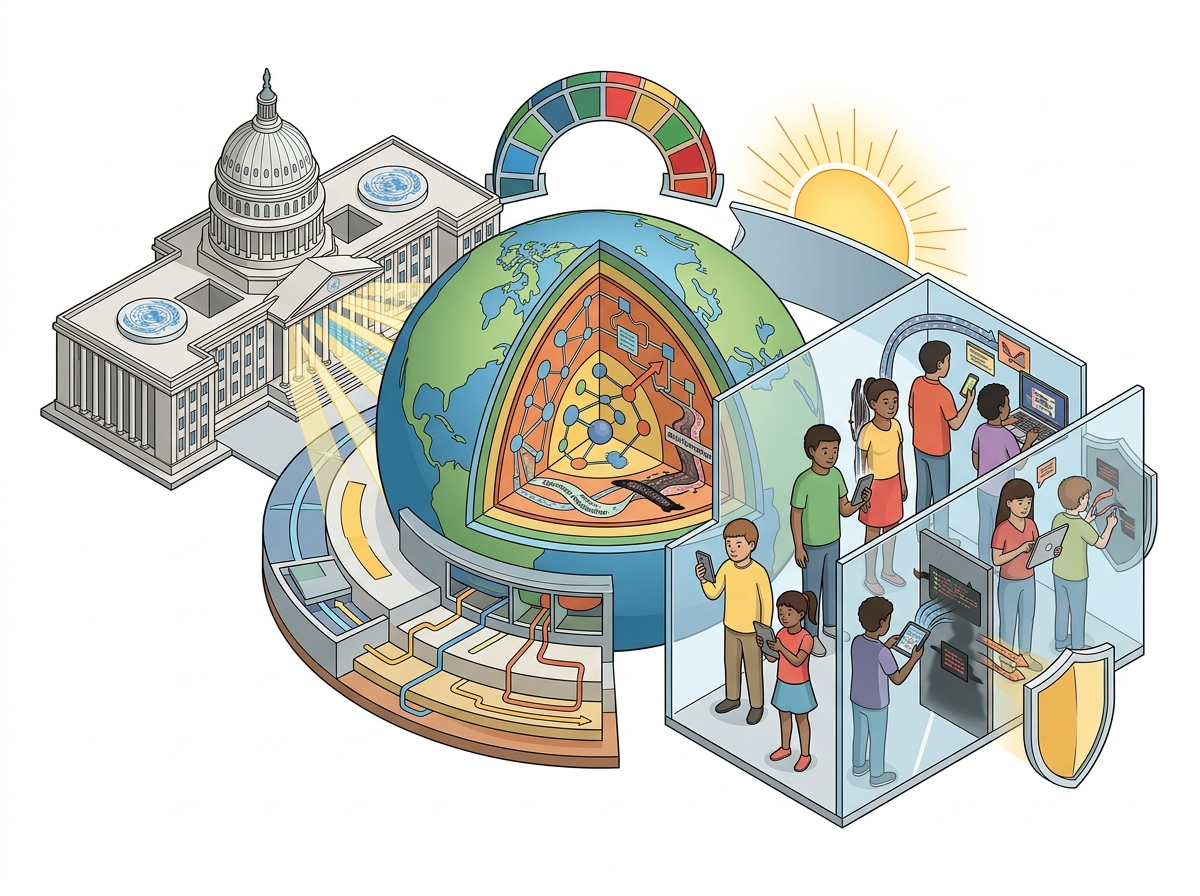
The United Nations has issued a policy brief highlighting the urgent need for coordinated action to safeguard children and young people from the systemic risks posed by online information ecosystems, including disinformation, algorithmic manipulation, and AI-driven exploitation. This development underscores the intersection of digital governance, child rights, and emerging technologies, making it a critical issue for UPSC aspirants preparing for governance and technology-related questions.
Background
- The digital divide has narrowed significantly, with over 80% of young people aged 15–24 globally now online, and in low-income countries, youth outpace other demographics in internet adoption nearly two to one.
- The UN’s brief precedes International Youth Day, emphasising the need for proactive measures to address online harms before they escalate further.
- The UN Secretary-General’s call for an *AI Child Safety Pledge* reflects growing concerns over unregulated AI systems, likening their deployment to untested medical practices without safeguards.
- Online harms are not accidental but are structurally embedded in business models that prioritise engagement, data monetisation, and compulsive usage patterns.
- Algorithmic biases and AI-generated content exacerbate risks such as exploitation, surveillance, and manipulative design, disproportionately affecting young, impressionable users.
- The brief highlights the dual role of youth as both victims and agents of change, requiring their inclusion in policy and technological solutions.
What is Information Integrity and How Does It Relate to Children’s Online Safety?
- Information integrity refers to the accuracy, reliability, and ethical handling of information in digital ecosystems, ensuring that users—especially children—are not misled, manipulated, or harmed by false, biased, or exploitative content.
- Children and adolescents are particularly vulnerable due to their developmental stage, limited critical thinking skills, and susceptibility to algorithmic manipulation designed to maximise engagement and data extraction.
- Key risks include disinformation, cyberbullying, algorithmic bias, AI-generated deepfakes, hidden advertising (e.g., influencer marketing), and data surveillance, all of which can distort perceptions, harm mental health, and expose users to exploitation.
- The UN brief identifies *commercial surveillance* as a systemic issue, where personal data is harvested and monetised without adequate safeguards for minors, normalising pervasive tracking during formative years.
- Algorithmic systems, such as recommendation engines, are optimised for profit rather than child welfare, often reinforcing harmful content loops (e.g., extremist material, self-harm triggers) through engagement-driven design.
- The brief also highlights *dark patterns*—deceptive user interface designs that trick users into sharing data or making unintended purchases—as a growing concern in digital platforms targeting youth.
- AI exacerbates these risks by enabling hyper-personalised manipulation, including AI-generated content tailored to exploit emotional vulnerabilities or facilitate grooming and trafficking.
- The UN advocates for a *rights-based approach*, integrating child protection into AI governance frameworks, ensuring that young users are not treated as ‘guinea pigs’ for unregulated technologies.
Key Features
| Feature | Significance |
|---|---|
| Global Digital Penetration of Youth | Over 80% of young people aged 15–24 are online, with disproportionately higher access in low-income countries, amplifying exposure to information risks. |
| Algorithmic Risks and AI | AI-driven engagement tactics (e.g., dark patterns, loot boxes) and AI-generated content exploit developmental vulnerabilities, outpacing regulatory responses. |
| Commercial Surveillance | Business models prioritising attention and data monetisation normalise pervasive surveillance and manipulative design, particularly affecting impressionable youth. |
| Youth as Agents of Change | Children and young people are not merely victims but creators, organisers, and contributors to public debate, requiring their inclusion in governance frameworks. |
| Regulatory Lag in AI Governance | The rapid adoption of AI has created a critical window for embedding children’s rights into governance frameworks before risks become entrenched. |
Why it Matters
Societal Impact
- The digital ecosystem’s design choices disproportionately harm youth, whose cognitive and emotional development is still in formative stages, leading to long-term societal consequences.
- Online harms extend beyond individual victims to collective civic engagement, threatening the integrity of youth-led movements and public discourse.
- The intersection of AI, commercial exploitation, and youth vulnerability necessitates a paradigm shift in how societies conceptualise digital rights and protections.
Policy and Governance
- The UN brief underscores the urgency for Member States to integrate children’s rights into AI governance, behavioural advertising regulations, and content moderation policies.
- National governments must balance innovation with safeguards, ensuring that digital policies are evidence-based and adaptable to technological evolution.
- International cooperation is critical to harmonise standards, given the cross-border nature of digital platforms and AI systems.
Economic Dimensions
- The monetisation of youth attention and data represents a structural economic incentive that conflicts with child welfare, requiring regulatory intervention to realign incentives.
- Investments in digital literacy and protective technologies for youth can yield long-term economic benefits by reducing societal costs of online harms.
- Advertisers and technology companies face growing reputational and legal risks, necessitating proactive measures to mitigate exposure.
Challenges
1. Regulatory Lag in AI Governance
- AI adoption outpaces policy responses, creating a governance vacuum that exposes youth to untested and potentially harmful technologies.
- The analogy of AI to ‘untested medicine’ highlights the ethical imperative for pre-market safety assessments and post-market monitoring.
- Existing frameworks (e.g., GDPR) are insufficient for addressing AI-specific risks to children, requiring tailored legislation.
UPSC Link: GS3: Science & Tech – AI Governance
2. Commercial Exploitation of Youth Data
- Business models centred on attention and data monetisation prioritise engagement over child welfare, normalising harmful design practices.
- Hidden advertising tactics (e.g., influencer marketing, microtargeting) exploit developmental vulnerabilities, increasing compulsive use and spending.
- The lack of transparency in data collection and processing further entrenches commercial surveillance, undermining trust in digital ecosystems.
UPSC Link: GS3: Economy – Digital Economy
3. Algorithmic Bias and Misinformation
- Algorithms designed to maximise engagement often amplify polarising or harmful content, disproportionately affecting youth with limited critical thinking skills.
- AI-generated misinformation and deepfakes pose novel threats to information integrity, requiring advanced detection and mitigation strategies.
- The brief highlights the need for algorithmic accountability, including audits and transparency measures to reduce systemic biases.
UPSC Link: GS2: Governance – Digital Divide
4. Online Harassment and Surveillance
- Youth, particularly young women, minorities, and activists, face heightened risks of harassment, doxxing, and surveillance in digital spaces.
- The anonymity of online platforms exacerbates these risks, necessitating stronger safeguards and reporting mechanisms.
- The intersection of AI and surveillance technologies (e.g., facial recognition) raises concerns about privacy and autonomy for young users.
UPSC Link: GS1: Society – Gender & Vulnerable Sections
5. Digital Divide and Access Inequities
- While youth in low-income countries have higher digital penetration, they often lack access to protective technologies, digital literacy, and safe online environments.
- The brief underscores the need for equitable digital access paired with safeguards to prevent exacerbating existing inequalities.
- Policy interventions must address both connectivity gaps and the quality of digital experiences to ensure inclusive protection.
UPSC Link: GS2: Governance – Digital Divide
6. Youth Exclusion from Governance
- Despite their central role in digital ecosystems, youth are often excluded from policy-making processes that directly impact their rights and safety.
- The brief advocates for participatory governance, ensuring youth perspectives are integrated into research, legislation, and technological design.
- Exclusion risks undermining the effectiveness of solutions and perpetuating top-down, adult-centric approaches to digital governance.
UPSC Link: GS2: Governance – Citizen Participation
Challenges — UPSC Perspective
| Issue | Concern |
|---|---|
| AI Governance Vacuum | Lack of robust frameworks to regulate AI systems, leaving youth exposed to untested and potentially harmful technologies. |
| Commercial Surveillance | Normalisation of pervasive data collection and manipulative design practices that prioritise engagement over child welfare. |
| Algorithmic Bias | Amplification of polarising or harmful content, disproportionately affecting youth with limited critical thinking skills. |
| Online Harassment | Heightened risks of harassment, doxxing, and surveillance for young women, minorities, and activists in digital spaces. |
| Digital Divide | Inequities in access to protective technologies and digital literacy, exacerbating vulnerabilities in low-income countries. |
| Youth Exclusion | Limited participation of youth in governance processes, risking ineffective and top-down policy responses. |
Way Forward
- Establish multi-stakeholder task forces comprising governments, technology companies, advertisers, and youth representatives to co-design AI governance frameworks tailored to child safety.
- Enact legislation mandating algorithmic transparency, regular audits for bias, and pre-market safety assessments for AI systems targeting or affecting children.
- Implement strict data protection regulations for youth, including limits on data collection, processing, and commercial use, with penalties for non-compliance.
- Develop digital literacy programmes integrated into school curricula, focusing on critical thinking, online safety, and ethical technology use.
- Create reporting mechanisms and grievance redressal systems for youth to report online harms, with dedicated support for vulnerable groups.
- Promote the adoption of age-appropriate design standards (e.g., default privacy settings, limited data sharing) for digital platforms and applications.
- Encourage technology companies to adopt the UN’s AI Child Safety Pledge, committing to prioritise child welfare in AI development and deployment.
- Foster international cooperation to harmonise standards for AI governance, content moderation, and data protection, ensuring consistency across jurisdictions.
UPSC Value Addition
Keywords for Mains Answer-Writing
Children’s online safety · Information integrity · Digital harms to minors · Algorithmic bias and AI risks · UN Global Compact on AI Governance · UNICEF recommendations on digital rights · Dark patterns in digital platforms · Commercial surveillance of children · UN Secretary-General’s AI Child Safety Pledge · International Youth Day 2026 · UN brief on information crisis · Youth-led digital activism
Constitutional & Policy Linkages
- Article 21 (Right to Life and Personal Liberty) – Safeguarding children’s privacy and autonomy in digital spaces.
- Article 15(3) (Special Provisions for Children) – Empowering the state to make protective provisions for children’s digital rights.
- Article 39(f) (Children’s Development) – Ensuring policies protect children from exploitation and harm in all spheres, including digital.
Concept Flow
Digital Penetration → Increased Online Exposure → Algorithmic Engagement → Commercial Surveillance & Manipulative Design → Youth Vulnerability → Online Harms (Misinformation, Harassment, Exploitation) → AI Adoption → Rapid Technological Change → Regulatory Lag → Governance Vacuum → Unchecked Risks for Youth → Youth Participation → Digital Agency → Policy Exclusion → Ineffective Solutions → Need for Inclusive Governance → Commercial Incentives → Data Monetisation → Surveillance Capitalism → Normalisation of Harmful Practices → Systemic Risks for Children → Global Standards → National Legislation → Corporate Compliance → Youth Protection → Sustainable Digital Ecosystems
Prelims Practice Questions
Q1. Consider the following statements regarding the UN’s concerns about children’s online safety:
1. The UN brief highlights that over 80% of young people aged 15 to 24 are online globally.
2. The brief identifies algorithmic biases and commercial surveillance as primary risks to children’s information integrity.
3. The UN Secretary-General has called for an ‘AI Child Safety Pledge’ to regulate emerging AI technologies.
How many of the above statements are correct?
- Only one
- Only two
- All three
- None
Answer: All three — Statements 1 and 3 are correct. Statement 2 is also correct as the brief explicitly mentions algorithmic biases and commercial surveillance as risks to children’s information integrity.
Q2. Assertion (A): The UN brief argues that harms faced by children online are accidental and not systemic.
Reason (R): The brief attributes these harms to business models that monetise attention and personal data, and design choices aimed at maximising engagement.
Select the correct option from the following:
- Both A and R are true, and R is the correct explanation of A.
- Both A and R are true, but R is NOT the correct explanation of A.
- A is true, but R is false.
- A is false, but R is true.
Answer: ? — Assertion (A) is false because the UN brief states that harms are not accidental but are the product of systemic business models and design choices. Reason (R) is true as it correctly explains the systemic nature of these harms.
Q3. Which of the following is NOT a concern highlighted by the UN brief on children’s online safety?
- Algorithmic biases
- Dark patterns in digital platforms
- Increased physical activity among children
- Commercial surveillance
Answer: Increased physical activity among children — The UN brief highlights algorithmic biases, dark patterns, and commercial surveillance as concerns. Increased physical activity among children is not mentioned as a concern.
Mains Practice Question
✍ The proliferation of digital technologies has exposed children to significant risks to their information integrity, including disinformation, algorithmic biases, and commercial exploitation. Critically examine the governance mechanisms required to safeguard children’s rights in the digital ecosystem. (15 Marks)
Approach: MODEL-ANSWER SKELETON:
1. **Introduction (2 marks)**: Define information integrity and its importance for children’s development. Mention the UN brief’s key concerns (disinformation, algorithmic biases, commercial surveillance) and the urgency highlighted by the UN Secretary-General’s AI Child Safety Pledge.
2. **Systemic Risks (4 marks)**:
– Algorithmic biases and AI-driven risks: Discuss how AI systems can amplify harms (e.g., deepfakes, manipulative content). Cite the UN’s warning about AI outpacing regulatory responses.
– Commercial surveillance and dark patterns: Explain how business models monetise children’s data and use addictive design features (e.g., loot boxes, infinite scroll). Reference the brief’s critique of manipulative design.
– Data exploitation: Highlight the UN’s concern about hidden advertising tactics targeting children.
3. **Governance Mechanisms (5 marks)**:
– **Regulatory Frameworks**: Discuss the need for robust AI governance (e.g., the AI Child Safety Pledge, global compacts). Reference the UN’s call for Member States to prioritise child safety in AI regulation.
– **Platform Responsibilities**: Examine the role of technology companies in moderating content, ensuring transparency in algorithms, and implementing child-friendly design principles.
– **Multi-stakeholder Collaboration**: Highlight the UN’s emphasis on involving advertisers, media, researchers, and civil society in addressing harms.
– **Legal Safeguards**: Mention existing frameworks like the UN Convention on the Rights of the Child (Article 16 on privacy) and domestic laws (e.g., India’s Digital Personal Data Protection Act, 2023).
4. **Challenges and Way Forward (4 marks)**:
– **Implementation Gaps**: Discuss the difficulty of regulating rapidly evolving technologies (e.g., AI) and the need for adaptive governance.
– **Youth Participation**: Emphasise the UN’s recommendation to integrate children’s perspectives into policymaking and research.
– **Balancing Rights and Innovation**: Argue for a rights-based approach that protects children while fostering innovation in digital spaces.
– **Conclusion**: Summarise the need for a multi-dimensional governance strategy that combines regulation, corporate accountability, and youth empowerment.
Source: news.un.org
Generated by AanyaAi for educational purpose.

- KWML’s Feasibility Reports for Water Metro in 18 Cities: UPSC & PCS Insights - October 3, 2026
- ओडिशा में वन्यजीव अनुसंधान अनुदान कार्यक्रम शुरू, सिमिलिपाल में 300 कैमरे और बढ़ेंगे - October 3, 2026
- India Summons Pakistan High Commission Official Over Violation - October 3, 2026

No Comments