


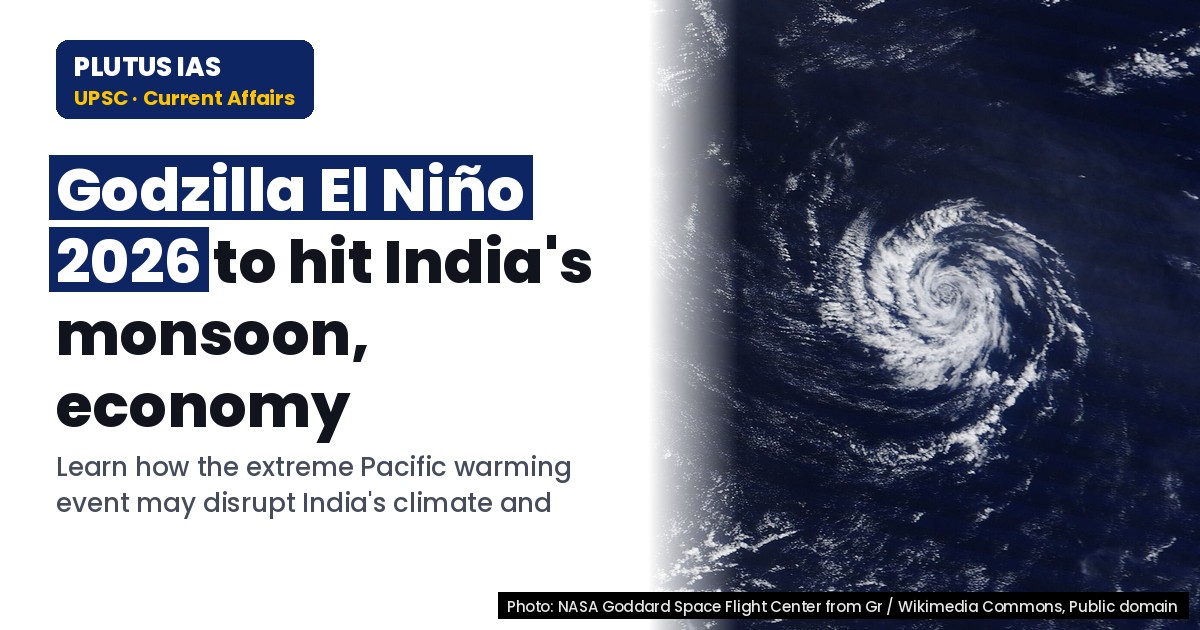
24 Oct Understanding ‘Godzilla’ El Niño Impact on India’s Climate & Economy
✎ El Niño, a warm phase of ENSO, is characterized by abnormal Pacific Ocean warming (Nino 3.4 region) with a RONI threshold of +0.5°C, suppressing India’s southwest monsoon and exacerbating heatwaves, droughts, and agricultural…
Subject Relevance — Where This Topic Fits
- GS Paper I — Geography (Physical Geography, Climate Change) | GS Paper III — Environment, Disaster Management, and Agricultural Productivity
- Prelims: ENSO, El Niño, La Niña, Nino 3.4 region, Relative Ocean Nino Index (RONI), Southwest Monsoon, Northeast Monsoon, Long Period Average (LPA), Heatwaves, Water Stress, Agricultural Output, Economic Growth, World Meteorological Organization (WMO)
- Essay: Climate Change and Global Weather Anomalies: The Role of Ocean-Atmosphere Interactions, Agricultural Resilience in the Face of Extreme Climatic Events
Quick Revision: El Niño, a warm phase of ENSO, is characterized by abnormal Pacific Ocean warming (Nino 3.4 region) with a RONI threshold of +0.5°C, suppressing India’s southwest monsoon and exacerbating heatwaves, droughts, and agricultural losses.
Why is this in the news?
This extreme warming is expected to suppress India’s southwest monsoon rainfall, exacerbate heatwaves, and disrupt agricultural productivity, water availability, and economic growth, necessitating urgent policy and adaptive measures.
Background
- El Niño is one component of the El Niño-Southern Oscillation (ENSO) cycle, a naturally occurring phenomenon driven by interactions between the Pacific Ocean and the atmosphere.
- ENSO operates in three phases: El Niño (warm phase), La Niña (cool phase), and neutral, each influencing global weather patterns distinctly.
- India’s southwest monsoon, which contributes ~70% of annual rainfall, is particularly sensitive to El Niño events due to its teleconnection with Pacific Ocean warming.
- Historical records indicate that strong El Niño events (e.g., 1997-98, 2015-16) have coincided with severe droughts, reduced agricultural output, and economic slowdowns in India.
- Climate change is amplifying the intensity and frequency of extreme ENSO events, as evidenced by the rapid warming observed in the 2026 El Niño.
What is El Niño and the ENSO Cycle?
- ENSO is a coupled ocean-atmosphere phenomenon characterized by fluctuations in sea surface temperatures (SST) and atmospheric pressure in the tropical Pacific Ocean.
- El Niño refers to the warm phase of ENSO, marked by abnormal warming of SSTs in the central and eastern equatorial Pacific, typically lasting 9-12 months.
- La Niña is the cool phase, featuring below-average SSTs in the same region, often associated with enhanced monsoon rainfall in India.
- The Nino 3.4 region (5°N-5°S, 120°W-170°W) is the primary indicator for ENSO monitoring, with temperature anomalies exceeding +0.5°C for El Niño and -0.5°C for La Niña over a 3-month average.
- ENSO phases alter global weather patterns by disrupting the Walker Circulation, a zonal atmospheric circulation over the Pacific, leading to shifts in rainfall and temperature distributions.
- El Niño suppresses the southwest monsoon in India by weakening the monsoon trough and reducing moisture transport from the Indian Ocean.
- The northeast monsoon, which affects southern India, is less influenced by El Niño and may remain normal even during strong El Niño events.
UPSC Value Addition
Keywords for Mains Answer-Writing
El Niño Southern Oscillation (ENSO) · Indian Monsoon Variability · Climate Change and Agriculture · Extreme Weather Events · Pacific Ocean Warming · Monsoon Deficit and Water Stress · Economic Impact of Climate Anomalies · Nino 3.4 Index · Relative Ocean Nino Index (RONI) · Drought and Food Security · Global Climate Patterns · Intergovernmental Panel on Climate Change (IPCC) Reports
Prelims Practice Questions
Q1. Consider the following statements about El Niño Southern Oscillation (ENSO):
1. El Niño refers to the abnormal cooling of surface waters in the equatorial Pacific Ocean.
2. The Nino 3.4 region is a key indicator used to monitor ENSO phases.
3. An average Relative Ocean Nino Index (RONI) value exceeding 0.5 degrees Celsius over a three-month period indicates an El Niño event.
4. La Niña is associated with below-normal sea surface temperatures in the central and eastern equatorial Pacific.
How many of the above statements are correct?
- Only one
- Only two
- Only three
- All
Answer: All — Statements 2, 3, and 4 are correct. Statement 1 is incorrect because El Niño refers to abnormal warming, not cooling, of surface waters in the equatorial Pacific Ocean.
Q2. Assertion (A): The southwest monsoon in India contributes approximately 70% of the country’s annual rainfall.
Reason (R): El Niño conditions suppress monsoon rainfall by altering atmospheric circulation patterns over the Indian Ocean.
Options:
A. Both A and R are true, and R is the correct explanation of A.
B. Both A and R are true, but R is not the correct explanation of A.
C. A is true, but R is false.
D. A is false, but R is true.
Answer: ? — Both A and R are true, and R correctly explains A. The southwest monsoon’s rainfall contribution and its suppression during El Niño are well-documented phenomena.
Q3. Match the following phases of the El Niño Southern Oscillation (ENSO) with their respective characteristics:
Column I (ENSO Phase) Column II (Characteristic)
1. El Niño A. Abnormal cooling of central and eastern equatorial Pacific Ocean
2. La Niña B. Neutral sea surface temperature anomalies in the equatorial Pacific
3. Neutral C. Abnormal warming of central and eastern equatorial Pacific Ocean
Options:
A. 1-A, 2-B, 3-C
B. 1-C, 2-A, 3-B
C. 1-B, 2-C, 3-A
D. 1-A, 2-C, 3-B
Answer: ? — The correct match is: 1-C (El Niño = abnormal warming), 2-A (La Niña = abnormal cooling), and 3-B (Neutral = no significant anomalies).
Mains Practice Question
✍ El Niño events are increasingly being linked to extreme weather patterns and socio-economic disruptions. Critically analyse the implications of the 2026 El Niño for India’s agricultural sector, water resources, and economic growth. (15 Marks)
Approach: MODEL-ANSWER SKELETON:
1. **Introduction (2 Marks)**: Define El Niño and ENSO, and briefly explain the 2026 El Niño’s intensity (RONI > 2°C) and its global context.
2. **Impact on Indian Agriculture (4 Marks)**:
– Monsoon variability: Link to 87% LPA rainfall (2026) and its impact on kharif crops (rice, pulses, coarse cereals).
– Spatial variation: Contrast deficient rainfall in central and southern India with normal northeast monsoon.
– Food security: Cite IPCC projections (e.g., AR6) on yield declines for staple crops under warming scenarios.
– Government response: Mention the Pradhan Mantri Fasal Bima Yojana (PMFBY) and buffer stock management.
3. **Water Resources and Drought (4 Marks)**:
– Surface water stress: Decline in reservoir levels (e.g., major dams like Bhakra, Nagarjunasagar) and groundwater depletion.
– Policy frameworks: National Water Policy 2012, Jal Shakti Abhiyan, and inter-state water disputes (e.g., Cauvery).
– Adaptation strategies: Rainwater harvesting, watershed management, and crop diversification.
4. **Economic Growth and Policy Challenges (3 Marks)**:
– Inflationary pressures: Food price volatility and its impact on CPI/WPI (reference to 2022-23 food inflation).
– GDP growth: Cite RBI/IMF reports on El Niño’s negative impact on GDP (e.g., 0.2-0.5% reduction in growth).
– Fiscal measures: Mention the need for climate-resilient infrastructure and subsidies for farmers.
5. **Conclusion (2 Marks)**:
– Synthesis: Emphasise the need for integrated climate adaptation policies (e.g., National Mission for Sustainable Agriculture).
– Forward-looking: Highlight India’s role in global climate negotiations (e.g., COP28 commitments) and the importance of early warning systems.
Source: The Indian Express
Generated by AanyaAi for educational purpose.
Related guides on our sites
- Current affairs for upsc 2026
- Best economics optional coaching for upsc
- Best economics optional teacher for upsc
- How to prepare for GS paper 1 for UPSC CSE mains exam

- Understanding ‘Godzilla’ El Niño Impact on India’s Climate & Economy - October 24, 2026
- सिंहस्थ 2028: सब्जियों और फूलों की कमी रोकने की तैयारी, जानें पूरा प्लान - October 24, 2026
- India-UN Fund: A Model for South-South Cooperation in UPSC Exams - October 24, 2026

No Comments