


31 Jul Union Cabinet Extends PM-Kisan Scheme till 2031 with ₹3.15L Cr Allocation
✎ PM-KISAN is a Direct Benefit Transfer (DBT)-based income support scheme providing ₹6,000/year to landholding farmer families, implemented via Aadhaar-linked bank accounts, with a ₹3.15 lakh crore outlay approved for 2026-31 to…
Subject Relevance — Where This Topic Fits
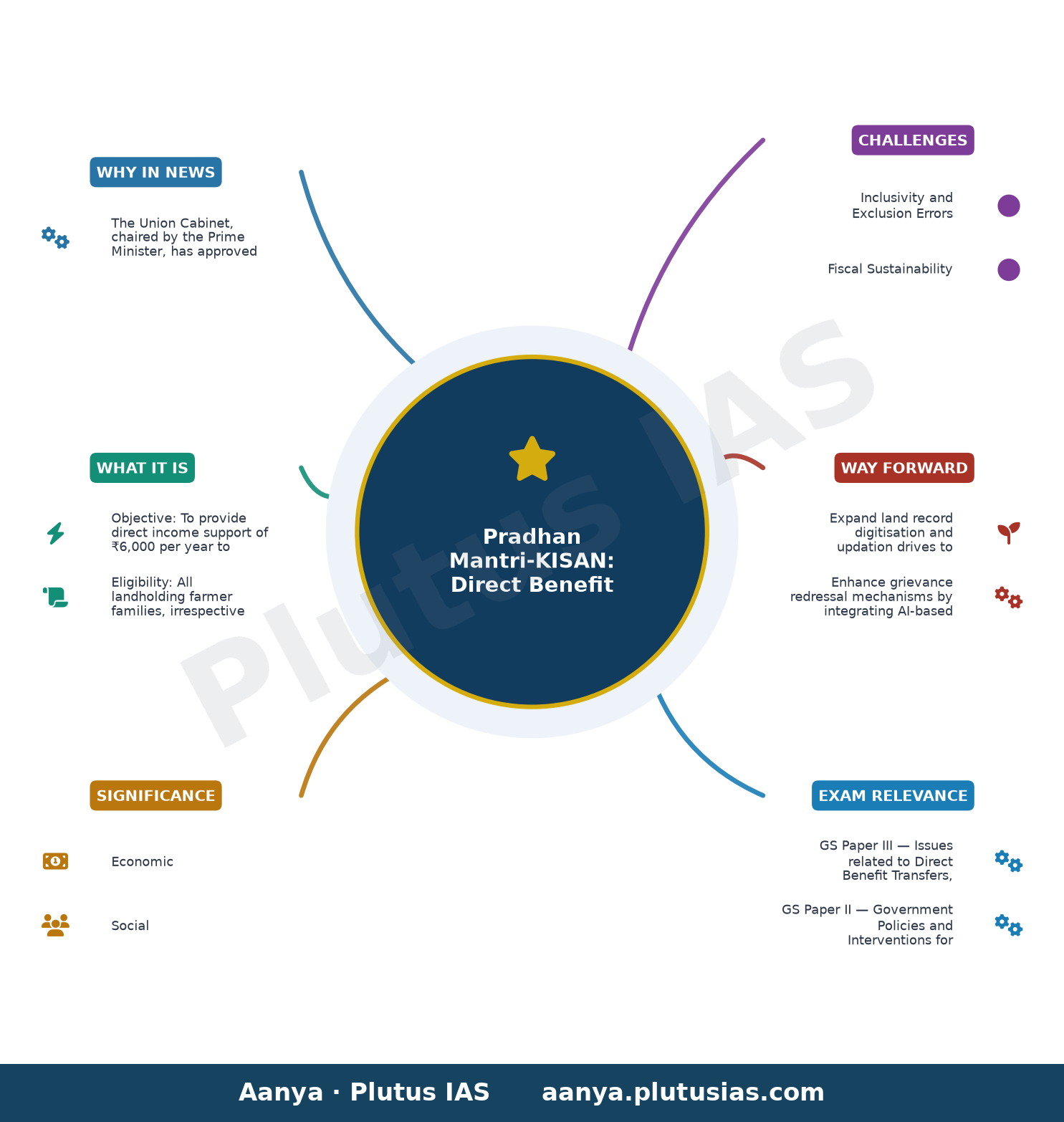
- GS Paper III — Issues related to Direct Benefit Transfers, Agricultural Finance and Rural Development | GS Paper II — Government Policies and Interventions for Development in various sectors
- Prelims: Pradhan Mantri-KISAN Samman Nidhi (PM-KISAN), Direct Benefit Transfer (DBT), Aadhaar-based Authentication, Kisan Credit Card (KCC), Minimum Support Price (MSP), Agricultural Productivity, Rural Economy, Farm Income Support, Digital Public Infrastructure (DPI), Union Budget Allocations
- Essay: Agrarian distress and state-led welfare: Lessons from PM-KISAN, Digital governance as a tool for inclusive development: The case of PM-KISAN
Quick Revision: PM-KISAN is a Direct Benefit Transfer (DBT)-based income support scheme providing ₹6,000/year to landholding farmer families, implemented via Aadhaar-linked bank accounts, with a ₹3.15 lakh crore outlay approved for 2026-31 to bolster farm incomes and rural resilience.
Why is this in the news?
The Union Cabinet, chaired by the Prime Minister, has approved the continuation of the Pradhan Mantri-KISAN Samman Nidhi (PM-KISAN) scheme from 2026-27 to 2030-31 with a financial outlay of ₹3.15 lakh crore. This decision underscores the government’s long-term commitment to enhancing farm incomes through direct income support, leveraging the Direct Benefit Transfer (DBT) mechanism, and reinforcing the nexus between agricultural prosperity and national economic growth.
Background
- PM-KISAN was launched in February 2019 as a flagship Central Sector Scheme under the Ministry of Agriculture and Farmers’ Welfare, aimed at providing income support to landholding farmer families across the country.
- The scheme operates on a 100% Central funding model, with no state share, ensuring uniform benefit delivery across all states and Union Territories.
- PM-KISAN is implemented through a robust Digital Public Infrastructure (DPI) framework, integrating Aadhaar-based authentication, land records digitisation, and a secure DBT platform to minimise leakages and ensure timely transfers.
- Since its inception, the scheme has disbursed over ₹4.47 lakh crore to farmers across 23 instalments, with the 23rd instalment benefiting 9.49 crore farmers.
- During the COVID-19 pandemic, PM-KISAN provided critical financial relief by disbursing over ₹1.71 lakh crore to farmers, demonstrating its role as a counter-cyclical welfare measure.
- The scheme has been evaluated by independent bodies such as NITI Aayog’s Development Monitoring and Evaluation Office (DMEO), which found that 92% of beneficiaries utilised funds for agricultural investments and 85% reported improved farm income and reduced dependence on informal credit.
What is the Pradhan Mantri-KISAN Samman Nidhi (PM-KISAN) Scheme?
- Objective: To provide direct income support of ₹6,000 per year to eligible landholding farmer families in three equal instalments, enhancing their purchasing power for agricultural inputs and reducing distress.
- Eligibility: All landholding farmer families, irrespective of size of landholding, subject to exclusion criteria such as higher income tax payers, constitutional posts, and retired government employees with pension above ₹10,000.
- Funding: 100% Central funding with an outlay of ₹3.15 lakh crore for the period 2026-27 to 2030-31, ensuring continuity and predictability in income support.
- Implementation Mechanism: Utilises Aadhaar-based authentication, digitised land records, and a secure DBT platform to ensure transparent, leakage-proof, and timely transfer of benefits directly to beneficiaries’ bank accounts linked with Aadhaar.
- Coverage: Covers all states and Union Territories, with over 14.5 crore beneficiary families receiving benefits since inception, including a significant proportion of women farmers (approximately 25% of beneficiaries).
- Impact: Contributed to a 9.65% increase in agricultural GDP, 10.53% rise in productivity, and 21.18% growth in foodgrain production during 2020-21 to 2025-26, as per independent evaluations.
- Linkages with Other Schemes: Complements initiatives such as Kisan Credit Card (KCC), Soil Health Cards, and PM-KISAN Maan Dhan Yojana (for small and marginal farmers’ pension), creating a holistic support ecosystem for farmers.
- Digital Governance: Exemplifies the integration of Digital India initiatives, including Aadhaar seeding, DBT, and real-time monitoring, to enhance efficiency, transparency, and accountability in welfare delivery.
Key Features
| Feature | Significance |
|---|---|
| Direct Benefit Transfer (DBT) | Ensures timely, transparent, and leakage-free transfer of ₹6,000 annually to 12 crore+ farmers via Aadhaar-authenticated bank accounts, reducing intermediaries and corruption. |
| Financial Inclusion | Mandates linkage of farmers to the formal banking system, enhancing access to credit and insurance products for rural households. |
| Digital Authentication | Uses Aadhaar-based biometric verification and geo-tagging to eliminate duplicate beneficiaries and ensure target efficiency. |
| Income Support Mechanism | Provides unconditional cash transfer of ₹6,000/year in three equal installments, acting as a safety net against agrarian distress. |
| Multiplier Effect on Agriculture | Empirical evidence shows increased investment in seeds, fertilizers, and machinery, boosting productivity and reducing reliance on informal credit. |
Why it Matters
Economic
- Enhances rural demand and stimulates agricultural sector growth, contributing to GDP expansion through higher farm incomes and consumption.
- Reduces income inequality by providing a predictable income stream to marginal and small farmers, who constitute ~86% of India’s farming population.
- Acts as a counter-cyclical fiscal tool, stabilising rural economies during climate shocks or market fluctuations.
Social
- Empowers women farmers, who account for ~25% of beneficiaries, by directly transferring funds to their bank accounts, enhancing their decision-making autonomy.
- Strengthens food security by incentivising higher agricultural output through increased input investments, aligning with the National Food Security Mission.
- Mitigates farmer distress, reducing the incidence of agrarian suicides, particularly in states with high farm indebtedness.
Governance
- Demonstrates the efficacy of technology-driven welfare delivery, setting a precedent for other DBT schemes like PM-KISAN Maandhan or PM-SHRI.
- Enhances fiscal transparency by linking disbursements to verified land records and Aadhaar, reducing leakages to <2% (as per CAG audits).
- Serves as a model for cooperative federalism, with the Centre bearing the financial burden while states implement last-mile delivery.
Strategic
- Supports the goal of doubling farmer incomes by 2022 (extended to 2030) by providing a stable income floor, complementing market reforms and MSP mechanisms.
- Aligns with the vision of ‘Atmanirbhar Bharat’ by reducing dependence on imports through increased domestic agricultural productivity.
- Strengthens India’s position in global agricultural negotiations by ensuring food security and stable supply chains.
Challenges
1. Inclusivity and Exclusion Errors
- Risk of exclusion of tenant farmers and sharecroppers due to reliance on land records, which often exclude non-landholding cultivators.
- Aadhaar seeding challenges in remote areas, leading to delays in beneficiary identification and payment disbursements.
- Overlap with other welfare schemes (e.g., PM-KISAN Maandhan) may create confusion among beneficiaries regarding eligibility.
UPSC Link: GS-III: Agriculture, Direct Benefit Transfers
2. Fiscal Sustainability
- Annual outlay of ₹3.15 lakh crore (2026-31) poses a strain on the Union Budget, especially amid competing priorities like infrastructure and defence.
- Inflationary pressures could erode the real value of the fixed ₹6,000 transfer, reducing its efficacy over time.
- Dependence on cess revenues (e.g., cess on coal) for funding creates vulnerability to economic downturns.
UPSC Link: GS-III: Fiscal Policy, Resource Mobilisation
3. Agricultural Productivity Constraints
- Limited impact on structural issues like fragmented landholdings, water scarcity, and post-harvest losses, which require long-term solutions.
- Income support may disincentivise diversification into high-value crops or allied activities if not paired with market linkages.
- Climate change-induced yield variability threatens the predictability of farm incomes, necessitating adaptive measures.
UPSC Link: GS-III: Agriculture, Climate Change
4. Implementation Bottlenecks
- Digital divide in rural India hampers Aadhaar authentication and DBT efficiency, particularly in North-Eastern states and tribal areas.
- Delays in fund disbursement due to bureaucratic hurdles or technical glitches in the Public Financial Management System (PFMS).
- Lack of grievance redressal mechanisms for beneficiaries facing payment failures or incorrect exclusions.
UPSC Link: GS-II: Governance, E-Governance
5. Distributional Equity
- Large farmers (holding >5 hectares) receive a disproportionate share of benefits, raising concerns about regressive redistribution.
- Urban and peri-urban farmers may inadvertently benefit if land records are not updated, diluting the scheme’s rural focus.
- Regional disparities persist, with states like Uttar Pradesh and Maharashtra receiving higher allocations due to larger farmer populations.
UPSC Link: GS-III: Agriculture, Inclusive Growth
Challenges — UPSC Perspective
| Issue | Concern |
|---|---|
| Land Record Inaccuracy | Exclusion of tenant farmers and sharecroppers due to outdated or incomplete land records. |
| Aadhaar Seeding Delays | Technical and infrastructural gaps in rural areas delay Aadhaar-based authentication and payment disbursements. |
| Fiscal Strain | Annual outlay of ₹63,000 crore (2026-31) risks crowding out other developmental expenditures. |
| Inflation Erosion | Fixed ₹6,000 transfer loses real value over time, reducing its purchasing power. |
| Climate Vulnerability | Extreme weather events threaten the scheme’s long-term impact on farm incomes and productivity. |
| Digital Divide | Poor internet connectivity and lack of digital literacy in rural areas hinder seamless DBT implementation. |
Way Forward
- Expand land record digitisation and updation drives to include tenant farmers and sharecroppers, leveraging the SVAMITVA scheme for geo-tagging.
- Enhance grievance redressal mechanisms by integrating AI-based chatbots and toll-free helplines for real-time issue resolution.
- Link PM-KISAN payments to agri-input subsidies and crop insurance to create a comprehensive safety net for farmers.
- Introduce a dynamic adjustment mechanism for the ₹6,000 transfer, indexed to inflation or agricultural GDP growth to maintain real value.
- Strengthen last-mile delivery by partnering with local self-help groups (SHGs) and cooperatives for beneficiary authentication and awareness campaigns.
- Conduct periodic impact assessments using satellite imagery and AI to monitor land use changes and productivity gains post-PM-KISAN.
- Integrate PM-KISAN with e-NAM (electronic National Agriculture Market) to ensure seamless market linkages for beneficiaries.
- Explore public-private partnerships to improve rural digital infrastructure, including last-mile connectivity and Aadhaar authentication centres.
UPSC Value Addition
Keywords for Mains Answer-Writing
Pradhan Mantri Kisan Samman Nidhi (PM-KISAN) · Direct Benefit Transfer (DBT) in agriculture · Agrarian distress alleviation measures · Farm income support schemes · Digital governance in welfare delivery · Aadhaar-enabled Direct Benefit Transfer (AeDBT) · Agricultural productivity and investment · Rural economy strengthening mechanisms · Fiscal federalism in welfare schemes · Sustainable agriculture financing
Constitutional & Policy Linkages
- Article 39(b): Directive Principle of State Policy mandating equitable distribution of resources, including agricultural income support.
- Article 48: Directive Principle promoting modern and scientific agriculture, aligning with PM-KISAN’s productivity enhancement goals.
Concept Flow
Policy Announcement (Feb 2019) → Direct Benefit Transfer (DBT) Mechanism → Aadhaar Authentication & Land Record Verification → Farmer Identification & Exclusion of Duplicates → Quarterly Installments (₹2,000 each) → Agricultural Investment & Input Purchase → Enhanced Productivity & Income → Rural Demand Stimulus → Economic Growth & Food Security.
Prelims Practice Questions
Q1. Consider the following statements regarding the Pradhan Mantri Kisan Samman Nidhi (PM-KISAN) scheme:
1. It provides direct income support of ₹6,000 per year to eligible land-holding farmer families.
2. The financial assistance is transferred in three equal instalments directly to the beneficiaries’ bank accounts.
3. The scheme is implemented through the State Governments using the Direct Benefit Transfer (DBT) mechanism.
4. The scheme was launched in 2020 and is applicable only to marginal and small farmers.
How many of the above statements are correct?
- Only one
- Only two
- Only three
- All four
Answer: Only three — Statements 1, 2, and 3 are correct. Statement 4 is incorrect as the scheme was launched in February 2019 and is applicable to all land-holding farmer families, irrespective of landholding size.
Q2. Assertion (A): The Pradhan Mantri Kisan Samman Nidhi (PM-KISAN) scheme utilises Aadhaar-enabled Direct Benefit Transfer (AeDBT) for transparent and efficient fund disbursement.
Reason (R): Aadhaar authentication ensures unique identification of beneficiaries, reduces duplication, and minimises leakages in welfare delivery.
Options:
A. Both A and R are true, and R is the correct explanation of A.
B. Both A and R are true, but R is not the correct explanation of A.
C. A is true, but R is false.
D. A is false, but R is true.
Answer: ? — Both Assertion (A) and Reason (R) are true, and Reason (R) correctly explains Assertion (A). The PM-KISAN scheme indeed uses Aadhaar-enabled DBT for transparent and efficient fund disbursement, leveraging Aadhaar authentication to ensure unique identification and reduce leakages.
Q3. Match the following columns related to the Pradhan Mantri Kisan Samman Nidhi (PM-KISAN) scheme:
Column I (Feature) Column II (Description)
A. Financial Outlay (2026-27 to 2030-31) 1. ₹3.15 lakh crore
B. Annual Income Support per Farmer Family 2. ₹6,000
C. Number of Instalments per Year 3. Three
D. Launch Year 4. February 2019
Options:
A. A-1, B-2, C-3, D-4
B. A-2, B-1, C-3, D-4
C. A-1, B-3, C-2, D-4
D. A-4, B-2, C-3, D-1
- A
- B
- C
- D
Answer: A — The correct matching is: A-1 (Financial Outlay ₹3.15 lakh crore for 2026-27 to 2030-31), B-2 (Annual Income Support ₹6,000), C-3 (Three instalments per year), D-4 (Launch Year February 2019).
Mains Practice Question
✍ The Pradhan Mantri Kisan Samman Nidhi (PM-KISAN) scheme represents a paradigm shift in India’s approach to agricultural distress alleviation by institutionalising direct income support to farmers. Critically examine the efficacy of PM-KISAN in achieving its stated objectives of enhancing farm incomes, reducing agrarian distress, and promoting agricultural investment. Also, analyse the scheme’s role in reinforcing the broader framework of digital governance in welfare delivery. (15 Marks)
Approach: MODEL-ANSWER SKELETON:
1. **Introduction (2 Marks)**
– Brief background: Launch of PM-KISAN in February 2019, its objective of providing direct income support to land-holding farmer families.
– Statutory/Institutional framework: Implementation through the Department of Agriculture, Cooperation & Farmers’ Welfare, Ministry of Agriculture and Farmers’ Welfare; use of Aadhaar-enabled Direct Benefit Transfer (AeDBT) and DBT portal.
2. **Efficacy in Achieving Stated Objectives (6 Marks)**
– **Enhancing Farm Incomes**:
– Data: Over ₹4.47 lakh crore disbursed in 23 instalments; ₹18,984 crore in the 23rd instalment benefiting 9.49 crore farmers.
– Impact: Studies by NITI Aayog’s DMEO indicate 85% of beneficiaries reported improved agricultural income.
– **Reducing Agrarian Distress**:
– Context: COVID-19 pandemic response: ₹1.71 lakh crore disbursed to support farmers during the crisis.
– Evidence: Reduction in reliance on informal credit; improved economic stability for rural households.
– **Promoting Agricultural Investment**:
– Mechanism: Timely availability of funds enables purchase of seeds, fertilisers, irrigation equipment, and agricultural machinery.
– Outcome: Increased agricultural productivity; data from 2020-21 to 2025-26 shows 9.65% growth in agriculture sector, 10.53% rise in productivity, and 21.18% increase in foodgrain production.
3. **Role in Digital Governance (4 Marks)**
– **Transparency and Efficiency**:
– Use of Aadhaar for beneficiary authentication, elimination of ghost beneficiaries, and minimisation of leakages.
– Digital verification and real-time monitoring through the DBT portal.
– **Institutionalisation of DBT**:
– PM-KISAN as a model for other welfare schemes (e.g., PM-KISAN Maan-Dhan, PM-SHRI).
– Strengthening of the JAM (Jan Dhan-Aadhaar-Mobile) trinity in welfare delivery.
– **Empowerment of Beneficiaries**:
– Direct transfer of funds to bank accounts enhances financial inclusion and autonomy of farmers.
– Reduction in intermediaries and rent-seeking behaviour.
4. **Critiques and Challenges (3 Marks)**
– **Exclusion Errors**: Gaps in land records leading to exclusion of eligible farmers; need for regular updation of land records.
– **Landholding Criteria**: Scheme excludes tenant farmers and agricultural labourers, who are equally vulnerable to agrarian distress.
– **Sustainability**: Long-term fiscal sustainability of the scheme amid competing demands on the exchequer.
– **Regional Disparities**: Uneven disbursement across states due to variations in land records and administrative capacities.
5. **Conclusion (2 Marks)**
– Balanced assessment: PM-KISAN has been a transformative step in direct income support, leveraging digital governance to enhance transparency and efficiency.
– Way Forward: Address exclusion errors, expand coverage to tenant farmers, and integrate with broader agricultural reforms for sustainable impact.
Source: PIB (Press Information Bureau)
Generated by AanyaAi for educational purpose.

- तेलंगाना सीयूआरई बिल वापसी की मांग: राज्यपाल से पुनर्विचार हेतु विधानसभा को लौटा देने का आग्रह - September 16, 2026
- Telangana Governor urged to return CURE Bill for reconsideration - September 16, 2026
- पाकिस्तान द्वारा पीओके में अनिश्चितकालीन इंटरनेट बंद: मानवाधिकार उल्लंघन - September 16, 2026

No Comments