


16 Sep Telangana Governor urged to return CURE Bill for reconsideration
✎ The 74th Constitutional Amendment Act, 1992, mandates democratic decentralisation in urban governance, requiring State laws to ensure elected local bodies, functional devolution, and participatory mechanisms; any deviation must…
Subject Relevance — Where This Topic Fits
- GS Paper II — Functions and Responsibilities of the Union and the States, Issues and Challenges Pertaining to the Federal Structure | GS Paper II — Constitutional and Non-Constitutional Bodies | GS Paper III — Urbanisation, Municipal Governance and Local Self-Governance
- Prelims: 74th Constitutional Amendment Act, 1992, Urban Local Bodies (ULBs), Property Tax Reforms, Ward Committees, GHMC Act, 1955, Constitutional Provisions on Local Governance (Part IX-A), Governor’s Discretionary Powers (Article 163, 200), Constitutional Governance and Federalism
- Essay: Federalism in India: Balancing Autonomy and Accountability in Urban Governance, The Role of Constitutional Institutions in Safeguarding Democratic Decentralisation
Quick Revision: The 74th Constitutional Amendment Act, 1992, mandates democratic decentralisation in urban governance, requiring State laws to ensure elected local bodies, functional devolution, and participatory mechanisms; any deviation must be constitutionally justified.
Why is this in the news?
The Telangana Governor has been urged to return the Core Urban Region (Integrated Governance) Bill, 2026, to the State Legislative Assembly for reconsideration by a public policy expert. The Bill, aimed at integrating governance in core urban regions, has raised significant concerns regarding its constitutional validity, the dilution of local self-governance, and the procedural fairness in property tax administration. These concerns underscore the need for legislative scrutiny to ensure alignment with constitutional principles and the 74th Constitutional Amendment Act, 1992.
Background
- The 74th Constitutional Amendment Act, 1992, mandates the establishment of Urban Local Bodies (ULBs) as institutions of self-government with specified functions, powers, and responsibilities, including preparation of plans for economic development and social justice.
- Telangana, like other States, has enacted municipal laws (e.g., GHMC Act, 1955) to operationalise the constitutional mandate, defining the roles of elected representatives, ward committees, and municipal authorities.
- The proposed Core Urban Region (CURE) Bill seeks to create an integrated governance framework for core urban regions, potentially overlapping with existing municipal jurisdictions and altering the balance of powers between State and local governments.
- Public policy experts have raised concerns over the Bill’s provisions that may dilute the statutory rights of ward committees, exclude elected representatives from key governance bodies, and vest excessive discretionary powers in executive authorities.
- The Bill’s approach to property tax administration, including automatic revisions and lack of safeguards, has been criticised for potential arbitrariness and lack of transparency.
- The Governor’s role in returning the Bill for reconsideration invokes constitutional provisions on the exercise of gubernatorial discretion in legislative matters, particularly where constitutional principles or public interest are at stake.
What is the Core Urban Region (Integrated Governance) Bill, 2026?
- The Bill proposes to establish a governance framework for ‘Core Urban Regions’ (CURE) in Telangana, integrating planning, development, and service delivery across municipal and regional jurisdictions.
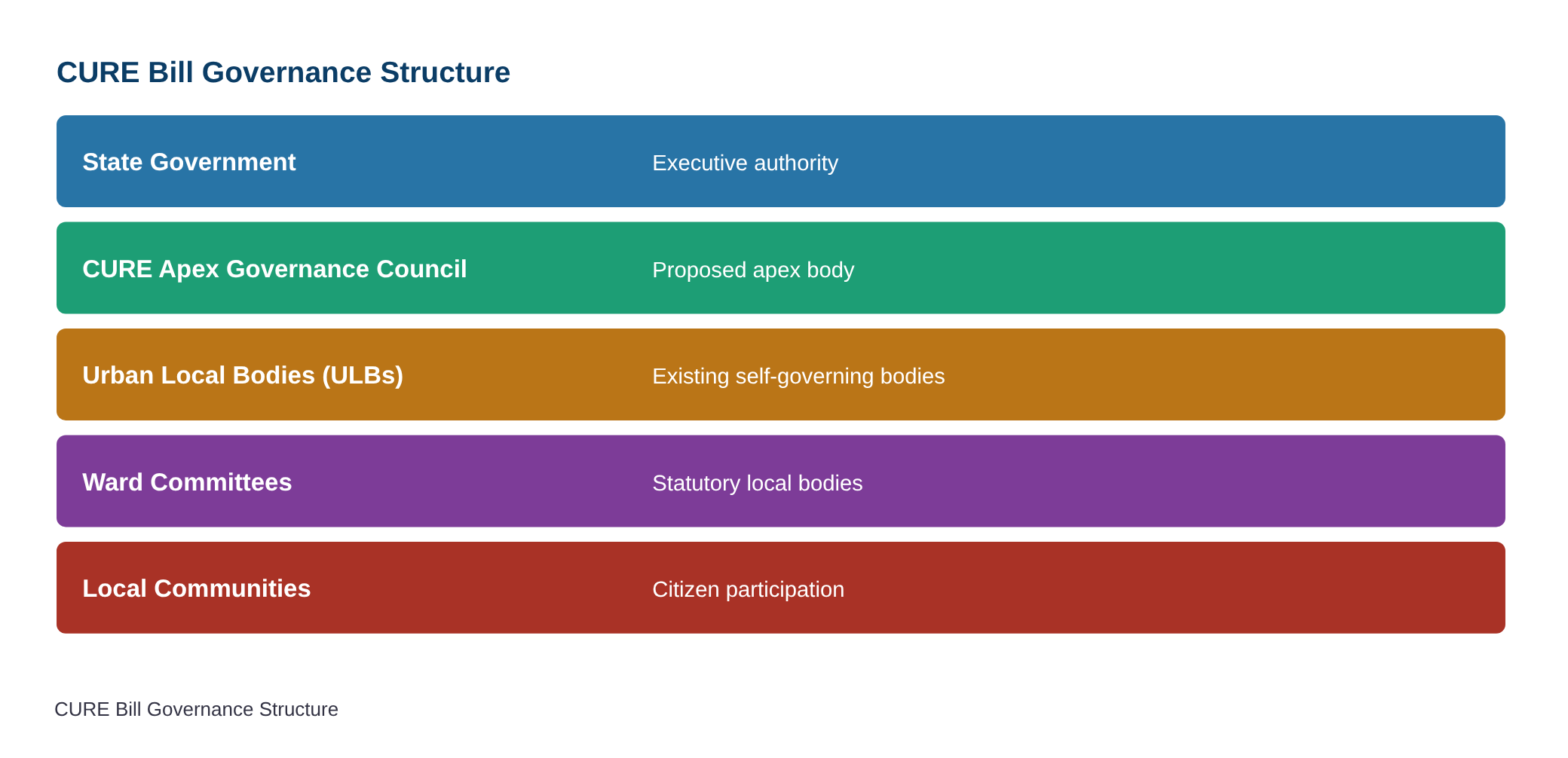
- It introduces a hierarchical structure of governance bodies, including a CURE Apex Governance Council, which would exercise overarching policy and planning powers but may exclude elected representatives from municipal corporations, raising questions about democratic accountability.
- The Bill seeks to vest significant powers in newly created authorities, with key functions such as property tax administration, infrastructure planning, and service delivery delegated to executive bodies rather than elected local governments.
- Provisions allow the State government to authorise CURE authorities to exercise powers beyond the Core Urban Region, potentially extending the Bill’s jurisdiction into areas not originally envisaged, which may conflict with the constitutional scheme of local governance.
- The Bill proposes modifications to the role and functions of ward committees, which under the GHMC Act, 1955, are statutorily empowered to supervise civic services, monitor institutions, and facilitate public participation in governance.
- Property tax administration under the Bill includes mechanisms for automatic revisions based on guideline values, discretionary powers for assessment units, and limited avenues for appeal, raising concerns about procedural fairness and transparency.
- The Bill does not specify the composition, powers, and functions of several newly created bodies in the Act itself, leaving these to executive notifications, which may lead to lack of clarity and potential misuse of power.
- The Bill’s provisions on the use of property tax revenue lack specific safeguards for ward- or zone-specific allocation, undermining the principle of subsidiarity in local governance and fiscal decentralisation.
Key Features
| Feature | Significance |
|---|---|
| CURE Apex Governance Council | Proposed apex body with overarching powers over policy direction and plans of the Core Urban Region (CURE), excluding elected representatives from municipal corporations, raising questions on democratic accountability in urban governance. |
| Ward Committee Powers | Reduction in statutory rights and functions of ward committees compared to the GHMC Act, 1955, potentially undermining local participation and civic oversight in urban planning and service delivery. |
| Property Tax Provisions | Executive discretion in determining guideline values, automatic revision of property tax, and lack of a specialised Property Tax Board, raising concerns over transparency, equity, and administrative fairness in tax assessment. |
| CURE Authority Jurisdiction | Provisions allowing CURE authorities to exercise powers beyond the Core Urban Region, which may blur the delineation of administrative boundaries and responsibilities under urban governance frameworks. |
| Appeal Mechanism | Establishment of a CURE Appellate Authority, but concerns over the effectiveness of appeals due to inadequate recording and communication of assessment decisions, impacting grievance redressal. |
Why it Matters
Urban Governance and Local Self-Government
- The Bill proposes a new governance architecture for the Core Urban Region, which may redefine the balance of power between state agencies, municipal bodies, and local communities, with implications for decentralisation and participatory democracy.
- The exclusion of elected representatives from the CURE Apex Governance Council raises constitutional questions regarding the principle of representative governance in urban local bodies as enshrined in the 74th Constitutional Amendment Act, 1992.
- The reduction in powers of ward committees could undermine the statutory framework for citizen participation in urban governance, a cornerstone of the 74th Amendment.
Fiscal Federalism and Revenue Management
- The Bill’s property tax provisions introduce significant executive discretion, which may impact fiscal federalism by altering the revenue base of local governments and their financial autonomy.
- Concerns over the lack of a specialised Property Tax Board and automatic revisions of property tax without objective criteria could lead to inequitable tax burdens and administrative arbitrariness.
- Safeguards sought for ward- or zone-specific allocation of property tax revenue aim to ensure that local infrastructure needs are addressed, reflecting principles of fiscal decentralisation.
Administrative Efficiency and Accountability
- The Bill’s provisions for newly created bodies with powers left to executive notifications may lead to administrative opacity and lack of accountability, particularly in the absence of clear criteria and transparency mechanisms.
- The proposed CURE Appellate Authority’s effectiveness hinges on robust record-keeping and communication of assessment decisions, highlighting the need for institutional safeguards in administrative processes.
Challenges
1. Constitutional Validity of Exclusion of Elected Representatives
- The exclusion of elected representatives from the CURE Apex Governance Council may violate the principles of representative governance as mandated by the 74th Constitutional Amendment Act, 1992, which requires urban local bodies to be governed by elected representatives.
- The Bill’s governance structure could be challenged on the grounds of violating the constitutional mandate for decentralisation and local self-government.
UPSC Link: 74th Constitutional Amendment Act, 1992
2. Erosion of Ward Committee Powers
- The reduction in statutory rights and functions of ward committees compared to the GHMC Act, 1955, may undermine the statutory framework for citizen participation in urban governance.
- This could lead to reduced civic engagement and oversight, potentially affecting the quality of urban service delivery and planning.
UPSC Link: 74th Constitutional Amendment Act, 1992 (Part IX-A)
3. Lack of Transparency in Property Tax Assessment
- The absence of a specialised Property Tax Board and the executive’s power to modify guideline values without objective criteria may result in arbitrary and inequitable tax assessments.
- The automatic revision of property tax following changes in guideline values raises concerns over administrative fairness and the potential for revenue disputes.
UPSC Link: Article 265 (Taxes not to be imposed save by authority of law)
4. Administrative Opacity in Newly Created Bodies
- The Bill’s reliance on executive notifications to define the composition, powers, and functions of newly created bodies may lead to administrative opacity and lack of accountability.
- This could result in arbitrary decision-making and reduced transparency in urban governance processes.
UPSC Link: Administrative Law Principles (Natural Justice)
5. Jurisdictional Ambiguity in CURE Authority Powers
- Provisions allowing CURE authorities to exercise powers beyond the Core Urban Region may blur the delineation of administrative boundaries and responsibilities, leading to jurisdictional conflicts.
- This could undermine the clarity and effectiveness of urban governance frameworks.
UPSC Link: Article 243Q (Constitution of Municipalities)
Challenges — UPSC Perspective
| Issue | Concern |
|---|---|
| Exclusion of Elected Representatives | Potential violation of the 74th Constitutional Amendment Act, 1992, and principles of representative governance in urban local bodies. |
| Reduction in Ward Committee Powers | Undermining of statutory framework for citizen participation in urban governance and local self-government. |
| Executive Discretion in Property Tax | Risk of arbitrary and inequitable tax assessments, lack of transparency, and administrative arbitrariness. |
| Opacity in Newly Created Bodies | Lack of clear criteria for defining powers and functions, leading to administrative opacity and reduced accountability. |
| Jurisdictional Ambiguity | Blurring of administrative boundaries and responsibilities, resulting in potential conflicts and reduced effectiveness of urban governance. |
| Effectiveness of Appeal Mechanism | Concerns over the adequacy of the CURE Appellate Authority due to inadequate recording and communication of assessment decisions. |
Way Forward
- The Telangana Legislative Assembly should conduct a comprehensive review of the Bill, incorporating public feedback and addressing concerns raised by stakeholders, including local governments and civil society.
- Ensure the inclusion of elected representatives in the CURE Apex Governance Council to align with the constitutional mandate for representative governance in urban local bodies.
- Restore the statutory rights and functions of ward committees to their original scope under the GHMC Act, 1955, to strengthen local participation and civic oversight.
- Establish a specialised Property Tax Board with clear, objective criteria for property tax assessment, including guideline values and revision mechanisms, to ensure transparency and equity.
- Define the jurisdiction of CURE authorities clearly to avoid overlap or conflict with existing municipal bodies, ensuring administrative clarity and effectiveness.
- Strengthen the CURE Appellate Authority by mandating detailed record-keeping and communication of assessment decisions to enhance the effectiveness of grievance redressal.
- Introduce safeguards for the allocation of property tax revenue, such as ward- or zone-specific accounting and utilisation for local infrastructure, to ensure fiscal decentralisation and accountability.
- Publish a consolidated text of the Bill, clearly indicating changes made after public consultation, to enhance transparency and public trust in the legislative process.
UPSC Value Addition
Keywords for Mains Answer-Writing
74th Constitutional Amendment Act, 1992 · Urban Local Bodies · Core Urban Region (CURE) Bill, 2026 · Ward Committees · Property Tax Reforms · Governor’s Role in State Legislation · Governance Architecture of Urban Local Governments · Public Policy and Constitutional Governance · Statutory Rights of Local Governments · Urban Governance and Federalism · Executive Notifications and Delegated Legislation · Urban Planning and Infrastructure Financing · Intergovernmental Relations in Urban Governance
Constitutional & Policy Linkages
- Article 243Q: Constitution of Municipalities (74th Amendment Act, 1992)
- Article 243P: Definitions (74th Amendment Act, 1992)
- Article 243W: Powers, Authority and Responsibilities of Municipalities (74th Amendment Act, 1992)
- Article 265: Taxes not to be imposed save by authority of law
- 74th Constitutional Amendment Act, 1992: Part IX-A (The Municipalities)
Concept Flow
Public Policy Expert’s Representation to Governor → Concerns raised on governance structure, powers of new bodies, and property tax provisions → Governor urged to return Bill for reconsideration → Constitutional questions on exclusion of elected representatives → Potential violation of 74th Amendment Act, 1992 → Review of Bill by Legislative Assembly → Incorporation of public feedback and alignment with constitutional mandates → Enactment of revised Bill with safeguards for transparency and accountability.
Prelims Practice Questions
Q1. Consider the following statements regarding the 74th Constitutional Amendment Act, 1992:
1. It mandates the creation of Ward Committees in all Urban Local Bodies.
2. It provides for the establishment of Metropolitan Planning Committees.
3. It empowers State Governments to dissolve Urban Local Bodies without prior approval of the State Legislature.
4. It requires that at least one-third of the seats in Urban Local Bodies be reserved for women.
How many of the above statements are correct?
- Only one
- Only two
- Only three
- All four
Answer: Only three — Statements 1, 2, and 4 are correct as per the 74th CAA. Statement 3 is incorrect because the Act does not empower State Governments to dissolve Urban Local Bodies unilaterally; dissolution requires legislative or judicial processes.
Q2. Assertion (A): The Governor of a State can return a Bill passed by the State Legislature for reconsideration.
Reason (R): The Governor’s power to return a Bill is derived from Article 200 of the Constitution of India.
Options:
A. Both A and R are true, and R is the correct explanation of A.
B. Both A and R are true, but R is NOT the correct explanation of A.
C. A is true, but R is false.
D. A is false, but R is true.
Answer: ? — Both A and R are true. The Governor can return a Bill for reconsideration under Article 200, and R correctly explains the constitutional basis of this power.
Q3. Match the following provisions of the 74th Constitutional Amendment Act with their respective descriptions:
Column I (Provision) | Column II (Description)
— | —
1. Composition of Municipalities | A. Reservation of seats for women, SCs, STs, and OBCs
2. Ward Committees | B. Creation of Metropolitan Planning Committees
3. State Finance Commission | C. Constitution of Municipal Boards with elected representatives
4. Metropolitan Planning Committee | D. Advisory bodies for urban planning in metropolitan areas
Options:
A. 1-A, 2-D, 3-B, 4-C
B. 1-C, 2-D, 3-A, 4-B
C. 1-B, 2-A, 3-D, 4-C
D. 1-D, 2-C, 3-B, 4-A
Answer: ? — 1-C (Composition of Municipalities involves elected representatives), 2-D (Ward Committees are advisory bodies), 3-A (State Finance Commission advises on municipal finance), 4-B (Metropolitan Planning Committees are created for urban planning).
Mains Practice Question
✍ The Core Urban Region (Integrated Governance) Bill, 2026, seeks to redefine the governance architecture of urban local bodies in Telangana. Critically examine the constitutional and governance implications of the Bill’s provisions, particularly with reference to the 74th Constitutional Amendment Act, 1992, and the principles of local self-governance. Also, assess the concerns raised regarding the dilution of statutory rights of Ward Committees and the proposed powers of newly created bodies. (15 Marks)
Approach: MODEL-ANSWER SKELETON:
1. **Introduction (2 marks)**
– Briefly outline the 74th CAA’s objectives: decentralisation, local self-governance, and empowerment of Urban Local Bodies (ULBs).
– Mention the Telangana CURE Bill’s stated aim: integrated governance for the Core Urban Region.
2. **Governance Architecture and Constitutional Implications (4 marks)**
– **74th CAA Compliance**: Examine whether the Bill aligns with the CAA’s provisions on ULB composition, Ward Committees, and Metropolitan Planning Committees.
– **Role of Elected Representatives**: Critically assess the exclusion of elected representatives from the CURE Apex Governance Council, citing constitutional principles of representative democracy (Arts. 243P to 243ZG).
– **Delegated Legislation**: Discuss concerns over powers left to executive notifications, which may dilute legislative oversight (Art. 243ZD).
3. **Ward Committees and Statutory Rights (4 marks)**
– **Statutory Rights under 74th CAA**: Compare the Bill’s provisions on Ward Committees with the GHMC Act, 1955, and the CAA’s mandate for participatory governance.
– **Dilution of Functions**: Analyse the Bill’s reduction of Ward Committees’ roles (e.g., supervision of civic services, access to information) and its impact on local accountability.
– **Constitutional Concerns**: Link to Art. 243S, which mandates Ward Committees as statutory bodies in metropolitan areas.
4. **Property Tax Reforms and Fiscal Federalism (3 marks)**
– **Fiscal Autonomy**: Evaluate the Bill’s provisions on property tax, including the absence of a Property Tax Board, automatic revisions, and the Commissioner’s powers to alter assessment units.
– **Revenue Allocation**: Discuss the demand for ward-specific accounting and allocation of property tax revenue for local infrastructure, in line with Art. 243X.
– **Transparency and Accountability**: Critique the lack of criteria for assessment corrections and the need for reasoned orders (Art. 243W).
5. **Conclusion (2 marks)**
– Summarise the constitutional and governance risks posed by the Bill.
– Suggest reforms: inclusion of elected representatives in apex bodies, restoration of Ward Committee powers, and transparent fiscal mechanisms.
– Emphasise the need for alignment with the 74th CAA and principles of cooperative federalism.
Source: The Hindu
Telangana PCS (TGPSC (TSPSC)) — State PCS Practice
Prelims: Recently, the Governor of Telangana was urged to return which Bill to the State Assembly for reconsideration, citing concerns over its provisions?
- A. Telangana Public Employment (Reservation) Bill, 2024
- B. Telangana CURE (Comprehensive Urban and Rural Empowerment) Bill, 2024
- C. Telangana Land Acquisition (Amendment) Bill, 2024
- D. Telangana Education (Regulation) Bill, 2024
Answer: B. Telangana CURE (Comprehensive Urban and Rural Empowerment) Bill, 2024 — The Governor was urged to return the Telangana CURE (Comprehensive Urban and Rural Empowerment) Bill, 2024, to the Assembly for reconsideration due to concerns over its provisions.
Mains: Critically analyze the constitutional provisions and recent judicial precedents governing the role of the Governor in returning a Bill to the State Legislature for reconsideration. Discuss how this power has been exercised in the context of Telangana’s CURE Bill, 2024, and its implications for federalism and cooperative governance.
Generated by AanyaAi for educational purpose.
Related guides on our sites
- Anthropology VS PSIR
- Best PSIR optional coaching
- Best PSIR optional coaching online
- Best PSIR optional teacher

- Telangana Governor urged to return CURE Bill for reconsideration - September 16, 2026
- पाकिस्तान द्वारा पीओके में अनिश्चितकालीन इंटरनेट बंद: मानवाधिकार उल्लंघन - September 16, 2026
- PoK Internet Shutdown: Human Rights Violation & Governance Failure - September 16, 2026

No Comments