


11 Aug Union Minister Launches National Scholarship Portal for Agri Students: Key Highlights for UPSC/PCS
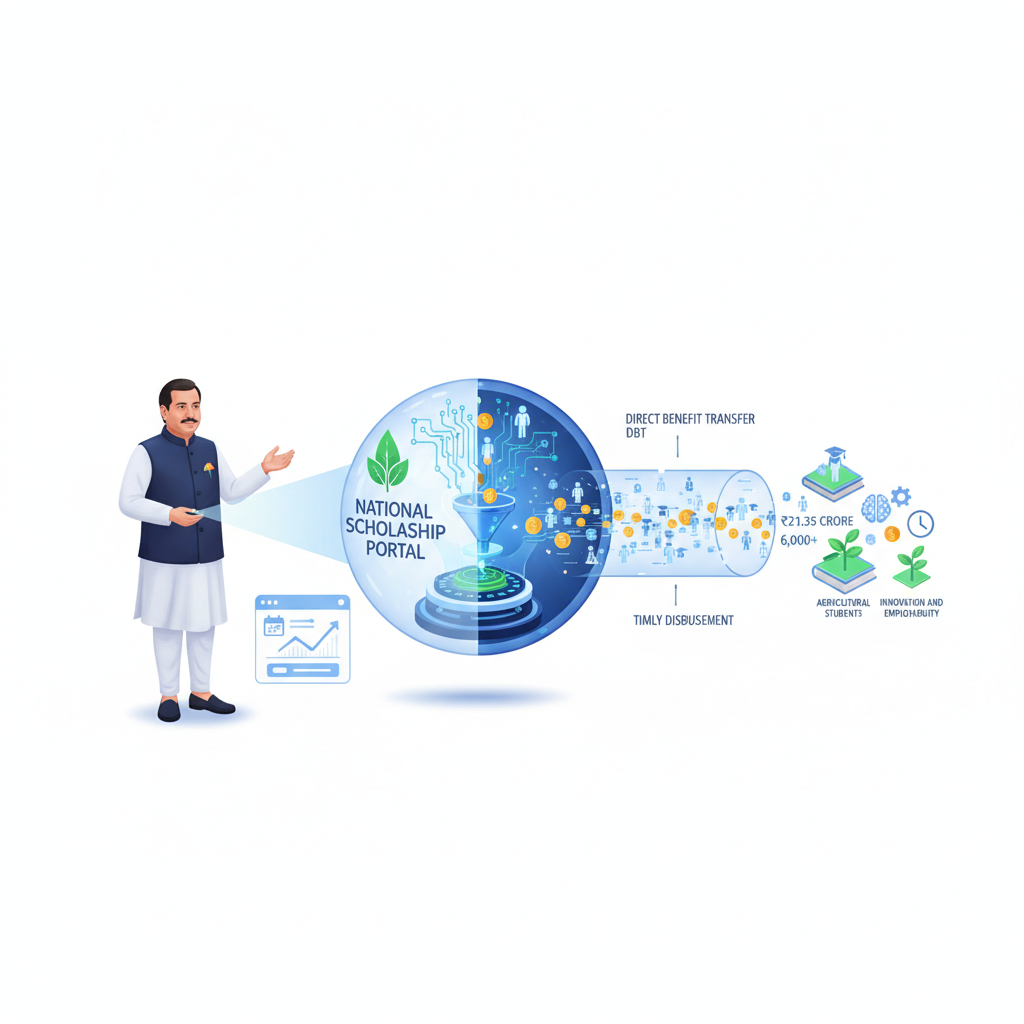
✎ The National Scholarship Portal (NSP) for agricultural students, launched in August 2026, leverages Direct Benefit Transfer (DBT) to disburse ₹21.35 crore to over 6,000 students, ensuring transparency, timeliness, and integration…
Subject Relevance — Where This Topic Fits
- GS Paper II — Governance, Transparency and Accountability | GS Paper III — Issues related to Direct Benefit Transfer (DBT), Agricultural Education and Skill Development
- Prelims: National Scholarship Portal (NSP), Direct Benefit Transfer (DBT), Indian Council of Agricultural Research (ICAR), Agricultural Education in India, Pradhan Mantri Kisan Samman Nidhi (PM-KISAN), Food Security, Green Revolution
- Essay: The role of technology in transforming agricultural education and farmer welfare, Ensuring timely and transparent welfare delivery: Lessons from DBT in agricultural scholarships
Quick Revision: The National Scholarship Portal (NSP) for agricultural students, launched in August 2026, leverages Direct Benefit Transfer (DBT) to disburse ₹21.35 crore to over 6,000 students, ensuring transparency, timeliness, and integration of practical training in agricultural education.
Why is this in the news?
The Union Minister of Agriculture and Farmers’ Welfare, Shri Shivraj Singh Chouhan, launched the National Scholarship Portal (NSP) for agricultural students on 10 August 2026, releasing scholarships amounting to ₹21.35 crore for over 6,000 students through Direct Benefit Transfer (DBT). This initiative underscores the government’s focus on streamlining financial assistance, ensuring timely disbursement, and integrating practical training in agricultural education to enhance employability and innovation in the sector.
Background
- The National Scholarship Portal (NSP) is a digital platform under the Ministry of Education, Government of India, designed to disburse scholarships to students across various disciplines, including agriculture.
- Direct Benefit Transfer (DBT) is a welfare delivery mechanism where subsidies and scholarships are transferred directly to beneficiaries’ bank accounts, reducing leakages and delays.
- The Indian Council of Agricultural Research (ICAR) is an autonomous body responsible for coordinating, guiding, and managing research and education in agriculture in India.
- Agricultural education in India has historically faced challenges such as delayed scholarship disbursements, lack of practical exposure, and limited industry integration.
- The Government of India has prioritised agricultural education reform under the broader agenda of food security, nutritional security, and doubling farmers’ income.
- The NSP-DBT integration for agricultural students aligns with the government’s push for transparency, accountability, and efficiency in welfare delivery systems.
What is the National Scholarship Portal (NSP) for Agricultural Students?
- The NSP is a centralised digital platform that facilitates the disbursement of scholarships and fellowships to students pursuing agricultural education across India.
- The NSP-DBT system ensures that scholarship amounts are transferred directly to the bank accounts of eligible students, eliminating intermediaries and reducing delays.
- The initiative targets undergraduate, postgraduate, and doctoral students in agricultural sciences, including those enrolled in ICAR-affiliated institutions.
- The portal provides a single-window interface for students to apply for scholarships, track their applications, and receive disbursement updates in real time.
- The integration of NSP with DBT aligns with the government’s broader digital governance initiatives, such as the JAM Trinity (Jan Dhan, Aadhaar, Mobile) for financial inclusion.
- The initiative also emphasises the importance of practical training in agricultural education, encouraging students to engage in fieldwork, research, and innovation.
Key Features
| Feature | Significance |
|---|---|
| Direct Benefit Transfer (DBT) integration with NSP | Eliminates intermediaries, reduces delays, and ensures timely disbursal of scholarships to 6,000+ agricultural students |
| Automated scholarship disbursal mechanism | Streamlines the process of fund transfer, enhancing transparency and accountability in financial assistance |
| Emphasis on practical training in agricultural education | Aligns with the need for skill-based learning to produce competent farmers, scientists, and agri-entrepreneurs |
| Real-time tracking and grievance redressal system | Facilitates monitoring of scholarship distribution and addresses student concerns promptly |
| Inter-ministerial coordination (Agriculture, Rural Development) | Demonstrates a unified governance approach to support agricultural education and innovation |
Why it Matters
Economic
- Enhances financial inclusion of agricultural students by providing direct monetary support, reducing economic barriers to education
- Supports the development of a skilled workforce in agriculture, potentially increasing productivity and rural income
- Encourages investment in agricultural education and research, fostering innovation and entrepreneurship in the sector
Social
- Promotes equitable access to agricultural education by addressing financial constraints faced by students from marginalised backgrounds
- Strengthens the linkage between education, research, and field-level application, ensuring relevance of academic training to real-world agricultural challenges
- Encourages youth participation in agriculture and allied sectors, addressing the issue of rural-to-urban migration
Institutional
- Demonstrates the effective utilisation of digital governance tools (NSP-DBT) to improve service delivery in the education sector
- Highlights the role of ICAR and its affiliated institutions in fostering agricultural innovation and human resource development
- Reinforces the government’s commitment to aligning education policies with national priorities such as food security and farmer welfare
Strategic
- Supports the realisation of Sustainable Development Goals (SDG 2: Zero Hunger, SDG 4: Quality Education) through targeted educational interventions
- Contributes to India’s self-reliance in agricultural education and research, reducing dependency on foreign expertise
- Aligns with the National Education Policy (NEP) 2020’s emphasis on vocational training and skill development
Challenges
1. Digital Divide and Infrastructure Gaps
- Uneven access to digital infrastructure in rural areas may limit the reach of NSP-DBT for some students
- Dependence on technology requires robust cybersecurity measures to prevent data breaches or fraud
- Ensuring last-mile connectivity for seamless scholarship disbursal in remote agricultural regions
UPSC Link: GS-II: Governance, e-governance
2. Ensuring Quality and Relevance of Agricultural Education
- Balancing theoretical knowledge with practical training to meet industry and field demands
- Addressing the mismatch between academic curricula and evolving agricultural technologies and practices
- Encouraging research that addresses local agricultural challenges while maintaining global standards
UPSC Link: GS-III: Agriculture, Education
3. Financial Sustainability and Resource Allocation
- Ensuring consistent funding for scholarships without compromising other agricultural development programmes
- Managing the scalability of DBT systems to accommodate increasing numbers of beneficiaries
- Preventing misallocation or underutilisation of funds due to administrative or procedural inefficiencies
UPSC Link: GS-III: Budgeting, Public Finance
4. Stakeholder Engagement and Feedback Mechanisms
- Institutionalising mechanisms for continuous feedback from students, faculty, and industry to refine the scholarship programme
- Ensuring transparency in the selection and disbursal process to maintain trust among beneficiaries
- Addressing potential resistance or scepticism from traditional stakeholders accustomed to conventional scholarship models
UPSC Link: GS-II: Transparency & Accountability
5. Aligning with Global Standards and Competitiveness
- Ensuring that Indian agricultural education remains competitive with international institutions in terms of curriculum and research output
- Facilitating international collaborations and exchanges to enhance the quality of education and innovation
- Addressing the brain drain of skilled agricultural professionals to other sectors or countries
UPSC Link: GS-II: International Relations, Education
Challenges — UPSC Perspective
| Issue | Concern |
|---|---|
| Digital Literacy among Students | Limited familiarity with NSP-DBT portal may hinder effective utilisation |
| Regional Disparities in Internet Access | Rural and remote areas may face connectivity issues affecting scholarship disbursal |
| Curriculum-Field Mismatch | Theoretical education may not adequately prepare students for practical agricultural challenges |
| Funding Fluctuations | Unpredictable budget allocations could disrupt the continuity of scholarship disbursals |
| Administrative Delays in Disbursal | Bureaucratic hurdles may still persist despite DBT integration |
| Monitoring and Evaluation Gaps | Lack of robust tracking systems to assess the impact of scholarships on students’ careers |
Government Initiatives — Must-Memorise for Prelims
- National Scholarship Portal (NSP)
- Direct Benefit Transfer (DBT) Scheme
- National Education Policy (NEP) 2020 (relevant provisions for skill-based education)
- ICAR’s Student READY Programme (for practical training and research exposure)
Way Forward
- Strengthen digital infrastructure in rural and semi-urban agricultural institutions to ensure seamless access to NSP-DBT
- Develop a robust grievance redressal mechanism integrated with the NSP portal for real-time issue resolution
- Collaborate with state governments to conduct awareness campaigns on the benefits and utilisation of NSP-DBT
- Revise agricultural education curricula to incorporate more practical training, internships, and industry partnerships
- Establish a dedicated research fund within ICAR to support innovative projects by scholarship recipients
- Promote international collaborations to expose students to global best practices in agricultural science and technology
- Conduct periodic impact assessments to evaluate the effectiveness of scholarships in improving educational outcomes and career trajectories
- Encourage alumni networks and mentorship programmes to guide students in their academic and professional journeys
UPSC Value Addition
Keywords for Mains Answer-Writing
National Scholarship Portal (NSP) · Direct Benefit Transfer (DBT) in scholarships · Agricultural education and innovation · Practical training in agriculture · ICAR institutions and scholarships · Food security and nutrition · Farmer income security · Digital governance in education · Transparency in scholarship disbursement · Agricultural research and startups
Constitutional & Policy Linkages
- Article 29(2): Right against discrimination in educational institutions (ensuring equitable access to scholarships)
- Article 30: Cultural and educational rights (protecting minority institutions in agricultural education)
- Article 41: Directive Principle of State Policy on right to work and education (supporting scholarships as a means to education)
- Seventh Schedule: Concurrent List (Education and Agriculture fall under shared responsibility of Centre and States)
Concept Flow
Agricultural education as a driver of rural development and food security → Government intervention via scholarships to address financial barriers to education → Integration of NSP with DBT for transparent and timely disbursal of funds → Emphasis on practical training to bridge the gap between academia and field realities → Enhanced employability and innovation in agriculture through skilled human resources → Long-term impact: Strengthened agricultural sector, improved farmer welfare, and national self-reliance
Prelims Practice Questions
Q1. Consider the following statements regarding the National Scholarship Portal (NSP):
1. The NSP is a digital platform for disbursing scholarships to students across India.
2. The NSP operates under the Ministry of Education.
3. The NSP uses Direct Benefit Transfer (DBT) to ensure timely disbursement of scholarships.
4. The NSP is exclusively for agricultural students.
How many of the above statements are correct?
- Only one
- Only two
- Only three
- All
Answer: Only three — Statements 1 and 3 are correct as NSP is a digital scholarship disbursement platform using DBT. Statement 2 is incorrect as NSP operates under the Ministry of Social Justice and Empowerment, not the Ministry of Education. Statement 4 is incorrect as NSP is not exclusive to agricultural students.
Q2. Assertion (A): The National Scholarship Portal (NSP) aims to ensure timely and transparent disbursement of scholarships to students.
Reason (R): The NSP uses Direct Benefit Transfer (DBT) to eliminate delays and ensure direct transfer of funds to beneficiaries’ accounts.
Options:
A. Both A and R are true, and R is the correct explanation of A.
B. Both A and R are true, but R is not the correct explanation of A.
C. A is true, but R is false.
D. A is false, but R is true.
Answer: ? — Both Assertion (A) and Reason (R) are true. The NSP indeed aims for timely and transparent disbursement of scholarships, and the use of DBT is a key mechanism to achieve this by ensuring direct transfer of funds to beneficiaries’ accounts.
Mains Practice Question
✍ The integration of Direct Benefit Transfer (DBT) with the National Scholarship Portal (NSP) represents a significant advancement in the governance of educational scholarships. Critically examine the implications of this integration for agricultural education and innovation in India. (15 Marks)
Approach: MODEL-ANSWER SKELETON:
1. **Introduction (2 Marks)**:
– Define NSP and DBT, and their roles in governance.
– Contextualise the integration within the broader framework of agricultural education and innovation.
2. **Mechanism and Objectives (3 Marks)**:
– Explain how NSP-DBT ensures timely, transparent, and leakage-free disbursement of scholarships.
– Highlight the specific provisions for agricultural students (e.g., ICAR scholarships, fellowships).
– Reference the recent initiative where 6,000+ agricultural students received ₹21.35 crore via DBT.
3. **Impact on Agricultural Education (4 Marks)**:
– **Access and Equity**: How DBT reduces financial barriers for students from marginalised backgrounds.
– **Quality and Practical Training**: Emphasis on experiential learning (e.g., fieldwork, internships) as per the Minister’s statement.
– **Institutional Strengthening**: Role of ICAR institutions in fostering research and innovation.
4. **Fostering Innovation and Startups (3 Marks)**:
– Link scholarships to agricultural innovation (e.g., agri-startups, research projects).
– Cite examples of how financial support enables students to pursue entrepreneurial ventures.
– Role of government schemes (e.g., Agri-Infrastructure Fund, PM-KISAN) in complementing NSP-DBT.
5. **Challenges and Criticisms (2 Marks)**:
– Digital divide and accessibility issues for students in remote areas.
– Ensuring accountability and grievance redressal mechanisms.
– Potential delays in scholarship processing despite DBT.
6. **Conclusion (1 Mark)**:
– Summarise the transformative potential of NSP-DBT in aligning agricultural education with national priorities (food security, nutrition, farmer income).
– Emphasise the need for continuous monitoring and feedback mechanisms.
Source: PIB (Press Information Bureau)
Generated by AanyaAi for educational purpose.

- KWML’s Feasibility Reports for Water Metro in 18 Cities: UPSC & PCS Insights - October 3, 2026
- ओडिशा में वन्यजीव अनुसंधान अनुदान कार्यक्रम शुरू, सिमिलिपाल में 300 कैमरे और बढ़ेंगे - October 3, 2026
- India Summons Pakistan High Commission Official Over Violation - October 3, 2026

No Comments