


19 Sep UPSC 2025 Geography optional Paper 2 analysis
UPSC 2025 Geography Optional Paper 2 Analysis – Reflections from Plutus IAS
The Union Public Service Commission (UPSC) Civil Services Examination is considered the toughest competitive exam in India. Among its many optional subjects, Geography has consistently remained one of the most popular choices. The optional is divided into two papers: Paper 1 (Physical and Human Geography) and Paper 2 (Indian Geography). While Paper 1 tests aspirants on conceptual and theoretical aspects, Paper 2 deals with applied and India-centric geography, making it both dynamic and challenging.
The UPSC 2025 Geography Optional Paper 2 continued this trend. It required aspirants not only to recall theoretical knowledge but also to apply it to India’s geographical realities, including resources, industries, agriculture, population, regional planning, and environmental issues. Interestingly, a detailed analysis shows that several questions reflected the classroom discussions, notes, and test series of Plutus IAS. This provided aspirants trained at Plutus IAS a distinct edge in tackling the paper with confidence.
Geography optional Paper 1 analysis
Best geography optional coaching
Best geography optional teacher
Best geography optional test series
Importance of Geography Paper 2
Paper 2 of the Geography optional syllabus focuses on India, covering:
- Physical Setting of India – structure, physiography, drainage, and climate.
- Resources – agriculture, water, minerals, energy resources.
- Economic Geography – industries, transport, trade, and regional development.
- Population and Settlement – growth, distribution, urbanization, migration.
- Contemporary Issues – environmental concerns, planning, policies, globalization.
Unlike Paper 1, Paper 2 requires aspirants to stay updated with current developments, government schemes, and regional policies. It demands the ability to apply geographical theories to India’s realities. That’s why expert guidance, like that of Plutus IAS, makes a difference in preparing students for such dynamic questions.
Overview of UPSC 2025 Geography Paper 2
The 2025 Paper 2 maintained UPSC’s reputation of being analytical and India-centric. The key highlights were:
- Balanced coverage of physical, economic, and human geography of India.
- Questions that linked traditional topics with contemporary developments.
- Application-based questions requiring maps, diagrams, and case studies.
- Noticeable reflections of themes discussed in Plutus IAS classes and test series.
The difficulty level of the paper can be categorized as moderate to difficult. Students with conceptual clarity and practice in answer writing with maps found the paper manageable, while others found it challenging.
Section-Wise Analysis of UPSC 2025 Geography Paper 2
1. Physical Setting of India
The paper included a question on the Himalayan tectonic activity and its impact on seismic hazards. This directly resonated with Plutus IAS lectures, where faculty explained the Indo-Eurasian plate collision, seismic zones of India, and case studies like the 2001 Bhuj earthquake and the 2015 Nepal earthquake. Students from Plutus IAS were prepared to provide a structured answer with both theory and case references.
Another question on the climatic variability of Indian monsoon was also covered in Plutus IAS classes. Aspirants recalled that teachers emphasized El Niño, La Niña, Indian Ocean Dipole, and climate change impact on monsoon patterns, which provided content for enriched answers.
2. Resources of India
Questions in this section included distribution and challenges of coal and natural gas resources. This had been a recurring theme in Plutus IAS test series. Aspirants were encouraged to integrate government initiatives such as the National Gas Grid and the shift toward renewable energy, which matched the requirements of the 2025 paper.
A question on water resource management in India also appeared, reflecting classroom discussions where Plutus IAS had emphasized interlinking of rivers, groundwater depletion, and policies like Jal Jeevan Mission. Students trained here could provide multidimensional perspectives, combining physical, economic, and policy-related aspects.
3. Agriculture
Agriculture formed the backbone of Paper 2 again in 2025. Key questions included:
- Green Revolution and its regional imbalance: Plutus IAS classes had stressed both achievements and challenges of the Green Revolution, particularly its overemphasis on Punjab, Haryana, and Western UP while neglecting Eastern and Northeastern India.
- Crop diversification: Aspirants were required to analyze the push towards horticulture, pulses, and oilseeds under schemes like PMKSY and NFSM. These schemes were thoroughly covered in Plutus IAS notes, giving students an edge.
- Impact of climate change on agriculture: This was a repeated theme in Plutus IAS discussions, where students were encouraged to use examples like shifting cropping patterns and extreme weather events affecting yields.
4. Industries
The 2025 paper asked about the IT industry and its spatial concentration. Plutus IAS mock tests had a similar question focusing on Bengaluru, Hyderabad, Pune, and Noida as IT hubs. Faculty emphasized reasons like skilled manpower, government IT policies, and global outsourcing trends, which matched the exam’s demand.
A question on iron and steel industry in India also appeared. Plutus IAS had detailed this with maps showing Jamshedpur, Rourkela, and Bhilai, along with challenges like dependence on imported coking coal and global competition.
5. Population and Urbanization
This section included questions on rural-urban migration and its socio-economic impact. Plutus IAS had highlighted push and pull factors, with case studies like Delhi and Mumbai urban influx, which directly helped students enrich their answers.
Another question focused on problems of Indian urbanization such as slums, congestion, waste management, and infrastructure stress. These issues were thoroughly discussed in Plutus IAS classes, often connected with government schemes like Smart Cities Mission and AMRUT.
6. Transport, Communication, and Trade
The paper featured a question on the role of inland waterways in India’s trade. This was anticipated in Plutus IAS sessions, where emphasis was given to National Waterway-1 and Sagarmala Project. Aspirants could write answers integrating both physical geography and government policies.
A question on the changing pattern of India’s foreign trade also reflected Plutus IAS test themes. Students who practiced these could highlight shifts from primary commodities to manufactured goods and India’s role in global trade organizations.
7. Regional Development and Planning
UPSC asked about regional disparities in India, a core topic of Plutus IAS test series. Faculty stressed reasons for disparities — historical neglect, uneven resource distribution, and policy imbalances. Aspirants were trained to supplement answers with maps highlighting BIMARU states and progressive regions like Southern India.
Another question on planning in India with special reference to NITI Aayog resonated with Plutus IAS discussions on the evolution from centralized planning to cooperative federalism.
8. Contemporary Issues
The final section had questions on environmental degradation, climate change, and disaster management. Plutus IAS had specifically trained students to use contemporary case studies like floods in Kerala, heatwaves in North India, and India’s commitments in COP summits. This gave aspirants an advantage in writing multidimensional and updated answers.
Reflections of Plutus IAS in Paper 2
Some clear overlaps between Plutus IAS preparation and the UPSC 2025 Geography Paper 2 include:
- Himalayan tectonics and seismicity – covered in Geomorphology-India integrated lectures.
- Climatic variability of monsoon – practiced through test questions.
- Coal and natural gas distribution – highlighted in test series with policy integration.
- Green Revolution and regional imbalance – directly reflected from classroom discussions.
- IT industry hubs – a repeated theme in mock tests.
- Rural-urban migration – case studies provided in Plutus IAS notes matched exam requirements.
- Inland waterways – emphasized in classes as part of transport geography.
- Regional disparities – predicted and practiced in essay-type test questions.
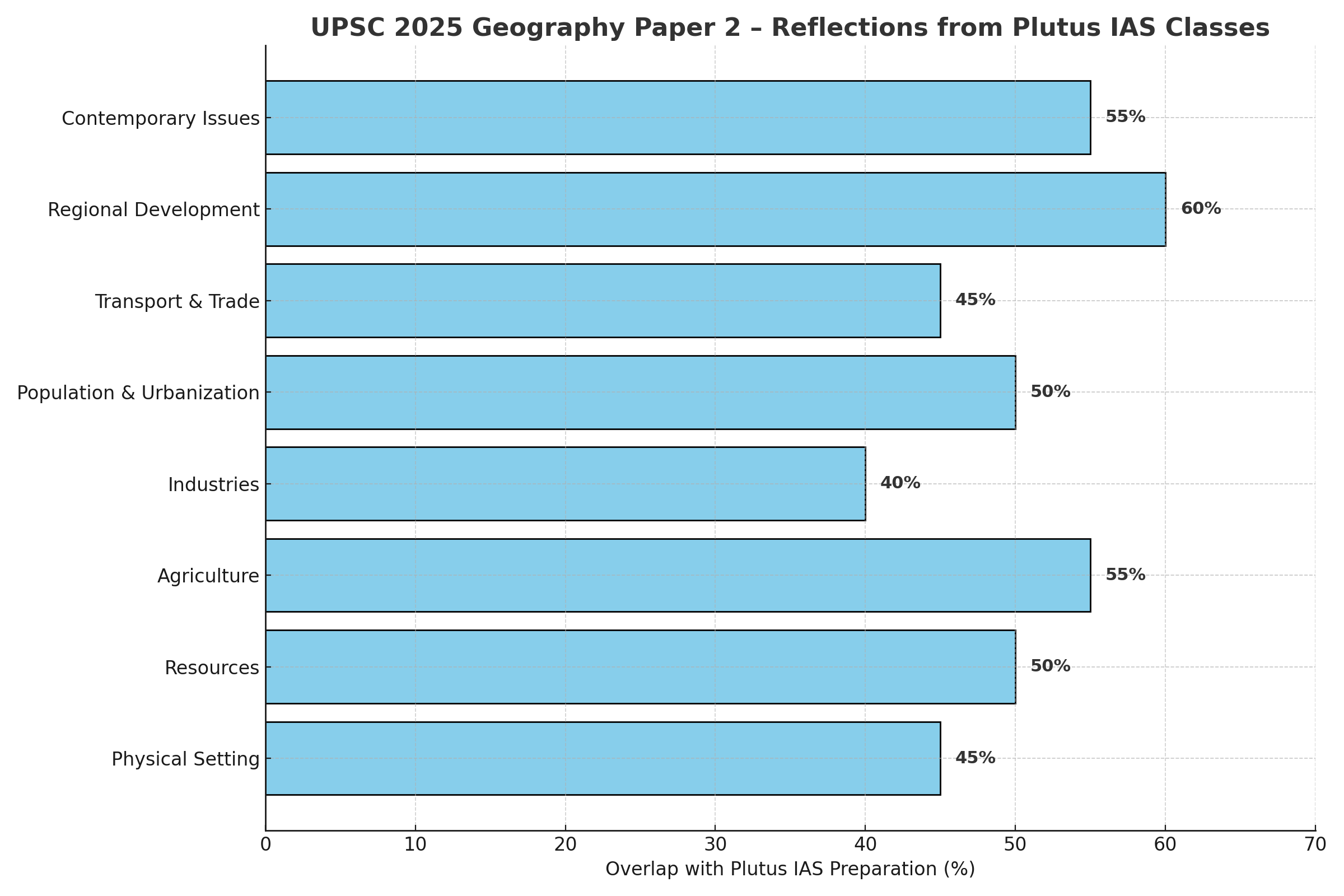
Students reported that nearly 40–50% of the paper’s questions overlapped in theme or approach with Plutus IAS classes. This alignment validates the institute’s teaching methodology and its ability to predict UPSC’s evolving trends.
Difficulty Level and Trends in 2025
The 2025 Paper 2 was moderately difficult. It was balanced in coverage but leaned towards application-based questions. Key trends include:
- Integration of physical and human aspects in Indian geography.
- Emphasis on current affairs and government policies.
- Focus on regional disparities, environmental issues, and planning.
- Need for diagrams, maps, and examples to fetch higher marks.
How Plutus IAS Prepared Students
Plutus IAS has emerged as a top choice for Geography optional aspirants because of its systematic coverage, predictive test series, and expert faculty. Their teaching approach helped students in 2025 in the following ways:
- Comprehensive Lectures: Covering every unit of Paper 2 with clarity and updated examples.
- Predictive Test Series: Many of the paper’s questions were part of their mock test discussions.
- Answer Writing Training: Students were taught to use maps, diagrams, and structured answers.
- Updated Notes: Notes included government schemes, policies, and latest reports.
- Mentorship: Personalized feedback refined answer quality and improved time management.
Student Reactions
Aspirants from Plutus IAS were satisfied after Paper 2. Many confirmed that nearly half of the questions overlapped with classroom or test content. This gave them confidence and reaffirmed their trust in the institute’s teaching model.
Key Takeaways for Future Aspirants
The 2025 analysis offers the following lessons:
- Analytical Preparation: Focus on application of concepts to India’s realities.
- Current Affairs Integration: Always link geographical answers to policies and contemporary issues.
- Practice Test Series: High-quality test series like Plutus IAS provide an edge.
- Maps and Case Studies: Use them to enrich answers and stand out.
- Structured Coaching: Institutes like Plutus IAS streamline preparation effectively.
Conclusion
The UPSC 2025 Geography Optional Paper 2 tested aspirants’ ability to interlink theory with India’s ground realities. With its balanced mix of physical setting, resources, agriculture, industries, population, transport, and contemporary issues, the paper rewarded those with holistic preparation. The reflections of Plutus IAS classroom teachings and test series in the paper highlighted the institute’s precision and reliability.
For future aspirants, the lesson is clear: structured, analytical, and updated preparation with expert mentorship is the key. With its proven record, Plutus IAS continues to stand out as the best platform for preparing Geography optional, helping aspirants not only prepare but also perform with confidence in the UPSC exam hall.

- बच्चों की भावनात्मक सुरक्षा और AI साथियों का जोखिम - October 8, 2026
- DDWS Conducts Regional Review of Jal Jeevan Mission 2.0 at IIM Bangalore - October 8, 2026
- आयुष्मान भारत: स्वास्थ्य सुरक्षा का मजबूत कवच, जानिए कैसे मिल रहा लाभ - October 8, 2026

No Comments