


12 Sep UPSC Alert: Centre Inaugurates Critical Care Blocks & Labs in Andhra Pradesh
✎ Critical Care Blocks (CCBs) and Integrated Public Health Laboratories (IPHLs) are twin pillars of India’s pandemic-ready health infrastructure under PM-ABHIM, designed to save lives during emergencies and detect outbreaks early…
Subject Relevance — Where This Topic Fits
- GS Paper II — Governance, Constitution, Polity, Social Justice and International Relations (Health Governance) | GS Paper III — Science and Technology, Health, Environment (Health Infrastructure and Pandemic Preparedness)
- Prelims: Critical Care Block (CCB), Integrated Public Health Laboratories (IPHL), Ayushman Bharat Health Infrastructure Mission (PM-ABHIM), National Health Mission (NHM), Disaster Management Act, 2005, Pandemic preparedness, Public health surveillance, Health emergency response, Intensive Care Units (ICU), Laboratory Networking
- Essay: Health Infrastructure as a Pillar of National Resilience, The Intersection of Technology and Public Health: Lessons from the Pandemic
Quick Revision: Critical Care Blocks (CCBs) and Integrated Public Health Laboratories (IPHLs) are twin pillars of India’s pandemic-ready health infrastructure under PM-ABHIM, designed to save lives during emergencies and detect outbreaks early through integrated surveillance and tertiary care.
Why is this in the news?
The inauguration of 10 Critical Care Blocks (CCBs) and 12 Integrated Public Health Laboratories (IPHLs) in Andhra Pradesh by the Union Health Minister underscores the ongoing implementation of the Ayushman Bharat Health Infrastructure Mission (PM-ABHIM), a central sector scheme aimed at fortifying India’s health system against future pandemics and public health emergencies while maintaining routine healthcare services. This initiative reflects a strategic shift from purely preventive healthcare to a comprehensive, tiered healthcare approach, integrating primary, secondary, and tertiary care with robust surveillance and emergency response mechanisms.
Background
- The COVID-19 pandemic exposed critical gaps in India’s health infrastructure, including inadequate critical care capacity, fragmented laboratory networks, and limited surge preparedness, necessitating a systemic overhaul.
- The National Health Policy 2017 emphasized the need for a resilient health system by strengthening the continuum of care—from preventive to tertiary services—through integrated service delivery and infrastructure development.
- The Disaster Management Act, 2005, provides the legal framework for coordinated response to public health emergencies, mandating preparedness plans at national, state, and district levels.
- The Ayushman Bharat Health Infrastructure Mission (PM-ABHIM) was launched with the objective to strengthen the health system’s capacity to deal with future pandemics and public health emergencies while continuing routine health services.
- Under PM-ABHIM, 631 Critical Care Blocks (CCBs) have been approved across India, including 10 in Andhra Pradesh, to enhance intensive care capacity and emergency response capabilities.
- Integrated Public Health Laboratories (IPHLs) are designed to integrate testing, surveillance, and data analytics for early detection and containment of disease outbreaks, aligning with the One Health approach.
What are Critical Care Blocks (CCBs) and Integrated Public Health Laboratories (IPHLs)?
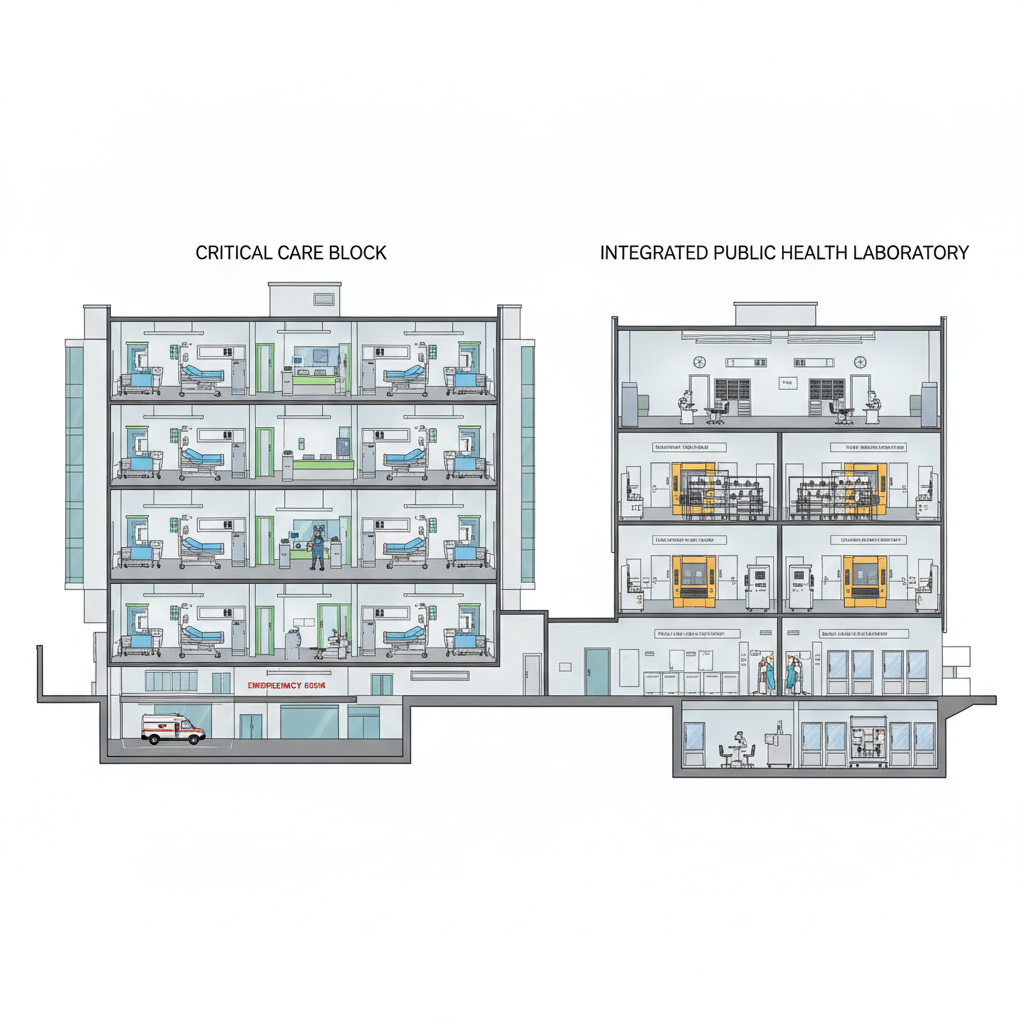
- Critical Care Blocks (CCBs): These are specialized units within district or tertiary care hospitals equipped with advanced life-support systems, including ICU beds, ventilators, oxygen supply, and trained medical personnel to manage critically ill patients. CCBs are designed to handle emergencies such as severe respiratory distress, sepsis, or trauma, ensuring uninterrupted tertiary care without compromising routine services.
- Integrated Public Health Laboratories (IPHLs): These are state-of-the-art diagnostic facilities that integrate microbiology, biochemistry, virology, and epidemiology under one roof. IPHLs are mandated to conduct real-time testing for notifiable diseases, genomic sequencing, and data-driven surveillance to detect outbreaks early and guide public health interventions.
- Tiered Healthcare Integration: CCBs and IPHLs are part of a broader strategy to strengthen the continuum of care—primary (health and wellness centres), secondary (district hospitals), and tertiary (medical colleges and super-specialty hospitals)—ensuring seamless referral and treatment pathways.
- Surveillance and Response: IPHLs serve as nodal centres for Integrated Disease Surveillance Programme (IDSP), enabling rapid outbreak detection, contact tracing, and containment. They are linked to the National Centre for Disease Control (NCDC) for real-time data sharing and policy formulation.
- Pandemic Preparedness: Both CCBs and IPHLs are designed to operate as surge capacity units during health emergencies, ensuring that routine healthcare services remain functional while emergency responses are scaled up efficiently.
- Technological Integration: IPHLs leverage digital tools such as AI-driven diagnostics, telemedicine, and blockchain for secure data management, while CCBs use electronic health records (EHRs) for patient monitoring and resource allocation.
- Human Resource Development: The establishment of CCBs and IPHLs is accompanied by training programs for healthcare workers in critical care, laboratory techniques, and emergency response protocols, ensuring a skilled workforce to operate these facilities.
Key Features
| Feature | Significance |
|---|---|
| Critical Care Block (CCB) | Provides advanced life-support infrastructure to manage critically ill patients, reducing mortality in emergencies such as sepsis, multi-organ failure, or post-surgical complications. |
| Integrated Public Health Laboratory (IPHL) | Enhances early detection of infectious diseases, antimicrobial resistance, and zoonotic threats through advanced diagnostic capabilities, enabling rapid public health response. |
| District-level deployment | Ensures decentralized critical care and diagnostic services, reducing urban-rural disparities in emergency healthcare access. |
| PM-ABHIM framework | Integrates tertiary care with primary and secondary healthcare, ensuring continuity of routine services during public health emergencies. |
| Standardized protocols | Facilitates interoperability between CCBs and IPHLs, enabling seamless data sharing and coordinated outbreak management. |
Why it Matters
Health Security Architecture
- Strengthens India’s resilience against future pandemics by creating a tiered healthcare infrastructure capable of handling both routine and emergency demands.
- Reduces dependence on ad-hoc conversions of existing facilities during crises, as witnessed during COVID-19 when non-COVID essential services were disrupted.
- Enhances India’s compliance with International Health Regulations (IHR, 2005) by improving early warning and response systems for disease outbreaks.
Economic Stability
- Minimizes economic losses from prolonged public health emergencies by preventing workforce disruptions and maintaining healthcare service continuity.
- Reduces out-of-pocket expenditure for families through timely and accessible critical care, thereby mitigating poverty due to health shocks.
Governance and Institutional Capacity
- Demonstrates a shift from reactive to proactive health governance, aligning with the National Health Policy (2017) emphasis on preventive and promotive healthcare.
- Strengthens state-level health systems, fostering a collaborative federal model for disaster preparedness and response.
Challenges
1. Human Resource Gaps
- Shortage of intensivists, critical care nurses, and laboratory technicians in rural and semi-urban areas, limiting effective utilization of CCBs and IPHLs.
- Need for continuous capacity-building programs to ensure standardized skill sets across facilities.
UPSC Link: GS-II: Health Infrastructure
2. Supply Chain Vulnerabilities
- Dependence on imported medical equipment and reagents for IPHLs, posing risks during global supply chain disruptions.
- Inadequate cold chain infrastructure for transporting biological samples in remote districts.
UPSC Link: GS-III: Health, Disaster Management
3. Regulatory and Data Integration Challenges
- Fragmented health data systems hinder real-time surveillance and coordinated response across states.
- Lack of standardized protocols for inter-state data sharing during public health emergencies.
UPSC Link: GS-II: E-Governance
4. Financial Sustainability
- Recurring operational costs for maintaining CCBs and IPHLs, including equipment upkeep, reagent procurement, and staff salaries.
- Risk of underutilization of facilities due to low awareness or poor referral mechanisms in certain districts.
UPSC Link: GS-III: Public Finance
5. Geographical and Logistical Barriers
- Hilly and tribal regions (e.g., Araku Valley) face connectivity challenges, delaying emergency response and sample transport.
- Limited last-mile delivery mechanisms for critical drugs and equipment in remote areas.
UPSC Link: GS-I: Tribal Welfare
Challenges — UPSC Perspective
| Issue | Concern |
|---|---|
| Human Resource Shortage | Insufficient trained personnel to operate CCBs and IPHLs, leading to underutilization or overburdening of existing staff. |
| Supply Chain Disruptions | Vulnerability to global shortages of diagnostic reagents and critical care drugs, particularly during crises. |
| Data Fragmentation | Lack of interoperable health information systems, impeding real-time disease surveillance and response coordination. |
| Financial Constraints | High recurring costs for maintenance and operations, risking long-term sustainability without adequate budgetary allocation. |
| Infrastructure Gaps | Inadequate transportation and connectivity in remote districts, delaying emergency medical interventions. |
| Regulatory Hurdles | Complexity in standardizing protocols across states, leading to inconsistencies in emergency response mechanisms. |
Government Initiatives — Must-Memorise for Prelims
- Pradhan Mantri Ayushman Bharat Health Infrastructure Mission (PM-ABHIM)
Way Forward
- Conduct periodic skill-gap assessments to identify and address human resource shortages in critical care and laboratory services.
- Establish dedicated supply chain networks for medical consumables, including buffer stocks for emergencies.
- Develop a unified health data platform (e.g., National Digital Health Mission) for real-time surveillance and inter-state coordination.
- Allocate dedicated funds under PM-ABHIM for maintenance and operational costs of CCBs and IPHLs.
- Strengthen last-mile connectivity in remote districts through public-private partnerships for emergency transport.
- Formulate standardized protocols for data sharing and emergency response, in alignment with WHO’s IHR (2005).
- Promote public awareness campaigns to enhance utilization of CCBs and IPHLs during routine and emergency scenarios.
- Leverage telemedicine and remote diagnostics to bridge gaps in specialist availability, particularly in rural areas.
UPSC Value Addition
Keywords for Mains Answer-Writing
Integrated Public Health Laboratories (IPHL) · Critical Care Blocks (CCB) · Ayushman Bharat Health Infrastructure Mission (PM-ABHIM) · Public health emergency preparedness · Health infrastructure strengthening · Primary, Secondary and Tertiary Healthcare integration · Pandemic preparedness · Health security framework · Public health surveillance · Health emergency response system
Concept Flow
COVID-19 pandemic → Disruption of routine healthcare services → Recognition of need for resilient health infrastructure → Launch of PM-ABHIM → Establishment of CCBs and IPHLs → Strengthening of early warning and critical care systems → Enhanced public health preparedness.
Prelims Practice Questions
Q1. Consider the following statements regarding the Ayushman Bharat Health Infrastructure Mission (PM-ABHIM):
1. PM-ABHIM was launched to strengthen India’s health infrastructure for routine healthcare services only.
2. Under PM-ABHIM, 631 Critical Care Blocks have been approved across India.
3. PM-ABHIM focuses exclusively on tertiary healthcare services.
How many of the above statements are correct?
- Only one
- Only two
- All three
- None
Answer: Only two — Statement 1 is incorrect as PM-ABHIM aims to strengthen health infrastructure for both routine and emergency healthcare services. Statement 2 is correct as the mission has approved 631 Critical Care Blocks nationwide. Statement 3 is incorrect as PM-ABHIM integrates primary, secondary, and tertiary healthcare services.
Q2. Assertion (A): Integrated Public Health Laboratories (IPHL) are designed to detect and respond to disease threats before they escalate into public health emergencies.
Reason (R): IPHLs are equipped with advanced diagnostic tools and surveillance systems to monitor and analyse health data in real time.
In the context of the above statements, which of the following is correct?
- Both A and R are true, and R is the correct explanation of A.
- Both A and R are true, but R is not the correct explanation of A.
- A is true, but R is false.
- A is false, but R is true.
Answer: Both A and R are true, and R is the correct explanation of A. — Assertion (A) is true as IPHLs are established to detect and respond to disease threats early. Reason (R) is also true and correctly explains why IPHLs can achieve this objective through advanced diagnostics and surveillance systems.
Q3. Match the following initiatives with their primary objectives:
Column I (Initiative) Column II (Primary Objective)
A. Critical Care Blocks (CCB) 1. Strengthening routine primary healthcare services
B. Integrated Public Health Labs 2. Enhancing tertiary care for critically ill patients
C. PM-ABHIM 3. Establishing a nationwide network for emergency health response
D. ‘Sanjeevani’ Programme (Andhra Pradesh) 4. Providing doorstep health services and health standards check-up
Select the correct match:
- A-2, B-3, C-1, D-4
- A-2, B-3, C-4, D-1
- A-3, B-2, C-1, D-4
- A-1, B-2, C-3, D-4
Answer: A-2, B-3, C-1, D-4 — Critical Care Blocks (CCB) aim to enhance tertiary care for critically ill patients (A-2). Integrated Public Health Labs (IPHL) are designed to establish a nationwide network for emergency health response (B-3). PM-ABHIM integrates primary, secondary, and tertiary healthcare services to strengthen health infrastructure (C-1). The ‘Sanjeevani’ Programme in Andhra Pradesh provides doorstep health services and health standards check-up (D-4).
Mains Practice Question
✍ Critically examine the significance of the Ayushman Bharat Health Infrastructure Mission (PM-ABHIM) in transforming India’s public health preparedness and response framework. How does the establishment of Critical Care Blocks (CCB) and Integrated Public Health Laboratories (IPHL) under PM-ABHIM contribute to this transformation? (15 Marks)
Approach: MODEL-ANSWER SKELETON:
1. **Introduction (2 Marks)**
– Brief context: Lessons from COVID-19 pandemic and the need for robust health infrastructure.
– Definition of PM-ABHIM: A centrally sponsored scheme under the National Health Mission (NHM) launched in 2021 to strengthen health infrastructure for both routine and emergency healthcare services.
2. **Objectives of PM-ABHIM (3 Marks)**
– Strengthening primary, secondary, and tertiary healthcare systems.
– Enhancing disease surveillance and early warning systems.
– Building resilience against future public health emergencies.
– Ensuring uninterrupted delivery of essential health services during crises.
3. **Role of Critical Care Blocks (CCB) (4 Marks)**
– Definition: Dedicated units within district hospitals for managing critically ill patients.
– Key features: Advanced life-support systems, trained medical staff, and integration with tertiary care.
– Contribution to public health preparedness: Reducing mortality rates, improving emergency response, and decongesting tertiary care facilities.
– Example: 631 CCBs approved under PM-ABHIM, including those inaugurated in Andhra Pradesh.
4. **Role of Integrated Public Health Laboratories (IPHL) (4 Marks)**
– Definition: State-of-the-art laboratories for disease detection, surveillance, and research.
– Key features: Real-time data analysis, genomic sequencing, and integration with national health databases.
– Contribution to public health preparedness: Early detection of outbreaks, rapid response to pandemics, and evidence-based policymaking.
– Example: 12 IPHLs inaugurated in Andhra Pradesh, enhancing the state’s disease surveillance capacity.
5. **Challenges and Way Forward (2 Marks)**
– Challenges: Funding constraints, human resource shortages, and inter-state coordination.
– Way forward: Leveraging technology (AI, telemedicine), strengthening public-private partnerships, and ensuring equitable distribution of resources.
6. **Conclusion (1 Mark)**
– PM-ABHIM represents a paradigm shift in India’s health infrastructure, integrating emergency preparedness with routine healthcare. The establishment of CCBs and IPHLs under this mission is a critical step toward building a resilient and responsive health system.
Source: PIB (Press Information Bureau)
Andhra Pradesh PCS (APPSC) — State PCS Practice
Prelims: Which of the following initiatives was inaugurated by the Union Health Minister, J.P. Nadda, in Andhra Pradesh as part of strengthening healthcare infrastructure?
- A) Ayushman Bharat Health and Wellness Centres
- B) Critical Care Blocks and Integrated Public Health Laboratories
- C) National Digital Health Mission centres
- D) Ayushman Arogya Mandirs
Answer: B) Critical Care Blocks and Integrated Public Health Laboratories — The Union Health Minister inaugurated Critical Care Blocks and Integrated Public Health Laboratories in Andhra Pradesh to enhance healthcare services in the state.
Mains: Discuss the significance of the inauguration of Critical Care Blocks and Integrated Public Health Laboratories in Andhra Pradesh from the perspective of strengthening the state’s healthcare infrastructure and addressing public health challenges. (150 words)
Generated by AanyaAi for educational purpose.
Related guides on our sites
- How to prepare for GS paper 1 for UPSC CSE mains exam
- Best UPSC coaching for IFOS exam
- Best mentorship programme for upsc
- UPSC+BA degree

- KWML’s Feasibility Reports for Water Metro in 18 Cities: UPSC & PCS Insights - October 3, 2026
- ओडिशा में वन्यजीव अनुसंधान अनुदान कार्यक्रम शुरू, सिमिलिपाल में 300 कैमरे और बढ़ेंगे - October 3, 2026
- India Summons Pakistan High Commission Official Over Violation - October 3, 2026

No Comments