


27 Jul UPSC Alert: Centre Launches 3-Month Drive to Clear 16,033 Pending Labour Cases
Subject Relevance — Where This Topic Fits
- GS Paper II — Governance, Administration and Challenges | GS Paper III — Labour, Employment, and Social Security
- Prelims: Industrial Disputes Act, 1947, Payment of Gratuity Act, 1972, Maternity Benefit Act, 1961, Chief Labour Commissioner (CLC), Labour Courts, Conciliation Machinery, Statutory Claims, Industrial Relations
- Essay: Judicial Reforms and Efficiency in Dispute Resolution: A Case Study of Labour Disputes, Balancing Industrial Peace and Worker Rights: The Role of Special Campaigns
Quick Revision: The Special Campaign for Expeditious Disposal of Long-Pending Labour Disputes (1 June–31 August 2026) aims to resolve 16,033 pending cases by leveraging Labour Courts, Industrial Tribunals, and conciliation machinery under the Industrial Disputes Act, 1947, to enhance industrial peace and worker justice.
Why is this in the news?
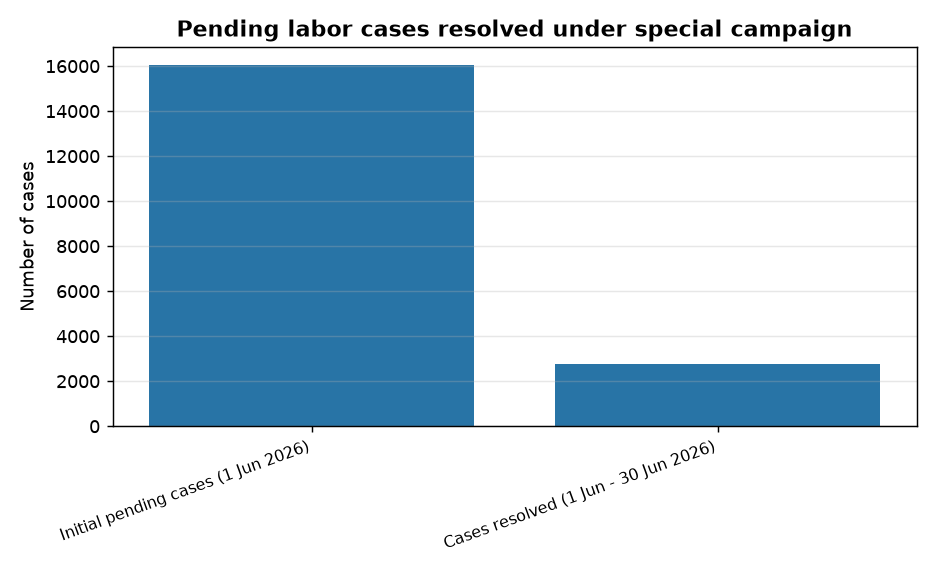
The Central Office of the Chief Labour Commissioner initiated a three-month special campaign from 1 June 2026 to 31 August 2026 to expedite the disposal of 16,033 long-pending labour disputes pending in regional offices across India. This initiative, aimed at resolving industrial disputes, wage claims, gratuity, maternity benefits, and other statutory entitlements, has already disposed of 2,769 cases in the first month, as reported by the Union Minister of State for Labour and Employment in a written reply to the Lok Sabha on 27 July 2026. The campaign underscores the government’s commitment to enhancing labour justice and reducing pendency in industrial adjudication mechanisms.
Background
- The Industrial Disputes Act, 1947, provides the legal framework for the investigation and settlement of industrial disputes in India, establishing Labour Courts and Industrial Tribunals as primary adjudicatory bodies.
- The Payment of Gratuity Act, 1972, mandates the payment of gratuity to employees upon termination of employment after five years of continuous service, with disputes often arising over eligibility and computation.
- The Maternity Benefit Act, 1961, guarantees maternity leave and benefits to women employees, with disputes commonly involving denial of benefits or non-compliance by employers.
- The Chief Labour Commissioner (CLC) functions under the Ministry of Labour and Employment and oversees the conciliation and adjudication machinery for labour disputes at the central level.
- Pendency of labour disputes has been a persistent challenge, exacerbated by procedural delays, inadequate staffing, and the complexity of industrial relations in sectors such as manufacturing, construction, and services.
- The COVID-19 pandemic and subsequent economic disruptions further exacerbated the backlog of labour disputes, necessitating targeted interventions to restore industrial harmony and protect worker rights.
What is the Special Campaign for Expeditious Disposal of Long-Pending Labour Disputes?
- The campaign is a time-bound initiative launched by the Central Office of the Chief Labour Commissioner to reduce the backlog of labour disputes pending in regional offices, operational from 1 June 2026 to 31 August 2026.
- The campaign targets disputes related to industrial conflicts, wage claims, gratuity, maternity benefits, and other statutory entitlements under labour laws, aiming to expedite their resolution through dedicated administrative and judicial efforts.
- The initiative leverages the existing conciliation and adjudication machinery, including Labour Courts, Industrial Tribunals, and the offices of the Deputy Chief Labour Commissioners, to prioritise and dispose of cases within the stipulated timeframe.
- The campaign includes measures such as dedicated benches for fast-tracking cases, enhanced monitoring by senior officials, and coordination with state labour departments to ensure compliance and reduce pendency.
- The first month of the campaign (June 2026) resulted in the disposal of 2,769 cases, representing a significant step toward reducing the total backlog of 16,033 cases reported as of 1 June 2026.
- The campaign aligns with broader efforts to reform India’s labour adjudication system, which has historically grappled with delays due to procedural complexities, lack of infrastructure, and resource constraints.
- The initiative reflects the government’s recognition of the socio-economic impact of unresolved labour disputes, which can lead to industrial unrest, financial hardship for workers, and adverse effects on productivity and investment.
- The campaign also highlights the role of the Chief Labour Commissioner’s office in ensuring the effective implementation of labour laws and the protection of workers’ rights through timely dispute resolution.
Key Features
| Feature | Significance |
|---|---|
| Three-month Special Campaign (1 June–31 August 2026) | Accelerates resolution of 16,033 pending labour disputes across regional offices by leveraging concentrated administrative focus and procedural streamlining. |
| Coverage of Dispute Types | Encompasses industrial disputes, wage claims, gratuity, maternity benefits, and other statutory entitlements to ensure comprehensive redressal within the labour justice framework. |
| Quantitative Targeting | Aims to reduce pendency by prioritising high-volume, low-complexity cases to demonstrate early impact and build institutional momentum. |
| Monitoring Mechanism | Regular progress reviews and written parliamentary updates (e.g., Lok Sabha reply by MoS Labour) enhance transparency and accountability in implementation. |
| Multi-Lingual Outreach | Dissemination of campaign details in English, Urdu, and Gujarati ensures accessibility across diverse linguistic regions of India. |
Why it Matters
Economic
- Timely resolution of wage and statutory benefit disputes enhances disposable income for workers, stimulating local consumption and supporting aggregate demand in labour-intensive sectors.
- Reduces litigation costs for enterprises by shortening dispute resolution timelines, thereby improving ease of doing business and fostering industrial competitiveness.
- Prevents capital lock-in in unresolved claims, enabling reinvestment in productive sectors and job creation.
Labour Rights & Social Justice
- Ensures adherence to statutory entitlements (e.g., gratuity, maternity benefits) mandated under the Payment of Gratuity Act, 1972, and Maternity Benefit (Amendment) Act, 2017, reinforcing labour welfare architecture.
- Mitigates exploitation risks by expediting redressal of unpaid wages and unfair dismissals, aligning with constitutional directive principles under Article 43 (living wage) and Article 39(e) (health of workers).
- Strengthens trust in labour adjudication systems, particularly for informal and migrant workers who face systemic barriers in accessing justice.
Administrative & Governance
- Demonstrates proactive governance by addressing pendency through targeted campaigns, contrasting with traditional reactive case management.
- Enhances inter-departmental coordination between labour offices, judicial bodies, and employers to streamline dispute resolution workflows.
- Sets a precedent for periodic pendency audits and time-bound resolution frameworks in other sectors of public service delivery.
Judicial & Legal
- Reduces burden on labour courts and tribunals by diverting simpler disputes to administrative channels, thereby expediting judicial processes for complex cases.
- Encourages out-of-court settlements, reducing caseload pressure and enabling courts to focus on constitutional and precedent-setting matters.
Challenges
1. Structural Pendency in Labour Dispute Resolution
- Historical backlog stems from understaffed labour offices, inadequate digital infrastructure, and procedural delays in evidence collection and hearings.
- Limited awareness among workers about their rights and redressal mechanisms exacerbates pendency, particularly in informal sectors.
- Inter-state variations in enforcement capacity and judicial efficiency create disparities in dispute resolution timelines.
UPSC Link: GS-II: Judiciary; GS-III: Labour Reforms
2. Resource Constraints
- Insufficient number of Labour Enforcement Officers (LEOs) and adjudicating authorities to handle the volume of pending cases within the campaign period.
- Dependence on manual record-keeping and paper-based processes limits scalability and real-time monitoring of case progress.
UPSC Link: GS-II: Government Policies; GS-III: E-Governance
3. Employer Opposition & Legal Tactics
- Employers may delay settlements through prolonged negotiations, appeals, or by exploiting loopholes in procedural laws (e.g., Industrial Disputes Act, 1947).
- Lack of stringent penalties for non-compliance with awards discourages voluntary compliance among recalcitrant employers.
UPSC Link: GS-II: Labour Laws; GS-III: Industrial Relations
4. Informal Sector Exclusion
- Workers in unorganised sectors (e.g., construction, gig economy) often lack formal employment records, complicating proof of entitlements and delaying redressal.
- Absence of unionisation in informal sectors reduces collective bargaining power, leaving workers vulnerable to arbitrary dismissals and wage suppression.
UPSC Link: GS-II: Social Sector; GS-III: Informal Sector
5. Digital Divide & Accessibility
- Limited digital literacy among workers, particularly in rural and tribal areas, hinders their ability to file claims or track case status online.
- Language barriers in digital portals (e.g., Hindi/English-centric interfaces) exclude non-English speakers from accessing redressal mechanisms.
UPSC Link: GS-II: Governance; GS-III: Digital Divide
Challenges — UPSC Perspective
| Issue | Concern |
|---|---|
| Understaffing in Labour Offices | Insufficient LEOs and adjudicators to process 16,033 cases within 3 months, risking superficial resolutions or backlog transfer. |
| Procedural Delays | Manual case management and evidence collection prolong hearings, defeating the purpose of time-bound campaigns. |
| Employer Non-Compliance | Awards remain unpaid due to weak enforcement mechanisms, undermining the campaign’s credibility. |
| Informal Sector Exclusion | Lack of formal employment records and union support excludes a significant workforce from redressal. |
| Digital Accessibility Gaps | Language and literacy barriers in e-filing portals exclude marginalised workers from participating in the campaign. |
Way Forward
- Expand digital infrastructure with multilingual e-filing portals and AI-assisted case management to track progress in real time.
- Augment staff strength by deploying retired labour officials, legal interns, and retired judges on a temporary basis to handle case backlog.
- Launch mass awareness drives in regional languages via radio, vernacular newspapers, and mobile vans to educate workers about their rights and redressal pathways.
- Strengthen enforcement by imposing progressive penalties on employers for non-compliance with awards and mandating quarterly compliance audits.
- Establish fast-track labour courts in high-pendency states with dedicated benches for wage disputes and maternity benefits.
- Integrate Aadhaar and EPFO databases to auto-verify employment records, reducing documentation burdens for workers.
- Conduct post-campaign audits to identify systemic bottlenecks and institutionalise periodic pendency reviews in labour adjudication.
- Collaborate with trade unions and industry associations to facilitate out-of-court settlements and promote voluntary compliance.
UPSC Value Addition
Keywords for Mains Answer-Writing
Industrial Disputes Act, 1947 · Payment of Gratuity Act, 1972 · Maternity Benefit Act, 1961 · Labour adjudication mechanisms · Industrial relations · Labour welfare legislation · Dispute resolution in labour · Role of Chief Labour Commissioner · Statutory claims under labour laws · Efficiency in labour administration
Constitutional & Policy Linkages
- Article 39(e): Directive Principle mandating health and strength of workers.
- Article 43: Directive Principle promoting living wage and decent standard of living.
- Article 21: Right to livelihood and fair trial in dispute resolution.
Concept Flow
Pending Labour Disputes → Administrative Backlog → Economic Stagnation (wage suppression, capital lock-in) → Social Inequity (exploited workers) → Governance Failure (weak enforcement) → Special Campaign Launched → Targeted Case Resolution → Enhanced Compliance & Trust → Sustainable Labour Justice Ecosystem.
Prelims Practice Questions
Q1. Which of the following is NOT a statutory claim covered under the special campaign initiated by the Chief Labour Commissioner’s office in June 2026?
- Gratuity claims under the Payment of Gratuity Act, 1972
- Maternity benefits under the Maternity Benefit Act, 1961
- Provident Fund contributions under the Employees’ Provident Fund Act, 1952
- Wage arrears under the Minimum Wages Act, 1948
Answer: Provident Fund contributions under the Employees’ Provident Fund Act, 1952 — The special campaign focuses on industrial disputes, wages, gratuity, maternity benefits, and other statutory claims. Provident Fund contributions fall under the purview of the Employees’ Provident Fund Organisation (EPFO) and are not explicitly mentioned as part of this campaign.
Q2. The special campaign launched by the Chief Labour Commissioner’s office in 2026 aims to resolve long-pending labour cases primarily through which mechanism?
- Judicial intervention by Labour Courts
- Conciliation and adjudication under the Industrial Disputes Act, 1947
- Arbitration by private tribunals
- Direct executive orders from the Ministry of Labour and Employment
Answer: Conciliation and adjudication under the Industrial Disputes Act, 1947 — The campaign targets the speedy disposal of industrial disputes and statutory claims, which are typically resolved through conciliation and adjudication mechanisms as outlined in the Industrial Disputes Act, 1947.
Mains Practice Question
✍ Critically examine the efficacy of the special campaign initiated by the Chief Labour Commissioner’s office to resolve long-pending labour cases. How does this initiative align with the broader objectives of labour welfare legislation in India?
Approach: Analyse the objectives of the campaign, including its scope (industrial disputes, wages, gratuity, maternity benefits) and the mechanisms employed (conciliation, adjudication). Evaluate its potential impact on labour welfare, citing relevant labour laws such as the Industrial Disputes Act, 1947, the Payment of Gratuity Act, 1972, and the Maternity Benefit Act, 1961. Discuss challenges such as resource constraints, backlog management, and enforcement gaps.
Source: PIB (Press Information Bureau)
Generated by AanyaAi for educational purpose.

- स्वच्छ सागर सुरक्षित सागर 5.0: 15 लाख लोगों ने ली महासागर संरक्षण की शपथ, जानें पूरा विवरण - September 21, 2026
- 15 लाख लोगों ने ली महासागर संरक्षण की शपथ: स्वच्छ सागर सुरक्षित सागर 5.0 अभियान की सफलता - September 21, 2026
- आईसीआई अगस्त 2026: आधार वर्ष 2022-23 के साथ प्रमुख उद्योगों का प्रदर्शन एवं वृद्धि दर - September 21, 2026

No Comments