


07 Aug UPSC Alert: Lok Sabha Passes Bill to Impose MDR on UPI Transactions
✎ The amendment to the Payment and Settlement Systems Act, 2007, removes the zero-MDR framework for UPI transactions, potentially introducing charges for merchants, while exempting FPI income from G-Sec investments from income tax…
Subject Relevance — Where This Topic Fits
- GS Paper III — Indian Economy and Issues Relating to Planning, Mobilisation of Resources, Growth, Development and Employment | GS Paper III — Effects of Liberalisation on the Economy, Changes in Industrial Policy and their Effects on Industrial Growth
- Prelims: Payment and Settlement Systems Act, 2007, Merchant Discount Rate (MDR), Unified Payments Interface (UPI), Foreign Portfolio Investors (FPIs), Government Securities (G-Secs), Digital Payment Ecosystem, Taxation Laws (Amendment) Bill, 2026, Income Tax Act, 2025
- Essay: The evolution of digital payment systems in India: Balancing innovation, accessibility, and sustainability, Global capital flows and regulatory frameworks: Lessons for emerging economies
Quick Revision: The amendment to the Payment and Settlement Systems Act, 2007, removes the zero-MDR framework for UPI transactions, potentially introducing charges for merchants, while exempting FPI income from G-Sec investments from income tax to attract global capital.
Why is this in the news?
The Lok Sabha recently passed the Taxation and Other Laws (Amendment) Bill, 2026, which includes critical amendments to the Payment and Settlement Systems Act, 2007. The amendment removes the existing legal prohibition on levying Merchant Discount Rate (MDR) on UPI transactions, potentially introducing charges for merchants. Additionally, the Bill exempts interest income and capital gains of Foreign Portfolio Investors (FPIs) from investments in Government Securities (G-Secs) from income tax, aiming to enhance India’s attractiveness as an investment destination. These changes reflect the government’s dual focus on sustaining the digital payments ecosystem while attracting global capital.
Background
- The Payment and Settlement Systems Act, 2007, was enacted to regulate and supervise payment systems in India, ensuring stability and efficiency in the financial sector.
- The zero-MDR framework for UPI transactions was introduced to promote digital payments and reduce the cost burden on merchants and consumers, aligning with the government’s vision of a cashless economy.
- Real-Time Gross Settlement (RTGS) and National Electronic Funds Transfer (NEFT) systems have historically levied service charges, but UPI transactions remained exempt to incentivise their adoption.
- The amendment follows the June 2026 ordinance that provided income tax exemptions to FPIs investing in G-Secs, aimed at attracting foreign capital and boosting liquidity in government securities.
- The Bill seeks to unlink the Payment and Settlement Systems Act from the Income Tax Act, granting the government greater flexibility in modifying the regulatory framework for digital payments without legislative overhauls.
- Opposition protests during the passage of the Bill underscored concerns over potential costs for merchants and the broader implications for the digital payments ecosystem.
What is the Taxation and Other Laws (Amendment) Bill, 2026?
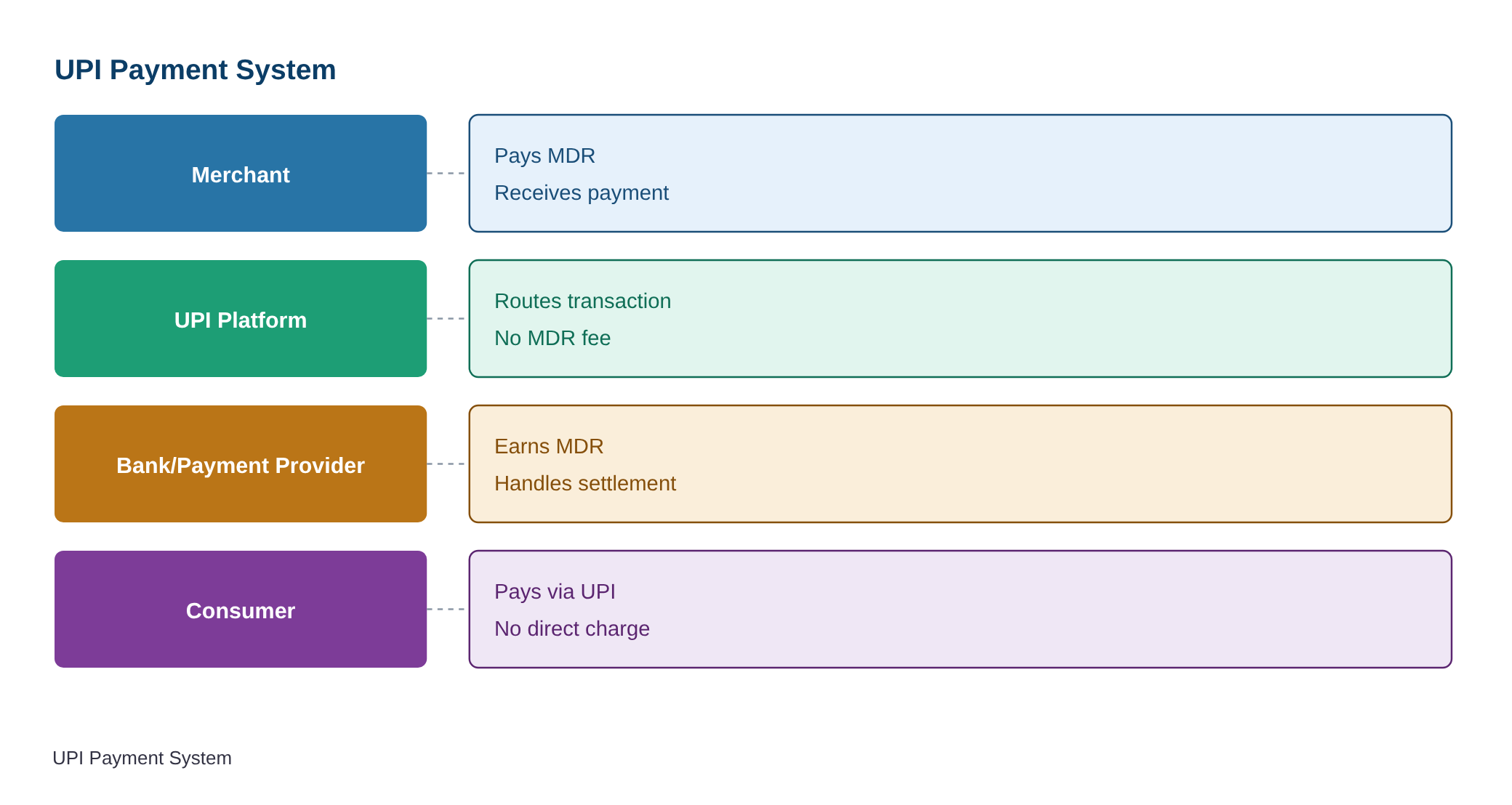
- The Bill amends the Payment and Settlement Systems Act, 2007, to remove the legal prohibition on levying Merchant Discount Rate (MDR) on UPI transactions, thereby enabling banks and payment service providers to charge merchants for UPI-based payments.
- It introduces provisions to exempt interest income and capital gains of Foreign Portfolio Investors (FPIs) from income tax when investing in Government Securities (G-Secs), enhancing India’s appeal to global investors.
- The Bill amends the Income Tax Act, 2025, and the Finance Act to incorporate these exemptions and regulatory changes, ensuring legal coherence and compliance.
- The amendment to the Payment and Settlement Systems Act, 2007, aims to create a sustainable revenue model for banks and payment service providers, ensuring the long-term viability of the digital payments ecosystem.
- The Bill replaces the June 2026 ordinance that initially proposed these amendments, formalising them through parliamentary approval.
- The government’s stated objective is to make India a more predictable and attractive destination for global capital, manufacturing, and business, aligning with broader economic liberalisation and growth strategies.
- The Bill was passed via voice vote in the Lok Sabha, reflecting the government’s majority but also highlighting political opposition to certain provisions.
- The changes are part of a broader effort to balance innovation in digital payments with the need for financial sustainability and global competitiveness.
Key Features
| Feature | Significance |
|---|---|
| Removal of zero-MDR provision for UPI transactions | Enables banks and payment service providers to levy Merchant Discount Rate (MDR) on UPI transactions, potentially introducing charges for merchants. |
| Amendment to Payment and Settlement Systems Act, 2007 | Provides legal authority to the government to modify or impose charges on electronic payment modes, including UPI, NEFT, and RTGS. |
| Unlinking from Income Tax Act, 2025 | Decouples the Payment and Settlement Systems Act from the Income Tax Act, allowing independent policy adjustments without legislative amendments. |
| Exemption of FPIs from capital gains tax on G-Sec investments | Enhances India’s attractiveness as an investment destination for global capital by providing tax exemptions to Foreign Portfolio Investors (FPIs). |
| Replacement of ordinance with a formal Bill | Converts the June 5, 2026 ordinance into a legislative Act, ensuring legal permanence and parliamentary scrutiny. |
Why it Matters
Economic Policy
- The amendment seeks to create a sustainable revenue model for banks and payment service providers, addressing the financial sustainability of the digital payments ecosystem.
- Introduction of MDR on UPI transactions may shift the cost burden from the government to merchants and, potentially, consumers, altering the pricing dynamics of digital transactions.
- Tax exemptions for FPIs on G-Sec investments aim to attract foreign capital, supporting India’s economic growth and global integration.
- The move aligns with the government’s broader objective of making India a predictable and business-friendly destination for global investors.
Digital Payments Ecosystem
- UPI has been a cornerstone of India’s digital payment revolution, with over 140 billion transactions annually. The amendment introduces uncertainty regarding the future cost structure of UPI transactions.
- The removal of the zero-MDR provision may incentivize banks to invest in payment infrastructure but could also discourage small merchants from adopting digital payment systems.
- The policy shift may necessitate a recalibration of the digital payments strategy to balance financial sustainability with inclusivity.
Fiscal Policy and Taxation
- The amendment to the Income Tax Act, 2025, provides tax exemptions to FPIs on capital gains from G-Sec investments, enhancing India’s appeal as a global investment hub.
- The unlinking of the Payment and Settlement Systems Act from the Income Tax Act allows for more flexible and independent policy adjustments in the digital payments and taxation domains.
Parliamentary and Legislative Process
- The passage of the Bill without discussion amid Opposition protests highlights the procedural challenges in legislative processes, particularly in contentious economic reforms.
- The conversion of an ordinance into a formal Bill ensures legal permanence and parliamentary oversight, reinforcing democratic accountability.
Challenges
1. Financial Inclusion vs. Sustainability
- The introduction of MDR on UPI transactions risks undermining the financial inclusion objectives of the digital payments revolution, particularly for small merchants and low-income users.
- The policy may disproportionately affect small businesses, which rely heavily on UPI for transactions, potentially increasing their operational costs.
- The government must balance the need for a sustainable revenue model with the goal of maintaining a low-cost, accessible digital payments ecosystem.
UPSC Link: GS3: Digital Payments and Financial Inclusion
2. Policy Uncertainty and Investor Confidence
- The removal of the zero-MDR provision introduces policy uncertainty, which may deter small merchants and consumers from fully embracing digital payment systems.
- Investors, particularly FPIs, may perceive the policy shift as a signal of changing regulatory dynamics, potentially affecting long-term investment decisions.
- Clear communication and a phased implementation strategy are essential to mitigate adverse impacts on investor confidence.
UPSC Link: GS3: Investment Climate and Ease of Doing Business
3. Regulatory and Compliance Burden
- The amendment may impose additional compliance burdens on banks and payment service providers, requiring them to adjust their systems and processes to accommodate MDR.
- The government must ensure that the transition to a charged UPI ecosystem is smooth and does not disrupt the existing digital payments infrastructure.
- Regulatory oversight will be critical to prevent exploitative pricing practices by banks and payment service providers.
UPSC Link: GS3: Regulatory Framework for Digital Payments
4. Impact on Consumer Behavior
- The potential introduction of charges on UPI transactions may lead to a shift in consumer behavior, with users reverting to cash transactions or exploring alternative digital payment modes.
- The policy could exacerbate the digital divide, particularly in rural and semi-urban areas where UPI is a primary mode of digital transactions.
- The government must monitor consumer behavior closely to assess the impact of the policy change and take corrective measures if necessary.
UPSC Link: GS3: Consumer Behavior and Digital Divide
5. Global Competitiveness and Investment Attraction
- While the tax exemptions for FPIs aim to attract global capital, the policy shift on UPI transactions may create mixed signals for international investors.
- India must ensure that its digital payments ecosystem remains competitive globally, balancing domestic revenue needs with international investor expectations.
- The government should articulate a clear vision for the digital payments ecosystem to reassure both domestic and international stakeholders.
UPSC Link: GS3: Global Competitiveness and Investment Flows
Challenges — UPSC Perspective
| Issue | Concern |
|---|---|
| Financial sustainability of digital payments | Risk of undermining the low-cost, inclusive digital payments ecosystem. |
| Policy uncertainty for merchants and consumers | Potential deterrent to the adoption of digital payment systems. |
| Compliance burden on banks and payment service providers | Additional regulatory and operational challenges. |
| Impact on consumer behavior and digital divide | Possible shift back to cash transactions, particularly in rural areas. |
| Mixed signals for global investors | Risk of creating uncertainty in India’s investment climate. |
Way Forward
- Conduct a phased implementation of MDR on UPI transactions, starting with high-value transactions to assess impact before full rollout.
- Introduce tiered pricing for UPI transactions to minimize the burden on small merchants and low-income users.
- Enhance financial literacy programs to educate merchants and consumers about the potential changes and their rights.
- Strengthen the grievance redressal mechanism for digital payment disputes to ensure consumer protection.
- Monitor the digital payments ecosystem closely to identify unintended consequences and take corrective measures promptly.
- Engage with stakeholders, including banks, payment service providers, merchants, and consumer groups, to design a balanced policy framework.
- Ensure transparency in the calculation and application of MDR to prevent exploitative pricing practices.
- Align the digital payments policy with broader economic goals, such as financial inclusion and global competitiveness.
UPSC Value Addition
Keywords for Mains Answer-Writing
Payment and Settlement Systems Act, 2007 · Merchant Discount Rate (MDR) · Unified Payments Interface (UPI) · digital payments ecosystem · Taxation and Other Laws (Amendment) Bill, 2026 · offshore funds and foreign portfolio investors (FPIs) · Income Tax Act, 2025 · sustainable revenue model for banks · monetary policy and digital public infrastructure · financial inclusion and consumer protection
Concept Flow
Introduction of zero-MDR framework for UPI transactions (2016) → Promotion of digital payments and financial inclusion. → Government observes revenue sustainability issues in digital payments ecosystem → Proposes amendment to Payment and Settlement Systems Act, 2007. → Taxation and Other Laws (Amendment) Bill, 2026 introduced in Parliament → Removal of zero-MDR provision for UPI transactions. → Bill passed in Lok Sabha without discussion → Potential introduction of MDR on UPI transactions. → Policy shift may impact financial inclusion and consumer behavior → Need for phased implementation and stakeholder engagement. → Government introduces tax exemptions for FPIs on G-Sec investments → Enhancement of India’s attractiveness as an investment destination.
Prelims Practice Questions
Q1. Consider the following statements regarding the Payment and Settlement Systems Act, 2007:
1. The Act currently prohibits banks and payment service providers from charging Merchant Discount Rate (MDR) on UPI transactions.
2. The Taxation and Other Laws (Amendment) Bill, 2026 seeks to amend the Act to allow levying of MDR on UPI transactions.
3. The Act governs the functioning of Real-Time Gross Settlement (RTGS) and National Electronic Funds Transfer (NEFT) systems.
How many of the above statements are correct?
- Only one
- Only two
- All three
- None
Answer: All three — Statements 1 and 2 are correct as the Act currently prohibits MDR on UPI, and the amendment seeks to remove this prohibition. Statement 3 is correct as the Act governs RTGS and NEFT systems.
Q2. Assertion (A): The Taxation and Other Laws (Amendment) Bill, 2026 aims to make India a more attractive destination for global capital by providing tax exemptions to foreign portfolio investors (FPIs).
Reason (R): The Bill amends the Income Tax Act, 2025 to exempt interest income and capital gains made by FPIs from investments in Government Securities (G-Secs).
- Both A and R are true, and R is the correct explanation of A
- Both A and R are true, but R is not the correct explanation of A
- A is true, but R is false
- A is false, but R is true
Answer: Both A and R are true, and R is the correct explanation of A — Both the assertion and reason are true, and the reason correctly explains the assertion as the tax exemption for FPIs in G-Secs is a key measure to attract global capital.
Q3. Match the following columns with reference to the Taxation and Other Laws (Amendment) Bill, 2026:
Column I
A. Payment and Settlement Systems Act, 2007
B. Income Tax Act, 2025
C. Finance Act, 2026
Column II
1. Exempts interest income and capital gains of FPIs from investments in G-Secs
2. Amended to allow levying of MDR on UPI transactions
3. Provides legal authority to modify the zero-MDR framework without direct legislative adjustments
- A-2, B-1, C-3
- A-1, B-2, C-3
- A-3, B-2, C-1
- A-2, B-3, C-1
Answer: A-2, B-1, C-3 — A matches with 2 (amendment to allow MDR on UPI), B matches with 1 (exemption for FPIs), and C matches with 3 (legal authority to modify zero-MDR framework).
Mains Practice Question
✍ Critically examine the implications of the amendment to the Payment and Settlement Systems Act, 2007, which seeks to allow levying of Merchant Discount Rate (MDR) on UPI transactions. Also, analyse the potential impact on financial inclusion, consumer welfare, and the sustainability of the digital payments ecosystem in India. (15 Marks)
Approach: MODEL-ANSWER SKELETON:
1. **Introduction (2 marks)**: Briefly state the amendment’s intent—removing the zero-MDR provision for UPI transactions—and its placement within the Payment and Settlement Systems Act, 2007.
2. **Rationale for the Amendment (3 marks)**:
– Need for a sustainable revenue model for banks and payment service providers.
– Ensuring continuity and growth of the digital payments ecosystem.
– Unlinking the Payment and Settlement Systems Act from the Income Tax Act to provide flexibility.
3. **Potential Implications (5 marks)**:
– **Financial Inclusion**: Risk of increased costs for merchants and consumers, particularly in rural and semi-urban areas where UPI is a primary mode of digital payments.
– **Consumer Welfare**: Possible erosion of the ‘free’ nature of UPI transactions, leading to reduced adoption among price-sensitive users.
– **Digital Payments Ecosystem**: Potential shift towards other payment modes (e.g., RTGS, NEFT) if UPI becomes costly, undermining the growth of UPI.
– **Competitive Dynamics**: Impact on fintech startups and small merchants who rely on low-cost UPI transactions.
4. **Counterarguments and Safeguards (3 marks)**:
– Arguments in favour: Revenue generation for banks and service providers, alignment with global practices (e.g., card payments).
– Safeguards: Gradual implementation, capping MDR rates, exemptions for small transactions, and ensuring transparency in pricing.
5. **Conclusion (2 marks)**: Weigh the trade-offs between revenue generation and financial inclusion, emphasizing the need for a balanced policy that sustains innovation while protecting consumer interests.
Source: Mint
Generated by AanyaAi for educational purpose.

- Gujarat HC orders FIR in ITS officer’s 2023 custodial death - October 3, 2026
- डीआरआई ने मुंबई एयरपोर्ट पर सोने-हीरे की तस्करी गिरोह का किया पर्दाफाश, 8 गिरफ्तार - October 3, 2026
- Chhattisgarh CM Rural Bus Scheme: 850 Villages Connected in 1 Year - October 3, 2026

No Comments