


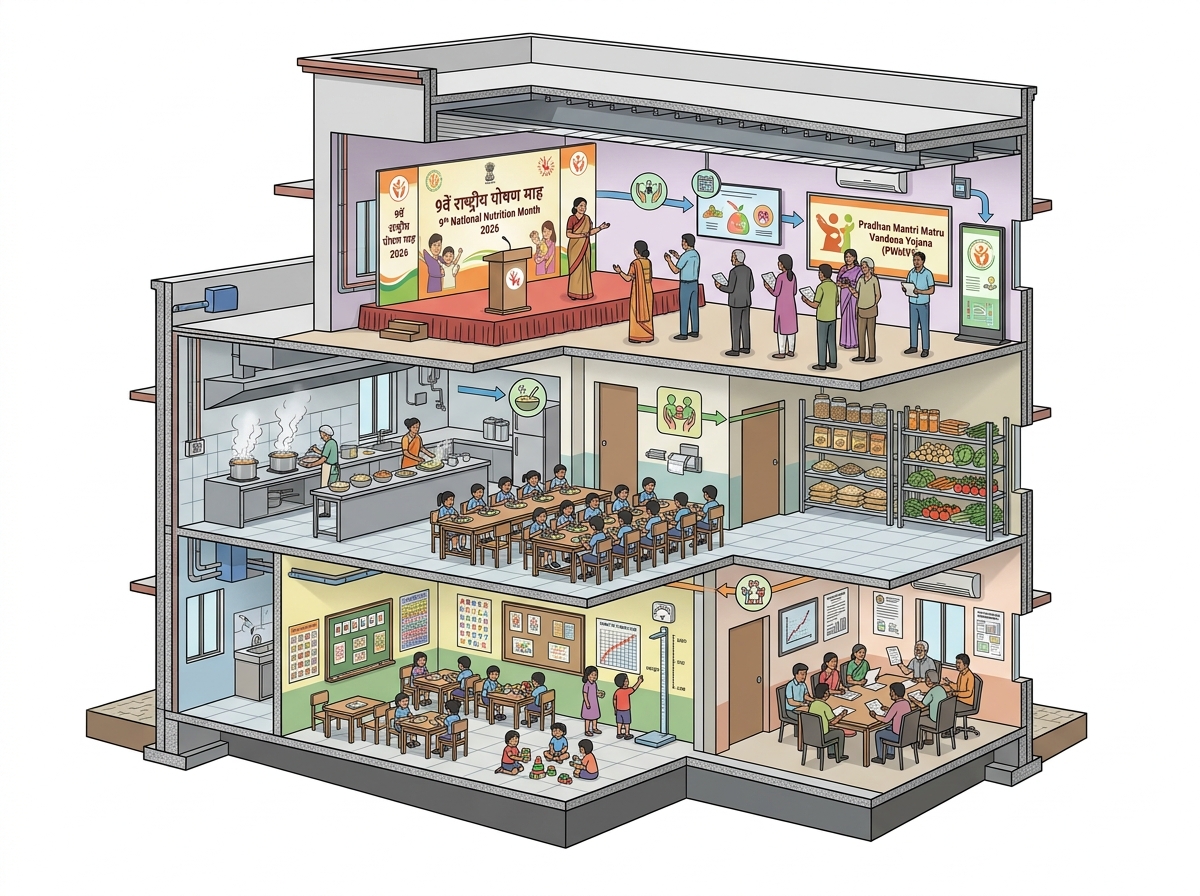
08 Sep UPSC Alert: National Nutrition Month 2026 Launch by Annpurna Devi in Varanasi
✎ National Nutrition Month (Poshan Maah) 2026 institutionalises community-led governance through Anganwadi Management Committees and mandates hot-cooked meals in all Anganwadi centres under Mission Poshan 2.0.
Subject Relevance — Where This Topic Fits
- GS Paper II — Governance, Transparency and Accountability | GS Paper III — Human Development and Social Sector | GS Paper I — Social Empowerment
- Prelims: Poshan Tracker, Mission Poshan 2.0, Supplementary Nutrition Programme (SNP), Anganwadi Management Committees (AMCs), PMMVY, ICDS, National Nutrition Mission (NNM), Pre-conception and Pre-natal Diagnostic Techniques (Prohibition of Sex Selection) Act, 1994 (for gender-based nutrition bias), National Food Security Act, 2013 (entitlements for pregnant women and children), Integrated Child Development Services (ICDS) Scheme, Ayushman Bharat – Health and Wellness Centres
- Essay: The interplay between nutrition security and demographic dividend in India’s journey to ‘Viksit Bharat 2047’, Community participation as the cornerstone of public health delivery: Lessons from the National Nutrition Mission
Quick Revision: National Nutrition Month (Poshan Maah) 2026 institutionalises community-led governance through Anganwadi Management Committees and mandates hot-cooked meals in all Anganwadi centres under Mission Poshan 2.0.
Why is this in the news?
The Ministry of Women and Child Development (MWCD) will launch the 9th National Nutrition Month (Poshan Maah) 2026 in Varanasi on 9 September 2026, marking a decade of the Pradhan Mantri Matru Vandana Yojana (PMMVY) and embedding the campaign within the revised Supplementary Nutrition Programme (SNP) guidelines under Mission Poshan 2.0. The event underscores the government’s renewed focus on institutionalising community-led governance through Anganwadi Management Committees (AMCs) and mandating hot-cooked meals in all Anganwadi centres, aligning nutrition interventions with the vision of a ‘Suposhit Bharat’ as the foundation for ‘Viksit Bharat 2047’.
Background
- The Integrated Child Development Services (ICDS) Scheme, operational since 1975, provides supplementary nutrition, pre-school education, immunisation, health check-ups, and referral services to children under six and pregnant/lactating mothers via Anganwadi centres.
- The Pradhan Mantri Matru Vandana Yojana (PMMVY), launched in 2017, offers conditional cash transfers of ₹5,000 to pregnant women and lactating mothers to improve maternal nutrition and health-seeking behaviour.
- The National Food Security Act (NFSA), 2013, guarantees food security to 75% of the rural and 50% of the urban population, with special provisions for pregnant women, lactating mothers, and children aged 6 months to 14 years.
What is the National Nutrition Month (Poshan Maah) 2026?
- A month-long public campaign (September 2026) under Mission Poshan 2.0, aimed at mobilising communities to improve nutrition, health, and early childhood development outcomes for women, children, and adolescents.
- The 2026 edition adopts the theme ‘Hamari Anganwadi, Hamari Zimmedari’ (Our Anganwadi, Our Responsibility), emphasising collective ownership of Anganwadi centres as the first point of contact for nutrition, health, and early education services.
- The SNP guidelines for 2026 mandate the provision of hot-cooked meals in Anganwadi centres, with weekly menu rotations using millets, pulses, and seasonal vegetables, replacing take-home rations where feasible.
- Anganwadi Management Committees (AMCs), as per the 2026 guidelines, are to be constituted and operationalised in all Anganwadi centres to enhance transparency, accountability, and community participation in nutrition service delivery.
- The campaign leverages live demonstrations of healthy recipes, nutrition fairs, and ‘protein-rich food’ drives to promote balanced diets, including plant-based and animal-based protein sources.
- Poshan Maah 2026 coincides with the 10th anniversary of the Pradhan Mantri Matru Vandana Yojana (PMMVY), highlighting a decade of maternal nutrition and health interventions under the scheme.
- The initiative is aligned with the ‘Suposhit Bharat’ (Well-Nourished India) vision, which is positioned as the foundation for ‘Viksit Bharat 2047’ (Developed India by 2047), integrating nutrition security with broader developmental goals.
Key Features
| Feature | Significance |
|---|---|
| Ninth National Nutrition Month (2026) | A month-long campaign to institutionalise community-led nutrition interventions, aligning with the vision of a ‘Suposhit Bharat’ (well-nourished India) as the foundation for ‘Viksit Bharat 2047’. |
| ‘Humari Anganwadi, Humari Jimmadari’ Theme | Shifts ownership of nutrition outcomes to local communities, particularly focusing on Anganwadi centres as primary hubs for child health, nutrition, and early education. |
| Revised Supplementary Nutrition Programme (SNP) Guidelines | Introduces mandatory hot-cooked meals, standardised SNP menu boards, and formalised Anganwadi Management Committees (AMCs) to enhance transparency and accountability in service delivery. |
| Live Demonstrations of Nutritious Recipes | Promotes dietary diversity and affordable, locally-sourced ingredients through practical cooking sessions in Anganwadi centres, supported by nutrition fairs. |
| Community Engagement via AMC | Strengthens participatory governance by mandating AMCs in all Anganwadi centres, ensuring local oversight of nutrition services and fostering collective responsibility. |
Why it Matters
Public Health
- Addresses critical gaps in maternal and child nutrition by institutionalising hot-cooked meals, a first in SNP guidelines, ensuring balanced protein and micronutrient intake.
- Aligns with global targets (e.g., SDG 2.2) to end malnutrition, particularly stunting and wasting in children under five.
- Supports early childhood development (ECD) through structured nutrition interventions in Anganwadi centres, a cornerstone of cognitive and physical growth.
Governance & Institutional Strengthening
- Enhances transparency and accountability in welfare delivery by formalising Anganwadi Management Committees (AMCs), a model of participatory governance.
- Integrates nutrition into the developmental agenda via inter-sectoral coordination between ministries (e.g., Women and Child Development, Health, Rural Development).
- Leverages community networks (SHGs, Panchayats) to amplify reach and sustainability of nutrition programmes.
Socio-Economic Impact
- Reduces healthcare burdens by preventing nutrition-related diseases in early childhood, lowering long-term costs for families and the state.
- Empowers women (e.g., SHG members) as agents of change in nutrition advocacy, aligning with gender-inclusive development.
- Promotes local agriculture by encouraging use of millets, pulses, and seasonal vegetables in SNP menus, supporting farmers’ livelihoods.
Policy Continuity & Vision Alignment
- Builds on the Poshan Abhiyaan (2018) to create a decade-long policy framework for nutrition, ensuring consistency and scalability.
- Links to the ‘Suposhit Bharat’ vision, framing nutrition as a non-negotiable pillar for achieving ‘Viksit Bharat 2047’.
- Celebrates the tenth anniversary of the Pradhan Mantri Matru Vandana Yojana (PMMVY), reinforcing maternal nutrition as a priority.
Challenges
1. Implementation Gaps in SNP
- Ensuring uniform adherence to revised SNP guidelines across states, particularly in remote and tribal regions.
- Addressing logistical challenges in sourcing fresh, local ingredients for hot-cooked meals at scale.
- Monitoring quality control in meal preparation to prevent contamination or nutritional deficiencies.
UPSC Link: GS-II: Welfare schemes for vulnerable sections
2. Community Mobilisation Barriers
- Overcoming socio-cultural barriers (e.g., dietary taboos) that limit acceptance of diverse or plant-based proteins.
- Sustaining grassroots participation in AMC meetings, especially in areas with low literacy or high migration.
- Balancing top-down directives with bottom-up innovations to avoid programme fatigue.
UPSC Link: GS-II: Role of SHGs and Panchayati Raj
3. Data and Monitoring Deficits
- Strengthening real-time data systems to track nutrition outcomes (e.g., stunting rates) and programme efficacy.
- Integrating nutrition metrics with health (e.g., ICDS, NHM) and education (e.g., ECCE) databases for holistic assessment.
- Training frontline workers (AWWs, ANMs) to use digital tools for reporting and feedback.
UPSC Link: GS-II: E-governance and service delivery
4. Resource Constraints
- Allocating adequate budgetary provisions for SNP enhancements, including infrastructure (e.g., kitchen sheds) and human resources.
- Mitigating delays in fund disbursement from central to state levels, particularly in fiscally stressed regions.
- Leveraging CSR partnerships and international aid (e.g., UNICEF, WHO) without compromising programme autonomy.
UPSC Link: GS-III: Resource mobilisation and utilisation
5. Inter-Ministerial Coordination Challenges
- Aligning nutrition goals with agriculture (e.g., millet promotion), health (e.g., immunisation), and education (e.g., ECCE) policies.
- Resolving turf issues between ministries (e.g., WCD vs. Health) to avoid duplication or gaps in service delivery.
- Ensuring convergence at the district level through robust institutional mechanisms (e.g., District Nutrition Committees).
UPSC Link: GS-II: Inter-state and Centre-State relations
6. Climate and Seasonal Variability
- Managing supply chain disruptions due to extreme weather events affecting local agriculture and food distribution.
- Adapting SNP menus to climate-resilient crops (e.g., millets) while maintaining nutritional balance.
- Training communities in post-harvest food preservation techniques to reduce wastage.
UPSC Link: GS-III: Environmental governance and sustainability
Challenges — UPSC Perspective
| Issue | Concern |
|---|---|
| Standardisation of SNP Guidelines | Risk of inconsistent implementation across states, leading to uneven nutrition outcomes. |
| Community Participation Fatigue | Low attendance in AMC meetings or nutrition fairs due to over-programming or lack of perceived benefits. |
| Data Silos in Nutrition Metrics | Fragmented reporting systems hinder real-time tracking of stunting, wasting, or anaemia reduction. |
| Logistical Bottlenecks in Hot-Cooked Meals | Delays in procurement, storage, or preparation of fresh ingredients in remote areas. |
| Socio-Cultural Dietary Practices | Resistance to adopting diverse proteins (e.g., millets, pulses) due to traditional food preferences. |
| Fiscal Federalism Constraints | Delays in fund flow from Centre to states, particularly in fiscally constrained regions. |
Government Initiatives — Must-Memorise for Prelims
- Poshan Abhiyaan (National Nutrition Mission)
- Supplementary Nutrition Programme (SNP) under ICDS
- Pradhan Mantri Matru Vandana Yojana (PMMVY)
- Mission Saksham Anganwadi and Nutrition 2.0
Way Forward
- Conduct state-wise capacity-building workshops for Anganwadi workers (AWWs) on revised SNP guidelines and menu planning.
- Establish a real-time dashboard for tracking SNP meal distribution, nutritional outcomes, and AMC participation.
- Launch a national-level ‘Protein Awareness Campaign’ in partnership with FSSAI and agricultural universities to promote dietary diversity.
- Incentivise SHGs and local farmers to supply fresh, local ingredients to Anganwadi centres through procurement linkages.
- Develop a climate-resilient SNP menu template, incorporating millets and seasonal vegetables, with regional adaptations.
- Strengthen inter-ministerial convergence by mandating quarterly reviews of nutrition outcomes under the District Nutrition Committees.
- Introduce a ‘Nutrition Champion’ award system to recognise high-performing Anganwadi centres and AMCs.
- Expand digital literacy programmes for AWWs to enable seamless reporting via mobile applications (e.g., Poshan Tracker).
UPSC Value Addition
Keywords for Mains Answer-Writing
National Nutrition Mission · Poshan Maah 2026 · Supplementary Nutrition Programme · Anganwadi Management Committees · Mission Saksham Anganwadi and Poshan 2.0 · Community Ownership and Accountability · Hot Cooked Meal in Anganwadi · Maternal Nutrition · Pradhan Mantri Matru Vandana Yojana · Early Childhood Care and Education · Nutrition-sensitive agriculture · Women and Child Development Ministry · Poshan Tracker · Sustainable Development Goal 2 · Malnutrition in India
Constitutional & Policy Linkages
- Article 47 (DPSP: raising the level of nutrition and standard of living)
- Article 21 (Right to Health as part of Right to Life)
Concept Flow
National Nutrition Policy (via DPSP Article 47) → Poshan Abhiyaan (2018) → Mission Saksham Anganwadi and Nutrition 2.0 → Revised SNP Guidelines (2026) → National Nutrition Month (2026) → Community-led interventions (AMCs, SHGs) → Improved maternal and child nutrition outcomes → Reduced stunting/wasting → Enhanced cognitive development → Foundation for ‘Viksit Bharat 2047’.
Prelims Practice Questions
Q1. Consider the following statements regarding the Supplementary Nutrition Programme (SNP) as per the revised guidelines for Poshan Maah 2026:
1. The revised SNP guidelines for the first time define ‘hot cooked meal’ for Anganwadi centres.
2. The guidelines mandate the establishment of Anganwadi Management Committees in all Anganwadi centres.
3. The SNP menu board is now optional for Anganwadi centres.
How many of the above statements are correct?
- Only one
- Only two
- All three
- None
Answer: Only two — Statement 1 and 2 are correct as per the revised SNP guidelines. Statement 3 is incorrect because the SNP menu board is now mandatory.
Q2. Assertion (A): The National Nutrition Mission (Poshan Abhiyaan) was launched in 2018 to make nutrition a national development priority.
Reason (R): The mission aims to reduce malnutrition among women, children, and adolescents through community-led interventions.
In the context of the above two statements, which one of the following is correct?
- Both A and R are true, and R is the correct explanation of A.
- Both A and R are true, but R is not the correct explanation of A.
- A is true but R is false.
- A is false but R is true.
Answer: Both A and R are true, but R is not the correct explanation of A. — Both the assertion and reason are true, and the reason correctly explains the assertion as Poshan Abhiyaan was indeed launched to prioritise nutrition and reduce malnutrition through community participation.
Q3. Match the following initiatives with their respective ministries/departments:
Column I (Initiative) | Column II (Ministry/Department)
1. Poshan Maah 2026 | A. Ministry of Women and Child Development
2. Pradhan Mantri Matru Vandana Yojana | B. Ministry of Health and Family Welfare
3. Mid-Day Meal Scheme | C. Ministry of Education
4. National Rural Health Mission | D. Ministry of Agriculture and Farmers’ Welfare
Select the correct match:
- 1-A, 2-A, 3-C, 4-B
- 1-A, 2-B, 3-C, 4-D
- 1-B, 2-A, 3-C, 4-D
- 1-A, 2-A, 3-D, 4-B
Answer: 1-A, 2-A, 3-C, 4-B — Poshan Maah 2026 and PMMVY are under the Ministry of Women and Child Development; Mid-Day Meal Scheme is under the Ministry of Education; and NRHM is under the Ministry of Health and Family Welfare.
Mains Practice Question
✍ The ninth edition of Poshan Maah 2026, themed ‘Hamari Anganwadi, Hamari Jimmedari’, seeks to institutionalise community ownership in addressing malnutrition. Critically examine the role of Anganwadi centres as frontline institutions in India’s nutrition governance architecture. Also, assess the significance of the revised Supplementary Nutrition Programme (SNP) guidelines in enhancing the efficacy of these centres. (15 Marks)
Approach: MODEL-ANSWER SKELETON:
1. **Introduction (2 Marks)**
– Briefly introduce Poshan Maah 2026, its theme, and the broader context of India’s nutrition challenges (e.g., NFSA 2013, POSHAN Abhiyaan 2018, SDG 2).
2. **Anganwadi Centres as Frontline Institutions (5 Marks)**
– Constitutional/legal basis: Article 45 (DPSP), Integrated Child Development Services (ICDS) Scheme, 1975.
– Role in nutrition governance: delivery of supplementary nutrition, pre-school education, immunisation, health check-ups, and referral services.
– Community interface: Anganwadi Workers (AWWs) as grassroots functionaries; challenges like understaffing, inadequate infrastructure, and low awareness.
– Data-driven governance: Poshan Tracker and ICDS-CAS for real-time monitoring.
3. **Revised SNP Guidelines: Key Provisions and Impact (5 Marks)**
– Definition of ‘hot cooked meal’ and its nutritional implications (e.g., protein, micronutrients, dietary diversity).
– Mandatory SNP menu boards and their role in standardising meal plans.
– Strengthening Anganwadi Management Committees (AMCs): composition, functions, and community participation.
– Linkages with Mission Saksham Anganwadi and Poshan 2.0: convergence with health, sanitation, and early childhood care.
4. **Critical Analysis and Way Forward (3 Marks)**
– Strengths: community ownership, standardisation, and multi-sectoral convergence.
– Challenges: implementation gaps, resource constraints, and inter-state disparities.
– Suggestions: capacity building of AWWs, leveraging technology (e.g., Poshan Tracker), and strengthening AMCs through gram panchayats.
5. **Conclusion (1 Mark)**
– Reiterate the centrality of Anganwadi centres in achieving ‘Suposhit Bharat’ and ‘Viksit Bharat 2047’.
Source: PIB (Press Information Bureau)
Uttar Pradesh PCS (UPPSC) — State PCS Practice
Prelims: Which of the following statements is/are correct regarding the 9th National Nutrition Month 2026 launch in Uttar Pradesh? 1. It will be inaugurated by Union Minister Annpurna Devi in Varanasi. 2. The event aims to address malnutrition among children and women in Uttar Pradesh. 3. The initiative is part of the POSHAN Abhiyaan launched by the central government. Select the correct option using the codes below:
- 1 and 2 only
- 2 and 3 only
- 1 and 3 only
- 1, 2 and 3
Answer: 1, 2 and 3 — The 9th National Nutrition Month 2026 will be launched by Union Minister Annpurna Devi in Varanasi, Uttar Pradesh, as part of the POSHAN Abhiyaan to combat malnutrition among children and women in the state.
Mains: Discuss the role of the POSHAN Abhiyaan in addressing malnutrition in Uttar Pradesh, with a focus on the significance of the 9th National Nutrition Month 2026 launch in Varanasi. Highlight the administrative and community-level interventions required to ensure its success in the state.
Generated by AanyaAi for educational purpose.
Related guides on our sites
- How to prepare for GS paper 1 for UPSC CSE mains exam
- Best UPSC coaching for IFOS exam
- Best mentorship programme for upsc
- UPSC+BA degree

- अटल वयो अभ्युदय योजना: वरिष्ठ नागरिकों के लिए एकीकृत देखभाल व्यवस्था - October 24, 2026
- मद्रास उच्च न्यायालय ने तमिलनाडु धर्मार्थ विभाग की लापरवाही पर कड़ी टिप्पणी की - October 23, 2026
- PM Modi’s Vision: Capacity Building Commission & Mission Karmayogi for Civil Services - October 23, 2026

No Comments