


19 Sep UPSC Alert: President appoints 14 judges to 5 High Courts in latest notification
✎ The President of India, exercising powers conferred by the Constitution, appointed 14 judicial officers as Additional and Permanent Judges in the High Courts of Delhi, Jammu & Kashmir and Ladakh, Jharkhand, and Karnataka on 19…
Subject Relevance — Where This Topic Fits
- GS Paper II — Polity and Governance (Judiciary)
- Prelims: Judicial appointments, Collegium System, Article 217, Article 224, High Court judges, Constitutional provisions on judiciary
Why is this in the news?
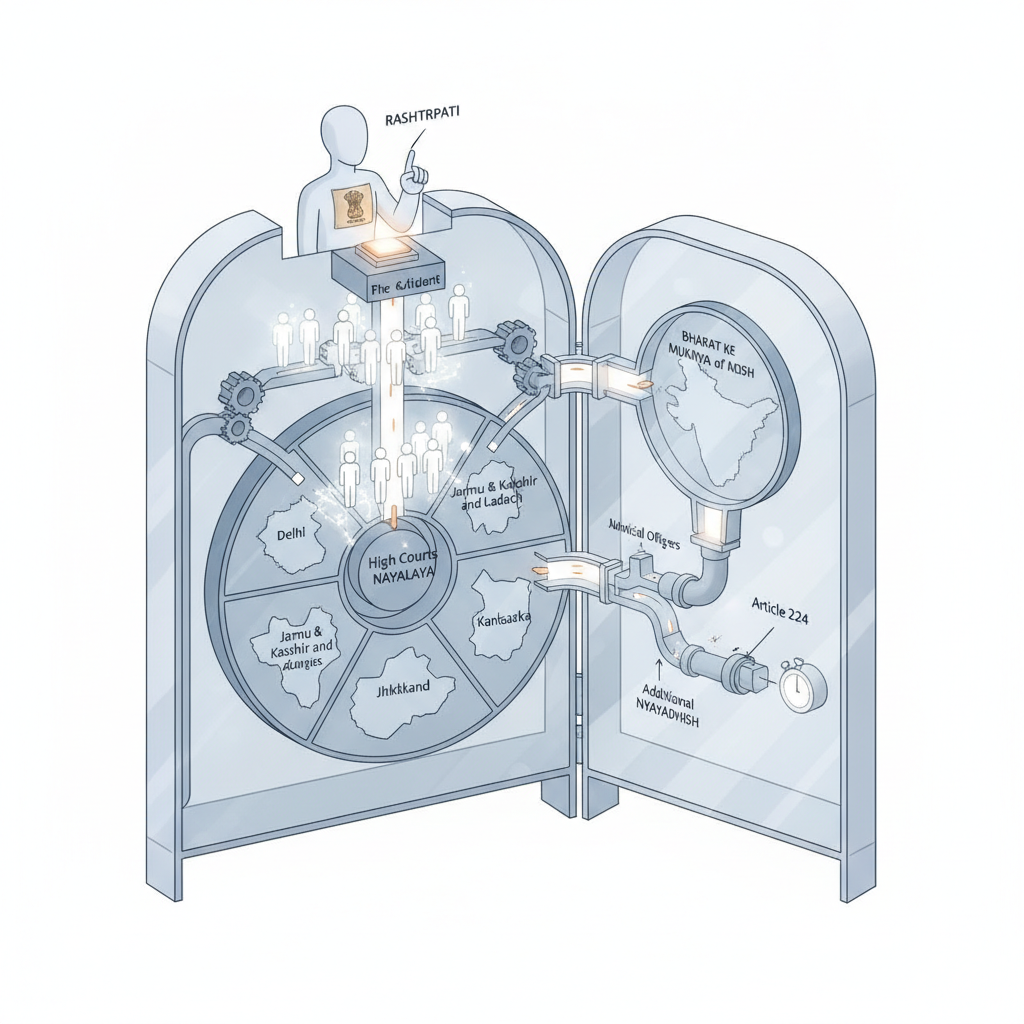
The President of India, exercising powers conferred by the Constitution, appointed 14 judicial officers as Additional and Permanent Judges in the High Courts of Delhi, Jammu & Kashmir and Ladakh, Jharkhand, and Karnataka on 19 September 2026. This appointment, made after consultation with the Chief Justice of India, underscores the constitutional mechanism for judicial appointments and the role of the executive in the functioning of the higher judiciary.
Background
- Article 224 provides for the appointment of Additional Judges to High Courts for a temporary period, typically to address workload or pending vacancies, with the possibility of their regularisation after a specified term.
- High Courts are constitutional courts with original and appellate jurisdiction over matters within their territorial jurisdiction, and their judges play a pivotal role in the administration of justice.
- The appointment of Additional Judges is a transitional measure to ensure judicial capacity until permanent appointments are made, thereby maintaining judicial efficiency.
Appointment of High Court Judges: Constitutional and Procedural Framework
- **Constitutional Basis**: Article 217(1) of the Constitution states that every Judge of a High Court shall be appointed by the President by warrant under his hand and seal, after consultation with the Chief Justice of India, the Governor of the State, and, in the case of appointment of a Judge other than the Chief Justice, the Chief Justice of the High Court.
- Judges of a High Court must be citizens of India and have held judicial office in India for at least ten years or been an advocate of a High Court for at least ten years, as stipulated under Article 217(2).
- The **appointment of Additional Judges** (Article 224) is a temporary measure, typically for a period of two years, and may be regularised into permanent appointments based on performance and seniority.
- The **appointment of Additional Judges** helps in reducing pendency of cases and ensures timely disposal of judicial work, thereby enhancing judicial efficiency.
Key Features
| Feature | Significance |
|---|---|
| Appointment of Judges to High Courts | Ensures constitutional mandate under Article 217 for the appointment of High Court judges, maintaining judicial independence and continuity of the judiciary. |
| Consultation with Chief Justice of India | Mandated by Article 217(1), the consultation process ensures judicial primacy in appointments, balancing executive and judicial authority. |
| Appointment of Additional Judges | Facilitates temporary augmentation of judicial capacity in High Courts, addressing pendency and workload challenges. |
| Geographical Distribution | Appointments across Delhi, Jammu & Kashmir, Ladakh, Jharkhand, and Karnataka High Courts reflect regional representation and judicial accessibility. |
| Judicial Appointment Process | Highlights the structured procedure involving executive (President) and judicial (CJI) consultation, ensuring transparency and meritocracy. |
Why it Matters
Judicial Administration
- Strengthens the constitutional framework of judicial appointments, ensuring adherence to Article 217 and the collegium system’s principles.
- Enhances judicial capacity in High Courts, particularly in regions with high pendency or specialized jurisdictions (e.g., Jammu & Kashmir, Ladakh).
- Promotes diversity in the judiciary through appointments of women judges and representation from different legal backgrounds.
- Supports the principle of separation of powers by maintaining judicial independence from executive interference.
Governance and Efficiency
- Addresses judicial vacancies and workload distribution, contributing to timely disposal of cases and reducing pendency.
- Facilitates specialized judicial expertise in areas such as constitutional law, administrative law, and criminal justice.
- Ensures regional representation in higher judiciary, aligning with the constitutional goal of accessible justice.
Constitutional Principles
- Reinforces the doctrine of judicial independence, a cornerstone of the Indian Constitution (Articles 50, 124, 217).
- Upholds the balance between executive and judicial authority in appointments, as envisaged under the Constitution.
Challenges
1. Judicial Vacancy and Pendency
- Persistent vacancies in High Courts contribute to judicial backlog, delaying justice delivery and affecting public trust.
- Regional disparities in judicial appointments may lead to underrepresentation in certain High Courts, impacting local governance.
UPSC Link: Judicial Appointments and Pendency (GS-II)
2. Collegium System and Transparency
- Criticism of the collegium system regarding opacity in the appointment process and lack of formalized criteria for selections.
- Balancing judicial independence with accountability remains a persistent challenge in judicial governance.
UPSC Link: Collegium System (GS-II)
3. Regional Representation
- Ensuring equitable geographical distribution of judges to address regional judicial needs and cultural sensitivities.
- Challenges in appointing judges from underrepresented communities or legal backgrounds.
UPSC Link: Judicial Appointments and Federalism (GS-II)
4. Judicial Workload Management
- High pendency in High Courts necessitates structural reforms, including appointment of additional judges and efficient case management.
- Need for specialized benches to handle complex legal domains (e.g., constitutional, commercial, and criminal law).
UPSC Link: Judicial Reforms and Pendency (GS-II)
Challenges — UPSC Perspective
| Issue | Concern |
|---|---|
| Judicial Vacancies | Leads to backlog and delays in justice delivery, undermining constitutional guarantees of speedy trial (Article 21). |
| Collegium System Transparency | Lack of formalized criteria and opacity in the appointment process raises concerns about meritocracy and accountability. |
| Regional Representation | Underrepresentation in certain High Courts may affect local governance and judicial accessibility. |
| Judicial Workload | High pendency necessitates structural reforms, including appointment of additional judges and efficient case management. |
| Judicial Independence | Balancing executive and judicial authority in appointments remains a persistent constitutional challenge. |
| Specialized Judicial Expertise | Need for judges with expertise in complex legal domains to ensure quality adjudication. |
Way Forward
- Strengthen the collegium system by introducing formalized criteria and transparent selection processes for judicial appointments.
- Address regional disparities in judicial appointments through targeted recruitment drives and regional representation policies.
- Augment judicial capacity by expediting the appointment of additional judges to High Courts with high pendency.
- Implement structural reforms in case management, including digitalization and specialized benches, to reduce judicial backlog.
- Enhance transparency in the appointment process by publishing selection criteria and feedback mechanisms for stakeholders.
- Promote diversity in the judiciary by encouraging appointments from underrepresented communities and legal backgrounds.
- Conduct periodic reviews of judicial vacancies and pendency to ensure proactive measures for judicial efficiency.
UPSC Value Addition
Keywords for Mains Answer-Writing
Judicial Appointments · Constitutional Provisions for Judicial Appointments · High Court Judges · Appointment of Additional Judges · Article 217 · Article 224 · Collegium System · Judicial Independence · Separation of Powers · Judicial Vacancies · Constitutional Amendments (42nd, 44th, 99th) · Judicial Appointments Commission · President’s Power of Appointment · Consultation with Chief Justice of India · Judicial Reforms
Constitutional & Policy Linkages
- Article 217: Appointment and conditions of office of High Court judges.
- Article 124: Establishment and constitution of the Supreme Court (relevant for judicial independence principles).
- Article 50: Separation of judiciary from executive (Directive Principle of State Policy).
- Article 227: Power of superintendence over all courts by the High Court.
Concept Flow
Constitutional Provision (Article 217) → Judicial Appointment Process (Consultation with CJI) → Appointment of Judges → Judicial Capacity Augmentation → Case Disposal Efficiency → Access to Justice.
Prelims Practice Questions
Q1. Consider the following statements regarding the appointment of High Court judges in India:
1. The President of India appoints judges of the High Courts after consultation with the Chief Justice of India.
2. The 99th Constitutional Amendment Act, 2014 introduced the National Judicial Appointments Commission (NJAC) for judicial appointments.
3. The collegium system was established by the Supreme Court in the Second and Third Judges Cases.
How many of the above statements are correct?
- Only one
- Only two
- All three
- None
Answer: All three — Statement 1 is correct as per Article 217(1) of the Constitution. Statement 2 is incorrect because the NJAC was struck down by the Supreme Court in 2015. Statement 3 is correct as the collegium system was evolved through judicial pronouncements in the Second and Third Judges Cases.
Q2. Assertion (A): The President of India exercises the power of appointing judges to the High Courts under Article 217 of the Constitution.
Reason (R): This power is exercised after consultation with the Chief Justice of India and the Governor of the concerned State.
Options:
A. Both A and R are true, and R is the correct explanation of A.
B. Both A and R are true, but R is NOT the correct explanation of A.
C. A is true, but R is false.
D. A is false, but R is true.
Answer: ? — Both the assertion and reason are correct. The President appoints High Court judges under Article 217, and the consultation includes the Chief Justice of India and the Governor of the State as per constitutional provisions.
Q3. Match the following constitutional provisions with their respective subjects:
Column I (Provision) | Column II (Subject)
— | —
1. Article 217 | A. Appointment of Additional Judges in High Courts
2. Article 224 | B. Appointment of Chief Justice of India
3. Article 124(2) | C. Appointment of Judges of High Courts
4. Article 216 | D. Constitution of High Courts
Options:
A. 1-C, 2-A, 3-B, 4-D
B. 1-A, 2-B, 3-C, 4-D
C. 1-D, 2-A, 3-B, 4-C
D. 1-B, 2-C, 3-A, 4-D
Answer: ? — Article 217 pertains to the appointment of High Court judges (1-C). Article 224 deals with the appointment of additional judges (2-A). Article 124(2) relates to the appointment of Supreme Court judges (3-B). Article 216 defines the constitution of High Courts (4-D).
Mains Practice Question
✍ The Constitution of India vests the power to appoint judges of the High Courts in the President, subject to consultation with the Chief Justice of India. Critically examine the constitutional framework governing judicial appointments in High Courts, highlighting the evolution of the collegium system and its implications for judicial independence. Also, discuss the role of the President in this process. (15 Marks)
Approach: MODEL-ANSWER SKELETON:
1. **Constitutional Framework**:
– Article 217(1): President’s power to appoint High Court judges after consultation with the Chief Justice of India (CJI) and the Governor of the State.
– Article 224: Provision for appointment of additional judges.
– Article 216: Constitution of High Courts.
2. **Evolution of the Collegium System**:
– **First Judges Case (1981)**: Supreme Court held that “consultation” did not imply “concurrence”.
– **Second Judges Case (1993)**: Introduced the collegium system, making consultation with the CJI a binding requirement.
– **Third Judges Case (1998)**: Expanded the collegium to a five-member body (CJI + 4 senior-most judges).
3. **Judicial Independence vs. Executive Role**:
– **Arguments for Collegium**: Ensures judicial primacy, reduces executive interference, and upholds separation of powers.
– **Criticisms**: Lack of transparency, opacity in selection, and potential for nepotism.
– **Judicial Appointments Commission (JAC)**: Proposed by the 99th Amendment (2014), but struck down by the Supreme Court in 2015 for violating the basic structure doctrine.
4. **Role of the President**:
– The President acts on the advice of the Council of Ministers but must ensure constitutional compliance.
– The President’s role is largely formal, as the collegium system dominates the appointment process.
– Recent appointments (e.g., the ones announced on 19 September 2026) reflect the collegium’s recommendations.
5. **Implications for Judicial Independence**:
– The collegium system strengthens judicial autonomy but raises concerns about accountability and transparency.
– The President’s role, while ceremonial, ensures constitutional oversight and adherence to the appointment process.
6. **Conclusion**:
– The collegium system, despite its flaws, remains the dominant mechanism for judicial appointments in India.
– The President’s role is symbolic but critical in upholding the constitutional framework.
Source: PIB (Press Information Bureau)
Jharkhand PCS (JPSC) — State PCS Practice
Prelims: As per the recent appointment by the President of India, which of the following High Courts received new judicial officers from Jharkhand in the latest batch of judicial appointments?
- Delhi High Court and Jammu & Kashmir High Court
- Ladakh High Court and Karnataka High Court
- Jharkhand High Court and Karnataka High Court
- Delhi High Court and Ladakh High Court
Answer: Delhi High Court and Jammu & Kashmir High Court — The President appointed judicial officers to Delhi, Jammu & Kashmir, Ladakh, Jharkhand, and Karnataka High Courts, with Jharkhand being one of the states included.
Mains: Discuss the constitutional provisions and procedural aspects governing the appointment of High Court judges in India, with a specific focus on the role of the President and the collegium system. How does this process impact the judicial governance of Jharkhand High Court, particularly in the context of tribal and regional representation?
Generated by AanyaAi for educational purpose.
Related guides on our sites
- Best PSIR optional coaching for upsc
- Best PSIR optional teacher for upsc
- Best teacher of PSIR optional for upsc
- Best PSIR optional coaching in delhi for UPSC

- KWML’s Feasibility Reports for Water Metro in 18 Cities: UPSC & PCS Insights - October 3, 2026
- ओडिशा में वन्यजीव अनुसंधान अनुदान कार्यक्रम शुरू, सिमिलिपाल में 300 कैमरे और बढ़ेंगे - October 3, 2026
- India Summons Pakistan High Commission Official Over Violation - October 3, 2026

No Comments