


08 Jul UPSC Economics optional
UPSC Economics Optional – Syllabus, Booklist, PYQs, and Strategy
UPSC Economics Optional Syllabus
online Notes of economics optional topic wise
The syllabus for Economics optional is divided into two papers: Paper I (Economic Theory and Applications) and Paper II (Indian Economy). Here’s a topic-wise breakdown:
Paper-I: Economic Theory
- Advanced Microeconomics: Price determination, market structures, general equilibrium, game theory, uncertainty
- Advanced Macroeconomics: National income, IS-LM model, inflation, unemployment, growth models (Solow, Harrod-Domar)
- Money, Banking, and Finance: Financial intermediation, RBI, monetary control, banking reforms
- International Economics: Trade theories, BOP, exchange rates, IMF, World Bank, WTO
- Growth and Development: Classical and neo-classical theories, HDI, gender development, poverty
Paper-II: Indian Economy
- Pre-Independence Economy: Agriculture, deindustrialization, railways
- Post-Independence Economy: Planning, liberalization, LPG reforms
- Agriculture: Land reforms, PDS, Green Revolution, subsidies
- Industry and Services: Industrial policies, MSMEs, disinvestment
- Banking and Finance: RBI, NPAs, IBC, monetary policy
- External Sector: FDI, exchange rate, BOP, foreign trade policy
- Growth and Employment: Unemployment trends, poverty, inequality, HDI indicators
Download the full syllabus in PDF:
UPSC Economics Optional Books
Here is a curated list of the most recommended books for UPSC Economics Optional:
Paper-I Books
- Microeconomics – HL Ahuja or Koutsoyiannis
- Macroeconomics – HL Ahuja and Dornbusch & Fischer
- Money and Banking – F.S. Mishkin or RBI Annual Reports
- International Economics – Bo Sodersten or Salvatore
- Growth and Development – Thirlwall or Debraj Ray
Paper-II Books
- Indian Economy – Uma Kapila or Mishra & Puri
- Economic Survey (latest two years)
- Union Budget (highlights)
- Ramesh Singh (Selective reading)
- Reports from NITI Aayog and RBI
Tip: Refer to Prateek Tripathi Sir’s handwritten notes from PlutusIAS for value-added content and diagram-based presentation.
UPSC Economics Optional PYQs (Previous Year Questions)
Solving PYQs is crucial for success in Economics optional. Here’s how to approach them:
Why PYQs Matter?
- Helps identify recurring themes and important models
- Improves understanding of how to apply theory to Indian context
- Develops speed and accuracy for 250-mark answer writing
Where to Find PYQs?
- UPSC official website (upsc.gov.in)
- Vision IAS or PlutusIAS test series compilations
- Economics Optional PYQ Booklet (available offline/online)
How to Use PYQs?
- Sort them topic-wise
- Write 10 answers every week
- Get evaluated by mentors or peers
- Revise answers before the exam
Strategy to Score 300+ in Economics Optional
1. Build Conceptual Clarity First
Don’t just memorize theories – understand assumptions, graphs, real-world implications. Use NCERT and HL Ahuja to build fundamentals before advancing to Bo Sodersten and Debraj Ray.
2. Practice Diagrams and Models
Economics answers are incomplete without diagrams. Practice drawing them neatly. Use color pencils in mock tests for emphasis (not in UPSC mains).
3. Use Current Affairs in Paper II
Refer to Economic Survey, RBI bulletins, and Budget. Quote recent data while writing answers about unemployment, inflation, poverty, etc.
4. Attempt Full-Length Tests
Join a structured test series like PlutusIAS. They provide expert feedback and rank comparison. Writing 6-8 tests before mains is crucial.
5. Interlink Paper I and Paper II
Apply theoretical frameworks to Indian examples. For example, use Solow’s growth model while discussing India’s GDP slowdown.
Best economics optional coaching for upsc
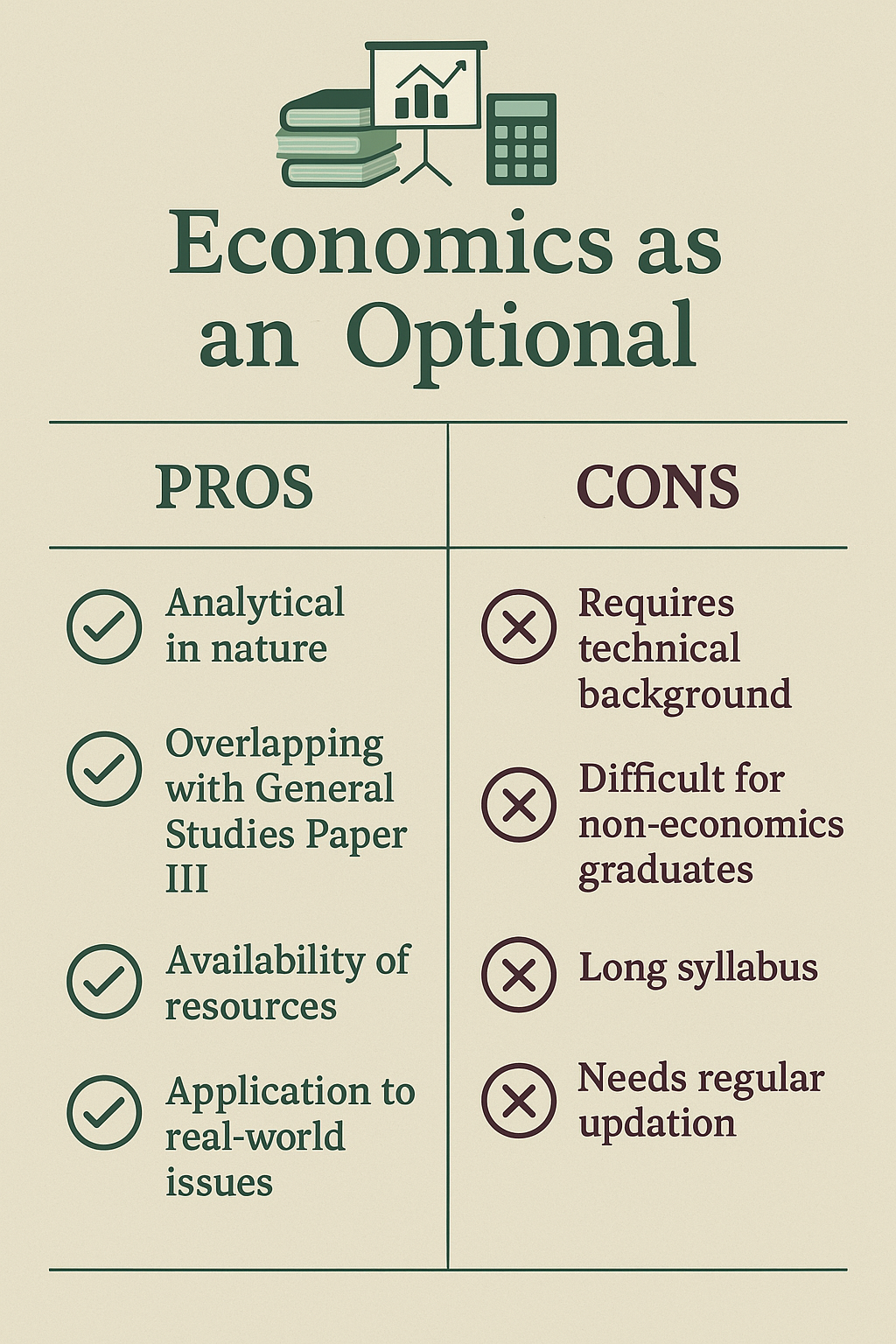
Why Choose Economics as an Optional?
- Scoring subject if concepts are strong and answers are well-structured
- Very helpful in GS3 (economy), Essay, and interview preparation
- Supports scientific and analytical answer writing style
- Clear syllabus with limited ambiguity
- Data and reports make answers richer
Top Faculties for UPSC Economics Optional
- Mr. Prateek Tripathi (PlutusIAS) – Known for analytical clarity and personalized mentorship
- Ramesh Singh (Author) – Good for Indian economy understanding
- Dr. G. Ramesh (Former IIM Prof.) – Highly recommended for Paper I
Conclusion
Economics optional is not just for aspirants with economics degrees. Even engineers and CA aspirants have scored highly by mastering models and applying them to Indian economic conditions. If you’re someone who enjoys data, development theory, and analysis – Economics is the right optional for you.
Stick to the syllabus, revise regularly, use PYQs and test series wisely, and write crisp, well-structured answers. With focused effort, scoring 300+ is achievable!
UPSC Economics Syllabus in English
UPSC Economics optionalSyllabus Hindi


No Comments