


17 Aug UPSC Exam Alert: How SC Fellowship Helped Sangita Das Overcome PhD Challenges
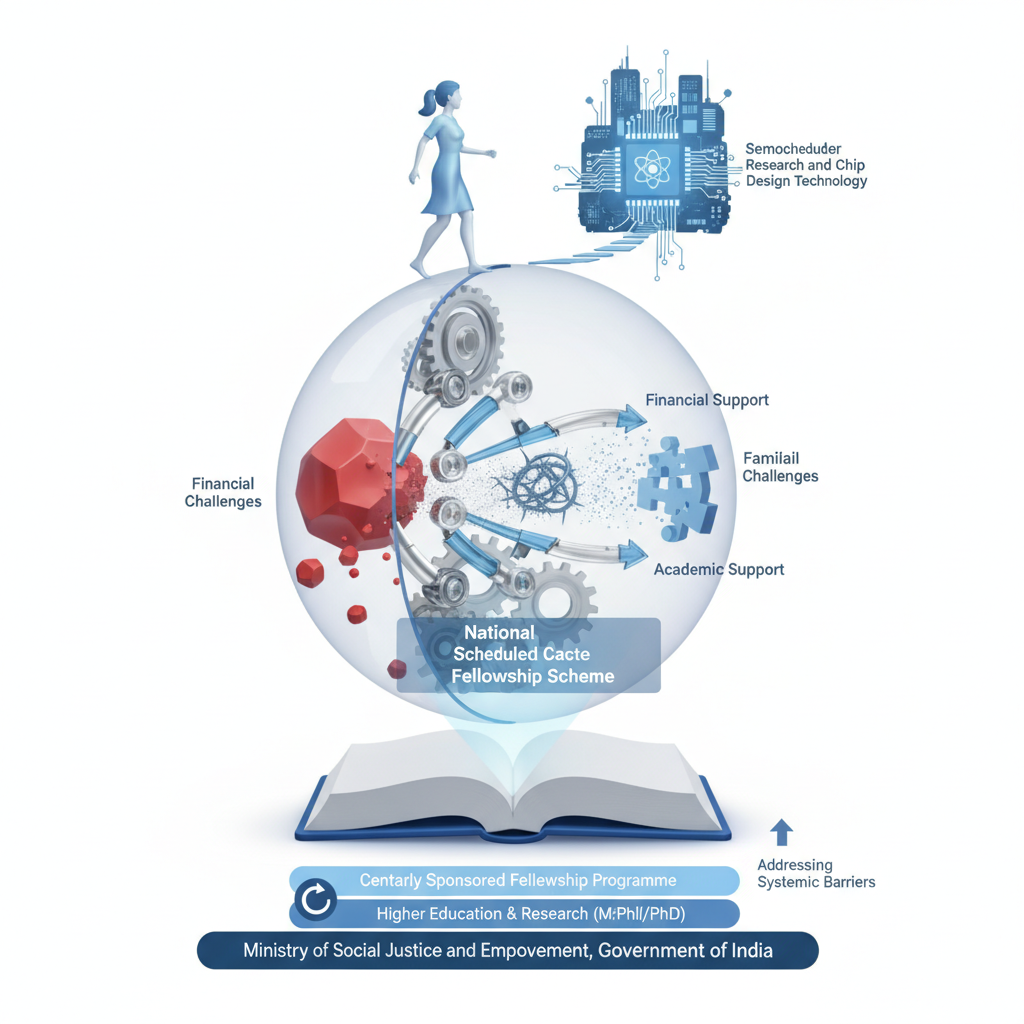
National Scheduled Caste FellowshiMinistry of Social Justice and EmpScheduled Caste scholarSemiconductor researchFinancial assistance✎ The National Scheduled Caste Fellowship Scheme (NFSC) provides structured financial support to SC students pursuing M.Phil and Ph.D programmes, enabling them to overcome financial barriers and contribute to India’s research…
Subject Relevance — Where This Topic Fits
- GS Paper II — Welfare Schemes for Vulnerable Sections | GS Paper III — Science and Technology — Research and Development | GS Paper IV — Human Values and Professional Ethics
- Prelims: National Scheduled Caste Fellowship Scheme (NFSC), Chip to Startup Programme, VLSI, Semiconductor Technology, SC/ST Welfare, Higher Education Funding, PhD Fellowship
- Essay: Equity in Education: Bridging the Opportunity Divide, Science and Technology as Catalysts for Social Transformation
Quick Revision: The National Scheduled Caste Fellowship Scheme (NFSC) provides structured financial support to SC students pursuing M.Phil and Ph.D programmes, enabling them to overcome financial barriers and contribute to India’s research ecosystem in critical domains such as semiconductor technology.
Why is this in the news?
The case of Ms. Sangita Das, a Scheduled Caste scholar, highlights the transformative role of the National Scheduled Caste Fellowship Scheme (NFSC) in enabling marginalised researchers to overcome multifaceted challenges—financial, familial, and academic—while pursuing advanced research in semiconductor and chip design technology.
Background
- The National Scheduled Caste Fellowship Scheme (NFSC) is a centrally sponsored fellowship programme implemented by the Ministry of Social Justice and Empowerment, Government of India, to support Scheduled Caste (SC) students in pursuing higher education and research at the M.Phil and Ph.D levels.
- The scheme aims to address systemic barriers in access to advanced education by providing financial assistance, thereby reducing dropout rates and fostering academic excellence among SC students.
- Scheduled Castes constitute approximately 16.6% of India’s population (Census 2011), and their representation in higher education and research remains disproportionately low due to socio-economic and structural constraints.
- The Chip to Startup (C2S) Programme, launched by the Ministry of Electronics and Information Technology (MeitY), promotes indigenous semiconductor and chip design innovation, aligning with India’s Atmanirbhar Bharat and Digital India missions.
- Semiconductor technology is a critical enabler for digital sovereignty, national security, and economic competitiveness, making research in this domain strategically significant.
- The NFSC reflects India’s constitutional commitment to substantive equality (Articles 15(4), 16(4), and 46) and aligns with the Sustainable Development Goal 4 (Quality Education) and Goal 10 (Reduced Inequalities).
What is the National Scheduled Caste Fellowship Scheme (NFSC)?
- The NFSC is a flagship fellowship scheme designed to provide financial support to Scheduled Caste students pursuing M.Phil and Ph.D programmes in Indian universities and institutions.
- The scheme is administered by the Ministry of Social Justice and Empowerment in collaboration with the University Grants Commission (UGC) and other academic bodies.
- Financial assistance under NFSC includes a monthly fellowship amount, contingency grant for research, and house rent allowance (HRA) where applicable, tailored to the academic stage of the scholar.
- For Ph.D scholars, the fellowship amount is ₹31,000 per month.
- Eligibility criteria include: (a) the candidate must belong to the Scheduled Caste category; (b) admission to M.Phil/Ph.D in a recognised Indian university or institution; (c) not availing any other central government fellowship simultaneously.
- The NFSC exemplifies affirmative action in higher education, ensuring that socio-economically disadvantaged groups are not excluded from the knowledge economy due to financial constraints.
Key Features
| Feature | Significance |
|---|---|
| Monthly financial assistance of ₹31,000 | Provides critical financial support to mitigate economic hardships during advanced research, enabling sustained academic pursuit without disruption. |
| Academic and research support | Includes access to resources, mentorship, and publication incentives, fostering a conducive environment for high-quality doctoral research. |
| Flexibility in utilisation | Allows recipients to balance research obligations with personal and familial responsibilities, including childcare and eldercare. |
| Merit-cum-means criteria | Ensures targeted support for Scheduled Caste candidates demonstrating academic excellence while facing socio-economic disadvantages. |
| Alignment with national priorities | Supports research in emerging technologies (e.g., semiconductor design) as part of India’s self-reliance initiatives in strategic sectors. |
Why it Matters
Economic
- Reduces financial vulnerability of SC scholars, enabling them to focus on research without resorting to external employment or debt.
- Contributes to human capital formation by supporting advanced education, which has long-term productivity and innovation benefits.
- Mitigates intergenerational poverty by providing a pathway for upward mobility through higher education and specialised skills.
Strategic
- Strengthens India’s semiconductor and VLSI ecosystem by nurturing specialised talent in critical technology domains.
- Enhances self-reliance in high-tech manufacturing, aligning with national missions such as ‘Chips to Startup’ and ‘Atmanirbhar Bharat’.
- Facilitates knowledge transfer and innovation through advanced research, supporting India’s transition to a knowledge-driven economy.
Social
- Promotes inclusivity in higher education and research by addressing systemic barriers faced by Scheduled Caste communities.
- Encourages gender inclusivity by supporting women scholars who balance research with caregiving responsibilities.
- Demonstrates the role of affirmative action in correcting historical inequities in access to advanced academic opportunities.
Challenges
1. Financial Constraints in Higher Education
- High cost of advanced research, including equipment, fieldwork, and publication fees, often exceeds personal or familial resources.
- Opportunity cost of pursuing PhD over immediate employment can deter aspirants from economically weaker sections.
- Lack of stipend parity with industry salaries in STEM fields creates financial disincentives for research careers.
UPSC Link: GS-II: Welfare Schemes for Vulnerable Sections
2. Work-Life-Research Balance
- Juggling doctoral research with familial responsibilities (e.g., childcare, eldercare) increases stress and reduces research productivity.
- Rigid academic timelines often clash with personal emergencies, leading to delays or abandonment of research.
- Inadequate institutional support for caregiving (e.g., childcare facilities, flexible deadlines) exacerbates challenges.
UPSC Link: GS-II: Social Sector Services
3. Research Ecosystem Gaps
- Limited access to advanced laboratories, mentorship, and collaborative networks in niche fields (e.g., semiconductor design).
- Bureaucratic delays in disbursing fellowships or approving research proposals disrupt academic continuity.
- Low representation of SC scholars in STEM disciplines due to systemic biases in admissions and funding allocations.
UPSC Link: GS-III: Science & Technology
4. Psychological and Emotional Stress
- Isolation and imposter syndrome are common among PhD scholars, particularly those from marginalised communities.
- Failure in experiments or rejection of papers can erode confidence and motivation without adequate support systems.
- Caregiver burden (e.g., managing ailing parents) compounds mental health challenges during research.
UPSC Link: GS-IV: Ethics in Governance
5. Institutional and Structural Barriers
- Hierarchical academic cultures may discourage SC scholars from seeking guidance or asserting their research needs.
- Lack of awareness about fellowship schemes among eligible candidates due to limited outreach in rural or remote areas.
- Gendered expectations (e.g., disproportionate caregiving roles) disproportionately affect women scholars.
UPSC Link: GS-II: Vulnerable Sections of Society
Challenges — UPSC Perspective
| Issue | Concern |
|---|---|
| Delayed disbursement of fellowships | Disrupts research continuity and increases financial strain on scholars. |
| Inadequate childcare support | Forces scholars to reduce research hours or abandon studies, particularly women. |
| Limited mentorship in niche fields | Hinders skill development and reduces the quality of research output. |
| High cost of research materials | Restricts access to cutting-edge tools, limiting experimental scope. |
| Lack of mental health services | Exacerbates stress and reduces resilience during high-pressure research phases. |
| Bureaucratic hurdles in approvals | Delays project initiation and approvals, affecting timelines and funding utilisation. |
Government Initiatives — Must-Memorise for Prelims
- Chips to Startup (C2S) Programme
Way Forward
- Enhance flexibility in fellowship disbursement to account for personal emergencies and caregiving needs.
- Expand institutional support for childcare and mental health services in universities and research institutions.
- Strengthen outreach programmes to increase awareness of fellowship schemes among SC candidates in rural and remote areas.
- Establish mentorship networks pairing senior researchers with SC scholars to improve guidance and retention.
- Increase funding for niche research fields (e.g., semiconductor design) to align with national strategic priorities.
- Introduce performance-linked extensions for scholars facing temporary disruptions due to valid reasons.
- Promote public-private partnerships to provide additional resources (e.g., lab access, stipends) for SC researchers.
- Conduct periodic reviews of fellowship schemes to identify gaps and incorporate feedback from beneficiaries.
UPSC Value Addition
Keywords for Mains Answer-Writing
National Scheduled Castes Fellowship Scheme (NFSC) · Scheduled Castes welfare · Higher education financing · Research funding mechanisms · Social justice and inclusion · Chips to Startup Programme · Semiconductor research · Academic resilience · Financial assistance for marginalised groups · Gender and caste intersectionality in academia
Concept Flow
Scheduled Caste communities face systemic barriers in accessing higher education and advanced research opportunities. → National Scheduled Caste Fellowship Scheme (NFCS) provides targeted financial and academic support to mitigate these barriers. → Recipients, such as Sangita Das, leverage NFCS to balance research obligations with personal and familial responsibilities. → Financial stability from NFCS enables sustained engagement in doctoral research, particularly in high-cost fields like semiconductor design. → Successful completion of PhD and subsequent professional roles (e.g., Project Associate-II) contribute to India’s self-reliance in strategic technologies. → Long-term outcomes include enhanced human capital, reduced intergenerational poverty, and strengthened innovation ecosystems.
Prelims Practice Questions
Q1. Consider the following statements regarding the National Scheduled Castes Fellowship Scheme (NFSC):
1. It is administered by the Ministry of Social Justice and Empowerment.
2. The fellowship provides financial support exclusively for undergraduate studies.
3. The scheme aims to promote academic and research excellence among Scheduled Caste students.
How many of the above statements are correct?
- Only one
- Only two
- All
- None
Answer: Only two — Statement 1 is correct as NFSC is administered by the Ministry of Social Justice and Empowerment. Statement 2 is incorrect as the fellowship supports higher education including PhD research. Statement 3 is correct as the scheme explicitly aims to promote academic and research excellence among Scheduled Caste students.
Q2. Assertion (A): The National Scheduled Castes Fellowship Scheme (NFSC) provides financial assistance to Scheduled Caste students pursuing higher education.
Reason (R): The scheme is designed to address socio-economic barriers and promote inclusion in academia.
Options:
A. Both A and R are true, and R is the correct explanation of A.
B. Both A and R are true, but R is not the correct explanation of A.
C. A is true, but R is false.
D. A is false, but R is true.
Answer: ? — Both Assertion (A) and Reason (R) are true. The NFSC indeed provides financial assistance to Scheduled Caste students for higher education, and the scheme is specifically designed to address socio-economic barriers and promote inclusion in academia. Thus, R correctly explains A.
Q3. Match the following schemes with their respective ministries:
Column I (Scheme)
1. National Scheduled Castes Fellowship Scheme (NFSC)
2. Chips to Startup Programme
3. National Overseas Scholarship for SCs
Column II (Ministry)
A. Ministry of Electronics and Information Technology
B. Ministry of Social Justice and Empowerment
C. Ministry of Education
Options:
1. 1-A, 2-B, 3-C
2. 1-B, 2-A, 3-C
3. 1-C, 2-A, 3-B
4. 1-B, 2-C, 3-A
- 1
- 2
- 3
- 4
Answer: 2 — 1. NFSC is administered by the Ministry of Social Justice and Empowerment (B). 2. Chips to Startup Programme is under the Ministry of Electronics and Information Technology (A). 3. National Overseas Scholarship for SCs is under the Ministry of Education (C).
Mains Practice Question
✍ The National Scheduled Castes Fellowship Scheme (NFSC) exemplifies the State’s commitment to promoting academic excellence and social inclusion among marginalised communities. In this context, critically examine the significance of targeted financial assistance schemes in addressing structural inequalities in higher education. Also, outline the institutional mechanisms required to ensure the effective implementation of such schemes. (15 Marks)
Approach: MODEL-ANSWER SKELETON:
1. **Introduction (2 Marks)**
– Define the National Scheduled Castes Fellowship Scheme (NFSC) and its objectives: financial support for SC students pursuing higher education and research.
– Contextualise with the case of Ms. Sangita Das, highlighting the role of NFSC in overcoming socio-economic and familial barriers.
2. **Significance of Targeted Financial Assistance (5 Marks)**
– **Addressing Structural Inequalities**: Explain how caste-based discrimination and socio-economic marginalisation create barriers to higher education. Cite data on enrolment disparities (e.g., SC representation in higher education vs. population share).
– **Promoting Inclusion**: Discuss how targeted schemes like NFSC foster diversity in academia and research, aligning with constitutional goals of social justice (Articles 15(4), 16(4), 46).
– **Economic Empowerment**: Highlight the role of financial assistance in reducing dropout rates and enabling students to focus on academic pursuits without financial stress.
3. **Challenges and Limitations (4 Marks)**
– **Implementation Gaps**: Discuss potential issues such as delayed disbursement, bureaucratic hurdles, or inadequate awareness among beneficiaries.
– **Sustainability**: Address concerns about the long-term viability of such schemes and the need for periodic reviews.
– **Intersectionality**: Acknowledge that caste intersects with gender, class, and region, requiring nuanced policy design.
4. **Institutional Mechanisms for Effective Implementation (4 Marks)**
– **Governance Structure**: Outline the role of the Ministry of Social Justice and Empowerment, nodal agencies, and academic institutions in monitoring and disbursing funds.
– **Transparency and Accountability**: Suggest measures like digital tracking of disbursements, grievance redressal mechanisms, and third-party audits.
– **Partnerships**: Highlight the importance of collaborations with universities, research institutions, and private sector stakeholders to enhance outreach and impact.
– **Data-Driven Policy**: Emphasise the need for disaggregated data on beneficiaries to assess the scheme’s effectiveness and identify gaps.
5. **Conclusion (2 Marks)**
– Summarise the transformative potential of targeted financial assistance schemes like NFSC in bridging inequalities.
– Stress the need for a multi-pronged approach combining financial support, institutional reforms, and societal awareness to achieve inclusive academic excellence.
Source: PIB (Press Information Bureau)
Generated by AanyaAi for educational purpose.

- KWML’s Feasibility Reports for Water Metro in 18 Cities: UPSC & PCS Insights - October 3, 2026
- ओडिशा में वन्यजीव अनुसंधान अनुदान कार्यक्रम शुरू, सिमिलिपाल में 300 कैमरे और बढ़ेंगे - October 3, 2026
- India Summons Pakistan High Commission Official Over Violation - October 3, 2026

No Comments