


21 Jul UPSC Focus: Govt Ensures Fertilizer Supply via Strategic Planning & Imports
Subject Relevance — Where This Topic Fits
- GS Paper III — Agriculture, Food Processing and Related Issues | GS Paper III — Issues related to direct and indirect farm subsidies and minimum support prices
- Prelims: Fertiliser Subsidy Scheme, Neem Coated Urea, Nutrient Based Subsidy (NBS) Policy, Urea Policy 2015, Fertiliser Control Order (FCO), Soil Health Card Scheme, PM-KISAN
- Essay: Agricultural productivity and food security: The role of strategic planning and global partnerships, Balancing self-reliance with global trade: Lessons from India’s fertiliser sector
Quick Revision: Fertiliser supply security in India is ensured through a triad of domestic production, strategic imports, and balanced policy frameworks like NBS and Neem Coated Urea, coordinated by the Department of Fertilisers to sustain agricultural productivity and food security.
Why is this in the news?
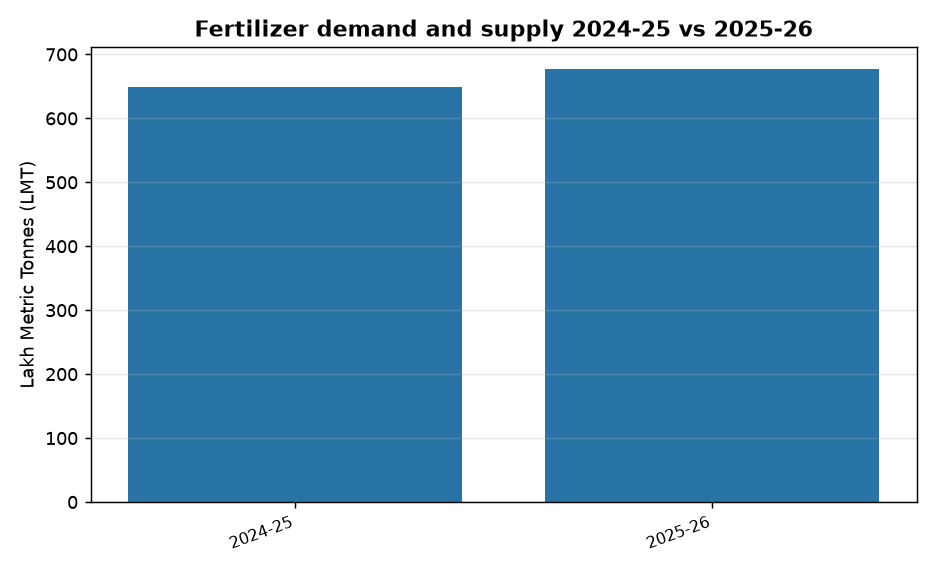
The Press Information Bureau (PIB) release dated 21 July 2026 highlights the Government of India’s proactive measures to ensure timely and adequate availability of fertilisers for the agricultural sector. It underscores the 4% projected increase in total fertiliser requirement for 2025-26, the strategic import agreements with key fertiliser-producing nations, and the coordination between domestic production, imports, and distribution to maintain supply chain resilience amid global uncertainties.
Background
- India’s agricultural productivity is critically dependent on the timely availability of fertilisers, particularly urea, diammonium phosphate (DAP), muriate of potash (MOP), and complex fertilisers (NPK).
- The Government implements the Nutrient Based Subsidy (NBS) policy to ensure balanced fertiliser use and rationalise subsidies based on nutrient content.
- The Soil Health Card Scheme (launched in 2015) provides farmers with soil nutrient status and recommendations for balanced fertiliser application.
- India is the second-largest consumer and third-largest producer of fertilisers globally, with significant dependence on imports for certain nutrients like phosphates and potash.
- The Fertiliser Control Order (FCO), 1985, regulates the quality, production, distribution, and sale of fertilisers in India.
- The Urea Policy 2015 introduced the concept of Neem Coated Urea to reduce diversion and improve soil health.
What is Fertiliser Supply Security?
- Fertiliser supply security refers to the uninterrupted availability of fertilisers to farmers at affordable prices, ensuring agricultural productivity and food security.
- It is achieved through a combination of domestic production, strategic imports, and efficient distribution mechanisms, coordinated by the Department of Fertilisers under the Ministry of Chemicals and Fertilisers.
- The Government conducts pre-sowing assessments in consultation with state governments and agricultural departments to estimate fertiliser requirements for each crop season.
- Long-term import agreements with fertiliser-producing countries (e.g., Saudi Arabia, Jordan, Morocco, Russia) mitigate supply chain risks and ensure price stability.
- The Nutrient Based Subsidy (NBS) policy incentivises the use of fertilisers based on their nutrient content, promoting balanced fertilisation and reducing over-reliance on urea.
- Neem Coated Urea, introduced under the Urea Policy 2015, enhances nitrogen use efficiency, reduces soil degradation, and prevents diversion for non-agricultural uses.
- The Fertiliser Control Order (FCO) ensures quality standards, while the Soil Health Card Scheme guides farmers on optimal fertiliser application based on soil nutrient status.
Key Features
| Feature | Significance |
|---|---|
| Advance Planning by DA&FW | Ensures demand-supply alignment through pre-sessional assessments in consultation with state governments. |
| Domestic Production Coordination | Maintains supply stability by synchronising production schedules with distribution networks. |
| Strategic Import Agreements | Secures long-term supply from key fertiliser-producing nations (Saudi Arabia, Jordan, Morocco, Russia) to mitigate global supply shocks. |
| Demand-Projection Accuracy | Demonstrates 4% growth in total fertiliser requirement (2025-26) against a 41% increase in media misinterpretation, highlighting data-driven policy. |
| Seasonal Consumption Monitoring | Tracks kharif 2026 consumption (151.74 LMT) against kharif 2025 (157.05 LMT) to adjust procurement and distribution dynamically. |
Why it Matters
Agricultural Productivity
- Guarantees timely fertiliser availability to sustain crop yields, particularly for high-yield varieties and rabi-kharif cycles.
- Reduces input cost volatility for farmers, ensuring economic viability of small and marginal holdings.
- Supports India’s self-sufficiency goals in food grains through balanced nutrient application.
Economic Stability
- Prevents inflationary pressures in agri-input markets by stabilising fertiliser prices through supply-side interventions.
- Reduces import dependency risks via diversified sourcing from multiple geographies (West Asia, North Africa, Russia).
- Enhances rural income security by minimising disruptions in agricultural operations.
Strategic Supply Chain Resilience
- Mitigates geopolitical risks (e.g., sanctions, trade restrictions) through multi-country agreements.
- Ensures buffer stocks for critical fertilisers (urea, DAP, MOP) to address emergency demand surges.
- Leverages long-term contracts to lock in favourable pricing and logistics terms.
Policy Coordination
- Demonstrates inter-ministerial synergy between Ministry of Chemicals & Fertilisers, Ministry of Agriculture, and state agencies.
- Aligns with the National Mission on Sustainable Agriculture (NMSA) by promoting balanced fertiliser use.
- Supports the Pradhan Mantri Kisan Samman Nidhi (PM-KISAN) by ensuring input availability for beneficiary farmers.
Challenges
1. Global Fertiliser Price Volatility
- Dependence on imported inputs (e.g., phosphates, potash) exposes India to international market fluctuations.
- Recent geopolitical tensions (e.g., Russia-Ukraine war) have disrupted supply chains and increased costs.
- Limited domestic production of non-urea fertilisers (e.g., DAP, MOP) necessitates higher import reliance.
UPSC Link: GS-III: Food Security
2. Logistical Bottlenecks
- Inadequate storage infrastructure at ports and hinterlands leads to delays in distribution.
- Railway freight constraints and road network deficiencies increase transit times and costs.
- Seasonal demand surges (e.g., kharif sowing) strain supply chains, risking shortages.
UPSC Link: GS-III: Infrastructure
3. Subsidy Burden and Fiscal Sustainability
- Urea subsidy (under Nutrient Based Subsidy scheme) imposes a significant fiscal burden (~₹1.5 lakh crore annually).
- Under-recovery of costs by fertiliser companies due to administered pricing distorts market signals.
- Need for gradual subsidy rationalisation to align with global prices and promote efficient fertiliser use.
UPSC Link: GS-III: Government Budgeting
4. Environmental and Health Concerns
- Excessive use of urea and imbalanced fertiliser application degrades soil health and water quality.
- Nitrate leaching from over-application contributes to groundwater contamination and eutrophication.
- Regulatory gaps in enforcing fertiliser quality standards risk farmer health and crop productivity.
UPSC Link: GS-III: Environmental Pollution
5. Climate Change Impacts
- Erratic monsoons and droughts alter fertiliser demand patterns, complicating procurement planning.
- Increased frequency of extreme weather events disrupts storage and transportation networks.
- Shift in cropping patterns (e.g., towards drought-resistant varieties) may reduce fertiliser intensity.
UPSC Link: GS-III: Disaster Management
Challenges — UPSC Perspective
| Issue | Concern |
|---|---|
| Price Volatility | Exposure to international markets increases fiscal and supply risks. |
| Logistical Delays | Storage and transport constraints hinder timely distribution. |
| Subsidy Distortions | Administered pricing undermines market efficiency and fiscal sustainability. |
| Soil Degradation | Imbalanced fertiliser use reduces long-term agricultural productivity. |
| Climate Variability | Extreme weather events disrupt demand-supply equilibrium. |
Way Forward
- Expand domestic production of non-urea fertilisers (e.g., DAP, MOP) through brownfield and greenfield projects under the Make in India initiative.
- Enhance multi-modal logistics (ports, railways, roads) to reduce transit times and costs for fertiliser distribution.
- Rationalise fertiliser subsidies by linking them to nutrient efficiency and promoting balanced fertiliser use (e.g., neem-coated urea).
- Strengthen soil health management through the Soil Health Card Scheme to reduce fertiliser overuse and improve crop yield.
- Diversify import sources further (e.g., Canada for potash, Egypt for phosphates) to mitigate geopolitical risks.
- Invest in cold storage and warehousing infrastructure at district levels to buffer seasonal demand surges.
- Promote precision agriculture techniques (e.g., drone-based fertiliser application) to optimise nutrient use.
- Establish a national fertiliser buffer stock to address emergency supply disruptions.
UPSC Value Addition
Keywords for Mains Answer-Writing
Agricultural productivity · Fertilizer subsidy · Food security · Supply chain resilience · Domestic fertilizer production · Strategic imports · Long-term import agreements · Kharif season · Urea, DAP, MOP, NPKS · Ministry of Chemicals and Fertilizers · Agricultural demand forecasting · Buffer stock management
Concept Flow
Government assesses fertiliser demand → Coordinates domestic production and imports → Ensures timely distribution → Supports agricultural productivity → Enhances food security → Contributes to economic stability. → Global fertiliser price volatility → Strategic import agreements → Supply chain resilience → Reduced fiscal burden → Sustainable agricultural growth. → Excessive fertiliser use → Soil degradation → Lower yields → Increased subsidy burden → Need for balanced nutrient policies. → Climate change impacts → Erratic monsoons → Altered fertiliser demand → Dynamic procurement planning → Adaptive agricultural policies. → Logistical bottlenecks → Delayed distribution → Farmer hardship → Policy interventions for infrastructure upgrades → Improved supply chains.
Prelims Practice Questions
Q1. Consider the following statements regarding fertilizer supply in India: 1. The total fertilizer requirement for 2025-26 is projected to increase by approximately 4% compared to 2024-25. 2. The government has entered into long-term import agreements with Morocco for 31 lakh metric tonnes of DAP. 3. The Kharif 2026 season witnessed a decline in the consumption of major fertilizers compared to Kharif 2025. Which of the statements given above is/are correct?
- 1 only
- 1 and 2 only
- 1 and 3 only
- 1, 2 and 3
Answer: 1 and 3 only — Statement 1 is correct as the total fertilizer requirement for 2025-26 is projected to be 677.18 LMT, a 4% increase from 649.43 LMT in 2024-25. Statement 2 is incorrect; the long-term import agreement with Morocco was for 25 LMT of DAP/ TSP, not 31 LMT. Statement 3 is correct as the total consumption of major fertilizers during Kharif 2026 (151.74 LMT) was lower than Kharif 2025 (157.05 LMT).
Q2. Which of the following is NOT a major fertilizer imported by India under the strategic long-term agreements mentioned in the PIB release?
- Urea
- DAP
- MOP
- NPKS
Answer: Urea — The PIB release mentions long-term import agreements for DAP, MOP, and NPKS but does not mention urea. Urea is primarily produced domestically in India and is not a focus of the strategic import agreements highlighted in the release.
Mains Practice Question
✍ Analyze the role of strategic import agreements in ensuring India’s fertilizer supply security. How does this approach complement domestic production in addressing the challenges of agricultural productivity and food security in the country? (250 words)
Approach: Begin by outlining the significance of fertilizers in enhancing agricultural productivity and ensuring food security. Discuss the challenges faced by India, such as fluctuating global prices, supply chain disruptions, and increasing demand. Explain how strategic import agreements with countries like Saudi Arabia, Jordan, Morocco, and Russia mitigate these challenges by ensuring a steady supply of critical fertilizers like DAP, MOP, and NPKS. Highlight the role of domestic production in reducing dependency on imports and maintaining buffer stocks. Conclude by emphasizing the need for a balanced approach combining domestic production, strategic imports, and efficient distribution to sustain agricultural growth and food security.
Source: PIB (Press Information Bureau)
Generated by AanyaAi for educational purpose.

- Jal Arpan: 1850+ Gram Panchayats Join Hands for Rural Water Supply - October 3, 2026
- भारत ने किया 5.56 किमी मुक्त अंतरिक्ष क्वांटम की वितरण लिंक का सफल परीक्षण - October 3, 2026
- Great Indian Bustard Reintroduction: 10-Year Effort Bears Fruit in Rajasthan - October 3, 2026

No Comments