


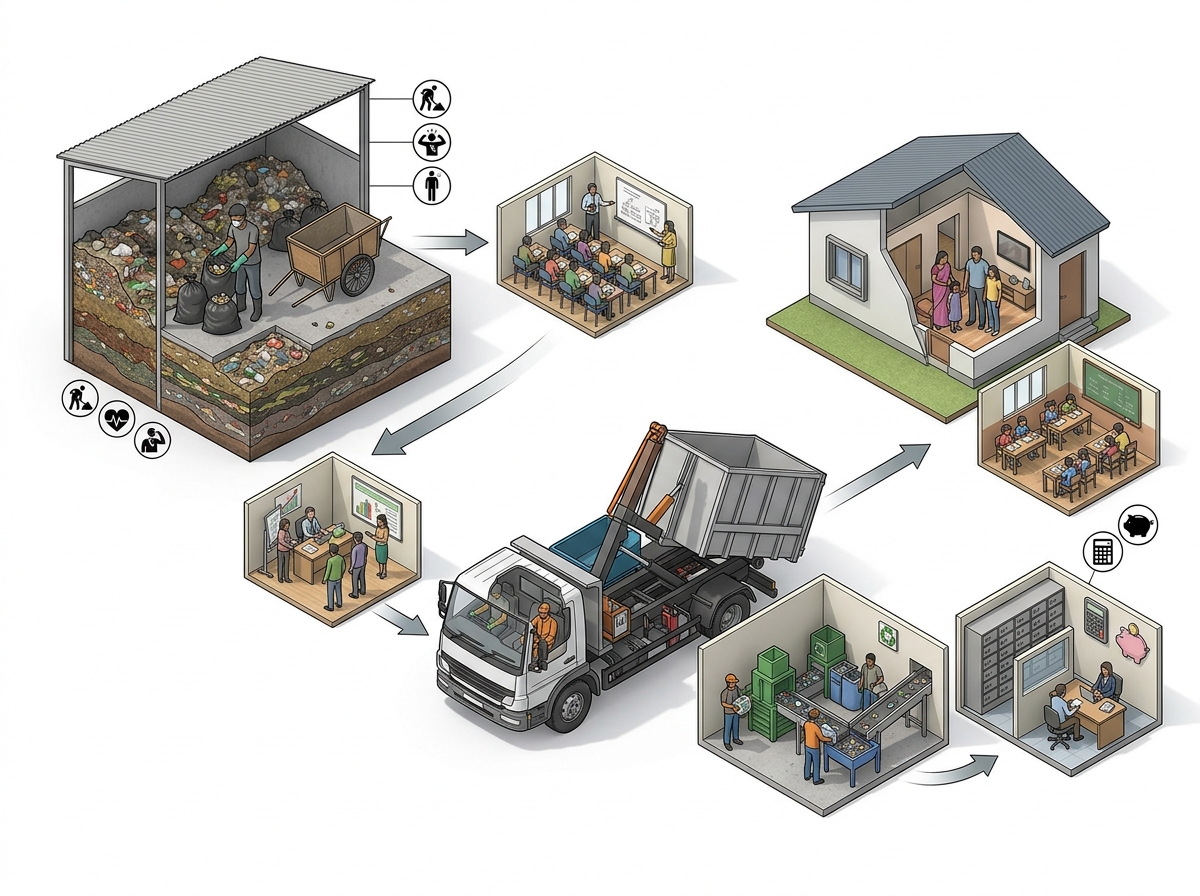
24 Sep UPSC Focus: How Swachhta Udyami Yojana Empowered a Waste Picker in Andhra Pradesh
✎ The Swachhta Udyami Yojana (SUY) under NAMASTE provides 50% capital subsidy and 50% term loan (up to ₹35 lakh per project) to sanitation workers for setting up micro-enterprises, enabling livelihood transformation and financial…
Subject Relevance — Where This Topic Fits
- GS Paper II — Social Justice and Empowerment | GS Paper III — Employment, Skill Development and Entrepreneurship
- Prelims: Swachhta Udyami Yojana, National Safai Karamchari Finance and Development Corporation, NULM, SECC 2011, Self-Employment Schemes
- Essay: Social upliftment through targeted welfare schemes, The role of financial inclusion in breaking intergenerational poverty
Quick Revision: The Swachhta Udyami Yojana (SUY) under NAMASTE provides 50% capital subsidy and 50% term loan (up to ₹35 lakh per project) to sanitation workers for setting up micro-enterprises, enabling livelihood transformation and financial inclusion.
Why is this in the news?
The case of Shri Chevuri Anjaneyulu, a waste collector from Guntur district, Andhra Pradesh, highlights the transformative impact of the Swachhta Udyami Yojana (SUY) under the NAMASTE (National Action for Mechanised Sanitation Ecosystem) initiative. His story underscores how targeted financial and entrepreneurial support can enhance livelihoods, promote financial security, and enable upward social mobility for marginalised communities engaged in sanitation work.
Background
- India’s sanitation workforce, including waste collectors and manual scavengers, faces systemic socio-economic exclusion, limited access to education, and occupational hazards.
- The SECC 2011 data identified over 180,000 households engaged in manual scavenging, predominantly from Scheduled Castes and Scheduled Tribes communities.
- The Prohibition of Employment as Manual Scavengers and their Rehabilitation Act, 2013, mandates the rehabilitation of manual scavengers through skill development and alternative livelihoods.
- The National Safai Karamchari Finance and Development Corporation (NSKFDC) was established in 1997 to provide financial assistance and developmental support to safai karamcharis and their dependents.
- The NAMASTE scheme, launched in 2022, aims to eliminate manual scavenging by providing mechanised sanitation solutions and livelihood support to workers.
- The Swachhta Udyami Yojana (SUY) is a component of NAMASTE, designed to promote entrepreneurship among sanitation workers through group projects and financial subsidies.
What is the Swachhta Udyami Yojana (SUY)?
- SUY is a sub-scheme under the NAMASTE initiative, launched by the Ministry of Social Justice and Empowerment to facilitate entrepreneurship among sanitation workers, including waste collectors, manual scavengers, and sewer workers.
- The scheme provides financial assistance in the form of term loans and capital subsidies for group projects, enabling beneficiaries to establish micro-enterprises in waste management, recycling, and allied sectors.
- Eligible beneficiaries include individuals from marginalised communities, particularly those identified under the SECC 2011 as engaged in manual scavenging or waste collection.
- The scheme offers a 50% capital subsidy (up to ₹17.5 lakh) and a 50% term loan (up to ₹17.5 lakh) for projects with a total cost of up to ₹35 lakh, with a repayment period of up to 7 years.
- SUY aims to enhance livelihood security by enabling beneficiaries to transition from informal, low-income occupations to sustainable, self-employment ventures.
- The scheme aligns with the broader objectives of the NAMASTE programme, which seeks to eliminate manual scavenging and improve the socio-economic conditions of sanitation workers.
- Implementation is facilitated through the National Safai Karamchari Finance and Development Corporation (NSKFDC), which acts as the nodal agency for disbursing funds and providing capacity-building support.
- SUY also includes skill development components to ensure beneficiaries are equipped with managerial and technical competencies required for running their enterprises.
Key Features
| Feature | Significance |
|---|---|
| Swachhta Udyami Yojana (SUY) | A sub-scheme under NAMASTE, providing financial assistance to sanitation workers for entrepreneurship in waste management. |
| Group Project Model | Facilitates collective entrepreneurship among sanitation workers, reducing individual financial risk and enhancing scalability. |
| Loan and Subsidy Structure | 50% loan (₹17.5 lakh) and 50% upfront capital subsidy (₹17.5 lakh) for project viability and sustainability. |
| Income Augmentation | Directly increases monthly earnings by approximately ₹10,000, improving household financial security. |
| Access to Private Education | Enables children of beneficiaries to attend English-medium private schools, breaking intergenerational poverty cycles. |
Why it Matters
Economic Empowerment
- Transforms informal waste-pickers into formal entrepreneurs, integrating them into the circular economy.
- Provides structured credit access to marginalised communities, reducing dependence on exploitative informal lenders.
- Demonstrates scalability of social entrepreneurship models for livelihood diversification among vulnerable groups.
Social Inclusion
- Addresses historical exclusion of Scheduled Tribes (ST) in formal employment and financial systems.
- Reduces social discrimination by enabling upward mobility through dignified livelihoods.
- Promotes intergenerational equity by facilitating quality education for children of beneficiaries.
Policy Implementation
- Illustrates the effectiveness of targeted welfare schemes in achieving Sustainable Development Goals (SDG 1, 8, 10).
- Highlights the role of specialised financial institutions (NSKFDC) in implementing socio-economic welfare schemes.
- Showcases the integration of multiple welfare instruments (credit, subsidy, skill support) for holistic impact.
Sustainability
- Encourages circular economy practices by formalising waste collection and recycling initiatives.
- Reduces urban solid waste management costs through decentralised, community-led solutions.
- Creates a replicable model for other marginalised occupational groups (e.g., manual scavengers).
Challenges
1. Access to Formal Credit
- Historical exclusion of informal workers from formal banking systems limits initial capital access.
- Collateral requirements act as a barrier despite government guarantees under SUY.
- Need for financial literacy programmes to enhance understanding of credit instruments among beneficiaries.
UPSC Link: GS3: Inclusive Growth
2. Social Stigma and Discrimination
- Deep-rooted caste-based occupational segregation perpetuates exclusion from mainstream economic activities.
- Limited social mobility due to entrenched prejudices in housing, education, and employment sectors.
- Requires multi-stakeholder interventions (NGOs, local governance) to dismantle systemic barriers.
UPSC Link: GS1: Social Empowerment
3. Skill and Capacity Gaps
- Lack of formal training in waste management and entrepreneurship among traditional waste-pickers.
- Need for continuous capacity-building to adapt to evolving waste management technologies.
- Entrepreneurship development programmes must align with market demand for sustainable outcomes.
UPSC Link: GS3: Skill Development
4. Policy Coordination Gaps
- Fragmented implementation across central, state, and local levels may dilute scheme effectiveness.
- Delays in disbursement of subsidies and loans can disrupt project timelines and beneficiary confidence.
- Requires robust monitoring mechanisms to track utilisation and impact at grassroots level.
UPSC Link: GS2: Centre-State Relations
5. Market Linkages and Sustainability
- Dependence on informal waste markets limits profitability and scalability of formal enterprises.
- Need for government-industry partnerships to ensure steady demand for recycled materials.
- Price volatility in secondary raw materials poses financial risks to micro-entrepreneurs.
UPSC Link: GS3: MSMEs
Challenges — UPSC Perspective
| Issue | Concern |
|---|---|
| Lack of Collateral | Excludes marginalised workers from formal credit despite government guarantees. |
| Caste-Based Exclusion | Perpetuates occupational segregation and limits economic mobility. |
| Limited Financial Literacy | Hinders effective utilisation of credit and subsidy instruments. |
| Market Volatility | Affects profitability of waste-based enterprises due to fluctuating raw material prices. |
| Implementation Delays | Disrupts project timelines and reduces beneficiary trust in welfare schemes. |
| Skill Mismatch | Traditional waste-pickers lack formal training in modern waste management practices. |
Government Initiatives — Must-Memorise for Prelims
- Swachhta Udyami Yojana (SUY) under NAMASTE
- National Safai Karamchari Finance and Development Corporation (NSKFDC) scheme
Way Forward
- Strengthen financial literacy programmes to enhance credit utilisation among beneficiaries.
- Expand skill development initiatives in waste management and entrepreneurship for scalability.
- Establish robust grievance redressal mechanisms to address implementation delays and disputes.
- Foster public-private partnerships to create stable demand for recycled materials.
- Integrate SUY with existing social protection schemes (e.g., PM-KISAN, Ayushman Bharat) for holistic support.
- Promote digital inclusion to facilitate access to financial services and market linkages.
- Conduct periodic impact assessments to refine scheme design and address emerging challenges.
UPSC Value Addition
Keywords for Mains Answer-Writing
Swachhta Udyami Yojana (SUY) · National Safai Karamchari Finance and Development Corporation (NSKFDC) · Namma Yojana · livelihood promotion for marginalised communities · financial inclusion of waste pickers · Scheduled Tribes welfare · group-based livelihood projects · subsidy-linked credit for informal workers · income augmentation for informal sector · social security for unorganised workers · entrepreneurship development for vulnerable groups · sustainable livelihoods through formal support mechanisms · capacity building for waste management entrepreneurs · inclusive growth and poverty alleviation · intersectionality of caste, tribe, and informal employment
Constitutional & Policy Linkages
- Article 46 (Promotion of educational and economic interests of weaker sections)
- Article 21 (Right to Livelihood and Dignity)
Concept Flow
Historical exclusion of ST communities → Informal waste-picking as primary livelihood → NAMASTE and SUY intervention → Financial assistance (loan + subsidy) → Group project formation → Entrepreneurship in waste management → Income augmentation (₹10,000/month) → Children’s education in private schools → Intergenerational mobility and social inclusion.
Prelims Practice Questions
Q1. Consider the following statements about the Swachhta Udyami Yojana (SUY):
1. SUY is implemented under the Namma Yojana initiative.
2. It provides both loans and upfront capital subsidies to beneficiaries.
3. The scheme is exclusively for urban waste management entrepreneurs.
4. The National Safai Karamchari Finance and Development Corporation (NSKFDC) acts as the nodal agency for SUY.
How many of the above statements are correct?
- Only one
- Only two
- Only three
- All four
Answer: All four — Statements 1, 2, and 4 are correct. Statement 3 is incorrect as SUY targets waste pickers and informal workers across urban and rural areas, not exclusively urban entrepreneurs.
Q2. Assertion (A): The National Safai Karamchari Finance and Development Corporation (NSKFDC) provides financial support to waste pickers under the Swachhta Udyami Yojana.
Reason (R): NSKFDC is mandated to promote the socio-economic welfare of Safai Karamcharis and related communities through credit-linked schemes.
Options:
A. Both A and R are true, and R is the correct explanation of A.
B. Both A and R are true, but R is not the correct explanation of A.
C. A is true, but R is false.
D. A is false, but R is true.
Answer: ? — Both the Assertion (A) and Reason (R) are correct, and R correctly explains A. NSKFDC is indeed the nodal agency for SUY, which provides financial support to waste pickers.
Q3. Match the following schemes with their respective nodal agencies:
Column I (Scheme) | Column II (Nodal Agency)
——————————————–|—————————
1. Swachhta Udyami Yojana (SUY) | A. Ministry of Housing and Urban Affairs
2. Namma Yojana | B. National Safai Karamchari Finance and Development Corporation (NSKFDC)
3. Deendayal Antyodaya Yojana-National Urban Livelihoods Mission (DAY-NULM) | C. Ministry of Social Justice and Empowerment
4. Pradhan Mantri Street Vendors AtmaNirbhar Nidhi (PM SVANidhi) | D. Ministry of Housing and Urban Affairs
Options:
1-B, 2-C, 3-A, 4-D
1-B, 2-C, 3-D, 4-A
1-C, 2-B, 3-A, 4-D
1-A, 2-B, 3-C, 4-D
- 1-B, 2-C, 3-A, 4-D
- 1-B, 2-C, 3-D, 4-A
- 1-C, 2-B, 3-A, 4-D
- 1-A, 2-B, 3-C, 4-D
Answer: 1-B, 2-C, 3-D, 4-A — Correct match: 1-B (SUY is implemented by NSKFDC), 2-C (Namma Yojana falls under the Ministry of Social Justice and Empowerment), 3-A (DAY-NULM is under the Ministry of Housing and Urban Affairs), 4-D (PM SVANidhi is also under the Ministry of Housing and Urban Affairs).
Mains Practice Question
✍ The Swachhta Udyami Yojana (SUY) exemplifies a targeted livelihood intervention for marginalised communities engaged in informal waste-picking. Critically examine the scheme’s design, implementation mechanisms, and potential to achieve sustainable livelihood outcomes for beneficiaries like Shri Chevuri Anjaneyulu. Also, analyse the role of the National Safai Karamchari Finance and Development Corporation (NSKFDC) in facilitating such interventions within the broader framework of India’s informal sector economy. (15 Marks)
Approach: MODEL-ANSWER SKELETON:
1. **Introduction (2 Marks)**
– Define SUY and its placement under the Namma Yojana initiative.
– Contextualise the scheme within India’s informal sector economy and the socio-economic vulnerabilities of waste pickers.
– Highlight the case of Shri Chevuri Anjaneyulu to illustrate the scheme’s impact.
2. **Design and Objectives of SUY (3 Marks)**
– Purpose: Livelihood promotion, financial inclusion, and socio-economic upliftment of waste pickers and marginalised communities.
– Key features: Group-based projects, credit-linked support (loan + upfront capital subsidy), and capacity building.
– Eligibility: Targets Scheduled Castes, Scheduled Tribes, Safai Karamcharis, and other marginalised groups.
3. **Implementation Mechanisms (4 Marks)**
– Role of NSKFDC: Nodal agency for credit facilitation, project appraisal, and subsidy disbursement.
– Project structure: Group-based projects (e.g., recycling units, waste collection enterprises) with a 50:50 debt-to-subsidy ratio.
– Monitoring and evaluation: Periodic reviews, skill training, and market linkages.
– Challenges: Access to formal credit, bureaucratic hurdles, and ensuring sustained income generation.
4. **Potential for Sustainable Livelihood Outcomes (3 Marks)**
– Economic empowerment: Increased income (e.g., ₹10,000/month additional earnings for Anjaneyulu), financial security, and reduced poverty.
– Social upliftment: Improved access to education (e.g., children in private schools), reduced social discrimination, and enhanced dignity.
– Limitations: Dependence on market conditions, scalability issues, and long-term sustainability of projects.
5. **Broader Framework: Informal Sector and Policy Interventions (3 Marks)**
– Role of informal sector in India’s economy: Employment generation, GDP contribution, and socio-economic vulnerabilities.
– Policy gaps: Lack of formal recognition, limited access to social security, and inadequate institutional support.
– SUY as a model: Demonstrates how targeted interventions can bridge gaps in formal support mechanisms.
– Comparative perspective: Contrast with other schemes like DAY-NULM or PM SVANidhi for waste pickers and street vendors.
6. **Conclusion (2 Marks)**
– SUY’s success in transforming livelihoods for marginalised groups like Anjaneyulu.
– Need for scaling up such interventions with stronger institutional backing, market linkages, and skill development.
– Emphasise the importance of inclusive growth and formalisation of the informal sector for sustainable development.
Source: PIB (Press Information Bureau)
Generated by AanyaAi for educational purpose.
Related guides on our sites
- Current affairs for upsc 2026
- How to prepare for GS paper 1 for UPSC CSE mains exam
- Best UPSC coaching for IFOS exam
- Best mentorship programme for upsc

- UPSC Focus: How Swachhta Udyami Yojana Empowered a Waste Picker in Andhra Pradesh - September 24, 2026
- संयुक्त राष्ट्र में समुद्र तल वृद्धि: जलवायु संकट का बड़ा खतरा - September 24, 2026
- UN Declaration on Sea Level Rise: UPSC Current Affairs for 2026 - September 24, 2026

No Comments