


31 Jul UPSC: How Ethanol Blended Petrol Balances Food Security & Energy Needs
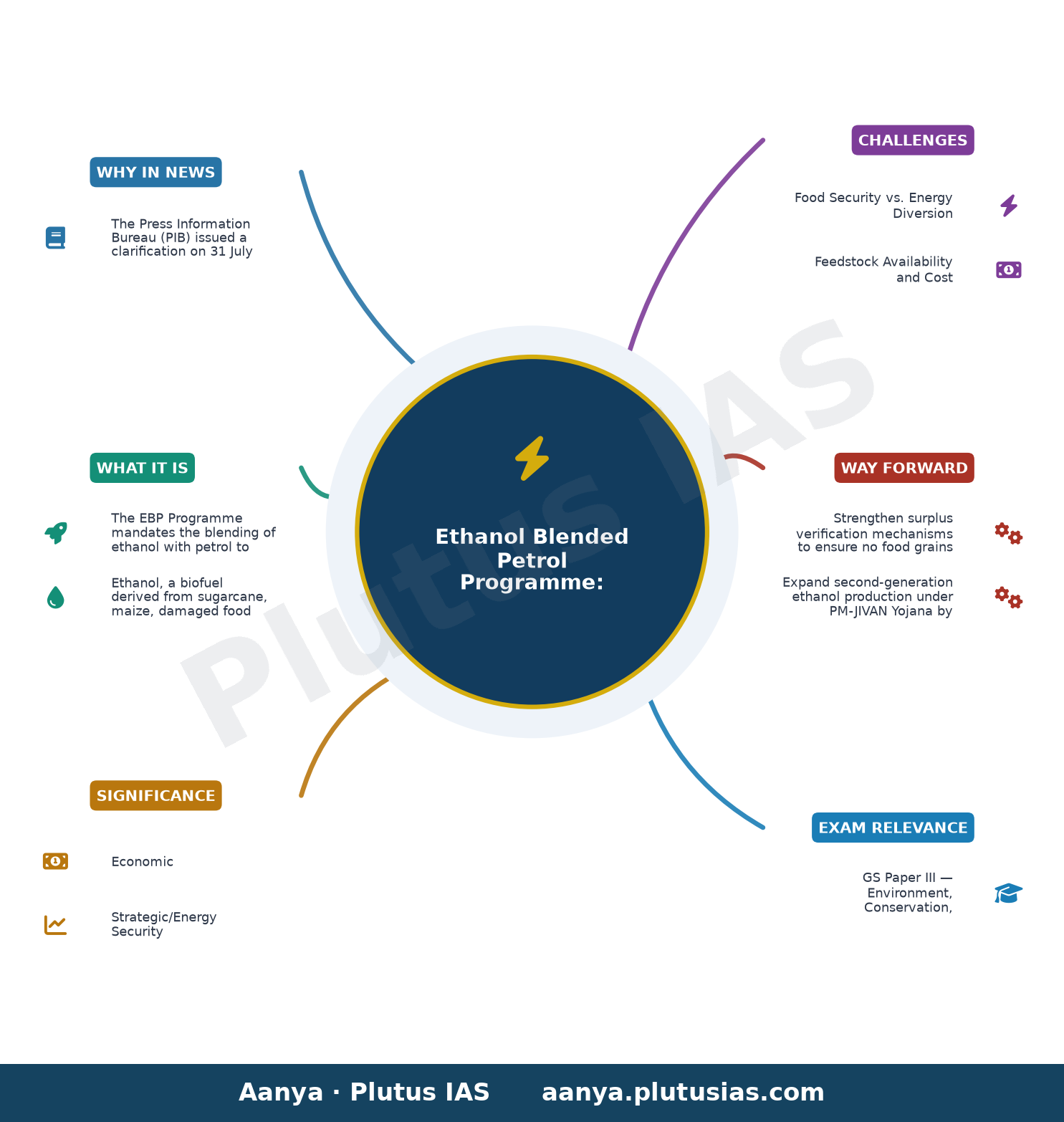
✎ The Ethanol Blended Petrol Programme integrates energy security, food security, and farmer welfare by utilising surplus and damaged food grains, agricultural residues, and molasses for ethanol production, ensuring no compromise…
Subject Relevance — Where This Topic Fits
- GS Paper III — Environment, Conservation, Environmental Pollution and Degradation; Energy
- Prelims: Ethanol Blended Petrol (EBP), National Biofuel Policy 2018, Ethanol Blending Targets, Food Corporation of India (FCI), Public Distribution System (PDS), National Food Security Act (NFSA), Minimum Support Price (MSP), Second-Generation Ethanol, Pradhan Mantri JI-VAN Yojana, Sugar Cess, Ethanol Supply Year (ESY)
- Essay: India’s Energy Transition: Balancing Sustainability and Food Security; Role of Biofuels in Achieving Net-Zero Emissions
Quick Revision: The Ethanol Blended Petrol Programme integrates energy security, food security, and farmer welfare by utilising surplus and damaged food grains, agricultural residues, and molasses for ethanol production, ensuring no compromise on food security while reducing crude oil import dependence.
Why is this in the news?
The Press Information Bureau (PIB) issued a clarification on 31 July 2026 to counter misconceptions surrounding the Ethanol Blended Petrol (EBP) Programme, particularly regarding its impact on food security, farmer welfare, and energy security. The clarification addressed false claims about the sale of FCI rice to distilleries at subsidised rates, the cost-effectiveness of ethanol vis-à-vis petrol, and the programme’s reliance on food grains, thereby reaffirming the programme’s role in India’s energy transition while safeguarding food security.
Background
- The Ethanol Blended Petrol (EBP) Programme was launched in 2013 under the National Biofuel Policy 2018, with a target to achieve 20% ethanol blending in petrol (E20) by 2025-26.
- India’s energy security is critically dependent on crude oil imports, which account for over 80% of its domestic consumption, making biofuels a strategic alternative to reduce import dependency.
- Food security in India is governed by the National Food Security Act (NFSA) 2013 and the Public Distribution System (PDS), which ensure subsidised food grains to over 800 million beneficiaries.
- The Food Corporation of India (FCI) procures food grains at Minimum Support Prices (MSP) to maintain buffer stocks and stabilise prices, ensuring food security before any surplus is diverted for ethanol production.
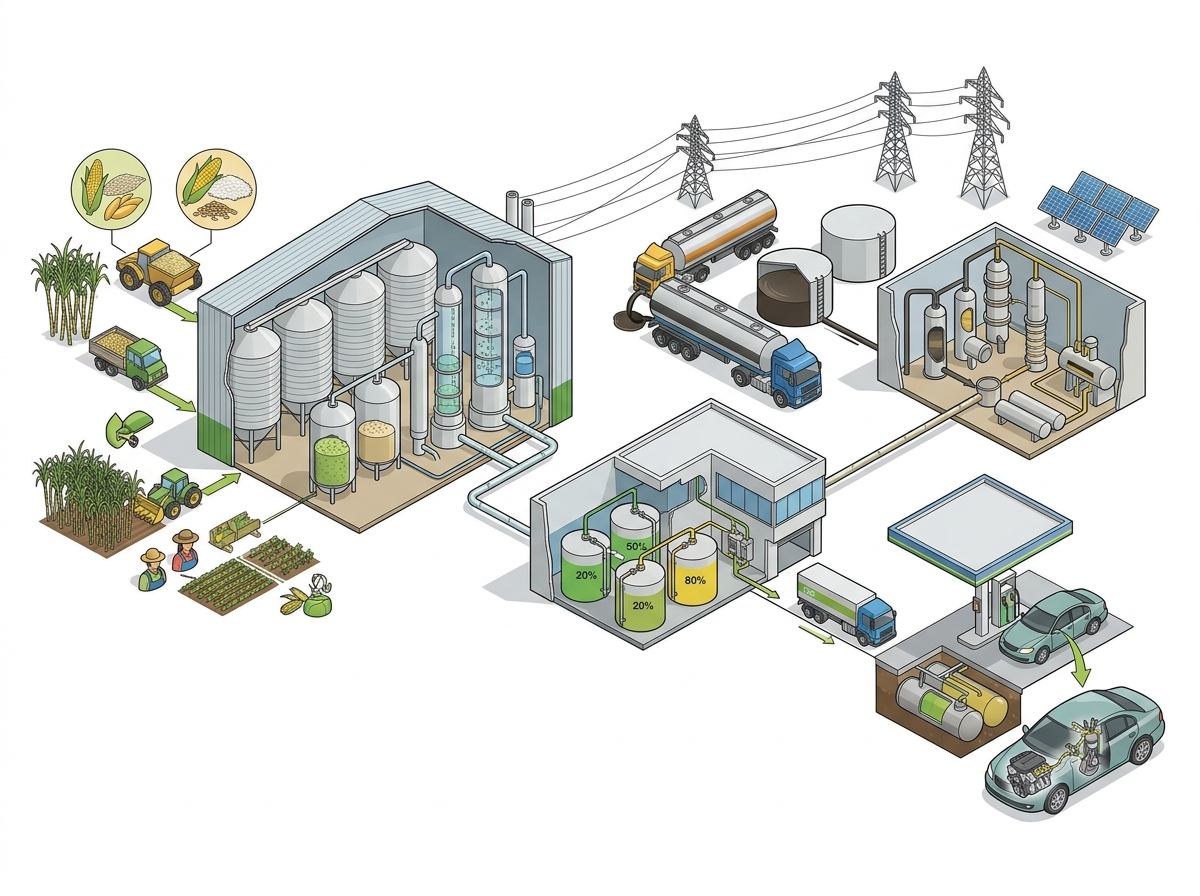
- The EBP Programme utilises surplus and damaged food grains, agricultural residues, and molasses to produce ethanol, thereby reducing waste and supporting farmer incomes.
- The Pradhan Mantri JI-VAN Yojana (2019) promotes the production of second-generation ethanol from agricultural residues, further diversifying feedstock sources beyond food grains.
What is the Ethanol Blended Petrol (EBP) Programme?
- The EBP Programme mandates the blending of ethanol with petrol to reduce crude oil import dependence, enhance energy security, and lower vehicular emissions.
- Ethanol, a biofuel derived from sugarcane, maize, damaged food grains, and agricultural residues, is blended with petrol in varying proportions (E5, E10, E20, etc.), with a target of 20% blending (E20) by 2025-26.
- The programme is implemented under the National Biofuel Policy 2018, which classifies biofuels into first-generation (food-based), second-generation (agricultural residues), and third-generation (algal biofuels).
- Ethanol production is incentivised through Minimum Support Prices (MSP) for ethanol derived from different feedstocks, ensuring remunerative prices for farmers and distilleries.
- The programme prioritises food security by diverting only surplus and damaged food grains to ethanol production after fulfilling PDS and buffer stock obligations under the NFSA.
- Second-generation ethanol production, promoted under the Pradhan Mantri JI-VAN Yojana, utilises agricultural residues (e.g., rice straw, sugarcane bagasse) to reduce reliance on food grains and enhance sustainability.
- The programme supports farmer welfare by providing an additional revenue stream through the sale of surplus and damaged food grains, molasses, and agricultural residues to ethanol producers.
Key Features
| Feature | Significance |
|---|---|
| Ethanol Blending Programme (EBP) | Aims to blend ethanol with petrol to reduce crude oil import dependency, enhance energy security, and support farmers by creating a secondary market for surplus agricultural produce. |
| Multi-Feedstock Approach | Utilizes surplus and waste agricultural produce (e.g., damaged grains, broken rice, agricultural residues) rather than diverting food grains, ensuring food security is not compromised. |
| Price Mechanism for Ethanol | Ethanol procurement prices are determined by government frameworks, ensuring fair remuneration for farmers while maintaining affordability for blending with petrol. |
| Food Security Safeguards | All food grains are first allocated to Public Distribution System (PDS), welfare schemes, and buffer stocks before any surplus is approved for ethanol production. |
| Second-Generation Ethanol Expansion | Under PM-JIVAN Yojana, agricultural residues (e.g., crop stubble) are increasingly used to produce ethanol, reducing dependence on food grains entirely. |
Why it Matters
Economic
- Reduces India’s import bill for crude oil by substituting a portion of petrol demand with domestically produced ethanol, thereby improving trade balance.
- Creates additional revenue streams for farmers through sale of surplus agricultural produce, including damaged grains and agricultural residues.
- Stimulates rural economy by promoting agro-based industries and generating employment in ethanol production and allied sectors.
Strategic/Energy Security
- Decreases reliance on imported crude oil, mitigating vulnerability to global oil price fluctuations and geopolitical risks.
- Supports India’s commitment to achieving 20% ethanol blending by 2025-26, aligning with global trends toward sustainable energy transitions.
- Enhances energy security by diversifying fuel sources and reducing dependence on fossil fuels.
Environmental
- Reduces vehicular emissions by blending ethanol, a cleaner-burning fuel, thereby contributing to India’s climate change mitigation goals.
- Promotes circular economy by converting agricultural waste and surplus into value-added products like ethanol.
Social
- Ensures food security by prioritizing allocation of food grains to PDS and welfare schemes before ethanol production.
- Supports farmer welfare by providing an assured market for surplus and waste agricultural produce, reducing post-harvest losses.
Challenges
1. Food Security vs. Energy Diversion
- Risk of diversion of food grains for ethanol production if surplus verification and allocation mechanisms are not strictly enforced.
- Potential public perception challenges due to misinformation about the programme’s impact on food prices and availability.
UPSC Link: GS3: Food Security; Energy Security
2. Feedstock Availability and Cost
- Dependence on seasonal agricultural produce (e.g., sugarcane, rice) may lead to supply fluctuations and price volatility.
- Higher procurement costs for certain feedstocks (e.g., maize, sugarcane juice) compared to others (e.g., damaged grains) may impact ethanol pricing and blending economics.
UPSC Link: GS3: Agricultural Marketing; Energy Resources
3. Infrastructure and Technology Gaps
- Limited storage and processing infrastructure for second-generation ethanol (from agricultural residues) necessitates significant investment.
- Need for advanced technologies to efficiently convert agricultural residues into ethanol at scale.
UPSC Link: GS3: Infrastructure; Science & Technology
4. Market and Policy Coordination
- Coordination between multiple stakeholders (farmers, distilleries, oil marketing companies) is essential to ensure seamless ethanol supply and blending.
- Policy consistency and long-term incentives are required to sustain farmer participation and industry investment.
UPSC Link: GS3: Policies for Inclusive Growth
Challenges — UPSC Perspective
| Issue | Concern |
|---|---|
| Surplus Verification | Rigorous certification of surplus food grains to prevent diversion for ethanol production. |
| Feedstock Diversification | Balancing reliance on food grains with second-generation ethanol to avoid food security risks. |
| Price Volatility | Managing procurement costs of feedstocks to ensure ethanol remains cost-competitive for blending. |
| Infrastructure Deficit | Expanding storage, transport, and processing facilities for ethanol and agricultural residues. |
| Farmer Awareness | Educating farmers on the benefits and processes of ethanol production to encourage participation. |
Way Forward
- Strengthen surplus verification mechanisms to ensure no food grains are diverted for ethanol production without meeting PDS and buffer stock obligations.
- Expand second-generation ethanol production under PM-JIVAN Yojana by incentivizing private investment in agricultural residue processing.
- Enhance coordination between state governments, farmers, distilleries, and oil companies to streamline ethanol procurement and blending.
- Invest in R&D to improve efficiency and reduce costs of converting agricultural residues into ethanol.
- Promote farmer producer organizations (FPOs) to aggregate surplus and waste agricultural produce for ethanol production.
- Implement long-term price stabilization mechanisms for ethanol to ensure economic viability for producers and affordability for consumers.
- Increase public awareness campaigns to dispel misconceptions about the programme’s impact on food security and farmer welfare.
UPSC Value Addition
Keywords for Mains Answer-Writing
Ethanol Blended Petrol (EBP) Programme · Energy Security · Food Security · National Food Security Act (NFSA) · Public Distribution System (PDS) · Minimum Support Price (MSP) · Biofuels Policy · Second-Generation Ethanol · Pradhan Mantri JI-VAN Yojana · Feedstock for Ethanol · Sustainable Agriculture · Import Substitution · Agricultural Waste Management · Ethanol Pricing Mechanism · Food vs Fuel Debate · Buffer Stock Management · Pradhan Mantri Kisan Samman Nidhi (PM-KISAN) · Sugarcane and Maize as Ethanol Feedstock · Carbon Neutrality · Circular Economy in Agriculture
Concept Flow
Global oil price volatility → Increased crude oil import dependency → Economic burden on India → Policy response: Ethanol Blending Programme (EBP) → EBP requires surplus agricultural produce → Need to ensure food security → Allocate food grains to PDS and welfare schemes first → Use only certified surplus for ethanol → Farmer participation → Additional income from surplus/waste produce → Rural economic upliftment → Energy security through reduced crude oil imports → Expansion to second-generation ethanol → Reduced dependence on food grains → Circular economy → Sustainable energy transition → Market coordination → Ethanol supply chain efficiency → Blending targets achieved → Reduced vehicular emissions → Climate change mitigation
Prelims Practice Questions
Q1. Consider the following statements regarding the Ethanol Blended Petrol (EBP) Programme in India: 1. The programme aims to reduce import dependency on crude oil by promoting ethanol blending in petrol. 2. The EBP Programme exclusively uses food grains like rice and wheat procured under the Minimum Support Price (MSP) mechanism for ethanol production. 3. The programme mandates that all surplus food grains must be diverted to ethanol production before meeting the requirements of the Public Distribution System (PDS). 4. Second-generation ethanol is produced from agricultural residues such as rice straw and sugarcane bagasse. How many of the above statements are correct?
- Only one
- Only two
- Only three
- All four
Answer: Only three — Statements 1 and 4 are correct. Statement 2 is incorrect because the EBP Programme uses a mix of approved feedstocks, including damaged grains and agricultural residues, after ensuring food security. Statement 3 is incorrect as the programme prioritizes food security obligations before diverting surplus grains for ethanol production.
Q2. Assertion (A): The Ethanol Blended Petrol (EBP) Programme in India contributes to reducing the fiscal burden on the government by lowering the subsidy on petrol. Reason (R): Ethanol blending reduces the price of petrol by substituting a portion of imported crude oil, thereby decreasing the overall cost of fuel for consumers.
- Both A and R are true, and R is the correct explanation of A
- Both A and R are true, but R is not the correct explanation of A
- A is true, but R is false
- A is false, but R is true
Answer: A is true, but R is false — Assertion (A) is true as the EBP Programme reduces the fiscal burden by lowering crude oil imports and stabilizing fuel prices. Reason (R) is also true but does not directly explain how the fiscal burden is reduced; it merely states the mechanism of price reduction. The fiscal benefit arises from reduced import costs, not just lower subsidies.
Q3. Match the following feedstocks used in ethanol production with their respective prices as per the Ethanol Supply Year 2025-26: Column I (Feedstock) 1. Maize 2. Sugarcane Juice/ C-Molasses 3. Damaged Grains 4. C-Heavy Molasses Column II (Price in ₹/litre) A. 65.61 B. 71.86 C. 64.00 D. 57.97
Answer: ? — 1-B (Maize: ₹71.86/litre), 2-A (Sugarcane Juice/C-Molasses: ₹65.61/litre), 3-C (Damaged Grains: ₹64.00/litre), 4-D (C-Heavy Molasses: ₹57.97/litre).
Mains Practice Question
✍ Critically examine the claim that the Ethanol Blended Petrol (EBP) Programme in India compromises food security by diverting food grains for ethanol production. Substantiate your answer with reference to the programme’s operational framework, statutory safeguards, and the role of surplus and waste management. (15 Marks)
Approach: MODEL-ANSWER SKELETON:
1. **Introduction**: Define the EBP Programme and its objectives (energy security, import substitution, farmer welfare).
2. **Operational Framework**: Explain the procurement and allocation process:
– Priority to PDS, NFSA, welfare schemes, and buffer stocks before diverting grains.
– Use of damaged grains, broken rice, and agricultural residues.
– Role of FCI and state agencies in certifying surplus stock.
3. **Statutory Safeguards**:
– Highlight provisions under the National Food Security Act (NFSA), 2013, and buffer stock norms.
– Emphasize that food security obligations are non-negotiable and legally enforceable.
4. **Data and Evidence**:
– Cite the negligible share of FCI rice in ethanol production (0.02% in ESY 2023-24; 24.64% in ESY 2025-26 only after surplus certification).
– Mention the dominance of maize and sugarcane-based feedstocks.
5. **Critique of the Claim**:
– Address the misconception of food grains being diverted at the cost of the poor.
– Explain the circular economy model: converting waste (e.g., damaged grains, agricultural residues) into energy.
6. **Second-Generation Ethanol**:
– Discuss the Pradhan Mantri JI-VAN Yojana and its role in reducing reliance on food grains.
7. **Conclusion**: Reaffirm that the EBP Programme is designed to balance energy security and food security without compromising the latter. Balance of views: Acknowledge concerns about potential long-term strain on food systems but counter with evidence of safeguards and diversification.
Source: PIB (Press Information Bureau)
Generated by AanyaAi for educational purpose.

- Great Indian Bustard Reintroduction: 10-Year Effort Bears Fruit in Rajasthan - October 3, 2026
- AI एजेंटों की स्वतंत्रता: कंपनियां कैसे रखती हैं नियंत्रण? जानिए पूरी प्रक्रिया - October 3, 2026
- Harivansh Leads India at 153rd IPU Assembly in Tanzania - October 3, 2026

No Comments