


27 Sep UPSC Mains 2025 GS Paper 2 Detailed Analysis: Syllabus Coverage, Difficulty & Strategy Insights
UPSC Mains 2025 GS Paper 2 Detailed Analysis: Syllabus Coverage, Difficulty & Strategy Insights
1. The Importance of GS Paper 2 in UPSC Mains
GS Paper 2 (Governance, Polity, Social Justice, and International Relations) is a critical paper in the UPSC Mains exam. Unlike GS1, which leans heavily on static content, GS2 is dynamic-heavy and requires aspirants to integrate current affairs with conceptual clarity.
-Weightage in Mains (250 Marks): Accounts for nearly 20% of GS marks, making it a deciding factor in final ranks.
-Impact on Rank: While not as scoring as GS1, a well-prepared candidate can secure above-average marks by integrating recent examples, committee recommendations, and judgments.
-Link to Interview: GS2 preparation develops a strong understanding of governance and foreign affairs, which is essential for the Personality Test.
2. Overview of GS Paper 2
a. Paper Pattern
-Duration & Marks: 3 hours | 250 marks
-Question Types: Mix of 10-markers (150 words) and 15-markers (250 words)
-Answer Writing Norms: Clear introduction–body–conclusion structure. Use Supreme Court cases, commissions (ARC, Punchhi, Sarkaria), international reports (UN, World Bank), and current schemes for value addition.
b. Broad Thematic Areas Covered
The GS Paper 2 syllabus can be grouped into four thematic pillars:
-Polity & Constitution: Functions of Legislature, Executive, Judiciary; separation of powers; constitutional bodies.
-Governance & Social Justice: Policies, rights issues, transparency, accountability, e-governance, welfare schemes.
-International Relations (IR): Bilateral, regional, global groupings, India’s foreign policy, diaspora issues.
-Current Affairs Integration: Judicial verdicts, government policies, international developments dominate the paper.
3. Trend Analysis (2020–2025)
-Polity & Constitution: Consistently 6–8 questions, often analytical (e.g., judicial reforms, federalism, parliamentary issues).
-Governance & Social Justice: Growing weightage, with focus on welfare delivery, e-governance, and rights-based policies.
-International Relations: 3–5 questions every year, requiring linkage with India’s foreign policy & current events.
Observation: UPSC has shifted from factual/definition-based questions to critical evaluation of policies, institutions, and reforms.
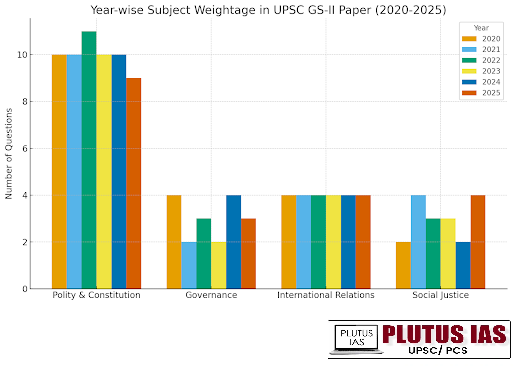
4. Topic-Wise Analysis of GS2 Mains Paper 2025
| Subject Area | Questions Asked | Nature of Questions | Difficulty Level |
|---|---|---|---|
| Polity & Constitution | 7 | Judicial reforms, federalism, legislature-executive relations | Moderate–High |
| Governance & Social Justice | 6 | Welfare schemes, e-gov, citizen charter, vulnerable sections | Moderate |
| International Relations | 5 | India’s relations with US, ASEAN, Global South, multilateralism | Moderate |
| Miscellaneous/Current Affairs | 2 | Issue-based, dynamic (data protection, cyber security, etc.) | Moderate |
5. Question-Wise Analysis & Synopsis
10 Markers (150 words)
Q1. Discuss the ‘corrupt practices’ for the purpose of the Representation of the People Act, 1951. Analyze whether the increase in the assets of the legislators and/or their associates, disproportionate to their known sources of income, would constitute ‘undue influence’ and consequently a corrupt practice.
Demand: Define corrupt practices; analyze link between disproportionate assets and undue influence.
Approach: Mention bribery, undue influence, false statements. Cite SC judgments (e.g., PUCL vs Union). Clarify that asset increase may indicate corruption but doesn’t automatically qualify unless linked to electoral manipulation.
Q2. Comment on the need of administrative tribunals as compared to the court system. Assess the impact of the recent tribunal reforms through rationalization of tribunals made in 2021.
Demand: Why tribunals? Compare with courts. Discuss 2021 reforms.
Approach: Tribunals = specialization, faster disposal. Reforms = rationalization, merger. Critique → issues of independence, appeals shifted to HCs → backlog risk.
Q3. Compare and contrast the President’s power to pardon in India and in the USA. Are there any limits to it in both the countries? What are ‘preemptive pardons’?
Demand: Compare scope and limits. Define preemptive pardons.
Approach: India – President acts on aid/advice, subject to judicial review. USA – independent, wide discretion, includes preemptive pardons (e.g., Nixon).
Q4. Discuss the nature of Jammu and Kashmir Legislative Assembly after the Jammu and Kashmir Reorganization Act, 2019. Briefly describe the powers and functions of the Assembly of the Union Territory of Jammu and Kashmir.
Demand: Nature of UT Assembly & its powers.
Approach: 2019 Reorganization Act → UT with legislature like Delhi/Puducherry. Limited powers (no police/public order). Discuss legislative subjects + unique features.
Q5. “The Attorney General of India plays a crucial role in guiding the legal framework of the Union Government and ensuring sound governance through legal counsel.” Discuss his responsibilities, rights and limitations in this regard.
Demand: Responsibilities, rights, and limits.
Approach: Duties – legal advisor, represents govt. Rights – audience in courts, Parliament participation. Limits – not bound by AG’s advice, can’t be member of govt.
Q6. Women’s social capital complements in advancing empowerment and gender equity. Explain.
Demand: Link social capital with empowerment.
Approach: Networks, SHGs, community participation → microfinance, political voice, collective action. Cite SEWA, Kudumbashree.
Q7. e-governance projects have a built-in bias towards technology and back-end integration than user-centric designs. Examine.
Demand: Critically examine design flaws.
Approach: Tech-centric approach ignores accessibility, user needs, inclusivity. Example – CSCs bridging gap. Need for citizen-centric, not just backend integration.
Q8. Civil Society Organizations are often perceived as being anti-State actors than non-State actors. Do you agree? Justify.
Demand: Are CSOs anti-State?
Approach: Balance: watchdog role, accountability vs adversarial stance. Examples – RTI, anti-corruption movements, NGOs in welfare.
Q9. India-Africa digital partnership is achieving mutual respect, co-development and long-term institutional partnerships. Elaborate.
Demand: Elaborate scope, mutual benefits.
Approach: Cooperation in IT, digital payments (UPI adoption), e-governance, telemedicine. Stress institutional partnerships (ISA, EXIM Bank).
Q10. “With the waning of globalization, post-Cold War world is becoming a site of sovereign nationalism.” Elucidate.
Demand: Link post-Cold War trends with nationalism.
Approach: Retreat of multilateralism, rise of protectionism, USA-China rivalry, BREXIT, India’s Atmanirbhar Bharat.
15 Markers (250 words)
Q11. “Constitutional morality is the fulcrum which acts as an essential check upon the high functionaries and citizens alike…” In view of the above observation of the Supreme Court, explain the concept of constitutional morality and its application to ensure balance between judicial independence and judicial accountability in India.
Demand: Define constitutional morality; apply in judicial accountability vs independence.
Approach: Cite Ambedkar, SC observations (Navtej Johar). Ensure balance: judges accountable, but independence vital.
Q12. Indian Constitution has conferred the amending power on the ordinary legislative institutions with a few procedural hurdles. In view of this statement, examine the procedural and substantive limitations on the amending power of the Parliament to change the Constitution.
Demand: Procedural & substantive limits.
Approach: Article 368 procedure; substantive limits → Kesavananda Bharati (basic structure). Include examples (Indira Gandhi vs Raj Narain).
Q13. Discuss the evolution of collegium system in India. Critically examine the advantages and disadvantages of the system of appointment of the Judges of the Supreme Court of India and that of the USA.
Demand: Trace evolution, critique, compare with USA.
Approach: 1st–3rd Judges’ cases. Advantages – judicial primacy, independence. Disadvantages – opacity, lack of accountability. USA → President + Senate approval.
Q14. Examine the evolving pattern of Centre-State financial relations in the context of planned development in India. How far have the recent reforms impacted the fiscal federalism in India?
Demand: Evolution + reforms impact.
Approach: Planned development era → central dominance. Recent → GST, Finance Commission, more devolution but debates continue.
Q15. What are environmental pressure groups? Discuss their role in raising awareness, influencing policies and advocating for environmental protection in India.
Demand: Role in awareness, policy advocacy.
Approach: Examples – Chipko, Narmada Bachao, Greenpeace. Impact on laws like EPA 1986, Forest Rights Act.
Q16. Inequality in the ownership pattern of resources is one of the major causes of poverty. Discuss in the context of ‘paradox of poverty’.
Demand: Resource ownership & poverty paradox.
Approach: Rich resources → poverty due to skewed distribution (tribal areas, mineral belts). Link to inclusive growth debates.
Q17. “In contemporary development models, decision-making and problem-solving responsibilities are not located close to the source of information and execution defeating the objectives of development.” Critically evaluate.
Demand: Critique centralized vs decentralized models.
Approach: Centralization → inefficiency, exclusion. Need local governance (73rd/74th Amendments). Examples – Kerala model, e-panchayats.
Q18. The National Commission for Protection of Child Rights has to address the challenges faced by children in the digital era. Examine the existing policies and suggest measures the Commission can initiate to tackle the issue.
Demand: Examine policies + suggest measures.
Approach: Cyberbullying, screen addiction, online exploitation. Existing laws (IT Act, POCSO). Suggestions: digital literacy, online grievance systems, stricter monitoring.
Q19. “Energy security constitutes the dominant kingpin of India’s foreign policy, and is linked with India’s overarching influence in Middle Eastern countries.” How would you integrate energy security with India’s foreign policy trajectories in the coming years?
Demand: Link energy needs with diplomacy.
Approach: India’s oil dependence → West Asia ties, diversification (Central Asia, Africa, renewables). Connect to IEA, ISA.
Q20. “The reform process in the United Nations remains unresolved, because of the delicate imbalance of East and West and entanglement of the USA vs. Russo-Chinese alliance.” Examine and critically evaluate the East-West policy confrontations in this regard.
Demand: Critically evaluate confrontations blocking reforms.
Approach: G4 vs P5 deadlock. USA vs Russia-China rivalry. Need consensus on expansion, veto reform.
6. Strategy Insights for the Upcoming Year
1. Deepen Constitutional Understanding:
–Revise important Articles, landmark judgments, constitutional amendments.
–Prepare federalism, separation of powers, judicial reforms, parliamentary issues.
2. Focus on Governance & Social Justice:
–Use current schemes (Digital India, Ayushman Bharat, PM Awas Yojana).
–Enrich with ARC recommendations, NITI Aayog reports, UNDP HDR, SDGs.
3. International Relations:
–Follow India’s relations with neighbors, Quad, BRICS, UN reforms, climate negotiations.
–Link foreign policy with Atmanirbhar Bharat, global value chains, security issues.
4. Answer Writing:
–Use case laws, data, contemporary examples, committee recommendations.
–For IR, mention recent visits, agreements, challenges, and way forward.
GS2 requires integrated preparation of static polity with dynamic governance and IR updates. Consistency in quoting Supreme Court cases, ARC reports, and recent developments will be the key differentiator.

- Elderly in India: Population, Challenges, and Government Initiatives - October 29, 2025
- Jal Jeevan Mission (JJM): Ensuring Tap Water to Every Rural Household - October 27, 2025
- National Blockchain Framework: Strengthening Governance through Blockchain Technology - October 25, 2025

No Comments