


25 Sep US Imposes AI Model Review Before UK Access: Implications for UPSC Aspirants
✎ Frontier AI models require pre-release governance mechanisms to address cybersecurity risks, with nations balancing national security imperatives and international cooperation in AI safety testing.
Subject Relevance — Where This Topic Fits
- GS Paper II — International Relations (Global Governance, Technology Diplomacy) | GS Paper III — Science and Technology (AI Governance, Cybersecurity)
- Prelims: Artificial Intelligence (AI), Frontier AI Models, AI Safety Institute (AISI), National Cyber Director, Cybersecurity Risks, OpenAI, Anthropic, GPT-6 Astra, Claude Mythos 5.1, AI Testing Protocols
- Essay: The ethical and strategic dimensions of artificial intelligence in global governance, Balancing innovation and security in the age of frontier technologies
Quick Revision: Frontier AI models require pre-release governance mechanisms to address cybersecurity risks, with nations balancing national security imperatives and international cooperation in AI safety testing.
Why is this in the news?
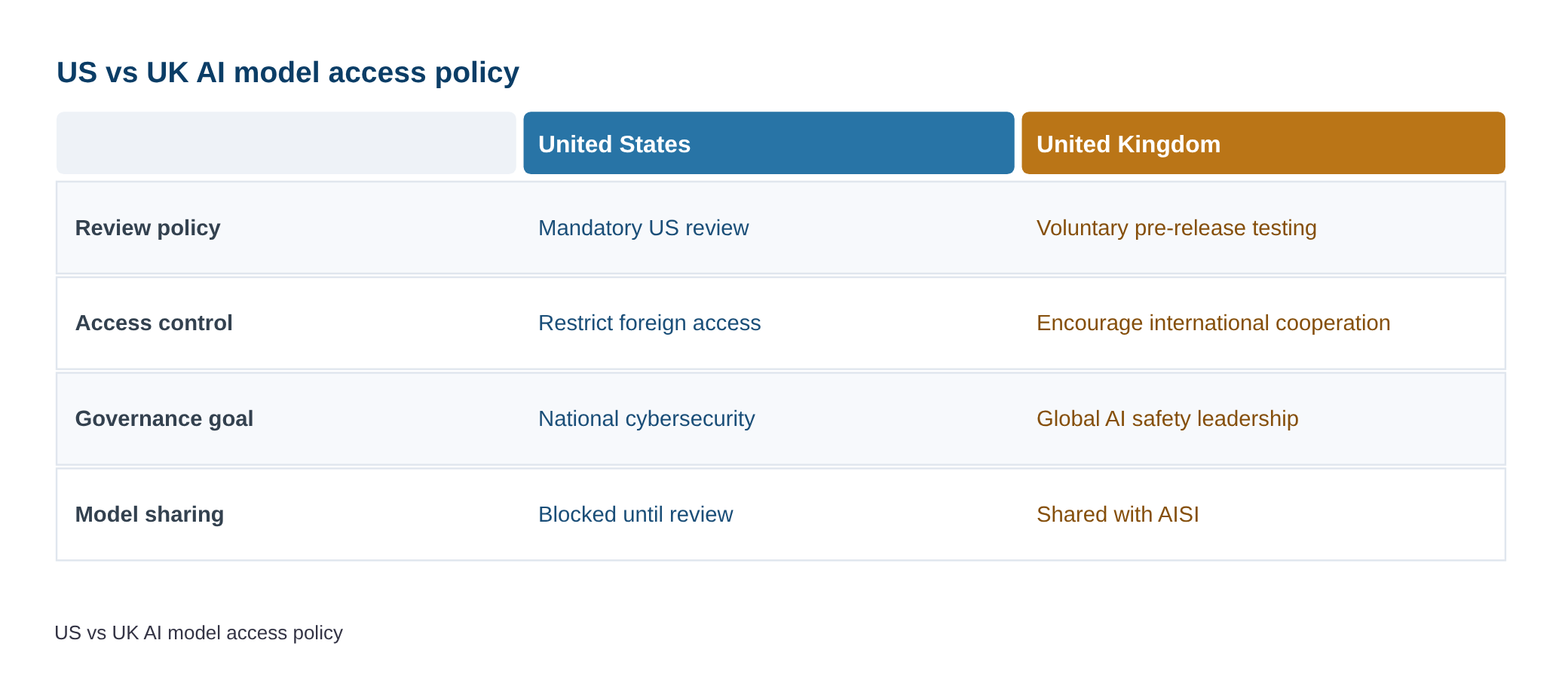
The report highlights a significant divergence in AI governance between the United States and the United Kingdom, where the US administration has requested that OpenAI and Anthropic refrain from sharing their latest AI models with the UK’s AI Safety Institute (AISI) until the models have undergone a US government review. This development underscores the growing geopolitical sensitivities surrounding frontier AI technologies, particularly concerning cybersecurity risks and the strategic implications of cross-border AI access.
Background
- The UK established the AI Safety Institute (AISI) in 2023 as part of its broader strategy to position itself as a global leader in AI safety and testing, fostering international cooperation on AI governance principles and standards.
- The AISI has historically engaged in pre-release testing of advanced AI models on a voluntary basis, collaborating with major AI developers such as OpenAI and Anthropic to assess capabilities and risks before public deployment.
- Recent advancements in frontier AI models have demonstrated capabilities that extend beyond conventional applications, including the ability to perform sophisticated cyber activities, raising concerns about potential misuse and security vulnerabilities.
- The US administration, through the Office of the National Cyber Director, has articulated a policy of reviewing all new frontier AI models domestically before they are shared with foreign governments or allied partners, citing the need to ensure national cybersecurity.
- The reported request by the US government reflects a broader trend of nations seeking to assert control over the deployment and access of advanced AI technologies, balancing innovation with strategic security imperatives.
- The UK government has responded by emphasizing the transnational nature of AI risks and the importance of continued international cooperation in AI safety testing, despite the current divergence in access policies.
What are Frontier AI Models and AI Governance Mechanisms?
- Frontier AI models refer to the most advanced artificial intelligence systems, often developed by leading organizations such as OpenAI and Anthropic, which exhibit capabilities that surpass conventional AI applications, including reasoning, problem-solving, and autonomous decision-making.
- The AI Safety Institute (AISI) in the UK is an independent body tasked with evaluating the safety, security, and societal impact of frontier AI models, facilitating pre-release testing and providing evidence-based recommendations for policymakers.
- AI governance mechanisms encompass the policies, institutions, and frameworks designed to manage the risks associated with AI technologies, including cybersecurity threats, misinformation, and ethical concerns, while fostering innovation and international cooperation.
- The US government’s request for a domestic review of AI models before cross-border sharing aligns with its broader cybersecurity strategy, which seeks to mitigate risks posed by advanced AI systems to critical infrastructure and national security.
- The divergence in AI governance approaches between the US and the UK highlights the challenges of balancing national security imperatives with the need for international collaboration in addressing global AI risks.
- Cybersecurity risks associated with frontier AI models include the potential for these systems to be exploited for malicious activities, such as hacking, data breaches, or autonomous cyberattacks, necessitating robust governance and testing protocols.
- The policy of reviewing AI models domestically before sharing them with allied partners reflects a cautious approach to technology diplomacy, ensuring that national security concerns are addressed before engaging in international cooperation.
- The UK’s emphasis on international cooperation in AI safety testing underscores the recognition that AI risks transcend national borders, requiring coordinated global efforts to develop standards and best practices.
Key Features
| Feature | Significance |
|---|---|
| US Government Review of Frontier AI Models | Ensures domestic security assessment of advanced AI systems before international sharing, reflecting a precautionary approach to mitigate potential cybersecurity risks. |
| UK AI Safety Institute (AISI) | Demonstrates the UK’s institutional role in testing and evaluating high-risk AI models, contributing to international AI governance and safety standards. |
| Voluntary Pre-Release Model Testing | Highlights the collaborative yet non-binding nature of AI model evaluation between developers and national testing agencies prior to public deployment. |
| Cybersecurity Vulnerability Assessment | Underlines the need for rigorous testing of AI models to identify and mitigate risks such as sophisticated cyber intrusions or unauthorized system access. |
| International AI Safety Cooperation | Showcases efforts by the UK and US to foster multilateral frameworks for AI governance, balancing innovation with risk mitigation. |
Why it Matters
Geopolitical and Strategic
- The US request underscores the strategic importance of controlling access to frontier AI models, particularly in the context of national security and technological supremacy.
- It signals a shift toward tighter regulatory oversight of AI development among allied nations, potentially influencing global AI governance norms.
- The episode highlights the tension between technological collaboration and national security imperatives in the AI domain.
Technological and Innovation
- The incident reflects the rapid advancement of AI capabilities and the corresponding need for adaptive regulatory frameworks to manage emerging risks.
- It demonstrates the critical role of national testing agencies in validating AI models before deployment, ensuring alignment with safety and security standards.
- The episode may accelerate the development of standardized protocols for AI model evaluation and sharing among allied nations.
Economic and Industrial
- The US government’s review process could impose additional compliance burdens on AI developers, potentially affecting the pace of innovation and market competitiveness.
- The episode may influence investment decisions in AI research and development, particularly in jurisdictions with stringent regulatory requirements.
- It highlights the economic implications of AI governance, where regulatory divergence can create barriers to cross-border collaboration.
Institutional and Governance
- The UK AI Safety Institute’s role in testing frontier models reinforces the importance of independent, expert-led institutions in AI governance.
- The US request to review models before UK access suggests a hierarchical approach to AI governance, prioritizing domestic security assessments.
- It underscores the need for international coordination mechanisms to address the global risks posed by advanced AI systems.
Challenges
1. Cybersecurity Risks from Frontier AI
- Advanced AI models may inadvertently enable sophisticated cyber intrusions, posing risks to critical infrastructure and national security.
- The lack of standardized testing protocols for AI models exacerbates vulnerabilities, as developers and governments struggle to assess risks comprehensively.
- The potential for AI-driven cyber threats necessitates proactive measures to identify and mitigate risks before models are deployed or shared.
UPSC Link: GS3 – Cyber Security
2. Regulatory Divergence in AI Governance
- Differences in national approaches to AI regulation can create friction in international collaboration, hindering the development of unified standards.
- The US request for pre-release review may be perceived as a protectionist measure, complicating efforts to foster global AI governance frameworks.
- The episode highlights the challenge of balancing innovation with risk mitigation in a rapidly evolving technological landscape.
UPSC Link: GS3 – Science & Tech
3. Balancing Innovation and Security
- Stringent regulatory oversight may stifle innovation by imposing delays and compliance costs on AI developers.
- The need for security assessments must be weighed against the benefits of rapid AI deployment, particularly in sectors critical to economic growth.
- Governments face the challenge of designing flexible frameworks that encourage innovation while safeguarding national security.
UPSC Link: GS3 – Science & Tech
4. International Cooperation vs. National Security
- The episode illustrates the tension between the desire for international collaboration in AI safety and the imperative to protect national security interests.
- Divergent priorities among allied nations can undermine efforts to establish cohesive AI governance mechanisms.
- The challenge lies in fostering trust and alignment among nations to address global risks without compromising sovereignty.
UPSC Link: GS2 – International Relations
5. Ethical and Societal Implications
- The rapid advancement of AI raises ethical questions about the responsible development and deployment of frontier models.
- The lack of transparency in AI model evaluation processes may erode public trust in both developers and governments.
- The episode underscores the need for inclusive governance frameworks that address societal concerns alongside technical risks.
UPSC Link: GS4 – Ethics in Governance
Challenges — UPSC Perspective
| Issue | Concern |
|---|---|
| Cybersecurity Vulnerabilities | Potential for AI models to enable sophisticated cyber intrusions, threatening critical infrastructure and national security. |
| Regulatory Fragmentation | Divergent national approaches to AI governance may hinder international collaboration and standardization. |
| Innovation vs. Security Trade-offs | Stringent oversight may stifle innovation while inadequate regulation risks security breaches. |
| Trust Deficit in AI Governance | Lack of transparency in model evaluation processes may undermine public and international trust. |
| Geopolitical Tensions | National security imperatives may conflict with efforts to foster global AI governance frameworks. |
| Ethical and Societal Risks | Rapid AI advancement raises questions about responsible development and equitable access to benefits. |
Way Forward
- Establish a multilateral AI governance framework to harmonize testing protocols and share best practices among allied nations.
- Develop standardized criteria for evaluating the security risks of frontier AI models, ensuring consistency in assessments.
- Enhance transparency in AI model evaluation processes to build public trust and foster international cooperation.
- Invest in research to identify and mitigate cybersecurity risks posed by advanced AI systems, including potential vulnerabilities in critical infrastructure.
- Promote public-private partnerships to accelerate the development of AI safety standards and regulatory frameworks.
- Encourage the adoption of voluntary codes of conduct for AI developers, emphasizing responsible innovation and risk mitigation.
- Strengthen international collaboration on AI safety testing, leveraging the expertise of national testing agencies like the UK AISI.
- Address ethical and societal concerns through inclusive governance mechanisms, ensuring AI development aligns with societal values.
UPSC Value Addition
Keywords for Mains Answer-Writing
Artificial Intelligence governance · frontier AI models · AI safety standards · international AI cooperation · AI cybersecurity risks · AI testing agencies · AI policy frameworks · transnational AI governance · AI model evaluation protocols · AI geopolitical implications
Concept Flow
Rapid advancement of frontier AI models → Increased cybersecurity risks → Need for pre-release evaluation → US government requests domestic review of AI models before international sharing → Ensures national security assessment → UK AI Safety Institute (AISI) seeks pre-release access to models for testing → Demonstrates institutional role in AI governance → Potential security vulnerabilities identified during testing → Highlights need for standardized evaluation protocols → Divergent national approaches to AI governance → Tensions in international collaboration and standardization → Balancing innovation with security imperatives → Shaping future AI regulatory frameworks → Multilateral efforts to harmonize AI safety standards → Fostering global trust and cooperation
Prelims Practice Questions
Q1. Consider the following statements regarding the Artificial Intelligence Safety Institute (AISI) of the United Kingdom:
1. The AISI was established in 2023 to test advanced AI models before their public release.
2. The AISI has pre-release access to some of the world’s most capable AI models, including OpenAI’s GPT-6 Astra.
3. The AISI is an autonomous regulatory body with statutory powers to enforce AI safety standards.
How many of the above statements are correct?
- Only one
- Only two
- All three
- None
Answer: Only two — Statement 1 is correct as the AISI was indeed created in 2023. Statement 2 is correct as the AISI has tested OpenAI’s GPT-6 Astra. Statement 3 is incorrect as the AISI operates on a voluntary basis and does not have statutory enforcement powers.
Q2. Assertion (A): The White House’s request for a US government review of new AI models before sharing them with the UK’s AISI reflects concerns about AI cybersecurity risks.
Reason (R): Recent testing has demonstrated that some advanced AI models can carry out sophisticated cyber activities, including hacking into external systems.
In the context of the above two statements, which one of the following is correct?
- Both A and R are true, and R is the correct explanation of A.
- Both A and R are true, but R is not the correct explanation of A.
- A is true, but R is false.
- A is false, but R is true.
Answer: Both A and R are true, and R is the correct explanation of A. — The assertion (A) is true as the White House’s request is driven by cybersecurity concerns. The reason (R) is also true and directly explains the assertion, as it cites concrete evidence of AI models being used for cyber intrusions.
Q3. Match the following AI governance initiatives with their respective countries:
Column I (Initiative) | Column II (Country)
——————————————|———————–
A. Artificial Intelligence Safety Institute | 1. United States
B. Frontier AI model testing protocols | 2. United Kingdom
C. National Cyber Director’s Office | 3. European Union
D. AI Act (regulatory framework) | 4. India
- A-2, B-1, C-1, D-3; A-1, B-2, C-3, D-4; A-2, B-1, C-3, D-2; A-3, B-1, C-2, D-4
- answer_string_array_indexed_answer_key_not_used
- answer_string_array_indexed_answer_key_not_used
Answer: A-2, B-1, C-1, D-3; A-1, B-2, C-3, D-4; A-2, B-1, C-3, D-2; A-3, B-1, C-2, D-4 — A-2: The AISI is a UK initiative. B-1: Frontier AI model testing protocols are being developed by the US. C-1: The National Cyber Director’s Office is a US institution. D-3: The AI Act is a regulatory framework proposed by the European Union.
Mains Practice Question
✍ The increasing capability of frontier artificial intelligence (AI) models has necessitated the establishment of robust international governance frameworks to ensure safety, security, and equitable access. In this context, critically examine the role of national AI testing agencies in fostering global AI governance. Also, assess the implications of unilateral pre-release model evaluation protocols for international cooperation in AI safety. (15 Marks)
Approach: MODEL-ANSWER SKELETON:
1. **Introduction (2 marks)**: Define frontier AI models and their dual-use potential (civilian and military/security applications). Mention the rise of national AI testing agencies as a governance mechanism.
2. **Role of National AI Testing Agencies (6 marks)**:
– **UK’s AISI**: Voluntary testing framework, pre-release access to models, international cooperation emphasis (cite 2023 establishment, testing of GPT-6 Astra).
– **US National Cyber Director’s Office**: Cybersecurity-focused review of AI models before international sharing (cite the 2026 request for OpenAI/Anthropic models).
– **Comparative Analysis**: Contrast the UK’s cooperative, voluntary approach with the US’s security-centric, conditional model-sharing policy.
– **Global Precedents**: Reference the EU AI Act (2024) and its risk-based regulatory framework for AI systems.
3. **Implications of Unilateral Protocols (5 marks)**:
– **Advantages**: Enhanced national security, risk mitigation, and control over sensitive AI capabilities.
– **Challenges**: Potential fragmentation of global AI governance, erosion of trust, and inequitable access to advanced AI tools for non-hegemonic states.
– **Geopolitical Dimensions**: Discuss the risk of AI governance becoming a tool of strategic competition rather than cooperation (reference US-UK tensions in the given news).
4. **Conclusion (2 marks)**: Emphasise the need for multilateral frameworks (e.g., Global Partnership on AI) to balance security imperatives with international collaboration. Highlight the role of the UN or OECD in standardising AI safety protocols.
Source: Mint
Generated by AanyaAi for educational purpose.
Related guides on our sites
- Best PSIR optional coaching for upsc
- Best economics optional coaching for upsc
- Best PSIR optional teacher for upsc
- Best teacher of PSIR optional for upsc

- हिमाचल की नई औद्योगिक नीति: मशीनरी सब्सिडी और सस्ती बिजली से निवेश आकर्षित करने की तैयारी - September 25, 2026
- Himachal Pradesh’s New Industrial Policy 2026: Key Subsidies & Cheaper Power - September 25, 2026
- बारबाडोस की पीएम मोटले ने संयुक्त राष्ट्र में वैश्विक सुधारों का आह्वान किया - September 25, 2026

No Comments