


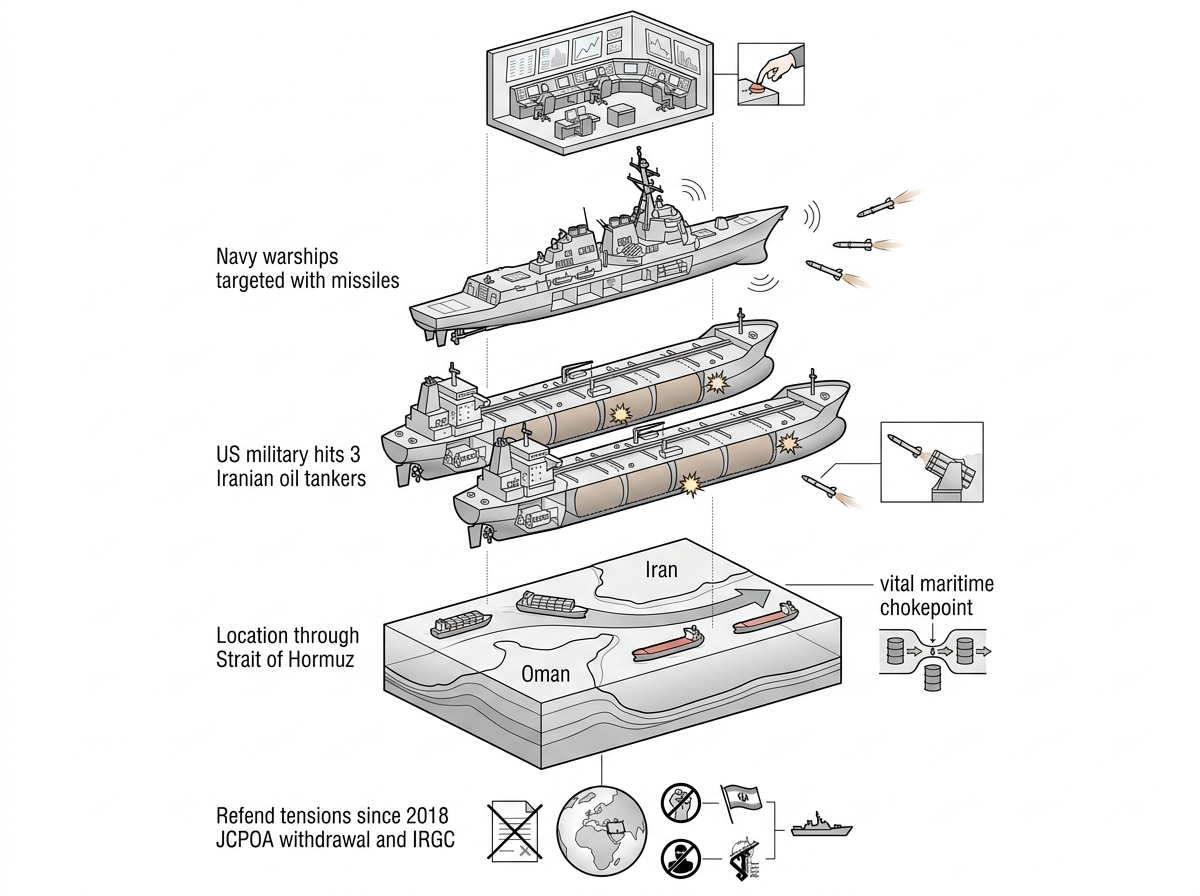
05 Sep US Strikes Iranian Oil Tankers in Persian Gulf: Key Security Implications for UPSC
✎ The Persian Gulf’s maritime chokepoints, particularly the Strait of Hormuz, are critical to global energy security, and their stability is contingent on adherence to UNCLOS and the principle of freedom of navigation.
Subject Relevance — Where This Topic Fits
- GS Paper II — International Relations — Regional and global groupings and agreements involving India and/or affecting India’s interests | GS Paper II — International Relations — Effect of policies and politics of developed and developing countries on India’s interests | GS Paper III — Security — Challenges to internal security through external state and non-state actors
- Prelims: Persian Gulf, Strait of Hormuz, Revolutionary Guard Corps (IRGC), Maritime Domain Awareness, UNCLOS, Freedom of Navigation Operations (FONOPs), Proxy warfare, Energy Security
- Essay: Geopolitical tensions and their impact on global energy security, The role of maritime choke points in shaping international relations
Quick Revision: The Persian Gulf’s maritime chokepoints, particularly the Strait of Hormuz, are critical to global energy security, and their stability is contingent on adherence to UNCLOS and the principle of freedom of navigation.
Background
- The Persian Gulf and Strait of Hormuz constitute a vital maritime chokepoint, through which approximately 20% of the world’s seaborne oil transits daily, making energy security a critical global concern.
- Tensions between the US and Iran have persisted since the withdrawal of the US from the Joint Comprehensive Plan of Action (JCPOA) in 2018 and subsequent reimposition of sanctions, leading to periodic confrontations in the region.
- Iran’s Revolutionary Guard Corps (IRGC) has been designated a terrorist organisation by the US, and its naval forces have been involved in multiple incidents, including seizures of commercial vessels and attacks on oil infrastructure.
- The Strait of Hormuz, a narrow waterway between Oman and Iran, is a critical global chokepoint, with over 17 million barrels of oil passing through daily, according to U.S. Energy Information Administration data.
- Maritime security in the region is governed by the United Nations Convention on the Law of the Sea (UNCLOS), which provides the legal framework for freedom of navigation and overflight, though enforcement remains contested.
- India, as a major energy importer, has a strategic interest in maintaining stability in the Persian Gulf, given its reliance on oil imports from the region.
What are the key dimensions of maritime security in the Persian Gulf?
- **Geostrategic Significance**: The Persian Gulf is bordered by eight countries and is the world’s largest single source of crude oil. The Strait of Hormuz, a 21-mile-wide waterway, is the only sea passage from the Gulf to the open ocean, making it a critical chokepoint for global energy supplies.
- **Maritime Chokepoints**: The Strait of Hormuz, Bab el-Mandeb, and the Suez Canal are among the world’s most strategically important maritime chokepoints, where disruptions can have global economic repercussions. Approximately 30% of global seaborne oil and 12% of liquefied natural gas pass through these routes annually.
- **Freedom of Navigation Operations (FONOPs)**: Conducted by naval powers to assert the principle of freedom of navigation under UNCLOS, FONOPs are often used to challenge excessive maritime claims and ensure unimpeded passage through critical waterways. The US has conducted numerous FONOPs in the Persian Gulf to counter Iran’s perceived encroachments.
- **Proxy Warfare and Non-State Actors**: Iran’s support for non-state actors, such as the Houthis in Yemen and various militias in Iraq, has intensified regional tensions. These groups have targeted commercial shipping and military assets, exacerbating instability.
- **Energy Security**: The global economy’s dependence on Persian Gulf oil makes the region a flashpoint for geopolitical competition. Disruptions in oil supply can trigger price volatility and economic instability, particularly in energy-importing nations like India.
- **Legal Framework**: UNCLOS provides the primary legal framework for maritime governance, including the rights of innocent passage, transit passage, and the exclusive economic zone (EEZ). However, interpretations of these provisions often lead to disputes, particularly regarding military activities in EEZs.
- **Maritime Domain Awareness (MDA)**: MDA refers to the effective understanding of anything associated with the maritime domain that could impact the security, safety, economy, or environment. It is critical for detecting and responding to threats such as piracy, smuggling, and military provocations.
- **Role of Regional and Extra-Regional Powers**: The security architecture of the Persian Gulf involves a complex interplay between regional states (e.g., Saudi Arabia, UAE, Iran) and extra-regional powers (e.g., US, China, Russia). The presence of foreign military bases and naval forces adds to the complexity of regional dynamics.
UPSC Value Addition
Keywords for Mains Answer-Writing
Maritime security · Freedom of Navigation Operations (FONOPs) · United Nations Convention on the Law of the Sea (UNCLOS) · Use of force in international law · Gray zone tactics · Regional security architecture · Proxy warfare · Economic warfare · Rules-based international order · Collective security · Strategic chokepoints · Non-state armed groups · Article 2(4) of the UN Charter · Jus ad bellum · Maritime domain awareness
Prelims Practice Questions
Q1. Consider the following statements regarding the legal framework governing the use of force in international relations:
1. Article 2(4) of the UN Charter prohibits the threat or use of force against the territorial integrity or political independence of any state.
2. The doctrine of ‘anticipatory self-defence’ is explicitly recognised in the UN Charter.
3. The International Court of Justice (ICJ) has held that economic coercion does not constitute a use of force under international law.
How many of the above statements are correct?
- Only one
- Only two
- All
- None
Answer: All — Statements 1 and 3 are correct. Statement 2 is incorrect as the UN Charter does not explicitly recognise ‘anticipatory self-defence’; it is a matter of customary international law interpretation.
Q2. Assertion (A): The concept of ‘freedom of navigation operations’ (FONOPs) is designed to challenge excessive maritime claims that are inconsistent with the United Nations Convention on the Law of the Sea (UNCLOS).
Reason (R): UNCLOS provides for the right of innocent passage through territorial seas and transit passage through international straits, which states must respect.
Options:
A. Both A and R are individually true, and R is the correct explanation of A.
B. Both A and R are individually true, but R is not the correct explanation of A.
C. A is true, but R is false.
D. A is false, but R is true.
Answer: ? — Both A and R are true, and R correctly explains A. FONOPs are conducted to uphold navigational rights under UNCLOS, including innocent passage and transit passage.
Q3. Match the following maritime chokepoints with their respective regions:
Column I (Chokepoint)
1. Strait of Hormuz
2. Strait of Malacca
3. Bab-el-Mandeb
4. Turkish Straits
Column II (Region)
A. Red Sea and Gulf of Aden
B. Persian Gulf and Gulf of Oman
C. Between the Black Sea and the Aegean Sea
D. Between the Indian Ocean and the South China Sea
Options:
1. 1-B, 2-D, 3-A, 4-C
2. 1-A, 2-B, 3-C, 4-D
3. 1-D, 2-A, 3-B, 4-C
4. 1-C, 2-D, 3-A, 4-B
Answer: ? — The correct matches are: 1-B (Strait of Hormuz connects the Persian Gulf and Gulf of Oman), 2-D (Strait of Malacca connects the Indian Ocean and South China Sea), 3-A (Bab-el-Mandeb connects the Red Sea and Gulf of Aden), 4-C (Turkish Straits connect the Black Sea and Aegean Sea).
Mains Practice Question
✍ The contemporary geopolitical landscape in West Asia is increasingly marked by the use of ‘gray zone tactics’ in maritime domains, including proxy warfare and economic coercion. Critically examine the legal and strategic implications of such actions under the framework of the United Nations Convention on the Law of the Sea (UNCLOS) and the UN Charter. (15 Marks)
Approach: MODEL-ANSWER SKELETON:
1. **Introduction (2 Marks)**
– Define ‘gray zone tactics’ in the maritime context: actions falling below the threshold of armed conflict but above peaceful dispute resolution.
– Contextualise with recent incidents (e.g., Strait of Hormuz, Bab-el-Mandeb) and their impact on regional security.
2. **Legal Framework under UNCLOS (4 Marks)**
– Article 19: Definition of ‘innocent passage’ through territorial seas.
– Article 38: Right of ‘transit passage’ through international straits.
– Article 58: Freedom of navigation in the Exclusive Economic Zone (EEZ).
– Article 87: Freedom of the high seas.
– Discuss the concept of ‘excessive maritime claims’ and their legal consequences.
3. **Legal Framework under the UN Charter (4 Marks)**
– Article 2(4): Prohibition on the use of force.
– Article 51: Right of self-defence (including anticipatory self-defence under customary international law).
– Economic coercion: ICJ jurisprudence (e.g., *Nicaragua v. United States*) and its status under international law.
– The doctrine of ‘unwilling or unable’ in the context of non-state actors.
4. **Strategic Implications (3 Marks)**
– Escalation risks: How gray zone tactics can spiral into open conflict.
– Impact on maritime domain awareness and collective security mechanisms (e.g., Combined Maritime Forces).
– Challenges to the ‘rules-based international order’ and the role of multilateral institutions.
5. **Conclusion (2 Marks)**
– Balance between asserting navigational rights and avoiding destabilising actions.
– Role of diplomacy, confidence-building measures, and adherence to international legal norms.
– Suggest measures for de-escalation and conflict prevention in maritime domains.
Source: orissapost.com
Generated by AanyaAi for educational purpose.
Related guides on our sites
- Current affairs for upsc 2026
- How to prepare for GS paper 1 for UPSC CSE mains exam
- Best UPSC coaching for IFOS exam
- Best mentorship programme for upsc

- US Strikes Iranian Oil Tankers in Persian Gulf: Key Security Implications for UPSC - September 5, 2026
- हरियाणा के नूंह में सीएक्यूएम की औद्योगिक निरीक्षण ड्राइव: 17 यूनिट्स नियमों का उल्लंघन - September 5, 2026
- सीएक्यूएम’s NCR Inspection Drive: 17 of 35 Units in Haryana’s Nuh Violated Pollution Norms - September 5, 2026

No Comments