


20 Oct Uttarakhand’s Special Teachers to Boost Education for Disabled Students
✎ The Uttarakhand initiative exemplifies decentralised governance in inclusive education, where block-level special educators prepare tailored action plans under the RPWD Act, 2016 and Samagra Shiksha Abhiyan to bridge gaps in…
Subject Relevance — Where This Topic Fits
- GS Paper II — Social Justice and Empowerment | GS Paper IV — Ethics, Integrity and Aptitude (Inclusive governance)
- Prelims: Rights of Persons with Disabilities Act, 2016, Samagra Shiksha Abhiyan, Inclusive education, Special educators, Block-level education administration
- Essay: Inclusive education as a cornerstone of equitable development, The role of governance in addressing societal marginalisation
Quick Revision: The Uttarakhand initiative exemplifies decentralised governance in inclusive education, where block-level special educators prepare tailored action plans under the RPWD Act, 2016 and Samagra Shiksha Abhiyan to bridge gaps in skill development and academic support for students with disabilities.
Why is this in the news?
The Uttarakhand Education Department has initiated a block-level action plan to enhance the educational and skill development of students with disabilities in government schools. This initiative, led by specially trained educators, aims to address gaps in inclusive education delivery by preparing tailored strategies based on individual needs and capacities. The move responds to persistent shortages of special educators and underscores the state’s commitment to aligning with the Rights of Persons with Disabilities Act, 2016, and the Samagra Shiksha Abhiyan.
Background
- The Rights of Persons with Disabilities (RPWD) Act, 2016 mandates inclusive education and equitable opportunities for persons with disabilities across all stages of learning.
- Samagra Shiksha Abhiyan (SSA), a centrally sponsored scheme, integrates inclusive education by providing resources, training, and infrastructure support for students with special needs in government schools.
- Uttarakhand, like other Himalayan states, faces geographical and logistical challenges in deploying special educators uniformly across all districts and blocks.
- Data from the Uttarakhand Education Department indicates significant vacancies in the posts of special educators, particularly in districts such as Pauri Garhwal (38 posts), Almora (23 posts), and Nainital (21 posts).
- The state’s initiative follows a broader national push for decentralised planning in education, empowering block-level authorities to design context-specific interventions.
- Inclusive education frameworks in India are increasingly emphasising skill development alongside academic learning to enhance employability and social integration for students with disabilities.
What is the Uttarakhand Action Plan for Students with Disabilities?
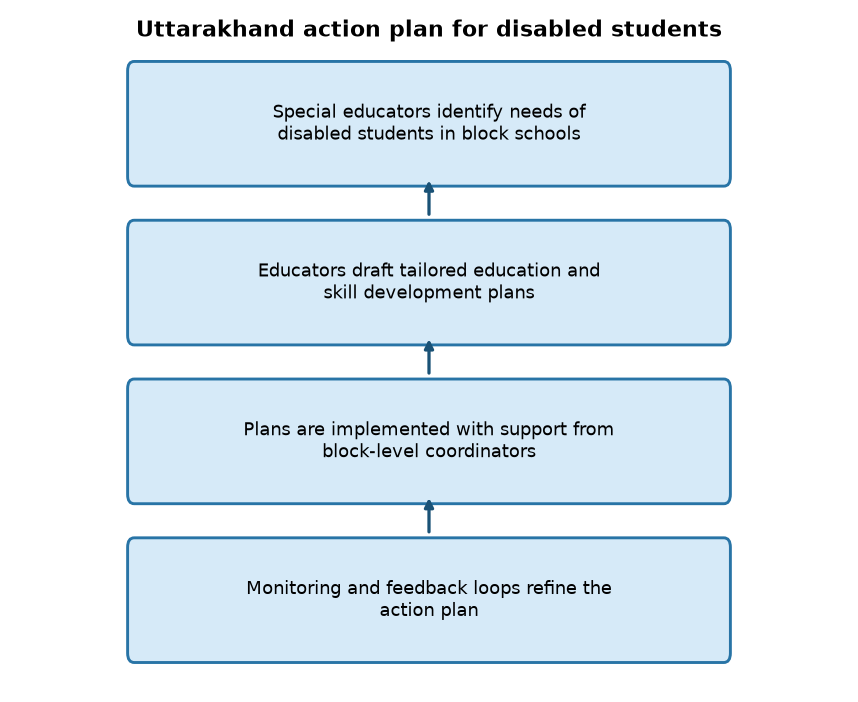
- The plan involves the deployment of specially trained educators at the block level to assess and address the educational and skill development needs of students with disabilities in government schools.
- Special educators will prepare individualised action plans based on the specific disabilities, learning capacities, and socio-economic contexts of the students.
- The initiative aims to bridge gaps in the availability of special educators by leveraging existing human resources through collaborative planning and capacity-building exercises.
- Block-level coordination will ensure that students with disabilities receive consistent support across schools within a development block, fostering a uniform approach to inclusion.
- The action plans will integrate academic support with vocational training, aligning with the RPWD Act’s emphasis on skill development and employability for persons with disabilities.
- The plan is expected to enhance the implementation of the Samagra Shiksha Abhiyan by providing a structured, decentralised framework for inclusive education delivery.
- Monitoring and evaluation mechanisms will be established to track progress, address bottlenecks, and ensure accountability in the execution of the plans.
- The initiative also highlights the importance of teacher training programmes to equip educators with the skills required to teach students with diverse disabilities effectively.
Key Features
| Feature | Significance |
|---|---|
| Development of action plan by special educators at block level | Ensures tailored educational and skill development strategies for students with disabilities, aligning with the Right to Education (RTE) Act, 2009. |
| Coordination role of special educators across schools in a block | Facilitates resource sharing, capacity building, and uniform implementation of inclusive education policies. |
| Identification of students based on special needs and capabilities | Enables targeted interventions, including assistive technologies, modified curricula, and skill training programs. |
| Leveraging expertise of primary and secondary level special educators | Promotes interdisciplinary collaboration and optimizes the use of existing human resources in the education system. |
| Integration with Samagra Shiksha Abhiyan (SSA) | Ensures alignment with national-level inclusive education initiatives and access to centrally sponsored schemes for students with disabilities. |
Why it Matters
Educational Inclusion
- Advances the constitutional mandate of equitable access to education under Article 21A and the RTE Act, 2009, by addressing systemic barriers for students with disabilities.
- Promotes the adoption of Universal Design for Learning (UDL) principles to accommodate diverse learning needs within mainstream classrooms.
Skill Development & Employment
- Aligns with the National Policy for Persons with Disabilities (2006) and the Rights of Persons with Disabilities (RPwD) Act, 2016, by fostering vocational training and employability.
- Supports the Skill India Mission by integrating skill development programs for students with disabilities, enhancing their economic independence.
Administrative Efficiency
- Strengthens decentralized planning in education through block-level special educators, ensuring localized solutions for diverse disability profiles.
- Enhances monitoring and evaluation mechanisms for inclusive education initiatives, enabling data-driven policy adjustments.
Social Equity
- Contributes to reducing the disability gap in educational attainment and employment outcomes, as envisaged under the Sustainable Development Goals (SDG 4 and SDG 8).
- Encourages community participation and awareness, fostering a culture of inclusivity in educational institutions.
Challenges
1. Shortage of Special Educators
- Vacancies in special educator positions across districts (e.g., 38 in Pauri, 21 in Chamoli) hinder the effective implementation of inclusive education policies.
- Lack of trained personnel exacerbates disparities in access to specialized support, particularly in remote and hilly regions of Uttarakhand.
UPSC Link: GS-II: Social Justice
2. Infrastructure and Resource Gaps
- Inadequate availability of assistive devices, accessible infrastructure, and adaptive learning materials in government schools limits the efficacy of inclusive education initiatives.
- Geographical constraints in hilly terrains (e.g., Uttarakhand) pose logistical challenges in deploying resources and personnel.
UPSC Link: GS-II: Social Justice
3. Awareness and Stigma
- Low awareness among parents, teachers, and communities about the rights and capabilities of students with disabilities delays early identification and intervention.
- Social stigma and attitudinal barriers perpetuate exclusion, requiring sensitization programs at multiple levels.
UPSC Link: GS-II: Social Justice
4. Policy-Implementation Disconnect
- Despite the RPwD Act, 2016 and SSA provisions, gaps persist between policy formulation and ground-level execution, particularly in rural and tribal areas.
- Lack of standardized protocols for monitoring inclusive education outcomes undermines accountability and continuous improvement.
UPSC Link: GS-II: Social Justice
5. Curriculum and Assessment Barriers
- Rigid curricula and examination systems often fail to accommodate diverse learning needs, limiting the participation of students with disabilities in mainstream education.
- Insufficient training for regular teachers in inclusive pedagogy restricts their ability to adapt teaching methods for students with disabilities.
UPSC Link: GS-II: Social Justice
Challenges — UPSC Perspective
| Issue | Concern |
|---|---|
| Vacancies in special educator positions | Delays in implementation of inclusive education plans and uneven distribution of expertise across blocks. |
| Limited access to assistive technologies | Restricts the ability of students with disabilities to participate fully in classroom activities and skill development programs. |
| Lack of accessible infrastructure | Excludes students with mobility impairments from educational opportunities, particularly in government schools. |
| Inadequate teacher training | Results in low confidence among regular teachers to handle diverse learning needs, perpetuating exclusion. |
| Delayed identification of disabilities | Leads to late interventions, reducing the effectiveness of remedial and skill development measures. |
| Insufficient community engagement | Hinders the adoption of inclusive practices and reduces parental involvement in educational planning. |
Government Initiatives — Must-Memorise for Prelims
- Samagra Shiksha Abhiyan (SSA)
- Rights of Persons with Disabilities (RPwD) Act, 2016
- National Policy for Persons with Disabilities, 2006
- Right to Education (RTE) Act, 2009
Way Forward
- Conduct a statewide audit of special educator vacancies and deploy additional personnel through targeted recruitment drives, prioritizing hilly and remote blocks.
- Establish block-level resource centers equipped with assistive technologies and adaptive learning materials to support students with disabilities.
- Develop standardized training modules for regular teachers on inclusive pedagogy and Universal Design for Learning (UDL) principles.
- Launch community sensitization campaigns in collaboration with local NGOs and self-help groups to reduce stigma and promote early identification of disabilities.
- Strengthen monitoring mechanisms by integrating real-time data collection on inclusive education outcomes, with periodic reviews by district education officers.
- Expand partnerships with vocational training institutes to design skill development programs tailored to the needs of students with disabilities.
- Ensure accessibility audits of government school infrastructure, with phased implementation of ramps, accessible toilets, and tactile pathways.
- Promote peer-learning networks among special educators to share best practices and optimize resource utilization across blocks.
UPSC Value Addition
Keywords for Mains Answer-Writing
Inclusive Education · Children with Special Needs · Right to Education Act 2009 · Special Educators · Samagra Shiksha Abhiyan · Block Resource Centre · Differently-abled Students · Skill Development for Disabled · Universal Design for Learning · National Education Policy 2020 · UN Convention on the Rights of Persons with Disabilities · Inclusive Pedagogy
Constitutional & Policy Linkages
- Article 21A (Right to Education)
- Article 41 (Directive Principles of State Policy – Education and Skill Development)
- Article 46 (Promotion of Educational and Economic Interests of Weaker Sections)
Concept Flow
Identification of gaps in inclusive education through policy reviews (RPwD Act, 2016; RTE Act, 2009) → → Recognition of systemic barriers (shortage of special educators, infrastructure gaps) in government schools → → Initiation of block-level action plans by special educators to address localized needs → → Integration with national schemes (Samagra Shiksha Abhiyan) for resource mobilization and standardization → → Implementation of inclusive pedagogy and skill development programs → → Monitoring and evaluation to ensure equitable outcomes and continuous improvement → → Feedback loop to policy makers for systemic reforms in inclusive education.
Prelims Practice Questions
Q1. Consider the following statements regarding the Right to Education (RTE) Act, 2009, in the context of children with special needs:
1. The RTE Act mandates free and compulsory education for children with disabilities aged 6 to 14 years.
2. The Act requires all schools to be made barrier-free and inclusive within three years of its enactment.
3. The Act provides for the appointment of special educators in schools to cater to the needs of children with disabilities.
4. The Act exempts private unaided schools from the provisions of inclusive education for children with disabilities.
How many of the above statements are correct?
- Only one
- Only two
- Only three
- All four
Answer: Only three — Statements 1, 2, and 3 are correct as per Sections 3(2), 19(5), and 3(3) of the RTE Act. Statement 4 is incorrect as the Act mandates inclusive education in all schools, including private unaided schools, under Section 12(1)(c).
Q2. Assertion (A): The National Education Policy (NEP) 2020 emphasizes the integration of children with disabilities into mainstream education through the adoption of Universal Design for Learning (UDL).
Reason (R): UDL is a framework that aims to remove barriers in the curriculum and learning environment to ensure all students can access and engage with educational content.
Options:
A. Both A and R are true, and R is the correct explanation of A.
B. Both A and R are true, but R is NOT the correct explanation of A.
C. A is true, but R is false.
D. A is false, but R is true.
Answer: ? — Both A and R are true. The NEP 2020 explicitly endorses UDL as a pedagogical approach to ensure inclusive education. R correctly explains A as UDL directly addresses the removal of barriers for children with disabilities.
Q3. Match the following initiatives with their respective objectives in the context of inclusive education for children with disabilities:
Column I
1. Samagra Shiksha Abhiyan
2. Block Resource Centre
3. UN Convention on the Rights of Persons with Disabilities
4. National Curriculum Framework 2023
Column II
A. Provides a comprehensive framework for inclusive education policies and practices.
B. Aims to integrate children with disabilities into mainstream schools through resource support.
C. Ensures the right to inclusive education and equal opportunities for persons with disabilities.
D. Functions as a local hub for teacher training and resource mobilization in inclusive education.
Options:
A. 1-B, 2-D, 3-C, 4-A
B. 1-D, 2-B, 3-A, 4-C
C. 1-A, 2-C, 3-B, 4-D
D. 1-C, 2-A, 3-D, 4-B
- A
- B
- C
- D
Answer: A — 1-B (Samagra Shiksha Abhiyan integrates children with disabilities into mainstream schools), 2-D (Block Resource Centre serves as a local hub for teacher training and resource mobilization), 3-C (UN Convention on the Rights of Persons with Disabilities ensures inclusive education rights), 4-A (National Curriculum Framework 2023 provides a framework for inclusive education policies).
Mains Practice Question
✍ The inclusion of children with disabilities in mainstream education is not merely a welfare measure but a constitutional and human rights imperative. In this context, critically examine the role of special educators in achieving the goals of inclusive education as envisaged under the Right to Education Act, 2009 and the National Education Policy, 2020. Also, assess the challenges in their effective deployment and suggest measures to enhance their impact. (15 Marks)
Approach: MODEL-ANSWER SKELETON:
1. **Constitutional and Legal Framework** (2 points):
– Article 21A (RTE Act 2009) and Article 45 (DPSP) mandate free and compulsory education for all children aged 6–14.
– UN Convention on the Rights of Persons with Disabilities (UNCRPD), ratified by India, requires inclusive education.
– NEP 2020 emphasizes ‘equitable and inclusive education’ with provisions for special educators.
2. **Role of Special Educators** (3 points):
– **Pedagogical Support**: Adapt teaching methods, develop Individualized Education Plans (IEPs), and use assistive technologies.
– **Resource Mobilization**: Train regular teachers in inclusive pedagogy and collaborate with Block Resource Centres (BRCs).
– **Advocacy**: Ensure barrier-free infrastructure and sensitize school communities.
– Cite Section 19(5) of RTE Act and NEP 2020’s emphasis on ‘special educators’ and ‘inclusive classrooms’.
3. **Challenges in Deployment** (4 points):
– **Shortage of Special Educators**: High vacancies in states like Uttarakhand (e.g., 38 in Pauri Garhwal).
– **Training Gaps**: Lack of standardized training programs for special educators.
– **Infrastructure Deficits**: Inadequate barrier-free access in rural schools.
– **Attitudinal Barriers**: Stigma and lack of awareness among teachers and parents.
4. **Measures to Enhance Impact** (3 points):
– **Policy Implementation**: Fill vacancies via accelerated recruitment and incentivize postings in remote areas.
– **Capacity Building**: Integrate special education courses in teacher training (e.g., DIETs) and conduct regular workshops.
– **Community Engagement**: Partner with NGOs and parents for awareness campaigns.
– **Monitoring**: Strengthen School Management Committees (SMCs) under RTE Act to track progress.
5. **Conclusion** (3 points):
– Special educators are pivotal to inclusive education but require systemic support.
– Balance between quantitative expansion (recruitment) and qualitative improvement (training) is essential.
– Cite examples from states like Kerala (Sarva Shiksha Abhiyan’s inclusive model) or international best practices (e.g., Finland’s inclusive education system).
Source: amarujala.com
Uttarakhand PCS (UKPSC) — State PCS Practice
Prelims: Under the Uttarakhand government’s initiative to enhance educational and skill development for differently-abled students, which of the following steps has been proposed to ensure effective implementation?
- A. Appointment of special educators with a dedicated action plan
- B. Mandatory inclusion of sign language in all school curricula
- C. Establishment of separate schools for differently-abled students in every district
- D. Provision of free laptops to all differently-abled students
Answer: A. Appointment of special educators with a dedicated action plan — The initiative focuses on appointing special educators and preparing a structured action plan for the educational and skill development of differently-abled students in Uttarakhand.
Mains: Critically analyse the role of special educators in Uttarakhand’s initiative for the educational and skill development of differently-abled students. Suggest measures to ensure their effective deployment and impact assessment.
Generated by AanyaAi for educational purpose.
Related guides on our sites
- Current affairs for upsc 2026
- Best PSIR optional coaching for upsc
- Best PSIR optional teacher for upsc
- Best teacher of PSIR optional for upsc

- National Unity Day 2026: Key Preparations & Significance for UPSC - October 21, 2026
- 14वां इंडिया केम 2026: मुंबई में वैश्विक रसायन उद्योग का महाकुंभ - October 21, 2026
- डीआरआई ने गुजरात में 19 करोड़ रुपये सोने की तस्करी गिरोह का भंडाफोड़ किया - October 21, 2026

No Comments