


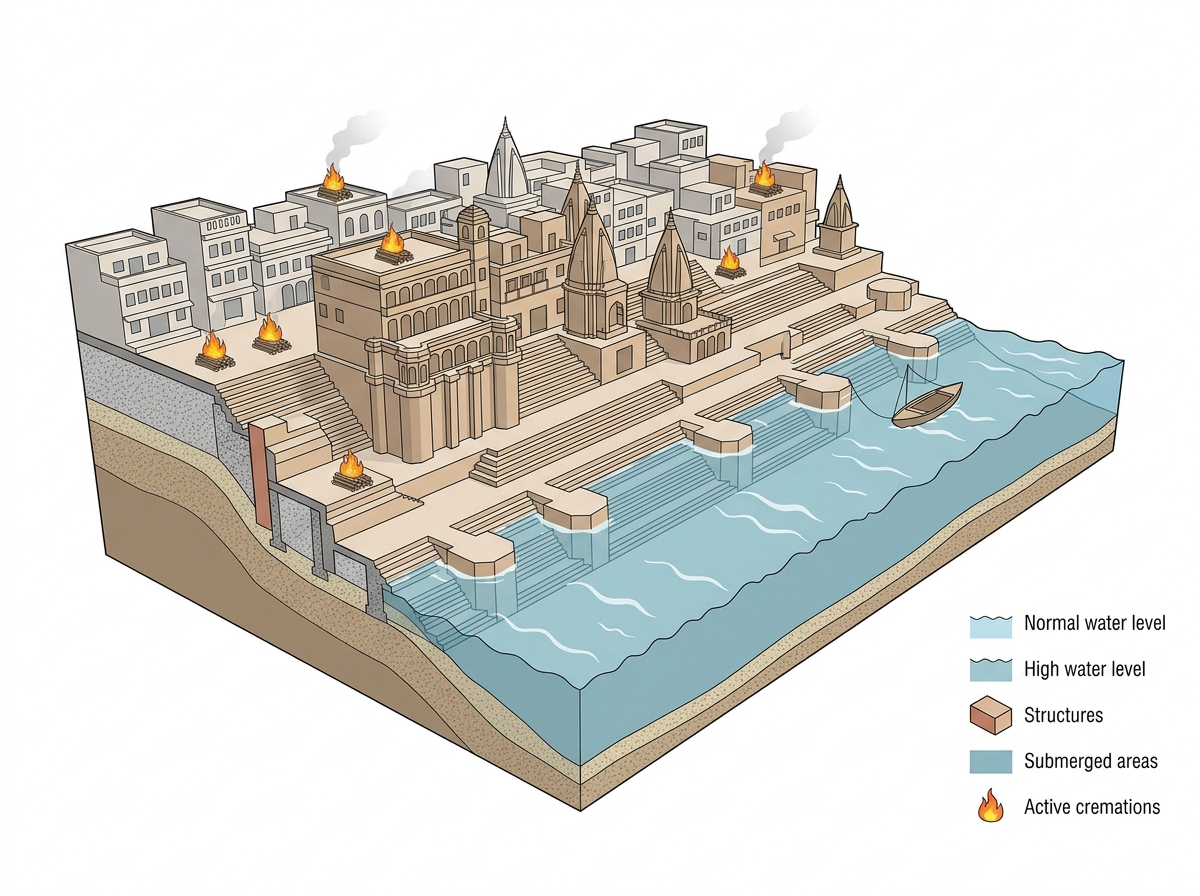
24 Aug Varanasi’s Ganga Ghats Submerged: Cremations Shift to Rooftops Amid Rising Floods
✎ The vulnerability of Varanasi’s ghats to flooding underscores the need for climate-resilient urban planning, integrating traditional knowledge with modern disaster risk reduction strategies.
Subject Relevance — Where This Topic Fits
- GS Paper II — Governance, Constitution, Polity, Social Justice and International Relations (Disaster Management) | GS Paper III — Environment, Ecology, Bio-diversity and Disaster Management
- Prelims: Ganga River System, Ghats of Varanasi, Cremation Practices in Hinduism, Flood Disaster Management, National Disaster Response Force (NDRF), Provincial Armed Constabulary (PAC), Jal Police, Danger Level of River, Sawan Festival, Ganga Aarti
- Essay: ‘Cultural heritage as a non-renewable resource: Balancing preservation with climate vulnerability’, ‘The intersection of faith, ecology, and governance: Lessons from Varanasi’s ghats’
Quick Revision: The vulnerability of Varanasi’s ghats to flooding underscores the need for climate-resilient urban planning, integrating traditional knowledge with modern disaster risk reduction strategies.
Why is this in the news?
The recent surge in the Ganga’s water level in Varanasi has submerged parts of iconic ghats, including Manikarnika and Dashashwamedh, disrupting traditional cremation rites and the Ganga Aarti. Cremations have been shifted to rooftops, and boat services suspended, highlighting the vulnerability of cultural and religious practices to hydrological extremes. This underscores the need for integrated flood risk management in heritage-rich urban riverfronts.
Background
- The Ganga River, a lifeline for northern India, flows through Varanasi, a city of profound religious and cultural significance.
- Varanasi’s ghats—stepped riverfronts—serve as sites for daily cremations, ritual baths, and cultural ceremonies, including the famous Ganga Aarti at Dashashwamedh Ghat.
- The Ganga’s water levels fluctuate seasonally, with monsoon-induced floods being a recurring challenge, particularly during the Sawan month (July–August).
- The Varanasi Municipal Corporation and district administration routinely monitor river levels and implement precautionary measures during the monsoon.
- Traditional cremation practices at Manikarnika Ghat, managed by the Dom community, are integral to Hindu religious rites and attract pilgrims globally.
What are the Ghats of Varanasi and their Cultural Significance?
- Varanasi’s ghats are a series of 84 stepped embankments along the western bank of the Ganga River, serving as sites for bathing, cremation, and religious ceremonies.
- Manikarnika Ghat is one of the oldest and most sacred cremation grounds in Hinduism, where approximately 100 cremations occur daily, with rites performed continuously.
- Dashashwamedh Ghat is the principal ghat for the Ganga Aarti, a daily ritual performed at dusk, attended by thousands of devotees and tourists.
- Ghat management involves coordination between the Varanasi Municipal Corporation, ASI, and local communities, including the Dom community, who traditionally conduct cremations.
- The ghats also serve as economic hubs, supporting boat services, vendors, and tourism, which are directly impacted by riverine flooding.
Key Features
| Feature | Significance |
|---|---|
| Submersion of Varanasi ghats | Disruption of traditional cremation practices, cultural rituals, and daily life in a UNESCO World Heritage city. |
| Shift of cremations to rooftops | Temporary adaptation to flooding, highlighting vulnerability of cremation infrastructure to extreme weather. |
| Suspension of boat services | Impediment to mobility of devotees, vendors, and logistical support for cremation services. |
| Rooftop Ganga Aarti | Adaptation of religious ceremonies to rising water levels, affecting tourism and cultural heritage. |
| NDRF and PAC deployment | Ensuring safety of pilgrims and locals amid submerged ghats and potential hazards. |
Why it Matters
Cultural and Religious
- Varanasi’s ghats are integral to Hindu religious practices, including cremation rites at Manikarnika and daily Ganga Aarti at Dashashwamedh.
- Flooding disrupts centuries-old traditions, affecting pilgrims and local communities dependent on these rituals.
- The Ganga Aarti, a global tourist attraction, faces operational challenges, impacting cultural tourism and local economies.
Environmental and Hydrological
- Rising Ganga levels reflect broader climate-change impacts, including erratic monsoon patterns and glacial melt in the Himalayas.
- Submersion of ghats underscores the need for flood-resilient urban planning in heritage cities.
- Riverine ecosystems face stress due to altered flow dynamics and sediment deposition during floods.
Urban Governance and Infrastructure
- Municipal Corporation’s delayed restoration of ghat connections highlights gaps in flood-response infrastructure.
- Vulnerability of cremation sites and religious structures to flooding necessitates retrofitting and relocation plans.
- Boat services suspension affects livelihoods of vendors and boat operators, exacerbating economic strain.
Challenges
1. Disruption of Cremation Practices
- Forced shift of cremations to rooftops due to submerged lower ghats, causing logistical and emotional distress.
- Traditional Dom community’s role in cremations is strained, with potential delays in last rites.
- Risk of public health hazards from improperly managed cremations in non-traditional settings.
UPSC Link: GS3: Disaster Management
2. Cultural and Religious Disruptions
- Inability to conduct Ganga Aarti at Dashashwamedh Ghat affects spiritual and tourist experiences.
- Loss of revenue from pilgrims and tourists impacts local businesses and temple economies.
- Cultural heritage sites face irreversible damage if flooding persists or recurs frequently.
UPSC Link: GS1: Indian Culture
3. Urban Flood Management
- Inadequate flood-resilient infrastructure in Varanasi’s heritage zones exacerbates vulnerability.
- Lack of permanent solutions for cremation sites and ghats during monsoon seasons.
- Coordinated response between municipal, state, and central agencies remains ad hoc.
UPSC Link: GS3: Urban Planning
4. Economic Impact on Livelihoods
- Suspension of boat services affects livelihoods of vendors, boat operators, and associated businesses.
- Tourism-dependent sectors face revenue losses due to disrupted religious and cultural activities.
- Long-term economic strain on local communities reliant on pilgrimage and tourism.
UPSC Link: GS3: Economic Sectors
5. Public Safety and Disaster Response
- Rising water levels pose drowning risks to pilgrims and locals, necessitating NDRF and PAC deployment.
- Delays in resuming boat services and ghat connections increase exposure to flood hazards.
- Need for real-time monitoring and early warning systems to mitigate risks.
UPSC Link: GS3: Disaster Management
Challenges — UPSC Perspective
| Issue | Concern |
|---|---|
| Submersion of ghats | Disruption of religious and cultural practices, public safety risks. |
| Cremation site vulnerability | Logistical challenges, public health risks, emotional distress. |
| Boat service suspension | Mobility constraints, economic losses for vendors and operators. |
| Ganga Aarti relocation | Cultural heritage loss, tourism revenue decline. |
| Delayed infrastructure restoration | Prolonged exposure to flood hazards, governance gaps. |
Way Forward
- Conduct a vulnerability assessment of Varanasi’s ghats and cremation sites to identify flood-prone zones and retrofitting needs.
- Develop a permanent relocation plan for cremation sites to higher ground, ensuring minimal disruption to traditions.
- Enhance real-time flood monitoring and early warning systems for ghats and riverine areas.
- Improve coordination between municipal, state, and central agencies for swift flood-response and restoration.
- Invest in flood-resilient infrastructure for ghats, including elevated platforms and drainage systems.
- Promote alternative livelihoods for boat operators and vendors affected by seasonal disruptions.
- Integrate climate-resilient urban planning into Varanasi’s heritage conservation efforts.
- Conduct public awareness campaigns on flood preparedness and safety measures for pilgrims.
UPSC Value Addition
Keywords for Mains Answer-Writing
Ganga river management · Varanasi ghats and cultural heritage · Flood preparedness and disaster response · National Disaster Response Force (NDRF) · Provincial Armed Constabulary (PAC) · Jal Police · Cremation practices in India · Cultural and religious significance of river ghats · Climate change and riverine flooding · Urban flooding and civic infrastructure · Traditional knowledge systems in disaster mitigation · Cultural heritage conservation · Flood risk assessment and early warning systems · River basin management · Civic administration and disaster preparedness
Concept Flow
Heavy monsoon rainfall → Ganga river discharge exceeds safe levels → Submersion of Varanasi ghats → Disruption of cremation practices and Ganga Aarti → Shift to rooftop ceremonies → Suspension of boat services → Economic and cultural losses → Deployment of disaster response teams → Need for flood-resilient infrastructure and governance reforms.
Prelims Practice Questions
Q1. Consider the following statements regarding the National Disaster Response Force (NDRF):
1. The NDRF operates under the administrative control of the Ministry of Home Affairs.
2. It was constituted under the Disaster Management Act, 2005.
3. The NDRF is deployed only for natural disasters and not for man-made disasters.
How many of the above statements are correct?
- Only one
- Only two
- All three
- None
Answer: Only two — Statement 1 is correct: The NDRF operates under the Ministry of Home Affairs. Statement 2 is correct: It was constituted under the Disaster Management Act, 2005. Statement 3 is incorrect: The NDRF is deployed for both natural and man-made disasters.
Q2. Assertion (A): The Ganga river in Varanasi has a cultural and religious significance that necessitates preservation of its ghats.
Reason (R): The ghats serve as platforms for cremation, religious rituals, and public gatherings, making them integral to the socio-cultural fabric of the city.
Options:
A. Both A and R are true, and R is the correct explanation of A.
B. Both A and R are true, but R is not the correct explanation of A.
C. A is true, but R is false.
D. A is false, but R is true.
- A
- B
- C
- D
Answer: A — Both the assertion and reason are true. The cultural and religious significance of the ghats is directly linked to their role in cremation, religious rituals, and public gatherings, which makes their preservation essential.
Q3. Match the following pairs related to flood management in India:
Column I (Institution/Body)
1. National Disaster Response Force (NDRF)
2. Provincial Armed Constabulary (PAC)
3. Jal Police
4. Varanasi Municipal Corporation
Column II (Role/Function)
A. Primarily responsible for maintaining law and order during disasters
B. Conducts round-the-clock patrolling and disaster response in Varanasi
C. Local civic body managing urban infrastructure and disaster preparedness
D. Specialised force for disaster response under the Ministry of Home Affairs
- 1-D, 2-A, 3-B, 4-C
- 1-A, 2-B, 3-C, 4-D
- 1-B, 2-A, 3-D, 4-C
- 1-C, 2-D, 3-A, 4-B
Answer: 1-D, 2-A, 3-B, 4-C — 1-D: NDRF is a specialised disaster response force under the Ministry of Home Affairs. 2-A: PAC is primarily responsible for maintaining law and order. 3-B: Jal Police conducts patrolling and disaster response in Varanasi. 4-C: Varanasi Municipal Corporation is the local civic body managing urban infrastructure.
Mains Practice Question
✍ The recurrent flooding of Varanasi’s ghats and the displacement of cremation practices to rooftops highlight the interplay between cultural heritage, urban infrastructure, and climate vulnerability. Critically examine the institutional and policy frameworks governing flood management and cultural heritage preservation in India. Also, discuss the role of traditional knowledge systems in mitigating such risks. (15 Marks)
Approach: MODEL-ANSWER SKELETON:
1. **Introduction (2 marks)**
– Briefly describe the incident in Varanasi and its significance in highlighting the vulnerability of cultural heritage sites to climate-induced disasters.
– State the objective: To examine institutional frameworks for flood management and cultural heritage preservation, and the role of traditional knowledge.
2. **Institutional Frameworks for Flood Management (5 marks)**
– **National Disaster Management Authority (NDMA)**: Role under the Disaster Management Act, 2005, and the National Disaster Management Plan (NDMP).
– **National Disaster Response Force (NDRF)**: Deployment, training, and operational protocols for riverine disasters.
– **State and Local Bodies**: Role of the Uttar Pradesh State Disaster Management Authority (UPSDMA), Varanasi Municipal Corporation, and Jal Police in monitoring and response.
– **Early Warning Systems**: Integration of IMD, CWC, and local agencies for flood forecasting and dissemination.
3. **Cultural Heritage Preservation Frameworks (4 marks)**
– **Constitutional and Statutory Provisions**: Article 49 (protection of monuments and places of national importance), Ancient Monuments and Archaeological Sites and Remains Act, 1958.
– **National Mission on Cultural Mapping**: Role in documenting and preserving intangible cultural heritage.
– **Local Governance**: Role of municipal bodies in maintaining ghats, including structural interventions and community engagement.
4. **Role of Traditional Knowledge Systems (3 marks)**
– **Historical Practices**: Indigenous knowledge of riverine ecosystems, seasonal patterns, and flood-resistant construction techniques.
– **Community-Based Disaster Risk Reduction (CBDRR)**: Involvement of traditional practitioners (e.g., Dom community in Varanasi) in disaster preparedness and response.
– **Integration with Modern Systems**: Case studies where traditional knowledge has been incorporated into flood management plans (e.g., traditional water harvesting systems).
5. **Challenges and Way Forward (3 marks)**
– **Gaps in Implementation**: Delayed response, lack of coordination between agencies, and inadequate funding for heritage conservation.
– **Climate Change Adaptation**: Need for climate-resilient infrastructure and long-term planning for heritage sites.
– **Policy Recommendations**: Strengthening early warning systems, community participation, and inter-agency coordination.
6. **Conclusion (2 marks)**
– Summarise the need for a multi-dimensional approach combining institutional frameworks, heritage preservation, and traditional knowledge to address climate-induced disasters.
Source: The Indian Express
Uttar Pradesh PCS (UPPSC) — State PCS Practice
Prelims: Which of the following is the primary reason for the shift of cremations from Varanasi’s iconic ghats to rooftops in recent years?
- A. Rising water levels of the Ganga due to climate change and upstream dam construction
- B. Decline in the availability of wood for cremation rituals
- C. Government ban on cremations at ghats to promote tourism
- D. Increased cost of cremation services at traditional ghats
Answer: A. Rising water levels of the Ganga due to climate change and upstream dam construction — The primary reason cited is the rising water levels of the Ganga, which have submerged or made ghats inaccessible for cremations, especially during monsoon seasons.
Mains: Discuss the socio-cultural and administrative challenges faced by the Uttar Pradesh government in preserving Varanasi’s ghats while addressing the environmental and public health concerns arising from the shift of cremations to rooftops. Suggest measures to mitigate these challenges in alignment with UP’s heritage conservation and sustainable development goals.
Generated by AanyaAi for educational purpose.
Related guides on our sites
- Current affairs for upsc 2026
- How to prepare for GS paper 1 for UPSC CSE mains exam
- Best UPSC coaching for IFOS exam
- Best geography optional coaching

- PM Modi’s Vision: Capacity Building Commission & Mission Karmayogi for Civil Services - October 23, 2026
- रक्षा मंत्री का सेना प्रमुखों को महत्वपूर्ण निर्देश: सुरक्षा चुनौतियों का सामना करने की तैयारी - October 23, 2026
- India-Samoa-Naoero Relations: Key Takeaways for UPSC & State PCS - October 23, 2026

No Comments