


08 Aug VBSA Bill: How Centralisation Threatens University Autonomy in India
✎ The Viksit Bharat Shiksha Adhishthan (VBSA) Bill threatens to centralise higher education governance, erode State autonomy, and undermine university autonomy by consolidating regulatory powers under a single Union-controlled…
Subject Relevance — Where This Topic Fits
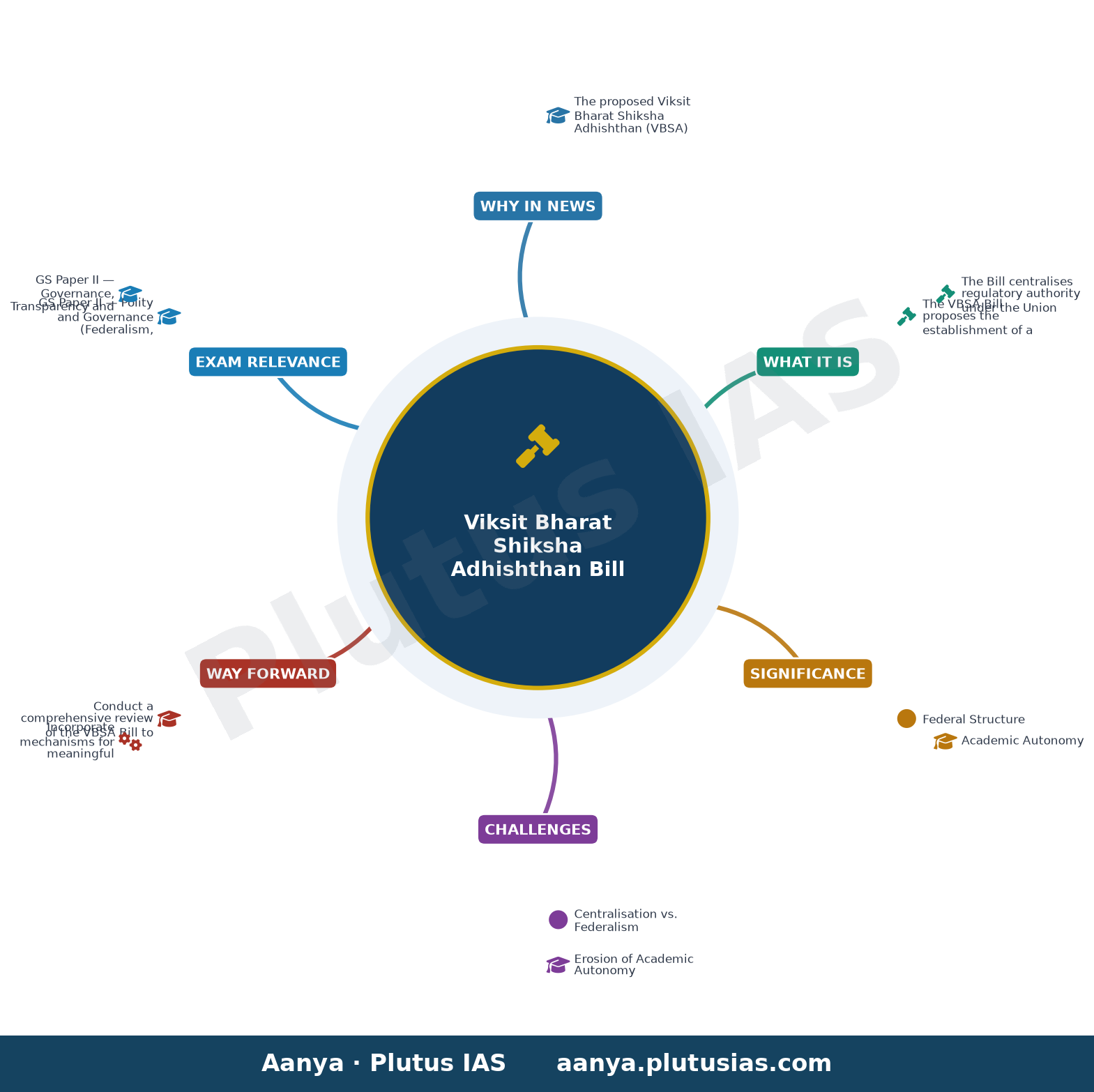
- GS Paper II — Polity and Governance (Federalism, Constitutional Amendments, Centre-State Relations) | GS Paper II — Governance, Transparency and Accountability (Regulatory Bodies in Education) | GS Paper III — Human Resource Development (Higher Education Reforms, Autonomy of Institutions)
- Prelims: Viksit Bharat Shiksha Adhishthan (VBSA) Bill, 42nd Constitutional Amendment (1976), Concurrent List (Seventh Schedule), National Education Policy (NEP) 2020, National Commission for Higher Education and Research (NCHER), Four-Year Undergraduate Programme (FYUGP), Kerala Sasthra Sahithya Parishad (KSSP), coaching industry in higher education
- Essay: The erosion of federalism in India: A critique of centralised governance in higher education, Higher education as a public good: Balancing autonomy, accountability, and equity
Quick Revision: The Viksit Bharat Shiksha Adhishthan (VBSA) Bill threatens to centralise higher education governance, erode State autonomy, and undermine university autonomy by consolidating regulatory powers under a single Union-controlled body, thereby undermining India’s federal structure and democratic academic culture.
Why is this in the news?
The proposed Viksit Bharat Shiksha Adhishthan (VBSA) Bill has sparked significant debate among academicians and policymakers regarding its potential to centralise higher education governance, undermine university autonomy, and diminish the constitutional role of State governments. Historian and educationist K.N. Ganesh’s critique at a Kerala Sasthra Sahithya Parishad (KSSP) workshop highlights concerns over the Bill’s alignment with broader trends of market-oriented reforms in higher education and its long-term implications for India’s federal structure and democratic academic culture.
Background
- The 42nd Constitutional Amendment (1976) transferred education from the State List to the Concurrent List, enabling greater central intervention in higher education governance.
- The National Commission for Higher Education and Research (NCHER) framework, proposed during the UPA government (2011), was similarly criticised for centralising regulatory powers and reducing State participation.
- The Kerala Sasthra Sahithya Parishad (KSSP), a prominent state-level academic body, has been vocal in opposing centralised reforms that undermine State autonomy in education.
What is the Viksit Bharat Shiksha Adhishthan (VBSA) Bill?
- The VBSA Bill proposes the establishment of a single apex regulatory body for higher education, consolidating powers currently vested in bodies like UGC, AICTE, and NCTE.
- The Bill centralises regulatory authority under the Union Government, significantly reducing the role of State governments in higher education governance, in violation of the federal spirit of the Constitution.
- The proposed regulatory framework does not include representation for teachers or students in its decision-making councils, raising concerns about democratic accountability and academic freedom.
- The Bill aligns with market-oriented reforms in higher education, emphasising employability and labour market alignment over critical thinking, scientific temper, and social responsibility.
- Critics argue that the Bill undermines the autonomy of universities by imposing uniform standards and reducing institutional flexibility in curriculum design and governance.
- The Bill’s provisions may exacerbate elitism in higher education by prioritising national entrance examinations and the coaching industry.
- The proposed legislation reflects a shift from higher education as a public good to a service-oriented model, with implications for equity, access, and democratic values.
Key Features
| Feature of VBSA Bill | Significance |
|---|---|
| Centralised Regulatory Authority | Concentrates regulatory powers with the Central government, reducing State autonomy in higher education governance. |
| Exclusion of Teachers and Students | Proposed apex body lacks representation from academic stakeholders, raising concerns over democratic participation in policy-making. |
| Diminished University Autonomy | Restricts institutional independence by centralising decision-making, potentially undermining academic freedom. |
| Reduction of State Role | Marginalises State governments in higher education policy, altering the federal balance post-42nd Constitutional Amendment (1976). |
| Elitist Higher Education Trends | Expansion of national entrance examinations and coaching culture may exacerbate inequities, prioritising market-driven outcomes over inclusive access. |
Why it Matters
Federal Structure
- The Bill represents a further centralisation of higher education, undermining the constitutional division of powers between the Centre and States under the Concurrent List.
- Weakening State roles in higher education governance may erode cooperative federalism, a cornerstone of India’s constitutional framework.
- Historical shift post-42nd Amendment (1976) accelerated central intervention; VBSA Bill deepens this trend, raising federalism concerns.
Academic Autonomy
- University autonomy is a fundamental principle of higher education, essential for fostering innovation, critical thinking, and democratic values.
- Centralised regulation risks homogenising academic standards, stifling institutional diversity and local contextualisation.
- Exclusion of teachers and students from regulatory bodies may marginalise academic expertise and student voices in policy formulation.
Social Equity
- Market-oriented reforms in higher education often favour urban, affluent sections, exacerbating social and regional disparities.
- National entrance examinations and coaching culture may create barriers for marginalised groups, limiting access to quality education.
- Higher education must nurture democratic values and social responsibility, not merely serve labour market demands.
Policy Continuity
- The VBSA Bill follows earlier proposals like the NCHER framework (2011), indicating a long-term trend toward centralisation in higher education governance.
- Such reforms have long-term implications for India’s public higher education system and its federal structure.
Challenges
1. Centralisation vs. Federalism
- The Bill risks undermining cooperative federalism by reducing State roles in higher education governance.
- Concentration of power at the Centre may lead to policy uniformity, disregarding regional educational needs and priorities.
- Historical shifts post-42nd Amendment (1976) have gradually eroded State autonomy; VBSA Bill accelerates this trend.
UPSC Link: GS-II: Federalism
2. Erosion of Academic Autonomy
- Centralised regulation may stifle institutional innovation and academic freedom, essential for higher education.
- Exclusion of teachers and students from regulatory bodies undermines democratic participation in academic governance.
- Homogenisation of standards risks disregarding local contexts and diverse academic cultures.
UPSC Link: GS-II: Education
3. Social Inequities in Higher Education
- Market-driven reforms may exacerbate social and regional disparities, limiting access for marginalised groups.
- Expansion of national entrance examinations and coaching culture may create elitist barriers to higher education.
- Higher education must prioritise inclusive access and democratic values over labour market alignment.
UPSC Link: GS-II: Social Justice
4. Policy Fragmentation and Continuity
- The VBSA Bill follows earlier proposals (e.g., NCHER 2011), indicating a lack of consensus on higher education governance.
- Frequent policy shifts may disrupt long-term planning and implementation in higher education institutions.
- Lack of stakeholder consultation may lead to policy resistance and implementation challenges.
UPSC Link: GS-II: Governance
5. Democratic Deficit in Academic Governance
- Exclusion of teachers and students from regulatory bodies raises concerns over participatory democracy in higher education.
- Centralised decision-making may marginalise academic expertise and student voices, undermining institutional accountability.
- Democratic governance in higher education is essential for fostering critical thinking and social responsibility.
UPSC Link: GS-II: Constitutional Framework
Challenges — UPSC Perspective
| Challenge | Concern |
|---|---|
| Centralisation of Power | Risk of undermining cooperative federalism and State roles in higher education governance. |
| Erosion of University Autonomy | Potential stifling of academic freedom and institutional innovation due to centralised regulation. |
| Exclusion of Stakeholders | Lack of representation for teachers and students in regulatory bodies, raising democratic deficit concerns. |
| Social Inequities | Expansion of elitist trends in higher education, exacerbating disparities in access and opportunity. |
| Policy Fragmentation | Lack of consensus and frequent shifts in higher education governance may disrupt long-term planning. |
| Democratic Governance | Centralised decision-making may marginalise academic expertise and student voices in policy formulation. |
Way Forward
- Conduct a comprehensive review of the VBSA Bill to assess its implications for federalism, academic autonomy, and social equity.
- Incorporate mechanisms for meaningful representation of teachers, students, and State governments in the proposed regulatory body.
- Strengthen provisions to safeguard university autonomy and institutional diversity in the Bill.
- Develop inclusive policies to mitigate elitist trends in higher education, ensuring equitable access for marginalised groups.
- Promote democratic governance in higher education by mandating participatory decision-making structures.
- Encourage regional consultations to ensure higher education policies align with local needs and priorities.
- Establish a multi-stakeholder task force to monitor the implementation of the Bill and address implementation challenges.
- Align the Bill with constitutional principles of cooperative federalism and academic freedom.
UPSC Value Addition
Keywords for Mains Answer-Writing
Viksit Bharat Shiksha Adhishthan (VBSA) Bill · university autonomy · federalism in higher education · 42nd Constitutional Amendment · National Education Policy (NEP) 2020 · higher education governance · centralisation vs decentralisation · State role in education · academic freedom · democratic participation in education policy · Kerala Sasthra Sahithya Parishad (KSSP) · Four-Year Undergraduate Programme (FYUGP) · market-oriented reforms in education · National Commission for Higher Education and Research (NCHER)
Constitutional & Policy Linkages
- Article 246: Division of Legislative Powers (Concurrent List – Entry 25: Education)
- 7th Schedule: Concurrent List – Entry 25: Education
- Article 29: Protection of Interests of Minorities in Education
Concept Flow
42nd Constitutional Amendment (1976) → Shift of Education to Concurrent List → Gradual Centralisation of Higher Education Governance → Centralisation Trend → Proposals like NCHER (2011) → VBSA Bill (2026) → Further Concentration of Regulatory Powers → Centralised Regulatory Framework → Diminished State Role → Weakening of Cooperative Federalism → Exclusion of Teachers/Students from Regulatory Bodies → Democratic Deficit in Academic Governance → Marginalisation of Academic Expertise → Market-Oriented Reforms → Expansion of National Entrance Examinations → Elitist Higher Education Trends → Social Inequities → Centralised Regulation → Homogenisation of Standards → Erosion of University Autonomy → Stifling of Innovation → Policy Fragmentation → Lack of Stakeholder Consultation → Implementation Challenges → Policy Resistance
Prelims Practice Questions
Q1. Consider the following statements regarding the Viksit Bharat Shiksha Adhishthan (VBSA) Bill, 2026:
1. The Bill proposes to establish a highly centralised regulatory framework for higher education in India.
2. The proposed apex regulatory body under the Bill will include representation from teachers and students in its councils.
3. The Bill seeks to diminish the role of State governments in higher education governance.
4. The Bill is the first legislative attempt to centralise higher education governance in India.
How many of the above statements are correct?
- Only one
- Only two
- Only three
- All four
Answer: Only three — Statements 1 and 3 are correct as the Bill aims to centralise regulatory powers and reduce State roles. Statement 2 is incorrect because the Bill does not provide for teacher or student representation in its councils. Statement 4 is incorrect because earlier attempts like the NCHER framework (2011) also aimed at centralisation.
Q2. Assertion (A): The 42nd Constitutional Amendment Act, 1976, shifted education to the Concurrent List, enabling greater central intervention in higher education governance.
Reason (R): The Concurrent List empowers the Union government to legislate on subjects in the State List if necessary, thereby facilitating centralisation in education policy.
- Both A and R are true, and R is the correct explanation of A
- Both A and R are true, but R is NOT the correct explanation of A
- A is true, but R is false
- A is false, but R is true
Answer: Both A and R are true, and R is the correct explanation of A — Both the Assertion and Reason are true. The 42nd Amendment moved education to the Concurrent List, and the Reason correctly explains how the Concurrent List enables central intervention. Thus, R is the correct explanation of A.
Q3. Match the following pairs related to higher education governance in India:
Column I (Committee/Body)
A. Viksit Bharat Shiksha Adhishthan (VBSA) Bill
B. National Commission for Higher Education and Research (NCHER)
C. Kerala Sasthra Sahithya Parishad (KSSP)
D. Four-Year Undergraduate Programme (FYUGP)
Column II (Description)
1. Proposed apex regulatory body for higher education with centralised powers
2. Framework mooted by the UPA government in 2011 for higher education reforms
3. State-level academic organisation advocating for democratic participation in education
4. Kerala’s initiative for curriculum restructuring in undergraduate programmes
Select the correct match:
- A-1, B-2, C-3, D-4
- A-2, B-1, C-4, D-3
- A-3, B-4, C-1, D-2
- A-4, B-3, C-2, D-1
Answer: A-1, B-2, C-3, D-4 — The correct matches are: A (VBSA Bill) – 1 (proposed apex regulatory body), B (NCHER) – 2 (framework mooted in 2011), C (KSSP) – 3 (State-level academic organisation), and D (FYUGP) – 4 (Kerala’s curriculum initiative).
Mains Practice Question
✍ Critically examine the constitutional and federal implications of the proposed Viksit Bharat Shiksha Adhishthan (VBSA) Bill, 2026, with particular reference to its impact on university autonomy and the role of State governments in higher education governance. (15 Marks)
Approach: MODEL-ANSWER SKELETON:
1. **Constitutional Context**:
– Reference the 42nd Constitutional Amendment (1976) that moved education to the Concurrent List, enabling central intervention.
– Contrast with the original federal structure where education was a State subject under the State List (Entry 11, List II, Seventh Schedule).
2. **Provisions of the VBSA Bill**:
– Highlight the centralised regulatory framework proposed, including the apex body’s composition and powers.
– Note the absence of teacher and student representation in decision-making councils.
3. **Impact on University Autonomy**:
– Discuss how centralised regulation may undermine institutional autonomy, academic freedom, and democratic governance in universities.
– Reference the Manmohan Singh-led UPA government’s NCHER framework (2011) as a precedent for similar centralising tendencies.
4. **Federalism Concerns**:
– Analyse the Bill’s implications for cooperative federalism, including the marginalisation of State governments in higher education policy.
– Cite critiques from scholars like K.N. Ganesh and the Kerala Sasthra Sahithya Parishad (KSSP) regarding the Bill’s potential to weaken democratic academic culture.
5. **Broader Trends**:
– Link the Bill to the NEP 2020’s market-oriented reforms and the increasing reliance on national entrance examinations.
– Discuss the elitist consequences of such reforms, including the expansion of the coaching industry.
6. **Balanced View**:
– Acknowledge potential arguments in favour of centralisation (e.g., uniformity in standards, addressing regional disparities).
– Counterbalance with arguments for decentralisation (e.g., contextual relevance, local governance, and democratic participation).
7. **Conclusion**:
– Weigh the long-term implications for India’s federal structure and public higher education system.
– Offer a reasoned stance on whether the Bill strikes a balance between uniformity and autonomy.
Source: The Hindu
Generated by AanyaAi for educational purpose.

- KWML’s Feasibility Reports for Water Metro in 18 Cities: UPSC & PCS Insights - October 3, 2026
- ओडिशा में वन्यजीव अनुसंधान अनुदान कार्यक्रम शुरू, सिमिलिपाल में 300 कैमरे और बढ़ेंगे - October 3, 2026
- India Summons Pakistan High Commission Official Over Violation - October 3, 2026

No Comments