


09 Aug VBSA Bill: How Centre’s Proposed Higher Education Law Threatens Autonomy & State Role
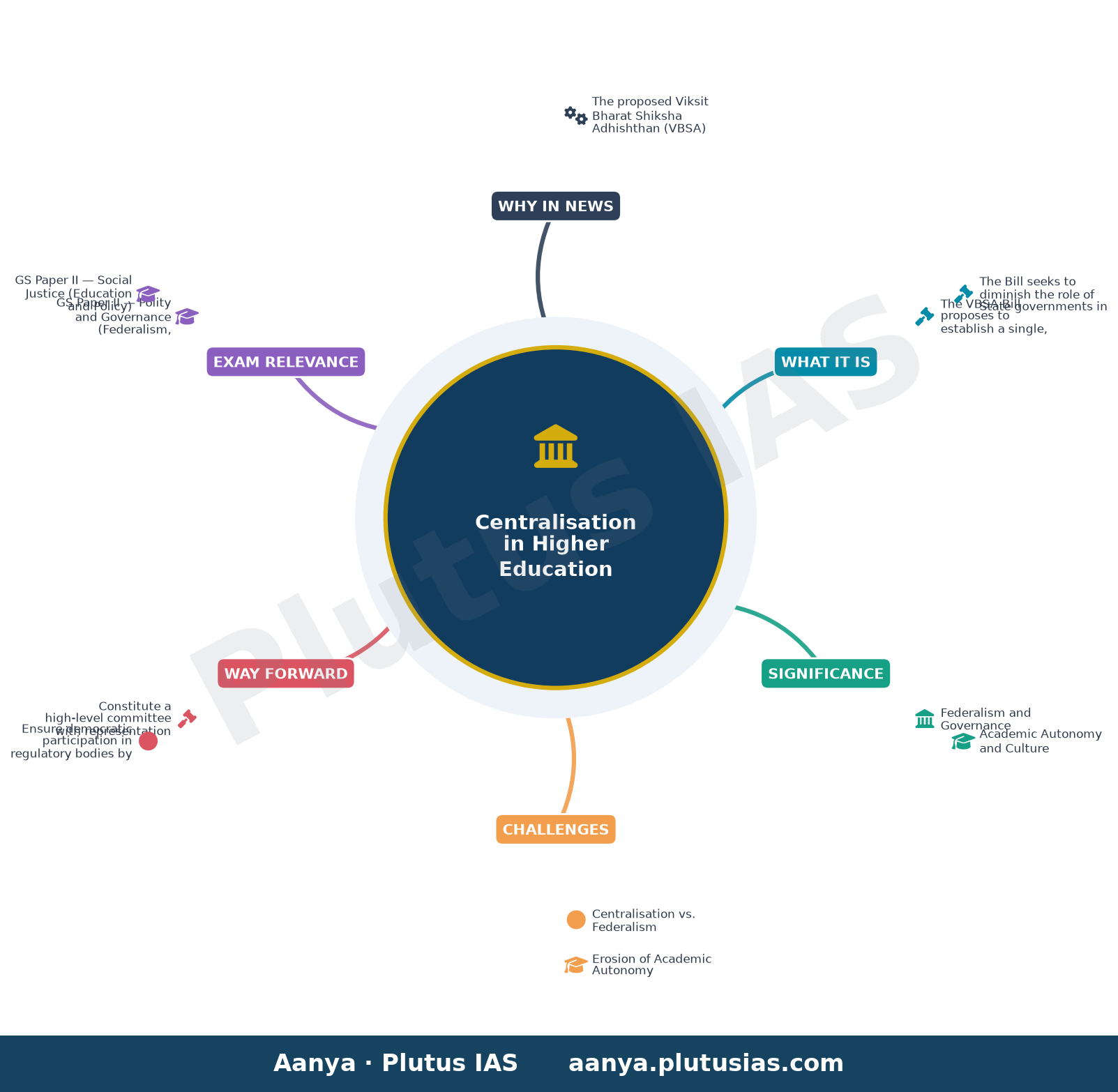
✎ The VBSA Bill seeks to centralise higher education governance by replacing multiple regulators with a single apex body, thereby diminishing State autonomy, university autonomy, and democratic participation in policymaking.
Subject Relevance — Where This Topic Fits
- GS Paper II — Polity and Governance (Federalism, Constitutional Amendments, Regulatory Bodies) | GS Paper II — Social Justice (Education and Policy)
- Prelims: Viksit Bharat Shiksha Adhishthan (VBSA) Bill, National Education Policy (NEP) 2020, 42nd Constitutional Amendment (1976), Concurrent List (Education), University autonomy, Regulatory bodies in higher education (UGC, AICTE, NCHER)
- Essay: The erosion of federalism in India: A critique of centralised higher education governance, Higher education as a public good: Balancing autonomy, equity, and marketisation
Quick Revision: The VBSA Bill seeks to centralise higher education governance by replacing multiple regulators with a single apex body, thereby diminishing State autonomy, university autonomy, and democratic participation in policymaking.
Why is this in the news?
The proposed Viksit Bharat Shiksha Adhishthan (VBSA) Bill has sparked a national debate on its potential to centralise higher education governance, diminish State-level autonomy, and undermine university autonomy. Historian and educationist K.N. Ganesh’s critique at a Kerala Sasthra Sahithya Parishad (KSSP) workshop highlights the Bill’s alignment with a broader trend of centralising educational policy, raising concerns about its long-term implications for India’s federal structure, democratic academic culture, and the public higher education system.
Background
- The 42nd Constitutional Amendment (1976) transferred education from the State List to the Concurrent List, enabling greater Central intervention in higher education governance.
- The National Commission for Higher Education and Research (NCHER) framework, proposed by the UPA government in 2011, was a precursor to the current centralisation drive in higher education.
- The expansion of national entrance examinations (e.g., JEE, NEET) and the growth of the coaching industry have raised concerns about elitism and the commercialisation of higher education.
What is the Viksit Bharat Shiksha Adhishthan (VBSA) Bill?
- The VBSA Bill proposes to establish a single, apex regulatory body for higher education, replacing existing regulators like UGC and AICTE, thereby centralising regulatory powers in the hands of the Central government.
- The Bill seeks to diminish the role of State governments in higher education governance, potentially undermining the constitutional framework of federalism as education falls under the Concurrent List.
- The proposed regulatory framework does not provide for representation of teachers or students in its governing councils, raising concerns about the lack of democratic participation in educational policymaking.
- The Bill aligns with the broader trend of market-oriented reforms in higher education, which prioritise standardisation and employability over academic autonomy.
- Critics argue that the VBSA Bill could further erode university autonomy by imposing uniform regulations, thereby restricting the ability of institutions to design curricula and research agendas independently.
- The Bill has been criticised for its potential to exacerbate elitism in higher education by relying heavily on national entrance examinations and expanding the coaching industry, which disproportionately benefits urban and affluent students.
- The VBSA Bill is part of a long-term process of centralisation in higher education governance, following the 42nd Constitutional Amendment (1976) and subsequent policy proposals like NCHER (2011).
- The Bill’s implementation could have significant implications for India’s federal structure, public higher education system, and the democratic culture of academic institutions.
Key Features
| Feature | Significance |
|---|---|
| Centralised Regulatory Framework | Establishes a single apex body under the Union Government, reducing State-level autonomy in higher education governance and policy formulation. |
| Exclusion of Teachers and Students | Proposed councils lack representation from academic stakeholders, raising concerns over democratic participation in educational decision-making. |
| Diminished University Autonomy | Institutional independence in curriculum design, admissions, and governance is curtailed, aligning higher education with market-driven objectives. |
| Elitist Entrance Examination System | Expansion of national entrance exams and coaching culture exacerbates socio-economic disparities, restricting access to quality education. |
| Federal Structure Erosion | Gradual shift of education to the Concurrent List (42nd Amendment, 1976) is further consolidated, marginalising State governments’ constitutional role. |
Why it Matters
Federalism and Governance
- The Bill undermines the federal principle by centralising higher education governance, contradicting the constitutional division of powers between the Union and States.
- State governments’ limited role in policy formulation may lead to regional disparities in educational access and quality.
- Historical centralisation trends (e.g., 42nd Amendment) are accelerated, raising concerns over democratic accountability in educational administration.
Academic Autonomy and Culture
- University autonomy, a cornerstone of academic freedom, is threatened by top-down regulatory control, potentially stifling innovation and critical thinking.
- Exclusion of teachers and students from regulatory bodies may erode democratic participation in educational policy-making.
- Market-oriented reforms risk reducing higher education to a tool for human resource production, neglecting its role in fostering scientific temper and social responsibility.
Social Equity and Inclusion
- National entrance exams and coaching culture disproportionately benefit urban, affluent sections, exacerbating socio-economic inequalities in higher education access.
- Centralised admissions may marginalise regional languages and local curricula, further alienating marginalised communities.
- Public higher education systems, historically more inclusive, face dilution under market-driven models.
Long-term Structural Impact
- The Bill continues a trajectory set by earlier proposals (e.g., NCHER, 2011) and NEP 2020, with potential long-term implications for India’s higher education ecosystem.
- Centralisation may weaken India’s federal structure, undermining cooperative federalism in education.
- Marketisation of higher education could lead to privatisation, reducing public investment and widening access gaps.
Challenges
1. Centralisation vs. Federalism
- The Bill risks undermining the constitutional role of States in education, as enshrined in Article 29 and the 7th Schedule.
- Centralised governance may lead to one-size-fits-all policies, ignoring regional educational needs and priorities.
- Potential erosion of cooperative federalism, as States lose meaningful participation in higher education policy.
UPSC Link: GS-II: Federalism, 7th Schedule
2. Erosion of Academic Autonomy
- University autonomy, guaranteed under the UGC Act, 1956, is threatened by excessive regulatory control.
- Lack of stakeholder representation in regulatory bodies may lead to policy decisions disconnected from ground realities.
- Market-driven reforms may prioritise employability over holistic education, stifling critical thinking and innovation.
UPSC Link: GS-II: Education Policy
3. Social Inequality in Higher Education
- Expansion of national entrance exams and coaching culture exacerbates socio-economic disparities, favouring urban, affluent candidates.
- Centralised admissions may marginalise regional languages and local curricula, limiting access for non-English-speaking students.
- Public higher education systems, historically more inclusive, face dilution under market-driven models.
UPSC Link: GS-I: Social Justice, GS-II: Education Policy
4. Federal Structure and Governance
- Gradual shift of education to the Concurrent List (42nd Amendment, 1976) is accelerated, raising concerns over democratic accountability.
- Centralised governance may lead to policy uniformity, ignoring regional educational needs and priorities.
- Potential erosion of cooperative federalism, as States lose meaningful participation in higher education policy.
UPSC Link: GS-II: Federalism, 7th Schedule
5. Long-term Structural Impact
- The Bill continues a trajectory set by earlier proposals (e.g., NCHER, 2011) and NEP 2020, with potential long-term implications for India’s higher education ecosystem.
- Centralisation may weaken India’s federal structure, undermining cooperative federalism in education.
- Marketisation of higher education could lead to privatisation, reducing public investment and widening access gaps.
UPSC Link: GS-II: Education Policy, GS-II: Federalism
Challenges — UPSC Perspective
| Issue | Concern |
|---|---|
| Centralisation of Regulatory Powers | Undermines State autonomy and cooperative federalism in higher education governance. |
| Exclusion of Stakeholders | Lack of teacher and student representation in regulatory bodies raises democratic deficit concerns. |
| Erosion of University Autonomy | Top-down control may stifle academic freedom and innovation in universities. |
| Elitist Entrance Examination System | Expansion of national exams and coaching culture exacerbates socio-economic disparities. |
| Marginalisation of Regional Priorities | Centralised policies may ignore local educational needs and languages. |
| Long-term Structural Impact | Continuation of market-driven reforms may weaken public higher education systems. |
Way Forward
- Constitute a high-level committee with representation from States, teachers, students, and experts to review the VBSA Bill’s provisions and suggest amendments.
- Ensure democratic participation in regulatory bodies by mandating proportional representation for teachers and students in decision-making councils.
- Strengthen university autonomy by devolving regulatory powers to institutions while maintaining accountability through transparent governance mechanisms.
- Promote regional languages and local curricula in higher education to address socio-cultural disparities and enhance inclusivity.
- Expand public funding for higher education to counter marketisation trends and ensure equitable access for marginalised communities.
- Conduct nationwide consultations with State governments to align higher education policies with regional needs and priorities.
- Introduce measures to reduce reliance on national entrance exams, such as decentralised admissions and multiple entry-exit pathways.
- Establish a monitoring mechanism to assess the Bill’s impact on federalism, academic autonomy, and social equity over a five-year period.
UPSC Value Addition
Keywords for Mains Answer-Writing
Viksit Bharat Shiksha Adhishthan (VBSA) Bill 2026 · University autonomy in higher education · Federalism and education policy · Concurrent List and 42nd Constitutional Amendment · National Education Policy (NEP) 2020 · Regulatory centralisation in education · Democratic participation in academic governance · Market-oriented reforms in education · State governments’ role in higher education · National entrance examinations and elitism · Kerala’s Four-Year Undergraduate Programme (FYUGP) · Federal structure and public higher education
Constitutional & Policy Linkages
- [‘Article 29: Protection of interests of minorities in educational institutions’]
- [‘7th Schedule: Division of powers between Union and States’]
- [‘Article 30: Right of minorities to establish and administer educational institutions’]
Concept Flow
Centralisation of higher education governance (VBSA Bill) → → Reduction in State autonomy (7th Schedule) → → Erosion of university autonomy (UGC Act, 1956) → → Exclusion of stakeholders (teachers, students) → → Marketisation of higher education (NEP 2020) → → Social inequality (entrance exams, coaching culture) → → Long-term impact on federalism and public education systems
Prelims Practice Questions
Q1. Consider the following statements regarding the Viksit Bharat Shiksha Adhishthan (VBSA) Bill, 2026:
1. The Bill seeks to establish a highly centralised regulatory framework for higher education in India.
2. The proposed apex regulatory body will include representation for both teachers and students in its councils.
3. The Bill is seen as a continuation of the centralisation trend initiated by the 42nd Constitutional Amendment, 1976.
How many of the above statements are correct?
- Only one
- Only two
- All
- None
Answer: Only two — Statement 1 is correct as the Bill aims to centralise regulatory powers. Statement 2 is incorrect because the Bill does not provide for representation of teachers or students in its councils. Statement 3 is correct as the 42nd Amendment shifted education to the Concurrent List, enabling greater central intervention.
Q2. Assertion (A): The Viksit Bharat Shiksha Adhishthan (VBSA) Bill, 2026, is criticised for undermining the autonomy of universities.
Reason (R): The Bill proposes to concentrate regulatory powers in the hands of the Central government, thereby diminishing the role of States in higher education governance.
In the context of the above two statements, which one of the following is correct?
- Both A and R are true, and R is the correct explanation of A.
- Both A and R are true, but R is not the correct explanation of A.
- A is true, but R is false.
- A is false, but R is true.
Answer: Both A and R are true, and R is the correct explanation of A. — The Assertion (A) is true as the Bill is criticised for undermining university autonomy. The Reason (R) is also true and correctly explains why the autonomy is undermined, as centralisation reduces State and institutional roles.
Q3. Which of the following best describes the primary concern raised by educationist K.N. Ganesh regarding the Viksit Bharat Shiksha Adhishthan (VBSA) Bill, 2026?
- The Bill will lead to excessive privatisation of higher education institutions.
- The Bill will weaken the constitutional role of States and undermine university autonomy.
- The Bill will abolish all entrance examinations for higher education admissions.
- The Bill will mandate a uniform syllabus across all Indian universities.
Answer: The Bill will weaken the constitutional role of States and undermine university autonomy. — K.N. Ganesh’s primary concern is that the Bill will weaken the constitutional role of States and undermine university autonomy by centralising regulatory powers.
Mains Practice Question
✍ Critically examine the implications of the proposed Viksit Bharat Shiksha Adhishthan (VBSA) Bill, 2026, for the autonomy of universities and the federal structure of higher education in India. How far does the Bill reflect a departure from the principles of cooperative federalism enshrined in the Constitution? (15 Marks)
Approach: MODEL-ANSWER SKELETON:
1. **Introduction**: Briefly define the VBSA Bill and its stated objectives (1 mark).
2. **Centralisation vs. Federalism**:
– Explain the constitutional framework of higher education (State List vs. Concurrent List post-42nd Amendment) (2 marks).
– Discuss how the Bill centralises regulatory powers in the Central government, citing specific provisions or proposals (2 marks).
3. **Impact on University Autonomy**:
– Define university autonomy in the Indian context (UGC Act, 1956; autonomy granted to institutions like IITs, IIMs) (2 marks).
– Analyse how the Bill’s apex regulatory body (e.g., composition, powers) undermines institutional autonomy (2 marks).
4. **Democratic Participation**:
– Critique the absence of representation for teachers and students in the proposed regulatory councils (1 mark).
– Link to the erosion of democratic academic culture (1 mark).
5. **Market-Oriented Reforms**:
– Discuss the Bill’s alignment with NEP 2020’s market-oriented reforms (e.g., focus on employability, entrance examinations) (2 marks).
6. **Counterarguments and Balancing Views**:
– Present arguments in favour of centralisation (e.g., uniformity, quality control, national standards) (1 mark).
– Contrast with critiques from scholars like K.N. Ganesh and Kerala’s FYUGP model (1 mark).
7. **Conclusion**: Weigh the Bill’s implications for federalism and autonomy, suggesting reforms or safeguards (1 mark).
Source: The Hindu
Generated by AanyaAi for educational purpose.

- KWML’s Feasibility Reports for Water Metro in 18 Cities: UPSC & PCS Insights - October 3, 2026
- ओडिशा में वन्यजीव अनुसंधान अनुदान कार्यक्रम शुरू, सिमिलिपाल में 300 कैमरे और बढ़ेंगे - October 3, 2026
- India Summons Pakistan High Commission Official Over Violation - October 3, 2026

No Comments