


07 Sep West Bengal’s Crackdown on Child Marriage: Arrests & Benefits Withdrawn
✎ The Prohibition of Child Marriage Act, 2006, read with the POCSO Act, 2012, provides a robust legal framework to combat child marriage, with enforcement requiring coordinated action by state agencies, judicial bodies, and civil…
Subject Relevance — Where This Topic Fits
- GS Paper I — Social Issues and Vulnerable Sections | GS Paper II — Governance, Polity and Social Justice | GS Paper IV — Ethics, Integrity and Aptitude
- Prelims: Prohibition of Child Marriage Act, 2006, Protection of Children from Sexual Offences (POCSO) Act, 2012, Bharatiya Nyaya Sanhita, 2023, Institutional deliveries, National Family Health Survey (NFHS), Child Marriage Free India Campaign, Section 9 of the Prohibition of Child Marriage Act, 2006
- Essay: The interplay of law, tradition, and social reform in addressing child marriage, Ethical imperatives of state intervention in personal and community practices
Quick Revision: The Prohibition of Child Marriage Act, 2006, read with the POCSO Act, 2012, provides a robust legal framework to combat child marriage, with enforcement requiring coordinated action by state agencies, judicial bodies, and civil society.
Why is this in the news?
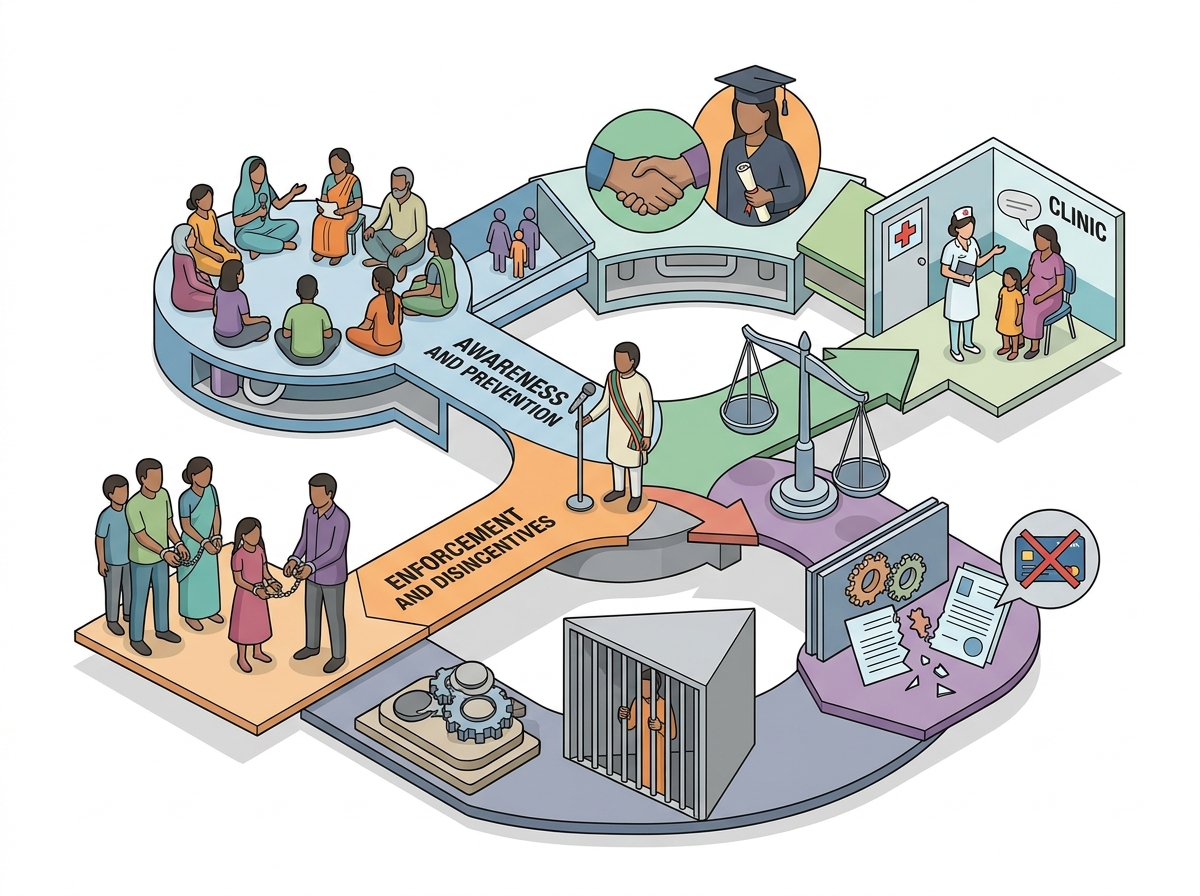
The Chief Minister of West Bengal recently announced a statewide crackdown on child marriage, including door-to-door identification drives, legal action under the Prohibition of Child Marriage Act, 2006, and the POCSO Act, and the withdrawal of welfare benefits for those involved. This initiative follows reports of nearly 60,000 institutional deliveries involving underage girls in the first half of 2026, highlighting the persistence of the practice despite legal prohibitions. The announcement underscores the role of state enforcement in addressing a deeply entrenched social issue, as well as the intersection of health, gender, and legal frameworks in governance.
Background
- Child marriage remains a significant social issue in India, with the National Family Health Survey (NFHS-5, 2019-21) reporting that 23.3% of women aged 20-24 were married before the age of 18, though this represents a decline from 26.8% in NFHS-4 (2015-16).
- The Prohibition of Child Marriage Act, 2006 (PCMA) is the primary legal instrument to prevent child marriages in India, replacing the earlier Child Marriage Restraint Act, 1929, and increasing the legal age of marriage for girls to 18 and for boys to 21.
- The Protection of Children from Sexual Offences (POCSO) Act, 2012, criminalises sexual intercourse with a girl below 18 years, which often accompanies child marriages, thereby providing an additional legal layer to address the issue.
- West Bengal has historically reported high rates of child marriage, with the state ranking among the top in institutional deliveries involving underage girls, as highlighted in the Chief Minister’s statement.
- Social reform movements, such as those led by Ishwar Chandra Vidyasagar in the 19th century, have historically advocated for the abolition of child marriage and the promotion of women’s education, reflecting the long-standing societal challenge.
What is child marriage and how is it addressed legally and institutionally in India?
- Child marriage is defined as a marriage where either of the parties is below the legal age of marriage, which is 18 years for girls and 21 years for boys under the Prohibition of Child Marriage Act, 2006 (PCMA).
- The PCMA prohibits the solemnisation of child marriages and provides for the annulment of such marriages upon the request of the child, with penalties for those who facilitate, solemnise, or promote such marriages, including parents, guardians, and religious officiants.
- The POCSO Act, 2012, criminalises sexual intercourse with a girl below 18 years, which is often linked to child marriages, thereby providing a complementary legal framework to address the sexual exploitation of minors.
- State governments are responsible for implementing the PCMA through district-level authorities, child welfare committees, and local governance bodies, including conducting surveys, awareness campaigns, and legal action.
- The Union government’s ‘Child Marriage Free India’ campaign, launched in 2021, aims to eliminate child marriage by 2030 through multi-stakeholder engagement, including state governments, civil society, and international partners.
- Institutional mechanisms such as the National Commission for Protection of Child Rights (NCPCR) and State Commissions for Protection of Child Rights (SCPCRs) monitor and report on child marriage cases, advocate for policy changes, and ensure compliance with legal provisions.
- The registration of marriages under the Hindu Marriage Act, 1955, or the Special Marriage Act, 1954, is mandatory in many states, and the absence of such registration can be used as evidence to identify child marriages during enforcement drives.
Key Features
| Feature | Significance |
|---|---|
| Prohibition of Child Marriage Act, 2006 | Primary legal instrument to criminalise child marriage in India, defining marriage age as 21 for males and 18 for females, with penalties for contravention. |
| POCSO Act, 2012 | Protection of Children from Sexual Offences Act provides stringent penalties for sexual crimes against minors, including those arising from child marriages. |
| Bharatiya Nyaya Sanhita, 2023 | Replaces the Indian Penal Code, retaining provisions on child marriage with enhanced penalties, including imprisonment up to two years and fine up to ₹1 lakh. |
| Door-to-door identification drives | Systematic community-level surveys to detect and document child marriages, ensuring compliance with statutory prohibitions. |
| Withdrawal of welfare benefits | Administrative measure to disincentivise child marriage by linking social security schemes to compliance with legal age of marriage. |
Why it Matters
Legal and Institutional
- Demonstrates the state’s commitment to enforcing central legislation (Prohibition of Child Marriage Act) through coordinated executive action.
- Highlights the role of local governance (door-to-door drives) in implementing national social policies at the grassroots level.
- Emphasises the integration of criminal law (POCSO, Bharatiya Nyaya Sanhita) with administrative measures to address child marriage holistically.
Social and Demographic
- Exposes persistent socio-cultural practices despite national legal frameworks, particularly in districts with high institutional deliveries to underage girls.
- Underscores the intersection of child marriage with maternal and child health outcomes, as evidenced by high rates of underage institutional deliveries.
- Reflects the historical continuity of reform movements, invoking Ishwar Chandra Vidyasagar’s 19th-century campaign against child marriage and for women’s education.
Administrative and Data Governance
- Raises questions about data sharing mechanisms between state and central agencies regarding child marriage and underage childbirths.
- Illustrates the use of administrative data (health department records) to inform policy enforcement and public communication.
- Demonstrates the state’s utilisation of welfare schemes as policy levers to deter socially harmful practices.
Challenges
1. Implementation Gaps in Grassroots Enforcement
- Child marriage is often informal and undocumented, making detection through door-to-door drives challenging without community cooperation.
- Cultural and familial pressures may impede reporting, necessitating sensitisation campaigns alongside enforcement.
- Legal literacy deficits among rural populations may lead to unintentional non-compliance, requiring sustained awareness initiatives.
UPSC Link: GS-II: Social Justice; Vulnerable Sections
2. Data Disparities and Inter-Agency Coordination
- Lack of standardised data sharing protocols between state health departments and central agencies hampers evidence-based policymaking.
- Discrepancies in reporting mechanisms (e.g., institutional vs. community-based data) may skew understanding of the problem’s magnitude.
- Need for a unified national database on child marriage to enable real-time monitoring and targeted interventions.
UPSC Link: GS-II: Governance; Transparency
3. Socio-Cultural Resistance to Legal Reforms
- Deep-rooted traditions and economic dependencies (e.g., dowry, early labour participation) may undermine the deterrent effect of legal penalties.
- Stigma associated with reporting child marriages can discourage victims and witnesses from coming forward, complicating enforcement.
- Balancing punitive measures with rehabilitation and support for affected minors remains a critical challenge.
UPSC Link: GS-I: Society; Social Empowerment
4. Resource Constraints in Public Health Systems
- High institutional deliveries to underage girls indicate systemic gaps in adolescent health services and family planning programmes.
- Limited capacity of local administration to conduct widespread door-to-door surveys without adequate staffing and logistical support.
- Need for integrated health, education, and social welfare interventions to address root causes of child marriage.
UPSC Link: GS-II: Health; Governance
5. Legal Ambiguities in Age Verification
- Proving age in rural areas without reliable birth records poses a significant hurdle in enforcement under the Prohibition of Child Marriage Act.
- Disputes over age documentation may lead to prolonged legal proceedings, delaying justice for victims.
- Requires strengthening of civil registration systems and adoption of scientific age determination methods.
UPSC Link: GS-II: Judiciary; Legal Framework
Challenges — UPSC Perspective
| Issue | Concern |
|---|---|
| Informal marriages | Undocumented unions escape detection, complicating enforcement of legal prohibitions. |
| Community non-cooperation | Fear of stigma or retaliation may deter reporting of child marriages by locals. |
| Age verification | Lack of reliable birth records in rural areas hinders proof of age for legal action. |
| Data fragmentation | Disparate reporting systems across states limit accurate assessment of child marriage prevalence. |
| Cultural norms | Traditional practices and economic dependencies sustain child marriage despite legal bans. |
| Rehabilitation gaps | Insufficient support systems for minors rescued from child marriages post-enforcement. |
Way Forward
- Strengthen inter-departmental coordination between health, women and child development, and local governance for integrated enforcement.
- Launch targeted awareness campaigns in high-prevalence districts to sensitise communities on legal consequences and support services.
- Establish a state-level task force with representatives from civil society, law enforcement, and health officials for real-time monitoring.
- Digitise civil registration systems to ensure accurate age verification and streamline data sharing with central agencies.
- Expand adolescent health programmes to include family planning, sex education, and livelihood support to reduce early marriage incentives.
- Develop standard operating procedures for rescue, rehabilitation, and legal recourse for minors affected by child marriages.
- Conduct periodic audits of institutional deliveries to underage girls to identify high-risk areas for focused intervention.
- Collaborate with educational institutions to delay school dropouts, particularly for girls, as a preventive measure against early marriage.
UPSC Value Addition
Keywords for Mains Answer-Writing
Child Marriage · Prohibition of Child Marriage Act, 2006 · Protection of Children from Sexual Offences (POCSO) Act, 2012 · Bharatiya Nyaya Sanhita, 2023 · Institutional deliveries by underage girls · Childbirth statistics in West Bengal · Door-to-door drives for identification of child marriages · Government welfare benefits and child marriage linkages · Constitutional provisions on child protection (Article 21, 39(f), Directive Principles of State Policy) · Social reform movements (Ishwar Chandra Vidyasagar) · Juvenile Justice (Care and Protection of Children) Act, 2015 · Women’s empowerment and gender justice · Intersectionality of poverty and child marriage · Data-driven policy interventions for child protection
Concept Flow
Cultural practices → Early marriage → Legal prohibition (Prohibition of Child Marriage Act) → Enforcement gaps → Institutional deliveries to underage girls → Health and social consequences → State-led crackdown → Door-to-door drives → Legal action under POCSO and Bharatiya Nyaya Sanhita → Withdrawal of welfare benefits → Deterrence and rehabilitation.
Prelims Practice Questions
Q1. Consider the following statements regarding the Prohibition of Child Marriage Act, 2006:
1. The Act defines a child as a person below the age of 18 years for both boys and girls.
2. The Act provides for the appointment of Child Marriage Prohibition Officers to prevent child marriages.
3. The Act mandates the registration of all marriages, including those solemnised before the Act came into force.
4. The Act imposes a punishment of up to two years imprisonment and a fine of up to ₹1 lakh for child marriage.
How many of the above statements are correct?
- Only one
- Only two
- Only three
- All four
Answer: All four — Statements 1, 2, and 4 are correct. Statement 3 is incorrect as the Act does not mandate retrospective registration of marriages solemnised before its enactment.
Q2. Assertion (A): The Protection of Children from Sexual Offences (POCSO) Act, 2012, provides for stringent punishment for sexual offences against children, including those committed in the context of child marriages.
Reason (R): The POCSO Act, 2012, is a standalone legislation that operates independently of the Prohibition of Child Marriage Act, 2006, and does not address the issue of child marriages directly.
Options:
A. Both A and R are true, and R is the correct explanation of A.
B. Both A and R are true, but R is not the correct explanation of A.
C. A is true, but R is false.
D. A is false, but R is true.
Answer: ? — Assertion (A) is true as the POCSO Act covers sexual offences against children, including those in child marriages. Reason (R) is false because the POCSO Act does address the vulnerability of children in child marriages, even if it does not explicitly prohibit child marriages.
Q3. Match the following legal provisions with their corresponding objectives:
Column I (Legal Provision)
A. Prohibition of Child Marriage Act, 2006
B. POCSO Act, 2012
C. Bharatiya Nyaya Sanhita, 2023
D. Juvenile Justice (Care and Protection of Children) Act, 2015
Column II (Objective)
1. To provide a comprehensive legal framework for the protection of children from sexual offences.
2. To prohibit child marriages and protect children from the consequences of early marriage.
3. To consolidate and amend laws relating to offences and their punishments, including provisions for child protection.
4. To provide care, protection, and rehabilitation of children in need of care and protection.
Options:
A-2, B-1, C-3, D-4
A-1, B-2, C-3, D-4
A-2, B-1, C-4, D-3
A-3, B-1, C-2, D-4
Answer: ? — Correct matches: A-2 (Prohibition of Child Marriage Act, 2006 prohibits child marriages), B-1 (POCSO Act protects children from sexual offences), C-3 (Bharatiya Nyaya Sanhita, 2023 consolidates penal laws including child protection), D-4 (Juvenile Justice Act provides care and protection for children).
Mains Practice Question
✍ Critically examine the legal and policy framework governing child marriage in India, with particular reference to the Prohibition of Child Marriage Act, 2006, the POCSO Act, 2012, and the Bharatiya Nyaya Sanhita, 2023. Also, assess the role of state-led enforcement mechanisms in addressing the persistence of child marriages, citing recent initiatives such as door-to-door drives in West Bengal. (15 Marks)
Approach: MODEL-ANSWER SKELETON:
1. **Legal Framework Overview (4 Marks)**
– Prohibition of Child Marriage Act, 2006: Key provisions (Sections 3, 4, 9, 11), definition of child, prohibition of child marriage, voidability of child marriages, and penalties (Section 9: up to 2 years imprisonment and ₹1 lakh fine).
– POCSO Act, 2012: Protection of children from sexual offences, including those in child marriages; stringent punishments (Sections 4, 6, 8, 10).
– Bharatiya Nyaya Sanhita, 2023: Consolidation of penal laws; specific provisions addressing child marriage and related offences (Sections 69, 70, 71).
– Constitutional provisions: Article 21 (right to live with dignity), Article 39(f) (Directive Principles of State Policy), and Article 15(3) (empowerment of women and children).
2. **State-Led Enforcement Mechanisms (4 Marks)**
– Role of Child Marriage Prohibition Officers (Section 16, Prohibition of Child Marriage Act, 2006).
– Door-to-door drives in West Bengal: Identification of underage marriages, issuance of show-cause notices, and withdrawal of welfare benefits.
– Data-driven interventions: Use of institutional delivery records to identify underage pregnancies and marriages.
– Challenges: Lack of uniform enforcement, socio-economic barriers, and resistance from communities.
3. **Recent Initiatives and Data (3 Marks)**
– West Bengal’s initiative: Door-to-door drives, arrests, and withdrawal of benefits; statistics on institutional deliveries by underage girls (e.g., 60,000 in 6 months).
– National data: NFHS-5 (2019-21) data on child marriage prevalence; states with high incidence (e.g., Bihar, West Bengal, Rajasthan).
– Role of social reformers: Ishwar Chandra Vidyasagar’s campaign against child marriage in the 19th century as a historical precedent.
4. **Critical Assessment and Way Forward (4 Marks)**
– Strengths: Legal provisions, state initiatives, and data-driven approaches.
– Weaknesses: Enforcement gaps, socio-economic determinants (poverty, lack of education), and cultural practices.
– Suggestions: Strengthening of Child Marriage Prohibition Officers, community awareness campaigns, and intersectoral coordination (health, education, and social welfare departments).
– Balanced view: Legal deterrence must be complemented by socio-economic empowerment and education to address root causes.
Source: The Indian Express
Generated by AanyaAi for educational purpose.
Related guides on our sites
- Best sociology optional coaching
- Best coaching for sociology optional
- Best sociology optional coaching online
- is sociology good optional

- गुजरात में स्थापित होंगे भारत के 12 सेमीकंडक्टर संयंत्रों में से 6, जानिए कैसे? - September 14, 2026
- Gujarat to host 6 of India’s 12 semiconductor facilities: Key UPSC insights - September 14, 2026
- डब्ल्यूपीआई मुद्रास्फीति अगस्त में बढ़कर 9.92% हुई: मुख्य कारण क्या हैं? - September 14, 2026

No Comments