


12 Aug Why Road Accident Death Data Varies: Gadkari Explains to Rajya Sabha
✎ The discrepancies in road accident death figures across government reports stem from differences in reporting methodologies, with the eDAR portal introduced to harmonise and standardise data collection across states and Union…
Subject Relevance — Where This Topic Fits
- GS Paper III — Infrastructure: Energy, Ports, Roads, Airports, Railways, etc. | GS Paper III — Science and Technology — Developments and their Applications and Effects in Everyday Life
- Prelims: Road Accidents in India report, Accidental Deaths and Suicides in India (ADSI), Crime in India report, Bharatiya Nyaya Sanhita (BNS), Electronic Detailed Accident Report (eDAR) portal, VAHAN, Sarathi, PM Gati Shakti, NHAI Data Lake, National Health Authority (NHA), State Crime Records Bureau (SCRB), Indian Penal Code (IPC)
- Essay: The Role of Data Integrity in Governance: Lessons from Road Safety Statistics
Quick Revision: The discrepancies in road accident death figures across government reports stem from differences in reporting methodologies, with the eDAR portal introduced to harmonise and standardise data collection across states and Union Territories.
Why is this in the news?
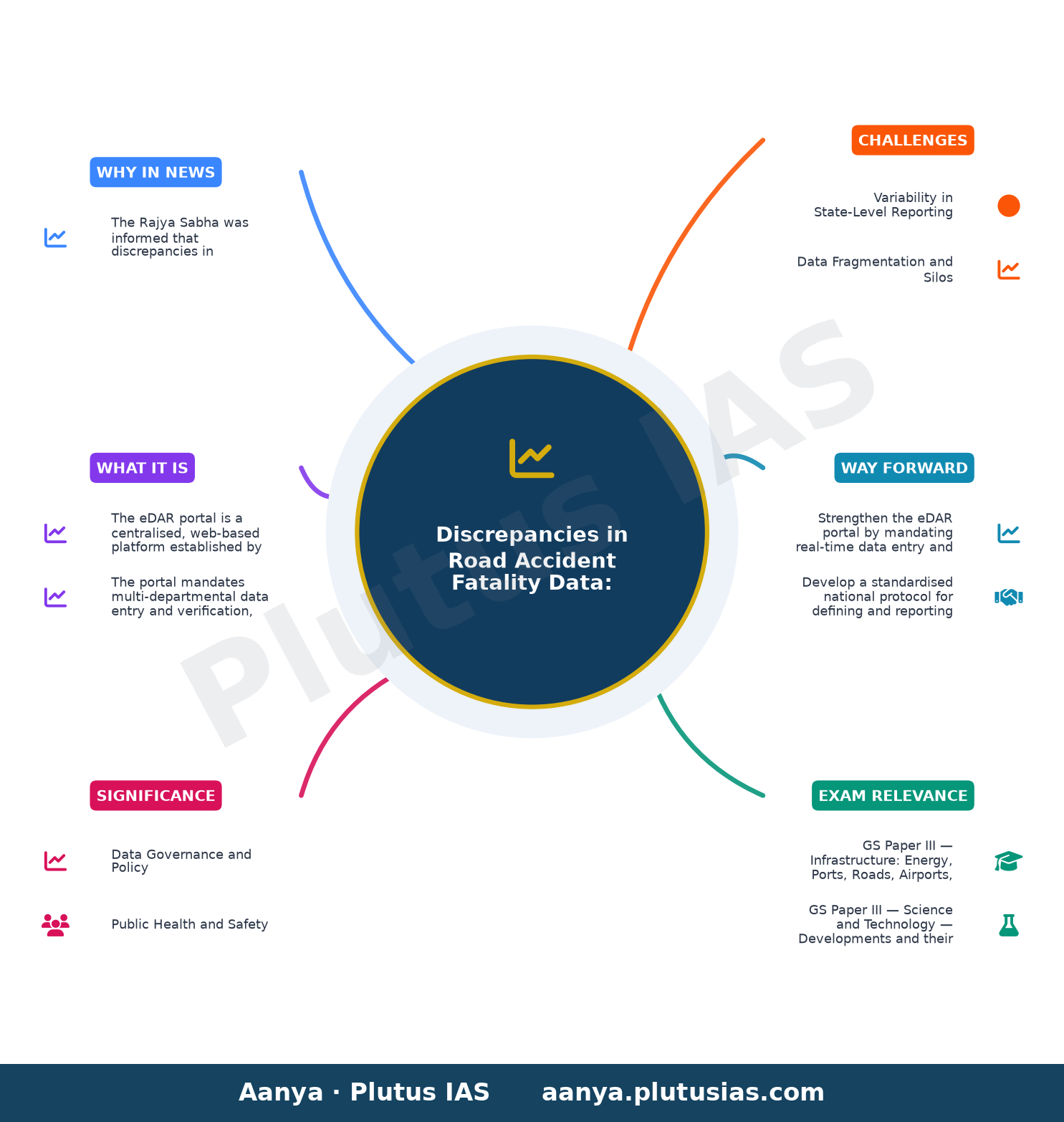
The Rajya Sabha was informed that discrepancies in official road accident death figures across government reports—such as the Ministry of Road Transport and Highways’ (MoRTH) ‘Road Accidents in India’, the National Crime Records Bureau’s (NCRB) ‘Accidental Deaths and Suicides in India’, and the ‘Crime in India’ report—arise from methodological variations in state and Union Territory reporting. The Union Minister for Road Transport and Highways highlighted the need for harmonised data collection and introduced the Electronic Detailed Accident Report (eDAR) portal as a centralised solution to improve data consistency and reliability.
Background
- The Constitution of India allocates the subject of ‘roads and road transport’ to the Concurrent List, enabling both the Union and State Governments to legislate and administer road safety measures.
- Road safety is a critical public health and governance challenge, with India accounting for approximately 11% of global road traffic fatalities, as per WHO estimates.
- The Ministry of Road Transport and Highways (MoRTH) publishes annual reports on road accidents, while the National Crime Records Bureau (NCRB) compiles data under the ‘Accidental Deaths and Suicides in India’ and ‘Crime in India’ reports.
- The ‘Crime in India’ report records only those road accident deaths that involve penal violations under the Indian Penal Code (IPC) or the Bharatiya Nyaya Sanhita (BNS), leading to narrower coverage compared to other datasets.
- The eDAR portal integrates with multiple national databases, including VAHAN (vehicle registration), Sarathi (driving licences), PM Gati Shakti (logistics infrastructure), NHAI’s Data Lake, and the National Health Authority’s Transaction Management System.
What is the Electronic Detailed Accident Report (eDAR) portal and its role in road safety data management?
- The eDAR portal is a centralised, web-based platform established by MoRTH to standardise the reporting and analysis of road accident data across India.
- The portal mandates multi-departmental data entry and verification, involving police, transport, health departments, road-owning agencies, and insurance companies to ensure accuracy and completeness.
- Data collected through eDAR includes details such as accident location, time, vehicle involved, casualties, and cause of the accident, enabling evidence-based policymaking.
- The portal is integrated with key national systems—VAHAN (vehicle registration), Sarathi (driving licences), PM Gati Shakti (logistics infrastructure), NHAI’s Data Lake, and NHA’s Transaction Management System—to facilitate seamless data exchange and analysis.
- eDAR aims to address discrepancies in road accident data by enforcing standardised reporting formats and reducing reliance on state-specific methodologies.
- The portal supports real-time data entry and analysis, which is critical for identifying high-risk accident zones and implementing targeted road safety interventions.
Key Features
| Feature | Significance |
|---|---|
| Electronic Detailed Accident Report (eDAR) portal | Centralised digital repository for road accident data, integrating inputs from police, transport, health departments, and other agencies to ensure standardised reporting. |
| VAHAN and Sarathi databases | Vehicle and driver registration systems linked to eDAR, enabling traceability of accident-related vehicles and drivers for accurate data compilation. |
| PM Gati Shakti and NHAI Data Lake integration | Provides spatial and infrastructure context to accidents, aiding in analysis of road design, traffic density, and accident hotspots. |
| National Health Authority’s Transaction Management System | Captures hospital-reported road injury data, complementing police records to reduce underreporting of non-fatal accidents. |
| State Crime Records Bureaus (SCRB) | Primary source for Crime in India report; records accidents involving penal law violations, leading to narrower coverage compared to broader datasets. |
Why it Matters
Data Governance and Policy
- Highlights the critical role of standardised data collection in formulating evidence-based road safety policies and targeted interventions.
- Demonstrates the need for harmonised reporting frameworks across states and Union Territories to ensure comparability and reliability of accident statistics.
- Emphasises the integration of multi-departmental data systems (transport, health, police) to create a holistic view of road safety challenges.
Public Health and Safety
- Underreported accidents distort the true burden of road injuries, impeding effective public health planning and emergency response strategies.
- Accurate fatality data is essential for evaluating the impact of road safety measures such as speed limits, helmet laws, and vehicle safety standards.
- Non-penal accidents (e.g., single-vehicle crashes) are often excluded from IPC/BNS-based datasets, leading to gaps in injury surveillance.
Institutional Coordination
- Illustrates the necessity of inter-departmental and inter-agency collaboration to address systemic gaps in data reporting and verification.
- Showcases the role of centralised platforms like eDAR in bridging institutional silos and enabling real-time data sharing.
- Underscores the importance of capacity-building in state agencies to adopt uniform reporting methodologies.
Legal and Administrative Framework
- Differentiates between penal and non-penal road accidents, clarifying the scope and limitations of datasets like Crime in India.
- Reveals administrative challenges in aligning state-level reporting practices with national standards.
- Highlights the need for periodic audits and validation mechanisms to ensure data integrity across reporting agencies.
Challenges
1. Variability in State-Level Reporting
- Differences in data collection methodologies across states and Union Territories lead to inconsistencies in reported accident figures.
- Lack of standardised definitions for road accidents, injuries, and fatalities complicates cross-jurisdictional comparisons.
- Underreporting of non-fatal accidents due to incomplete police records or absence of hospital-based data linkages.
UPSC Link: GS-II: Governance, Transparency & Accountability
2. Data Fragmentation and Silos
- Road accident data is scattered across multiple agencies (police, transport, health, insurance), hindering comprehensive analysis.
- Delayed or incomplete data entry into systems like eDAR reduces the utility of real-time decision-making tools.
- Absence of a unified legal framework mandating standardised reporting across all states and Union Territories.
UPSC Link: GS-II: e-Governance, Digital Infrastructure
3. Underreporting of Non-Penal Accidents
- Accidents not involving penal law violations (e.g., single-vehicle crashes) are often excluded from datasets like Crime in India.
- This exclusion creates a skewed perception of road safety challenges, particularly in rural and semi-urban areas.
- Hospital-based injury surveillance systems are not uniformly integrated with police records, leading to gaps in data.
UPSC Link: GS-II: Public Health, Data Systems
4. Capacity and Resource Constraints
- State Crime Records Bureaus and police departments may lack the technical and human resources to adopt advanced reporting systems.
- Training gaps among officials in data entry, verification, and analysis of road accident reports.
- Limited inter-agency coordination in resource-constrained states, particularly in the northeastern and hilly regions.
UPSC Link: GS-II: Governance, Human Resource Development
5. Legal and Procedural Ambiguities
- Ambiguities in the definition of ‘road accident’ across legal frameworks (e.g., IPC vs. Motor Vehicles Act) lead to inconsistent reporting.
- Lack of mandatory provisions for hospitals to report road injuries to police or central databases.
- Delays in updating legal provisions (e.g., transition from IPC to BNS) may temporarily disrupt data consistency.
UPSC Link: GS-II: Legal Framework, Policy Implementation
Challenges — UPSC Perspective
| Issue | Concern |
|---|---|
| Inconsistent state-level methodologies | Leads to disparities in reported accident figures, complicating national-level analysis. |
| Fragmented data systems | Prevents real-time tracking of road safety trends and hampers targeted interventions. |
| Exclusion of non-penal accidents | Results in underestimation of the true burden of road injuries, particularly in rural areas. |
| Resource and capacity gaps | Undermines the ability of states to adopt and maintain standardised reporting systems. |
| Legal ambiguities in definitions | Creates confusion in data classification, affecting the reliability of official statistics. |
| Delayed integration of hospital data | Reduces the comprehensiveness of injury surveillance systems. |
Way Forward
- Strengthen the eDAR portal by mandating real-time data entry and verification across all states and Union Territories.
- Develop a standardised national protocol for defining and reporting road accidents, injuries, and fatalities to ensure consistency.
- Expand the integration of hospital-based injury surveillance systems with police records to capture non-penal accidents.
- Conduct periodic audits and validation exercises to assess the accuracy and completeness of road accident data.
- Enhance inter-departmental coordination through regular meetings between transport, health, police, and road-owning agencies.
- Provide capacity-building programmes for state officials on data management, reporting standards, and eDAR utilisation.
- Legislate mandatory reporting of road injuries by hospitals to central databases, aligning with the Motor Vehicles Act.
- Promote public awareness campaigns to encourage reporting of all road accidents, including minor incidents, to improve data completeness.
UPSC Value Addition
Keywords for Mains Answer-Writing
Road safety governance · Electronic Detailed Accident Report (eDAR) portal · National Crime Records Bureau (NCRB) · Ministry of Road Transport and Highways (MoRTH) · Bharatiya Nyaya Sanhita (BNS) · Indian Penal Code (IPC) · Data harmonisation in governance · State Crime Records Bureaus (SCRB) · Road accident reporting methodologies · VAHAN and SARATHI databases · PM Gati Shakti initiative · National Health Authority (NHA)
Concept Flow
Divergent state-level reporting methodologies → Inconsistent accident data across government reports → Gaps in national road safety assessment → Need for standardised data collection → Adoption of eDAR portal and multi-agency integration → Enhanced data accuracy and policy formulation → Improved road safety outcomes.
Prelims Practice Questions
Q1. Consider the following statements regarding road accident death reporting in India:
1. The Electronic Detailed Accident Report (eDAR) portal is a centralised repository for road accident data.
2. The Crime in India report records all road accident deaths, including those not involving penal law violations.
3. The NCRB’s Accidental Deaths and Suicides in India report includes deaths due to road accidents.
4. The Bharatiya Nyaya Sanhita (BNS) replaces the Indian Penal Code (IPC) for recording road accident deaths.
How many of the above statements are correct?
- Only one
- Only two
- Only three
- All four
Answer: Only three — Statement 1 is correct: eDAR is a centralised repository. Statement 2 is incorrect: Crime in India records only deaths under penal law violations. Statement 3 is correct: NCRB’s report includes road accident deaths. Statement 4 is correct: BNS replaces IPC for penal provisions.
Q2. Assertion (A): The variation in road accident death figures across government reports stems from differences in state-level reporting methodologies.
Reason (R): The Crime in India report records only deaths registered under IPC or BNS provisions, excluding non-penal cases.
Options:
A. Both A and R are true, and R is the correct explanation of A.
B. Both A and R are true, but R is not the correct explanation of A.
C. A is true, but R is false.
D. A is false, but R is true.
- A
- B
- C
- D
Answer: A — Both A and R are true. R correctly explains why figures vary: non-penal cases are excluded from Crime in India, while other reports include them.
Q3. Match the following government reports with their respective coverage of road accident deaths:
Column I (Report) | Column II (Coverage)
1. Road Accidents in India (MoRTH) | A. Only deaths under IPC/BNS provisions
2. Accidental Deaths and Suicides in India (NCRB) | B. All road accident deaths, including non-penal cases
3. Crime in India (NCRB) | C. Deaths due to negligence relating to road accidents
Options:
A. 1-B, 2-C, 3-A
B. 1-C, 2-B, 3-A
C. 1-B, 2-A, 3-C
D. 1-A, 2-B, 3-C
- A
- B
- C
- D
Answer: A — 1-B: MoRTH’s report includes all road accident deaths. 2-C: NCRB’s Accidental Deaths report includes deaths due to negligence. 3-A: Crime in India records only deaths under penal law provisions.
Mains Practice Question
✍ The divergence in official road accident death figures across government reports undermines public trust in governance data. Critically examine the institutional and methodological reasons for these discrepancies, and suggest measures to enhance data harmonisation and credibility. (15 Marks)
Approach: MODEL-ANSWER SKELETON:
1. **Institutional Reasons**:
– **Divergent Mandates**: MoRTH’s ‘Road Accidents in India’ captures all road deaths, while NCRB’s ‘Crime in India’ records only deaths under IPC/BNS (Sections 279, 304A, etc.).
– **State-Level Variations**: Reporting methods differ across State Crime Records Bureaus (SCRB) and police departments, leading to inconsistencies.
– **Penal vs. Non-Penal Cases**: Non-penal road deaths (e.g., mechanical failure) are excluded from ‘Crime in India’ but included in MoRTH/NCRB’s accidental deaths report.
2. **Methodological Challenges**:
– **Data Sources**: MoRTH relies on police FIRs, transport departments, and health records; NCRB aggregates state-reported data.
– **Lag in Reporting**: Delays in state-level data compilation affect timeliness and accuracy.
– **Technological Gaps**: While eDAR (Electronic Detailed Accident Report) portal integrates VAHAN, SARATHI, and PM Gati Shakti, its adoption remains uneven across states.
3. **Consequences**:
– **Policy Distortions**: Inaccurate data hampers targeted interventions (e.g., NHAI’s Data Lake for highway safety).
– **Public Perception**: Erosion of trust in official statistics, complicating evidence-based policymaking.
4. **Reforms and Way Forward**:
– **Standardisation**: Adopt a unified reporting framework under eDAR, mandating real-time data entry by police, transport, and health departments.
– **Capacity Building**: Train SCRB officials and police personnel on eDAR protocols and penal code provisions.
– **Third-Party Audits**: Introduce independent verification mechanisms (e.g., National Health Authority’s Transaction Management System) to cross-check figures.
– **Legal Clarity**: Amend the Motor Vehicles (Amendment) Act, 2019, to explicitly define reporting obligations for states under Section 215 (Accident Reporting).
5. **Comparative Perspective**:
– Reference global models (e.g., EU’s CARE database) where harmonised reporting has improved road safety outcomes.
Balance: Acknowledge government’s efforts (eDAR integration) while critiquing systemic gaps (state-level resistance, technological disparities). Conclude with a balanced view on institutional reforms.
Source: Hindustan Times
Generated by AanyaAi for educational purpose.

- KWML’s Feasibility Reports for Water Metro in 18 Cities: UPSC & PCS Insights - October 3, 2026
- ओडिशा में वन्यजीव अनुसंधान अनुदान कार्यक्रम शुरू, सिमिलिपाल में 300 कैमरे और बढ़ेंगे - October 3, 2026
- India Summons Pakistan High Commission Official Over Violation - October 3, 2026

No Comments