


12 Dec Yemen Civil War Enters New Phase as Southern Forces Advance
This article covers “Daily Current Affairs” and From Yemen Civil War Enters New Phase as Southern Forces Advance
SYLLABUS MAPPING
GS – 2 International Relations – Yemen Civil War Enters New Phase as Southern Forces Advance
FOR PRELIMS
Yemen’s civil war and its impact on regional peace.
FOR MAINS
Middle East Conflicts and Global Stability: A Case Study of Yemen
Why in the News?
Yemen’s long-running civil war has entered a new and more dangerous phase as rival factions intensify military clashes and shift territorial control. Recently, the UAE-backed Southern Transitional Council (STC) has made significant gains in southern Yemen, capturing key provinces and oil-rich areas, raising the possibility of a southern bid for independence and further fragmenting the country’s political landscape. Meanwhile, the internationally recognised government faces diminishing authority and Saudi–UAE disagreements over Yemen policy have complicated efforts at a unified counter-insurgency strategy. The conflict’s escalation has renewed humanitarian concerns, disrupted regional security, and attracted international condemnation, including from the United Nations, making Yemen a prominent current affairs issue.
Yemen Civil War Enters New Phase as Southern Forces Advance
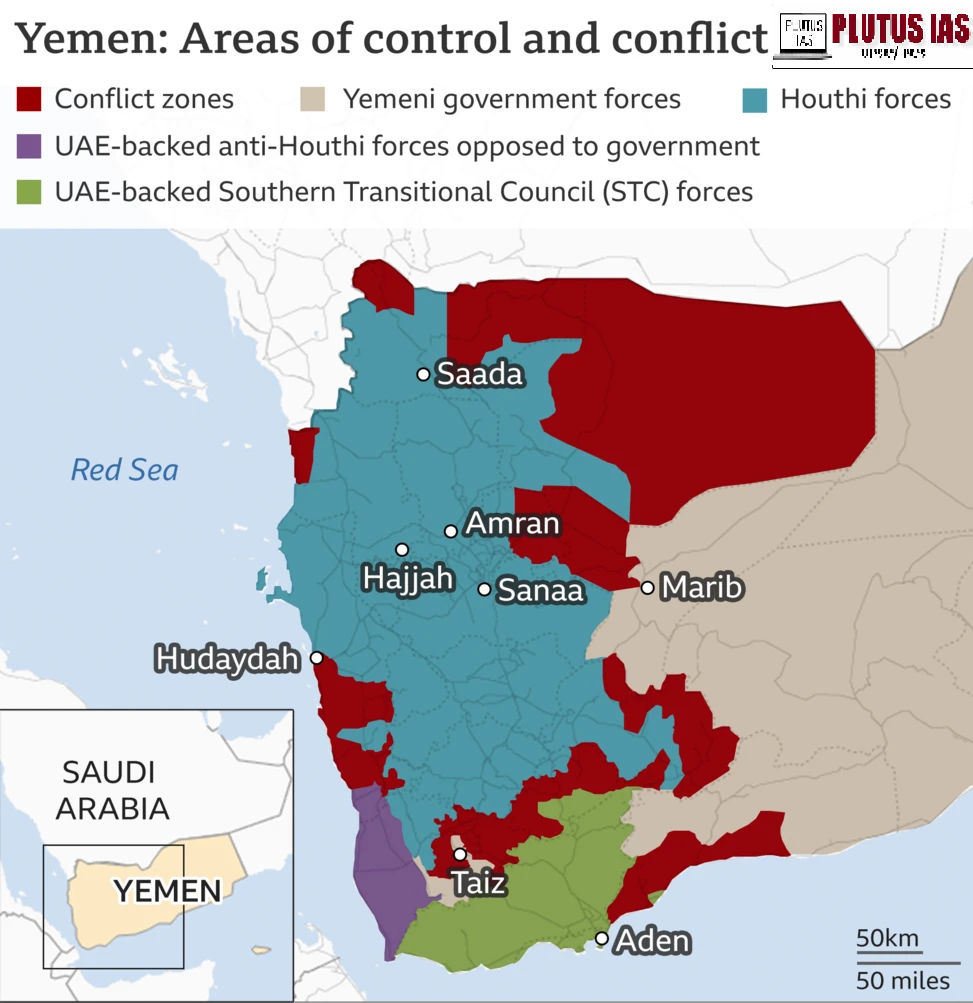
Yemen has been engulfed in civil war since 2014–15, when the Houthi movement seized the capital Sanaa and displaced the internationally recognised government. What began as a political power struggle has expanded into a multi-layered conflict involving regional powers, separatist factions, tribal interests, and humanitarian crises. As of 2025, the conflict has entered a new and dangerous phase, with the rise of the UAE-backed Southern Transitional Council (STC) and renewed factional clashes.
Background of the Conflict
2014: Houthis capture Sanaa.
2015: Saudi-led coalition intervenes to restore government.
2018–22: Stalemate persists; humanitarian situation worsens.
2022–24: Fragile ceasefires fail to produce a political settlement.
2025: STC’s renewed offensive in southern Yemen reignites tensions.
Key Actors in the Conflict
| Actor | Territorial Control / Role | External Support | Objectives / Notes |
|---|---|---|---|
| Houthis (Ansar Allah) | Control northern Yemen including Sanaa | Iran | Seek political dominance and recognition as the legitimate government |
| Internationally Recognised Government / Presidential Leadership Council (PLC) | Limited control in southern & eastern Yemen | Saudi Arabia | Restore authority; weakened by internal divisions |
| Southern Transitional Council (STC) | Major presence in southern Yemen; expanded control in 2025 | UAE | Advocates revival of independent South Yemen |
| Saudi Arabia (External Actor) | Supports PLC; secures Yemen–Saudi border | — | Contain Houthi influence; ensure regional stability |
| UAE (External Actor) | Supports STC militarily and politically | — | Secure ports, trade routes; influence southern Yemen politics |
| Iran (External Actor) | Backs the Houthis | — | Expand regional influence; counter Saudi–UAE bloc |
| UN & International NGOs | Mediation and humanitarian operations | Global community | Facilitate ceasefires; provide aid and conflict resolution mechanisms |
Causes and Drivers of the Current Escalation
a) Power Fragmentation: Competing authorities in the north (Houthis), south (STC), and internationally recognised government create a vacuum of unified leadership.
b) Regional Rivalries: Saudi–UAE tensions have resurfaced as they back rival factions, weakening prospects for peace.
c) Quest for Economic Control: Oil-rich provinces in the south and east have become strategic targets for both the government and the STC.
d) Ceasefire Failures: Repeated inability to secure lasting ceasefires has allowed each faction to consolidate militarily.
Recent Developments (2024–25)
a) STC Territorial Gains
Captured major parts of Hadramaut and Mahra.
Aimed at controlling ports, borders, and oil fields.
Government forces retreat from several areas.
b) Rising Gulf Friction
Saudi and UAE tensions deepen over control of Yemen’s south.
This undermines the unity of the anti-Houthi coalition.
c) Houthi Assertiveness
Continued missile and drone capabilities.
Clashes with government forces persist around Marib and Taiz.
d) UN Concerns
Humanitarian agencies face operational restrictions.
Protection of civilians remains a key issue.
Humanitarian Crisis (World’s Worst)
a) Human Suffering: Over 23 million in need of aid. Mass displacement, malnutrition, and disease outbreaks.
b) Economic Collapse: Currency decline, salary arrears, and disrupted public services.
c) Food Insecurity: Dependence on imports disrupted due to conflict. Risk of famine remains high.
Regional and Global Implications
a) Red Sea Security: Proximity to the Bab-el-Mandeb Strait threatens global shipping routes.
b) Geopolitical Rivalries: Iran–Saudi competition plays out through proxies. UAE’s assertiveness reshapes Gulf politics.
c) Terrorism Risks: Fragmentation allows AQAP and ISIS affiliates to exploit vacuums.
d) Global Energy Markets: Instability threatens regional oil transit and production.
Impact on India
a) Diaspora and Evacuation Risks: Large Indian community has been evacuated previously (Operation Raahat, 2015). Renewed violence keeps evacuation concerns alive.
b) Energy Security: Red Sea instability affects India’s trade routes and oil shipments.
c) Strategic Balancing: India maintains ties with Saudi Arabia, UAE, and Iran — all engaged indirectly in Yemen.
d) Humanitarian Role: India consistently supports UN aid and diplomatic initiatives.
Challenges to Peace
1. Deep Ideological and Political Divisions: The major factions – Houthis, PLC, and STC – hold opposing ideological positions and competing claims to legitimacy, making consensus difficult.
2. Conflicting Visions for Yemen’s Future: Different groups disagree on whether Yemen should remain unified or be partitioned into North and South, as demanded by the STC.
3. Regional Power Rivalries: Saudi Arabia, Iran, and the UAE back rival factions, turning Yemen into a battleground for regional influence and limiting chances of a unified peace effort.
4. Weak State Institutions: Years of conflict have eroded Yemen’s governance structures, judiciary, and security forces, preventing effective implementation of peace agreements.
5. Fragmentation of Armed Groups: Multiple militias, tribal forces, and local commanders operate independently, making ceasefire enforcement extremely challenging.
6. Lack of Inclusive Political Dialogue: There is no credible, broad-based negotiation platform that includes all stakeholders, including women, youth, and tribal groups, limiting the scope for sustainable peace.
Way Forward
1. Inclusive Political Negotiations: Dialogue must involve Houthis, government, STC, tribal factions, and women/youth representatives.
2. Regional Consensus: Saudi Arabia, UAE, and Iran must align minimally on de-escalation.
3. Strengthening UN Mediation: Enhanced mandate and pressure mechanisms for ceasefire enforcement.
4. Humanitarian Corridors: Guarantee safe passage for food, medicine, and UN personnel.
5. Rebuilding Institutions: Support for governance, judiciary, and local administrations to reduce power vacuums.
6. International Support for Reconstruction: Long-term assistance needed for infrastructure, economy, and social stabilisation.
Conclusion
Yemen’s civil war has evolved from a two-party conflict into a fragmented power struggle with deep regional dimensions. The recent rise of the STC and worsening Saudi-UAE tensions threaten a new phase of instability. A durable peace requires inclusive negotiations, regional cooperation, and strong humanitarian commitments. Without coordinated international and regional effort, Yemen’s crisis may deepen into permanent state fragmentation.
Prelims question:
Q. Consider the following pairs:
| Actor | Supporting Country |
|---|---|
| 1. Houthis | Iran |
| 2. Southern Transitional Council (STC) | UAE |
| 3. Presidential Leadership Council (PLC) | Saudi Arabia |
Which of the pairs given above are correctly matched?
a) 1 and 2 only
b) 2 and 3 only
c) 1, 2 and 3
d) None of the above
Answer: C
Mains Question
Q. Discuss the key actors involved in the Yemen Civil War and explain how their interests shape the conflict ? (250 words)

- PRAGATI: A Decade of Cooperative, Outcome-Driven Governance - January 15, 2026
- Iran’s Large-Scale Protests: Political Stability, Public Dissent and Regional Implications - January 14, 2026
- India–Oman CEPA: A Strategic Trade Pact for Jobs, Exports and Regional Integration - January 10, 2026

No Comments