


08 Aug YSRCP Slams AP Govt Over Krishna Water Release Policy for Farmers
✎ The Krishna River basin’s governance is governed by the KWDT awards, but inter-state disputes, delayed lift irrigation schemes, and policy contradictions between drinking water and irrigation priorities have intensified agrarian…
Subject Relevance — Where This Topic Fits
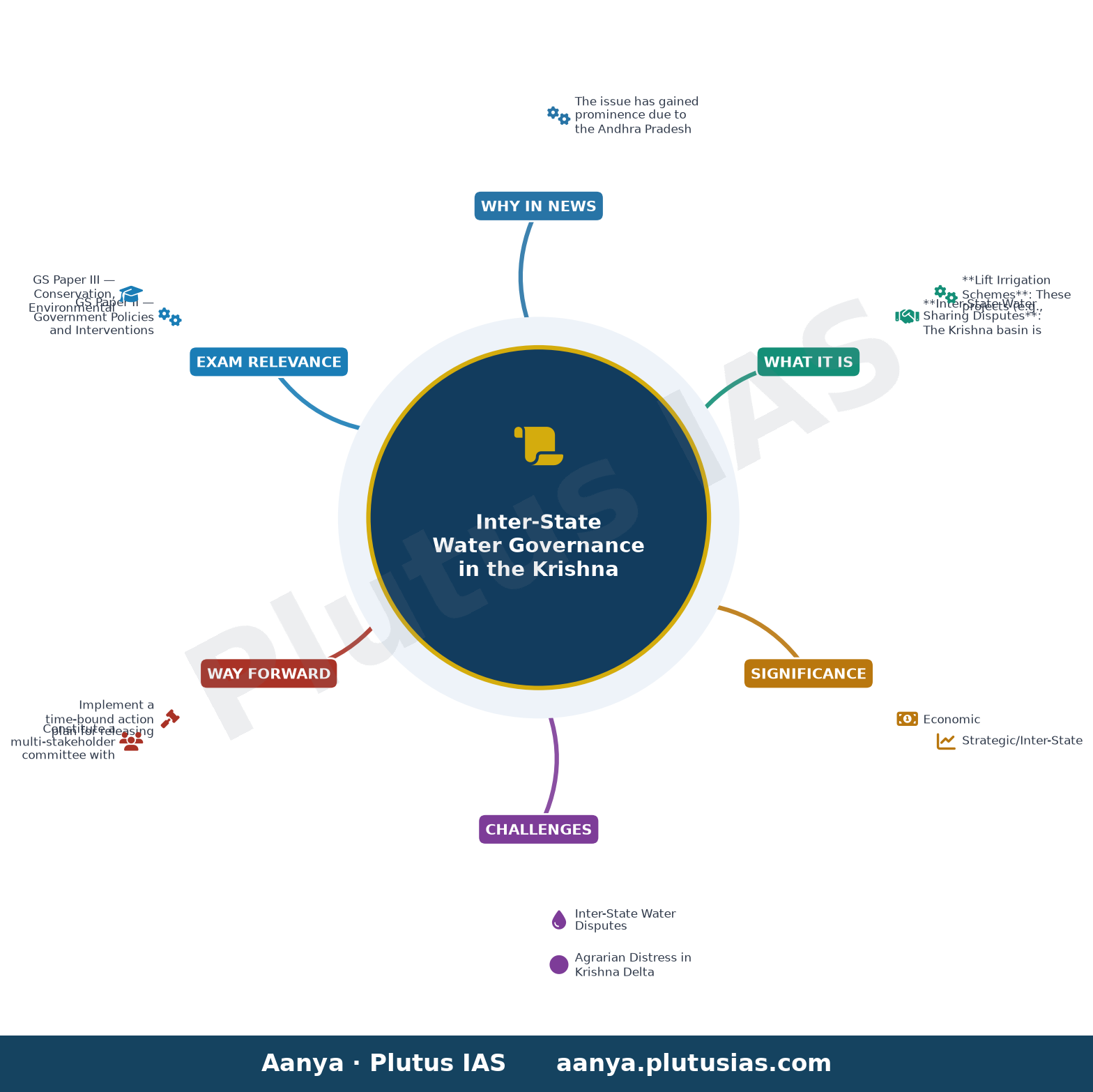
- GS Paper II — Government Policies and Interventions for Development in various sectors and Issues arising out of their Design and Implementation | GS Paper III — Conservation, Environmental Pollution and Degradation, Environmental Impact Assessment | GS Paper III — Water Resources and their Management
- Prelims: Krishna River Basin, Inter-State Water Disputes, Ayacut, Minimum Drawdown Level (MDL), Lift Irrigation Schemes, Kharif Season, Paddy Cultivation, TMC (Thousand Million Cubic Feet), Cusecs, Pulichintala Project, Pattiseema Project, Handri-Neeva Lift Scheme, Muchumarri Lift Scheme
- Essay: Federalism and Natural Resource Management: Balancing Regional Equity and National Development
Quick Revision: The Krishna River basin’s governance is governed by the KWDT awards, but inter-state disputes, delayed lift irrigation schemes, and policy contradictions between drinking water and irrigation priorities have intensified agrarian distress in the delta region.
Why is this in the news?
The issue has gained prominence due to the Andhra Pradesh government’s controversial advisory against paddy cultivation in the Krishna delta during the kharif season, despite substantial water releases from upstream reservoirs. The YSRCP’s criticism highlights systemic failures in inter-state water governance, delayed utilisation of available resources, and the agrarian distress resulting from policy contradictions in the Krishna basin, which is a critical agricultural and ecological zone shared by Andhra Pradesh, Telangana, and Karnataka.
Background
- Its basin supports agriculture, drinking water supply, and industrial needs across these states.
- The Krishna Water Disputes Tribunal (KWDT-I, 1976) and its subsequent awards (KWDT-II, 2010) allocated water shares among the riparian states, though disputes persist over utilisation and implementation.
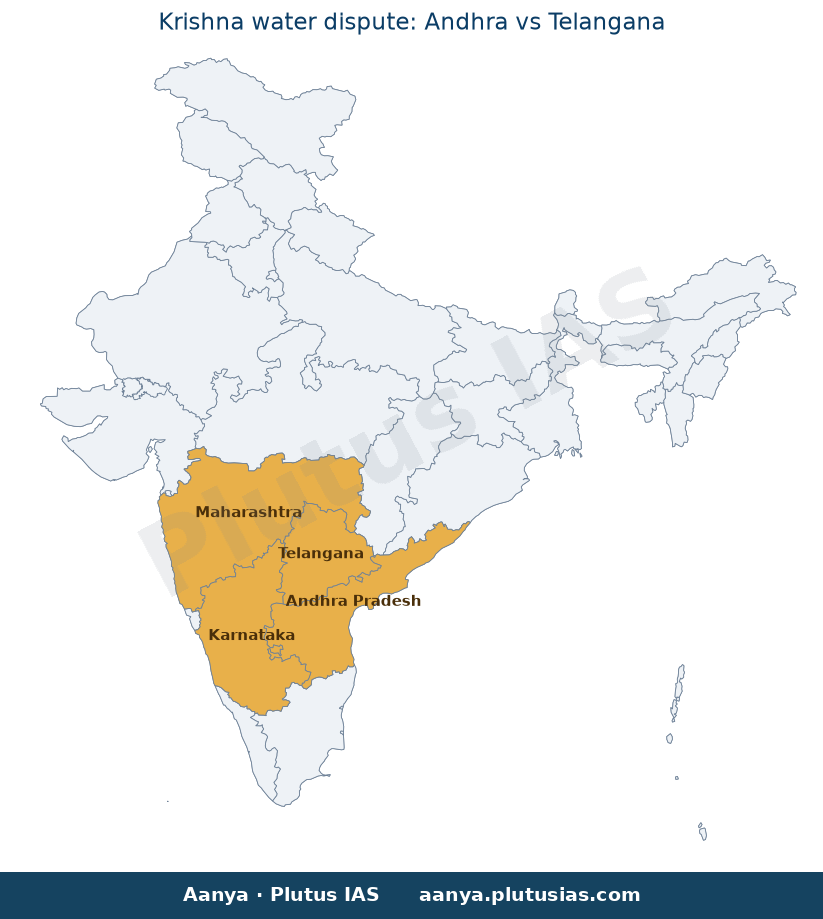
- Andhra Pradesh and Telangana have historically contested water-sharing agreements, particularly post-bifurcation in 2014, with both states developing independent irrigation projects to secure water for their regions.
- The Pulichintala and Pattiseema projects in Andhra Pradesh were constructed to stabilise water supply to the Krishna delta, a region critical for paddy cultivation, aquaculture, and sugarcane farming.
- Telangana has aggressively pursued lift irrigation schemes (e.g., Bhima-I, Bhima-II, Nettempadu, Koilsagar, Kalwakurthy) to utilise its allocated share of Krishna waters, while Andhra Pradesh has faced delays in operationalising similar schemes like Handri-Neeva and Muchumarri.
- The kharif season (June–October) is pivotal for paddy cultivation in the delta, with the crop requiring substantial water inputs, making water governance a socio-economic and political flashpoint.
What are the key water governance issues in the Krishna Basin?
- **Inter-State Water Sharing Disputes**: The Krishna basin is governed by the Krishna Water Disputes Tribunal (KWDT) awards, but states often interpret allocations differently, leading to conflicts over utilisation priorities (e.g., irrigation vs. drinking water).
- **Lift Irrigation Schemes**: These projects (e.g., Handri-Neeva, Muchumarri in Andhra Pradesh; Bhima-I, Nettempadu in Telangana) are designed to lift water from the Krishna to drought-prone areas, but their operationalisation is delayed by bureaucratic, financial, or political hurdles.
- **Minimum Drawdown Level (MDL)**: Reservoirs like Srisailam must maintain a minimum water level to ensure ecological balance and future water availability. Excessive releases or delays in utilisation can violate MDL norms, as alleged in the case of Srisailam.
- **Agrarian Dependence on Paddy**: The Krishna delta’s 10.5 lakh acres of ayacut (irrigated land) is primarily dedicated to paddy, sugarcane, and aquaculture. Paddy alone consumes ~5,000–6,000 cubic metres of water per hectare per season, making water availability a make-or-break factor for farmers.
- **Policy Contradictions**: The Andhra Pradesh government’s advisory against paddy cultivation in the kharif season, despite available water in Pulichintala (29 tmc ft.), reflects a failure to align water management with agricultural realities, exacerbating tenant farmer distress.
- **Drinking Water vs. Irrigation Priorities**: The Pulichintala project’s water is being reserved for drinking water until June 2027, raising questions about the state’s ability to balance competing demands without adequate planning or alternative arrangements.
- **Upstream vs. Downstream Dynamics**: Telangana’s proactive utilisation of Krishna waters through lift schemes contrasts with Andhra Pradesh’s delays, highlighting asymmetries in water governance and the need for coordinated basin-wide management.
- **Ecological and Economic Trade-offs**: Excessive water releases for irrigation can deplete reservoirs, while prolonged restrictions can trigger agrarian crises. Sustainable water governance requires integrating hydrological, agricultural, and ecological considerations.
Key Features
| Feature | Significance |
|---|---|
| Krishna River Basin | A transboundary river basin shared by Maharashtra, Karnataka, Telangana, and Andhra Pradesh, critical for irrigation, drinking water, and hydroelectric power generation in South India. |
| Jurala Project | A major irrigation project on the Krishna River in Telangana, enabling controlled water releases for downstream states and supporting multi-purpose uses. |
| Srisailam Reservoir | A key hydroelectric and irrigation reservoir on the Krishna River, with a minimum drawdown level (MDL) determining operational water releases for downstream regions. |
| Pulichintala Project | A multi-purpose project in Andhra Pradesh designed to stabilise the Krishna delta by storing and regulating water flows for irrigation and drinking water supply. |
| Handri-Neeva and Muchumarri Lift Schemes | Critical irrigation projects in Andhra Pradesh that lift water from the Krishna River basin to drought-prone regions, ensuring agricultural productivity in non-delta areas. |
| Pattiseema Project | A lift irrigation scheme in Andhra Pradesh that diverts Krishna waters to the Krishna delta, enhancing irrigation security for delta farmers. |
Why it Matters
Economic
- The Krishna delta is a major agricultural hub, with paddy, sugarcane, and aquaculture contributing significantly to Andhra Pradesh’s rural economy and food security.
- Delay in water releases to the delta threatens kharif sowing, risking crop failure, farmer distress, and potential migration from rural areas.
- Lift irrigation schemes like Handri-Neeva and Muchumarri are vital for drought-prone regions, ensuring equitable water distribution and reducing agrarian vulnerabilities.
- Chennai’s water supply relies on Krishna basin releases, highlighting the basin’s multi-state economic and strategic importance.
Strategic/Inter-State
- The Krishna River is governed by the Krishna Water Disputes Tribunal (KWDT-II), which allocates water shares among riparian states, necessitating cooperative management.
- Telangana’s early utilisation of Krishna waters through Bhima-I, Bhima-II, Nettempadu, Koilsagar, and Kalwakurthy schemes underscores its proactive water management strategy.
- Andhra Pradesh’s delay in utilising allocated Krishna waters risks violating inter-state water-sharing agreements and escalating disputes.
- The Pulichintala project’s water storage for drinking water until June 2027 raises questions about prioritisation and equitable distribution under the tribunal’s directives.
Environmental
- The Krishna delta’s ecosystem depends on regulated water flows for salinity control, sediment deposition, and biodiversity conservation in wetlands and mangroves.
- Excessive water releases from Jurala and Srisailam reservoirs without corresponding utilisation in delta regions may lead to downstream flooding or waterlogging in non-command areas.
- Agricultural practices like paddy cultivation in the delta are water-intensive, necessitating sustainable water management to balance economic needs and ecological limits.
Agrarian
- The kharif season in the Krishna delta is critical for paddy cultivation, with 10.5 lakh acres of ayacut (command area) dependent on timely water releases.
- Tenant farmers, who often lack land ownership, are particularly vulnerable to water shortages, facing financial losses and debt traps due to delayed or inadequate irrigation.
- The advisory against paddy cultivation in the delta reflects a policy of water rationing, which may exacerbate food security concerns and rural unemployment.
Challenges
1. Inter-State Water Disputes
- The Krishna River basin is governed by the Krishna Water Disputes Tribunal (KWDT-II), which allocates 2,130 TMC of water among Maharashtra (566 TMC), Karnataka (812 TMC), and Andhra Pradesh-Telangana (752 TMC).
- Andhra Pradesh’s delay in utilising its share risks ceding water to Telangana or Maharashtra, potentially violating tribunal directives and escalating inter-state tensions.
- Telangana’s utilisation of Krishna waters through lift schemes (e.g., Bhima-I) while Andhra Pradesh lags highlights asymmetries in water management and policy execution.
UPSC Link: GS Paper 2: Inter-State Relations
2. Agrarian Distress in Krishna Delta
- The delta’s 10.5 lakh acres of ayacut are primarily dependent on paddy cultivation, with no viable alternative crops due to soil salinity and waterlogging constraints.
- Delayed water releases force farmers to abandon kharif sowing, leading to loss of investment, increased debt, and potential migration to urban areas.
- Tenant farmers, who constitute a significant portion of the delta’s agricultural workforce, face disproportionate risks due to lack of land ownership and access to institutional credit.
UPSC Link: GS Paper 3: Agriculture
3. Policy Coordination and Implementation Gaps
- The Andhra Pradesh government’s advisory against paddy cultivation in the delta reflects a policy of water rationing, but lacks clarity on alternative livelihoods or compensation mechanisms for affected farmers.
- The Pulichintala project’s decision to reserve 29 TMC for drinking water until June 2027 prioritises urban needs over agricultural demands, raising questions about equitable water allocation.
- Delays in operationalising lift schemes like Handri-Neeva and Muchumarri exacerbate water scarcity in drought-prone regions, despite available water in upstream reservoirs.
UPSC Link: GS Paper 2: Centre-State Relations
4. Ecological Degradation in Delta Regions
- The Krishna delta’s ecosystem is highly sensitive to water flow variations, with salinity intrusion and sediment deposition threatening mangroves and wetlands.
- Excessive water releases without corresponding utilisation in delta regions may lead to downstream flooding or waterlogging, disrupting local biodiversity and livelihoods.
- Climate change-induced erratic rainfall patterns further strain the delta’s water balance, necessitating adaptive management strategies.
UPSC Link: GS Paper 3: Environment
5. Urban-Rural Water Allocation Dilemmas
- Chennai’s growing water demand has led to increased emphasis on diverting Krishna waters to meet urban needs, raising concerns about rural water security in the delta.
- The prioritisation of drinking water over agricultural uses in the Pulichintala project highlights the challenge of balancing urbanisation pressures with rural livelihoods.
UPSC Link: GS Paper 2: Federalism
6. Farmer Livelihoods and Tenancy Issues
- Tenant farmers in the delta invest heavily in kharif cultivation but lack land ownership, making them highly vulnerable to water shortages and policy shifts.
- The absence of alternative crops or livelihood options in the delta exacerbates farmer distress, with limited access to insurance or compensation mechanisms.
UPSC Link: GS Paper 3: Farmers’ Issues
Challenges — UPSC Perspective
| Issue | Concern |
|---|---|
| Inter-State Water Allocation | Risk of violating KWDT-II directives due to delayed utilisation of allocated Krishna waters by Andhra Pradesh. |
| Agrarian Crisis in Delta | Delayed water releases threaten kharif sowing, risking crop failure, farmer distress, and rural migration. |
| Policy Implementation Gaps | Lack of clarity on alternative livelihoods and compensation for farmers affected by water rationing policies. |
| Ecological Degradation | Salinity intrusion and sediment deposition in the delta threaten mangroves and wetlands due to water flow variations. |
| Urban-Rural Water Trade-offs | Prioritisation of Chennai’s water needs over delta agriculture raises concerns about rural water security. |
| Tenant Farmer Vulnerabilities | Lack of land ownership exposes tenant farmers to disproportionate risks from delayed water releases. |
Way Forward
- Implement a time-bound action plan for releasing Krishna waters to the delta, Handri-Neeva, Muchumarri, and K.C. Canal projects to prevent agrarian distress.
- Constitute a multi-stakeholder committee with representatives from Andhra Pradesh, Telangana, and the Krishna Water Disputes Tribunal to resolve inter-state water allocation disputes.
- Develop alternative crop diversification models for the delta, including short-duration paddy varieties or aquaculture, to reduce water dependency.
- Strengthen tenant farmer support through crop insurance, credit access, and compensation mechanisms for water shortages.
- Prioritise equitable water allocation by balancing urban drinking water needs (e.g., Chennai) with agricultural demands in the delta.
- Enhance monitoring of water releases from Jurala, Srisailam, and Pulichintala projects to ensure transparency and adherence to tribunal directives.
- Invest in modern irrigation techniques (e.g., drip irrigation) in the delta to improve water-use efficiency and reduce wastage.
- Conduct an ecological impact assessment of water flow variations in the delta to mitigate salinity intrusion and sediment deposition.
UPSC Value Addition
Keywords for Mains Answer-Writing
Krishna River water sharing · Andhra Pradesh-Telangana water disputes · Inter-State River Water Disputes Act, 1956 · Kharif season irrigation policy · Paddy cultivation in delta regions · Pulichintala project · Handri-Neeva lift irrigation scheme · Pattiseema project · Agrarian crisis and water governance · Inter-State Water Disputes Tribunal · Minimum drawdown level of reservoirs · Economic activities in Krishna delta · K.C. Canal · Srisailam reservoir water levels · Jurala project water releases
Concept Flow
Krishna River Basin governance under KWDT-II → Allocation of water shares to riparian states → Telangana’s proactive water utilisation via lift schemes → Andhra Pradesh’s delayed releases to delta and lift projects → Advisory against paddy cultivation in delta → Risk of agrarian distress and inter-state disputes → Policy gaps in equitable water allocation → Need for multi-stakeholder coordination and sustainable water management.
Prelims Practice Questions
Q1. Consider the following statements regarding the Krishna River water dispute between Andhra Pradesh and Telangana:
1. The Pulichintala project is designed to stabilise irrigation in the Krishna delta.
2. The Handri-Neeva lift irrigation scheme is operational in Telangana.
3. The Inter-State River Water Disputes Act, 1956, empowers the Union Government to constitute tribunals for resolving inter-state water disputes.
How many of the above statements are correct?
- Only one
- Only two
- All three
- None
Answer: All three — Statement 1 is correct as the Pulichintala project was constructed to stabilise irrigation in the Krishna delta. Statement 2 is incorrect because the Handri-Neeva lift irrigation scheme is operational in Andhra Pradesh, not Telangana. Statement 3 is correct as the Inter-State River Water Disputes Act, 1956, provides for the constitution of tribunals to resolve inter-state water disputes.
Q2. Assertion (A): The Srisailam reservoir’s water level crossing the minimum drawdown level indicates surplus water availability for irrigation.
Reason (R): Minimum drawdown level is the lowest permissible water level in a reservoir below which water cannot be released for irrigation purposes.
In the context of the above two statements, which one of the following is correct?
- Both A and R are true, and R is the correct explanation of A
- Both A and R are true, but R is not the correct explanation of A
- A is true, but R is false
- A is false, but R is true
Answer: A is true, but R is false — The assertion is true as crossing the minimum drawdown level indicates surplus water availability. However, the reason is false because the minimum drawdown level is the lowest level to which a reservoir can be drawn down to ensure operational safety and ecological balance, not the level below which water cannot be released for irrigation.
Q3. Match the following projects with their respective states:
Column I (Project) | Column II (State)
— | —
A. Pulichintala | 1. Telangana
B. Handri-Neeva | 2. Andhra Pradesh
C. Bhima-I | 3. Karnataka
D. Kalwakurthy | 4. Maharashtra
Select the correct match using the codes below:
- A-2, B-2, C-1, D-3
- A-2, B-2, C-1, D-1
- A-1, B-2, C-3, D-1
- A-2, B-1, C-1, D-3
Answer: A-2, B-2, C-1, D-1 — Pulichintala and Handri-Neeva projects are in Andhra Pradesh, while Bhima-I and Kalwakurthy are lift irrigation schemes in Telangana. Karnataka and Maharashtra are not directly involved in these projects as per the given context.
Mains Practice Question
✍ The failure of the Andhra Pradesh government to utilise available Krishna River water for irrigation in the delta and drought-prone regions, despite surplus inflows, reflects systemic governance deficits in water resource management. Critically analyse the institutional, legal, and political dimensions of this issue. (15 Marks)
Approach: MODEL-ANSWER SKELETON:
1. **Institutional Deficits**: Examine the role of the Water Resources Department (WRD), Andhra Pradesh, in delayed releases through projects like Handri-Neeva and Muchumarri; contrast with Telangana’s proactive utilisation of lift schemes (Bhima-I, Nettempadu).
2. **Legal Framework**: Discuss the Inter-State River Water Disputes Act, 1956, and the Krishna Water Disputes Tribunal (KWDT) awards; highlight the absence of a permanent tribunal mechanism for real-time dispute resolution.
3. **Political Economy**: Analyse the agrarian crisis in the Krishna delta (10.5 lakh acres ayacut) where paddy, sugarcane, and aquaculture dominate; link to tenant farmer investments and electoral pressures.
4. **Technical Constraints**: Evaluate reservoir operations (Pulichintala’s 29 tmc ft. held for drinking water until June 2027) and the Pattiseema project’s disputed efficacy.
5. **Comparative Perspective**: Contrast with Telangana’s utilisation of surplus water (Srisailam crossing MDDL) to support irrigation.
6. **Way Forward**: Propose institutional reforms (e.g., real-time data sharing, participatory governance with farmers), legal clarity on surplus water utilisation, and integrated basin management under the National Water Policy 2020.
Source: The Hindu
Generated by AanyaAi for educational purpose.

- KWML’s Feasibility Reports for Water Metro in 18 Cities: UPSC & PCS Insights - October 3, 2026
- ओडिशा में वन्यजीव अनुसंधान अनुदान कार्यक्रम शुरू, सिमिलिपाल में 300 कैमरे और बढ़ेंगे - October 3, 2026
- India Summons Pakistan High Commission Official Over Violation - October 3, 2026

No Comments