


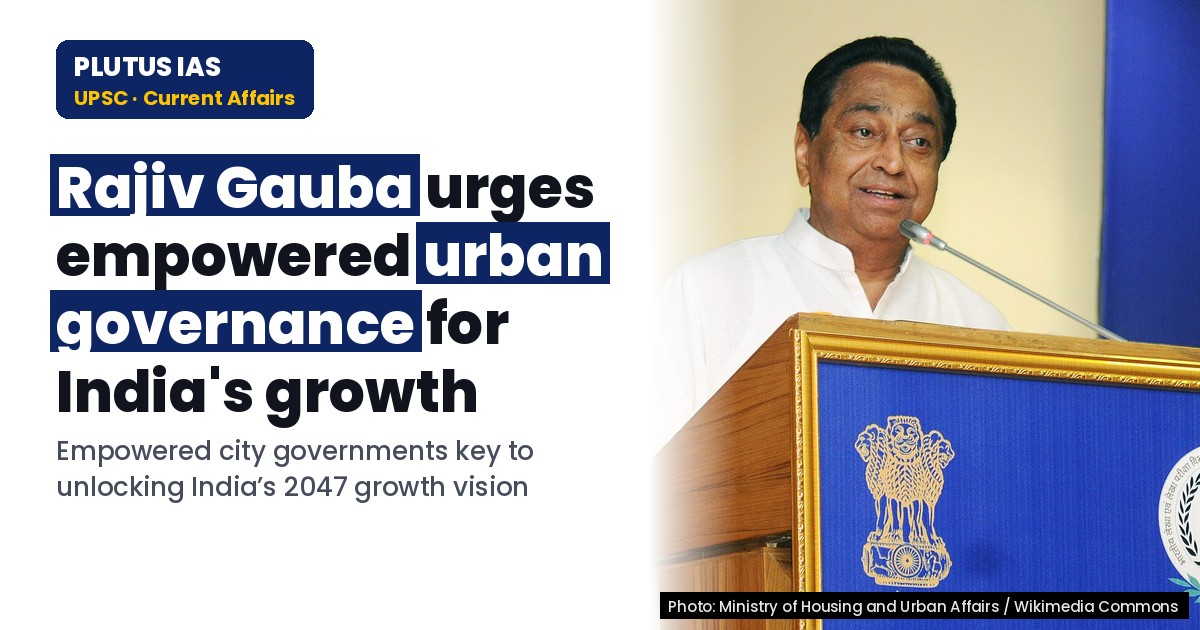
25 Oct नीति आयोग ने बताया: सशक्त शहरी सरकारें ही देश को बना सकती हैं विकसित
✎ Urban governance in India requires systemic reforms—devolution of functions, financial autonomy, and institutional capacity—to align with the 74th Constitutional Amendment Act, 1992, and address the needs of a rapidly urbanising…
Subject Relevance — Where This Topic Fits
- GS Paper II — Governance, Constitution, Polity, Social Justice and International Relations (Urban Governance, 74th Constitutional Amendment Act) | GS Paper III — Economy (Urban Infrastructure, Public Finance, Land Use Policies)
- Prelims: 74th Constitutional Amendment Act, 1992, Urban Local Bodies (ULBs), Smart Cities Mission, AMRUT, Pradhan Mantri Awas Yojana-Urban (PMAY-U), Metro Rail Projects, Urban Challenge Fund, Property Tax Reforms, Land Pooling, Mixed-Use Zoning, Metropolitan Planning Committees (MPCs), State Finance Commissions (SFCs), Mayor-in-Council System, Directly Elected Mayors, Urban Population Projections (2050), Urban Infrastructure Investment
- Essay: Urbanisation as a Catalyst for Economic Growth and Social Equity, Balancing Urban Development with Environmental Sustainability
Quick Revision: Urban governance in India requires systemic reforms—devolution of functions, financial autonomy, and institutional capacity—to align with the 74th Constitutional Amendment Act, 1992, and address the needs of a rapidly urbanising population.
Why is this in the news?
On 25 October 2026, NITI Aayog Member Rajiv Gauba, in his address at the Second National Urban Conference, underscored the critical need for empowered urban governments to unlock India’s developmental potential in the context of rapid urbanisation and demographic transitions. He highlighted structural gaps in urban governance, finance, and planning, advocating for systemic reforms aligned with the 74th Constitutional Amendment Act, 1992, to ensure effective service delivery, citizen participation, and sustainable urban growth.
Background
- India’s urban population is projected to reach 85 crore by 2050, constituting nearly 50% of the total population, up from the current 50 crore, driven by demographic and economic transitions.
- Urban areas are pivotal to economic growth, acting as hubs for talent, capital, and innovation, yet post-independence urban development has been largely neglected.
- Since 2014, initiatives such as the Smart Cities Mission, AMRUT, PMAY-U, Swachh Bharat Mission-Urban, and the Urban Livelihoods Mission have been launched to address urban challenges.
- Urban infrastructure investments have surged, with allocations increasing tenfold and significant investments in metro rail and bus systems (approximately ₹3.7 lakh crore).
- The Union Budget 2025-26 introduced the Urban Challenge Fund (₹1 lakh crore) under the Growth Hub initiative.
- The 74th Constitutional Amendment Act, 1992, mandates devolution of 18 functions to Urban Local Bodies (ULBs), including urban planning, water supply, fire services, and transport, but implementation remains uneven across states.
What is Urban Governance and Why is it Critical for India’s Development?
- Urban governance refers to the institutional, financial, and administrative mechanisms through which cities are managed, planned, and developed to deliver services and infrastructure to residents.
- Effective urban governance requires empowered Urban Local Bodies (ULBs) with adequate financial resources, administrative autonomy, and institutional capacity to address local needs and priorities.
- The 74th Constitutional Amendment Act, 1992, sought to decentralise governance by empowering ULBs with 18 functional domains, but its implementation has been inconsistent due to lack of political will, capacity constraints, and inadequate devolution of funds.
- Empowered urban governments can enhance service delivery (e.g., water supply, sanitation, transport), improve citizen participation through mechanisms like directly elected mayors and Mayor-in-Council systems, and foster economic growth by creating conducive environments for investment and innovation.
- Financial sustainability of ULBs is a major challenge, with limited own-source revenues (e.g., property taxes) and heavy dependence on state and central transfers; reforms in tax administration and user charges are essential.
- Urban planning in India is often rigid, with restrictive Floor Area Ratio (FAR) norms and zoning regulations that limit land supply, increase costs, and constrain housing and commercial development; reforms such as mixed-use zoning and land pooling can enhance efficiency.
- Metropolitan areas, often spanning multiple jurisdictions, require coordinated planning through institutions like Metropolitan Planning Committees (MPCs) to address spill-over effects and ensure integrated development.
- State Finance Commissions (SFCs) play a crucial role in determining the quantum and mechanism of financial transfers to ULBs; their regular constitution and adherence to constitutional timelines are vital for fiscal federalism.
Key Features
| Feature | Significance |
|---|---|
| Urban demographic transition | India’s urban population is projected to reach 85 crore by 2050, necessitating robust urban governance to address infrastructure, housing, and service delivery demands. |
| 74th Constitutional Amendment Act (CAA), 1992 | Mandates devolution of 18 functions to Urban Local Bodies (ULBs), including master planning, water supply, and transport, to empower local governance. |
| Urban Challenge Fund (2025-26 Budget) | A ₹1 lakh crore fund to develop cities as growth hubs, aligning with the ‘Viksit Bharat @ 2047’ vision. |
| Urban Economic Regions (UERs) | Allocation of ₹5,000 crore per region for 7 UERs over 5 years to catalyze economic activities and job creation. |
| Mayor-in-Council System | Proposed to enhance executive accountability and streamline decision-making in urban local bodies. |
| Property Tax and User Charges Reforms | Critical to augment municipal revenues, ensuring financial sustainability of ULBs. |
| Land Use Reforms | Relaxation of restrictive FAR norms and adoption of mixed-use zoning to optimize land supply and reduce costs. |
Why it Matters
Economic Growth and Competitiveness
- Cities are engines of economic growth, attracting talent, capital, and innovation; empowered urban governance is essential to unlock this potential.
- Efficient urban infrastructure reduces transaction costs, enhances productivity, and attracts investment, driving GDP growth.
- Urban economic regions can decentralize growth beyond metros, fostering balanced regional development.
Social Equity and Inclusion
- Empowered ULBs ensure equitable access to basic services (water, sanitation, housing) for all urban residents, including migrants and marginalized groups.
- Participatory governance mechanisms (e.g., directly elected mayors) enhance citizen engagement and accountability in service delivery.
- Revenue reforms (property tax, user charges) can reduce reliance on regressive levies, improving affordability for low-income households.
Administrative and Institutional Reforms
- Implementation of the 74th CAA requires states to devolve functions and financial resources to ULBs, strengthening local autonomy.
- Mayor-in-Council system and 5-year mayoral terms ensure continuity and reduce political instability in urban governance.
- Regular formation of State Finance Commissions ensures predictable and adequate fiscal transfers to ULBs.
Sustainable Urbanization
- Land use reforms (mixed-use zoning, transit-oriented development) optimize land utilization, reducing sprawl and environmental degradation.
- Investments in public transport (metro, buses) and housing (PMAY) mitigate congestion and improve quality of life in cities.
- Integrated urban planning addresses climate resilience, disaster risk reduction, and sustainable resource management.
Challenges
1. Fragmented Urban Governance
- States often retain control over cities, limiting the autonomy of ULBs despite the 74th CAA’s provisions.
- Lack of directly elected mayors and irregular municipal elections undermine accountability and continuity.
- Inadequate devolution of functions (e.g., master planning, transport) to ULBs restricts their ability to address local needs.
UPSC Link: GS-II: Local Government
2. Fiscal Constraints of ULBs
- Municipal revenues remain low, with heavy dependence on state transfers and limited internal resource mobilization.
- Property tax and user charge collection is inefficient, with high arrears and low coverage, constraining service delivery.
- Central Finance Commission grants to ULBs have increased (from 36% to 45%), but state transfers remain insufficient.
UPSC Link: GS-III: Fiscal Federalism
3. Regulatory and Land Use Bottlenecks
- Restrictive Floor Area Ratio (FAR) norms and rigid building bye-laws limit land supply, inflating housing costs.
- Outdated zoning regulations (e.g., single-use zones) discourage mixed-use development, increasing commute times and urban sprawl.
- Land pooling and assembly mechanisms are underutilized, delaying infrastructure projects and affordable housing.
UPSC Link: GS-III: Urban Land Reforms
4. Infrastructure and Service Delivery Gaps
- Urban infrastructure (water, sanitation, transport) lags behind demand, particularly in fast-growing cities.
- Public transport systems (metros, buses) suffer from last-mile connectivity issues and underutilization due to poor planning.
- Affordable housing shortages persist despite schemes like PMAY, with high land prices and construction costs.
UPSC Link: GS-II: Urban Development
5. Demographic and Migration Pressures
- Rapid urbanization strains existing infrastructure, with migrants and informal workers often excluded from formal service networks.
- Youth and working-age populations in cities require job opportunities, skill development, and social security to prevent urban poverty.
- Aging urban infrastructure (e.g., water pipelines, sewage systems) requires significant retrofitting and maintenance investments.
UPSC Link: GS-I: Urbanization
6. Climate Change and Resilience
- Cities are vulnerable to climate risks (floods, heatwaves, air pollution), but lack integrated climate action plans.
- Greenfield development often ignores ecological constraints, leading to unsustainable urban expansion.
- Limited institutional capacity in ULBs hampers the implementation of climate-resilient infrastructure.
UPSC Link: GS-III: Climate Change
Challenges — UPSC Perspective
| Issue | Concern |
|---|---|
| Devolution of Functions | States retain control over critical urban functions, limiting ULB autonomy despite 74th CAA. |
| Municipal Revenues | Low internal resource mobilization and dependence on state transfers constrain ULB operations. |
| Land Use Regulations | Restrictive FAR norms and zoning laws inflate costs and limit housing supply. |
| Public Transport Gaps | Inadequate metro/bus networks and last-mile connectivity hinder mobility. |
| Affordable Housing Shortage | High land prices and construction costs make housing unaffordable for low-income groups. |
| Climate Vulnerability | Cities lack integrated climate action plans, exacerbating risks from extreme weather events. |
Government Initiatives — Must-Memorise for Prelims
- Smart Cities Mission (SCM)
- Atal Mission for Rejuvenation and Urban Transformation (AMRUT)
- Pradhan Mantri Awas Yojana (PMAY-Urban)
- Swachh Bharat Mission (Urban)
- Deendayal Antyodaya Yojana – National Urban Livelihoods Mission (DAY-NULM)
- Urban Challenge Fund (2025-26 Budget)
- Urban Economic Regions (UERs) Scheme
Way Forward
- Strengthen devolution of 18 functions under the 74th CAA to ULBs, ensuring functional autonomy and accountability.
- Institute directly elected mayors with 5-year terms and implement Mayor-in-Council systems in all ULBs.
- Reform property tax and user charge regimes to enhance municipal revenues, including digitalization of tax collection.
- Relax restrictive FAR norms and adopt mixed-use zoning to optimize land supply and reduce housing costs.
- Expand public transport networks (metros, buses) with last-mile connectivity solutions and multi-modal integration.
- Establish State Finance Commissions to ensure regular and adequate fiscal transfers to ULBs.
- Integrate climate resilience into urban planning, including greenfield development and retrofitting of existing infrastructure.
- Promote land pooling and assembly mechanisms to accelerate infrastructure projects and affordable housing.
UPSC Value Addition
Keywords for Mains Answer-Writing
Urban Governance · 74th Constitutional Amendment Act · City Mayors · Urban Local Bodies · Urban Planning · Land Use Policy · Property Tax Reforms · Urban Infrastructure Financing · National Urban Mission · Metropolitan Governance · Decentralisation · Urban Local Government Reforms · Smart Cities Mission · AMRUT Scheme · Urban Population Growth · Urbanisation in India · Urban Metropolitan Governance Models
Constitutional & Policy Linkages
- Article 243P: Definition of Municipalities
- Article 243Q: Constitution of Municipalities
- Article 243R: Composition of Municipalities
- Article 243S: Constitution and Composition of Wards Committees
- Article 243T: Reservation of Seats
- Article 243U: Duration of Municipalities
- Article 243W: Powers, Authority and Responsibilities of Municipalities
Concept Flow
Rapid urbanization → Increased demand for infrastructure, housing, and services → Need for empowered urban governance → Implementation of 74th CAA provisions → Devolution of functions and financial resources to ULBs → Strengthening of municipal institutions (mayor-in-council, directly elected mayors) → Enhanced service delivery and citizen participation → Sustainable urban development → Economic growth and social equity
Prelims Practice Questions
Q1. Consider the following statements regarding the 74th Constitutional Amendment Act (CAA), 1992:
1. It mandates the establishment of a directly elected Mayor in every urban local body with a five-year term.
2. It requires States to transfer 18 municipal functions to urban local bodies, including master planning and water supply.
3. It provides for the constitution of State Finance Commissions to review the financial position of local bodies.
4. It empowers the Union Government to directly fund urban local bodies without state involvement.
How many of the above statements are correct?
- Only one
- Only two
- Only three
- All four
Answer: Only three — Statements 1, 2, and 3 are correct as per the 74th CAA. Statement 4 is incorrect as funding flows through the State Finance Commissions and State Governments, not directly from the Union Government.
Q2. Assertion (A): The Smart Cities Mission aims to promote sustainable and inclusive cities by leveraging technology and data.
Reason (R): The Mission focuses on retrofitting existing urban areas to enhance infrastructure and service delivery.
(a) Both A and R are true, and R is the correct explanation of A
(b) Both A and R are true, but R is not the correct explanation of A
(c) A is true, but R is false
(d) A is false, but R is true
- a
- b
- c
- d
Answer: b — The Smart Cities Mission indeed aims to promote sustainable and inclusive urban development through technology and data (A is true). It also focuses on retrofitting existing areas to improve infrastructure and services (R is true), and R correctly explains A as retrofitting is a core strategy under the Mission.
Q3. Match the following urban schemes with their respective objectives:
Column I
A. AMRUT Scheme
B. Smart Cities Mission
C. Pradhan Mantri Awas Yojana (Urban)
D. National Urban Livelihoods Mission
Column II
1. Provision of affordable housing for the urban poor
2. Retrofitting of existing urban areas with smart solutions
3. Improvement of urban infrastructure and service delivery
4. Skill development and livelihood support for urban poor
Select the correct match:
- A-3, B-2, C-1, D-4
- A-2, B-3, C-1, D-4
- A-1, B-4, C-2, D-3
- A-4, B-1, C-3, D-2
Answer: A-3, B-2, C-1, D-4 — AMRUT focuses on urban infrastructure and service delivery (A-3). Smart Cities Mission aims at retrofitting urban areas with smart solutions (B-2). PMAY(U) provides affordable housing (C-1). NULM supports skill development and livelihoods (D-4).
Mains Practice Question
✍ The efficacy of urban governance in India is constrained by structural and institutional deficits, despite constitutional provisions for decentralisation. Critically examine the challenges in achieving effective city governance in India, with reference to the 74th Constitutional Amendment Act, financial devolution, and the role of mayors. Also, assess the potential of recent initiatives like the Urban Challenge Fund to address these gaps. (15 Marks)
Approach: MODEL-ANSWER SKELETON:
1. **Constitutional Framework and Decentralisation**:
– 74th CAA (1992) and its provisions: mandatory devolution of 18 functions (e.g., master planning, water supply, fire services) to ULBs.
– State-level variations in implementation: incomplete transfer of functions, lack of autonomy in ULBs.
– Role of State Finance Commissions (SFCs): irregular constitution and inadequate devolution of funds.
2. **Institutional Challenges**:
– **Mayor-centric governance**: Absence of directly elected mayors with fixed tenure in most states; reliance on nominated or indirectly elected mayors.
– **Mayor-in-Council system**: Limited adoption despite potential for collective decision-making.
– **Urban local bodies (ULBs)**: Weak revenue base (property tax reforms pending), dependence on state grants, and lack of administrative capacity.
3. **Financial Devolution and Urban Financing**:
– Central Finance Commission (CFC) grants: increased share from 36% to 45%, yet insufficient for ULB needs.
– Urban Challenge Fund (UCF): ₹1 lakh crore allocation in 2025-26 budget for growth hubs; potential to address funding gaps but requires transparent disbursement mechanisms.
– Property tax and user fee reforms: low collection efficiency due to outdated valuation systems and political resistance.
4. **Recent Initiatives and Their Potential**:
– **Urban Challenge Fund**: Targeted funding for growth hubs; aligns with ‘Growth Hub’ initiative to develop cities as economic centres.
– **Urban Economic Regions (UERs)**: ₹5,000 crore allocation for 7 UERs; promotes integrated planning and infrastructure development.
– **Land Use Policy Reforms**: Need for mixed-use zoning, transit-oriented development (TOD), and land pooling to enhance land supply and reduce costs.
5. **Way Forward**:
– **Strengthening ULBs**: Directly elected mayors with 5-year terms, mandatory SFC constitution, and enhanced revenue powers.
– **Financial Reforms**: Improve property tax collection, expand user fees, and ensure timely devolution of funds.
– **Institutional Capacity Building**: Capacity building for ULB officials, adoption of digital governance tools, and participatory planning.
6. **Conclusion**:
– Structural reforms in governance, finance, and planning are essential to unlock India’s urban potential. While recent initiatives like the UCF are steps in the right direction, their success hinges on state-level cooperation and institutional strengthening.
Source: PIB (Press Information Bureau)
Generated by AanyaAi for educational purpose.
Related guides on our sites
- Anthropology VS PSIR
- Best PSIR optional coaching
- Best PSIR optional coaching online
- Best PSIR optional teacher

- नीति आयोग ने बताया: सशक्त शहरी सरकारें ही देश को बना सकती हैं विकसित - October 25, 2026
- Kerala PSC Chairperson Removal: Governor’s Recommendation Explained for UPSC - October 25, 2026
- लोकसभा स्पीकर बिरला और रूस के ड्यूमा स्पीकर वोलोडिन ने संसदीय सहयोग बढ़ाने पर बातचीत की - October 25, 2026

No Comments