


05 Sep उपराष्ट्रपति 6-9 सितंबर को पूर्वोत्तर राज्यों का दौरा: UPSC अध्ययन सामग्री
✎ The Vice-President of India is the constitutional Chairman of the Rajya Sabha and assumes the office of the President in case of vacancy, as per Articles 64 and 65 of the Constitution.
Subject Relevance — Where This Topic Fits
- GS Paper II — Polity and Governance: Constitutional Position and Functions of the Vice-President of India | GS Paper II — International Relations: India’s North-East as a Bridge to South-East Asia | GS Paper III — Social Justice: Inclusive Education and Accessibility for Persons with Disabilities
- Prelims: Vice-President of India, Article 63 of the Constitution, Article 64 (Vice-President as ex-officio Chairman of Rajya Sabha), North-Eastern Council, Sustainable Development Goals (SDG 4: Quality Education), Accessible India Campaign (Sugamya Bharat Abhiyan), Inclusive Education for Disabled Children
- Essay: The Role of Constitutional Institutions in Strengthening Federalism, Education and Cultural Heritage as Pillars of National Integration
Quick Revision: The Vice-President of India is the constitutional Chairman of the Rajya Sabha and assumes the office of the President in case of vacancy, as per Articles 64 and 65 of the Constitution.
Why is this in the news?
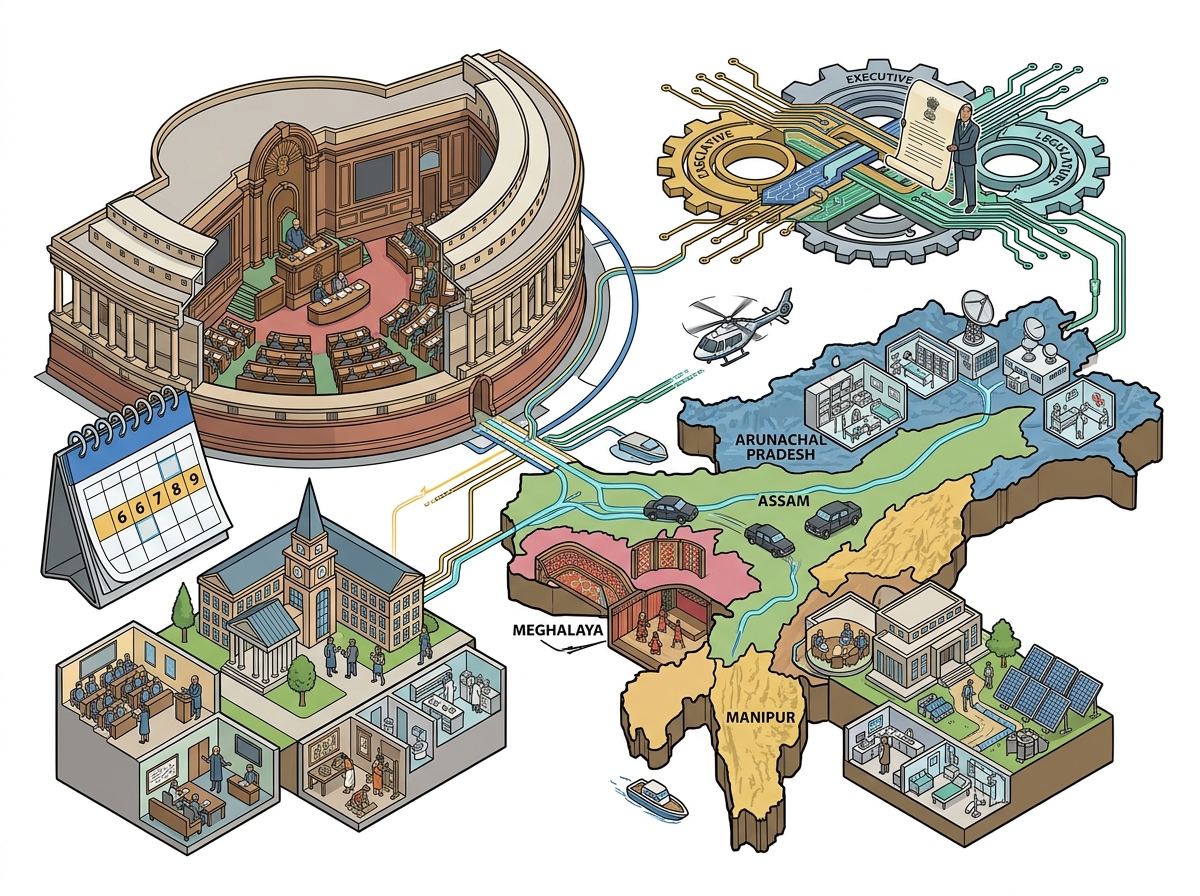
The official visit of the Vice-President of India to Assam, Meghalaya, Manipur, and Arunachal Pradesh from 6 to 9 September 2026 underscores the constitutional obligation of the Vice-President to engage with institutions of national importance, promote educational excellence, and foster cultural and social integration in the North-Eastern Region. This outreach aligns with the Vice-President’s broader role as the constitutional link between the executive and the legislature, as well as the ceremonial head of the Rajya Sabha.
Background
- Article 64 of the Constitution stipulates that the Vice-President shall be the ex-officio Chairman of the Rajya Sabha, thereby playing a pivotal role in the legislative process.
- The North-Eastern Region of India comprises eight states and is strategically significant for India’s Act East Policy and regional connectivity initiatives.
- The Vice-President’s visits to educational, cultural, and public institutions in the North-East reflect the constitutional mandate to promote national integration and social cohesion.
- The North-Eastern Council (NEC), established in 1971 under the North-Eastern Council Act, 1971, serves as the nodal agency for the economic and social development of the region.
- The Government of India has prioritised inclusive education and accessibility for persons with disabilities through initiatives such as the Accessible India Campaign and the Rights of Persons with Disabilities Act, 2016.
Constitutional Position and Functions of the Vice-President of India
- The Vice-President is elected by an electoral college consisting of members of both Houses of Parliament, in accordance with Article 66 of the Constitution.
- The Vice-President serves as the ex-officio Chairman of the Rajya Sabha, presiding over its sittings, maintaining order, and ensuring the smooth conduct of legislative business.
- In the event of the President’s absence, resignation, or inability to discharge duties, the Vice-President assumes the office of the President under Article 65 of the Constitution.
- The Vice-President’s role includes representing India at international forums, promoting constitutional values, and fostering inter-state and inter-regional harmony.
- The Vice-President’s visits to educational institutions, cultural centres, and public events are part of the constitutional outreach to strengthen grassroots engagement and national integration.
- The Vice-President’s participation in convocation ceremonies, cultural programmes, and public dialogues underscores the constitutional commitment to education, heritage, and social welfare.
- The Vice-President’s engagement with institutions such as the Sri Srimanta Sankaradeva University of Health Sciences (Assam) and the Jawarharlal Nehru State Museum (Arunachal Pradesh) highlights the constitutional emphasis on academic excellence and cultural preservation.
- The Vice-President’s visit to the डोनी पोलो मिशन विद्यालय (Doni Polo Mission School) for the hearing and visually impaired in Arunachal Pradesh aligns with the constitutional mandate for inclusive education and accessibility under the Rights of Persons with Disabilities Act, 2016.
Key Features
| Feature | Significance |
|---|---|
| Institutional Visits (Educational) | Demonstrates the constitutional role of the Vice-President in engaging with academic institutions, fostering educational diplomacy, and promoting higher education in the northeastern region. |
| Cultural & Public Engagement | Highlights the Vice-President’s role in strengthening cultural ties, promoting social harmony, and engaging with local communities through public events and dialogues. |
| Historical & Memorial Visits | Underscores the importance of commemorating historical events and honoring national heroes, particularly in regions with significant contributions to India’s freedom struggle. |
| Legislative Interaction | Reflects the constitutional function of the Vice-President in participating in legislative proceedings, such as addressing a special session of the Arunachal Pradesh Legislative Assembly. |
Why it Matters
Constitutional Role of the Vice-President
- The Vice-President, as the ex-officio Chairman of the Rajya Sabha, embodies the constitutional mandate to represent the nation’s unity and diversity, extending this role through state visits.
- Such visits reinforce the Vice-President’s function as a bridge between the central government and state institutions, fostering cooperative federalism.
- Engagement with educational and cultural institutions aligns with the constitutional directive to promote scientific temper and cultural heritage under Article 51A(h).
Northeast India: Strategic & Developmental Imperatives
- The visit underscores the government’s focus on the northeastern region, a critical frontier for India’s Act East Policy and regional connectivity initiatives.
- Institutional engagements in Assam, Meghalaya, Manipur, and Arunachal Pradesh highlight efforts to address educational and healthcare disparities in the region.
- Cultural and historical interactions reinforce national integration, countering narratives of isolation or neglect in the northeastern states.
Educational & Institutional Diplomacy
- The Vice-President’s presence at convocation ceremonies and college milestones serves as a symbolic endorsement of academic excellence and institutional growth.
- Dialogues with students and faculty promote youth engagement in nation-building, aligning with the National Education Policy’s emphasis on holistic development.
- Institutional visits to health sciences universities reflect the government’s commitment to strengthening healthcare infrastructure in the region.
Historical & Memorial Commemoration
- Visits to the INA Memorial in Manipur and war memorials honor the sacrifices of freedom fighters and soldiers, reinforcing the narrative of India’s struggle for independence.
- Such engagements align with the constitutional objective of preserving and promoting the ideals of nationalism and patriotism.
Challenges
1. Regional Disparities in Education & Healthcare
- Northeastern states face challenges in access to quality higher education, with institutions often lacking infrastructure and faculty.
- Healthcare disparities persist, particularly in rural and remote areas, necessitating targeted interventions by central and state governments.
- Limited connectivity and geographical barriers exacerbate developmental challenges, requiring sustained investment in infrastructure.
UPSC Link: GS-II: Regional Development
2. Cultural & Linguistic Diversity Management
- The region’s rich cultural and linguistic diversity poses challenges in policy implementation, requiring inclusive and participatory approaches.
- Ensuring representation of all communities in developmental and educational initiatives remains a persistent challenge.
UPSC Link: GS-II: Social Justice
3. Historical Memory & National Integration
- Preserving and promoting historical narratives, particularly those related to the freedom struggle, requires continuous effort to counter misinformation and apathy.
- Ensuring that memorials and museums remain accessible and relevant to younger generations is a key challenge.
UPSC Link: GS-I: Indian Culture
4. Legislative Engagement & Federalism
- Balancing the Vice-President’s role as a constitutional figure with the need for political neutrality in legislative interactions can be challenging.
- Ensuring that such visits translate into tangible policy outcomes for the states requires sustained follow-up.
UPSC Link: GS-II: Federalism
Challenges — UPSC Perspective
| Issue | Concern |
|---|---|
| Infrastructure Gaps in Education | Lack of adequate facilities in colleges and universities, particularly in rural and remote areas. |
| Healthcare Accessibility | Limited availability of specialized healthcare services, especially in tribal and hilly regions. |
| Cultural Preservation | Risk of erosion of indigenous languages and traditions due to modernization and migration. |
| Historical Narrative Gaps | Insufficient documentation and promotion of local histories tied to the freedom struggle. |
| Policy Implementation Bottlenecks | Delays in translating developmental schemes into ground-level benefits due to bureaucratic hurdles. |
Way Forward
- Strengthen institutional partnerships between central and northeastern state universities to enhance academic collaboration and research.
- Expand healthcare infrastructure in the region by leveraging schemes like the Ayushman Bharat Digital Mission and PM-Ayushman Bharat Health Infrastructure Mission.
- Promote cultural preservation through digital archiving of indigenous languages, traditions, and historical narratives.
- Enhance connectivity in the northeastern states via the Bharatmala Pariyojana and other road and rail infrastructure projects.
- Establish a dedicated cell within the Vice-President’s Secretariat to monitor follow-up actions from such visits and ensure accountability.
- Encourage youth participation in nation-building through mentorship programs and internships in central institutions.
- Facilitate inter-state cultural exchanges to foster national integration and celebrate the diversity of the northeastern region.
UPSC Value Addition
Keywords for Mains Answer-Writing
Vice-President of India · Constitutional position and functions · Institutional visits and outreach · Northeast India development · Cultural and educational diplomacy · State legislatures and governance · Public engagement by constitutional authorities · Historical and strategic significance of Northeast states · Role of constitutional offices in national integration · Democratic institutions and public participation
Constitutional & Policy Linkages
- Article 51A(h): Fundamental Duty to develop scientific temper and promote cultural heritage.
- Seventh Schedule: Distribution of legislative powers between the Union and States.
Concept Flow
Vice-President’s constitutional mandate → Engagement with institutions and communities → Reinforcement of cooperative federalism → Educational and healthcare disparities in the Northeast → Institutional visits and dialogues → Policy focus on regional development → Historical and cultural significance of the Northeast → Commemoration of freedom struggle and indigenous heritage → Promotion of national integration → Legislative interaction with state assemblies → Reinforcement of federal structure → Ensuring inclusive governance → Way forward actions → Translation of symbolic engagements into tangible outcomes → Sustained regional development
Prelims Practice Questions
Q1. Consider the following statements regarding the Vice-President of India:
1. The Vice-President is elected by an electoral college consisting of members of both Houses of Parliament.
2. The Vice-President holds office for a term of five years from the date on which he enters upon his office.
3. The Vice-President can be removed from office by a resolution of the Rajya Sabha passed by a majority of its members and agreed to by the Lok Sabha.
4. The Vice-President is the ex-officio Chairman of the Rajya Sabha.
How many of the above statements are correct?
- Only one
- Only two
- Only three
- All
Answer: All — Statements 1, 2, and 4 are correct. Statement 3 is incorrect as the resolution for removal must be passed by a majority of the Rajya Sabha and agreed to by the Lok Sabha, but the term ‘agreed to’ implies a simple majority in the Lok Sabha, not necessarily a majority of its members.
Q2. Assertion (A): The Vice-President of India is constitutionally empowered to preside over the Rajya Sabha.
Reason (R): The Vice-President is elected by the members of the Rajya Sabha and the Lok Sabha.
Options:
A. Both A and R are true, and R is the correct explanation of A.
B. Both A and R are true, but R is not the correct explanation of A.
C. A is true, but R is false.
D. A is false, but R is true.
Answer: ? — Assertion (A) is true as the Vice-President is the ex-officio Chairman of the Rajya Sabha. Reason (R) is also true but does not explain the assertion, as the Vice-President is elected by an electoral college comprising both Houses of Parliament, not solely the Rajya Sabha.
Q3. Match the following constitutional provisions with their correct descriptions:
Column I
1. Article 63
2. Article 64
3. Article 65
4. Article 66
Column II
A. The Vice-President shall be ex-officio Chairman of the Council of States.
B. The Vice-President shall be elected by the members of both Houses of Parliament in accordance with the system of proportional representation by means of the single transferable vote.
C. The Vice-President shall hold office for a term of five years from the date on which he enters upon his office.
D. The Vice-President shall not hold any other office of profit during his term of office.
Options:
1-A, 2-D, 3-B, 4-C
1-B, 2-A, 3-C, 4-D
1-A, 2-B, 3-C, 4-D
1-C, 2-D, 3-A, 4-B
- 1-A, 2-D, 3-B, 4-C
- 1-B, 2-A, 3-C, 4-D
- 1-A, 2-B, 3-C, 4-D
- 1-C, 2-D, 3-A, 4-B
Answer: 1-C, 2-D, 3-A, 4-B — The correct matches are: 1-A (Article 63), 2-B (Article 66), 3-C (Article 67), and 4-D (Article 65).
Mains Practice Question
✍ The Vice-President of India, as the ex-officio Chairman of the Rajya Sabha, plays a pivotal role in ensuring the smooth functioning of the Parliament and in fostering inter-state and inter-institutional dialogue. In the context of the Vice-President’s recent visit to the northeastern states, critically examine the significance of such institutional outreach programmes for national integration and governance. (15 Marks)
Approach: MODEL-ANSWER SKELETON:
1. **Constitutional Role of the Vice-President**:
– Ex-officio Chairman of the Rajya Sabha (Article 89).
– Role in maintaining decorum, ensuring debates, and upholding parliamentary traditions.
– Constitutional provisions governing the office (Articles 63-71).
2. **Institutional Outreach and National Integration**:
– Importance of the Vice-President’s visits to states, particularly in the Northeast, for fostering unity and addressing regional aspirations.
– Role in promoting cultural and educational diplomacy (e.g., visits to museums, universities, and historical sites as reported in the PIB release).
– Engagement with local institutions (e.g., Sri Srimanta Sankaradev Health Sciences University, Gauhati University, Manipur INA Memorial) to strengthen institutional linkages.
3. **Governance and Public Engagement**:
– The Vice-President’s participation in public events, cultural programmes, and academic ceremonies as a tool for grassroots-level engagement and awareness.
– Role in highlighting the developmental priorities of the Northeast and addressing concerns of under-representation or marginalisation.
4. **Challenges and Criticisms**:
– Limitations of such visits in addressing systemic issues (e.g., insurgency, infrastructure gaps, or governance deficits).
– The need for sustained follow-up actions beyond symbolic visits.
5. **Comparative Perspective**:
– Contrast with other constitutional authorities (e.g., President, Governors) and their outreach mechanisms.
– Lessons from similar programmes in other federations (e.g., US Vice-President’s role in inter-state diplomacy).
6. **Conclusion**:
– While institutional outreach programmes are symbolic and significant, their impact depends on follow-up actions, policy continuity, and multi-stakeholder engagement. The Vice-President’s role in such programmes complements constitutional duties but cannot substitute systemic reforms.
Source: PIB (Press Information Bureau)
Assam PCS (APSC) — State PCS Practice
Prelims: Which of the following states is NOT included in the official visit of the Vice President of India from 6th to 9th September as per the given context?
- Assam
- Meghalaya
- Manipur
- Nagaland
Answer: Nagaland — The Vice President’s visit includes Assam, Meghalaya, Manipur, and Arunachal Pradesh, but not Nagaland.
Mains: Discuss the significance of the Vice President of India’s visit to Assam and the northeastern states from a socio-economic and political perspective, with a focus on Assam’s role in the region.
Generated by AanyaAi for educational purpose.
Related guides on our sites
- How to prepare for GS paper 1 for UPSC CSE mains exam
- Best UPSC coaching for IFOS exam
- Best mentorship programme for upsc
- UPSC+BA degree

- ISRO का NVS-03 उपग्रह: NavIC को पुनः सक्रिय करेगा, जानिए कैसे? - October 24, 2026
- UPSC Alert: India Launches National Action Plan for Inland Small Fisheries - October 24, 2026
- विशेष अभियान 6: कपड़ा आयुक्त कार्यालय ने सफाई और दक्षता में बढ़ाया योगदान - October 24, 2026

No Comments