


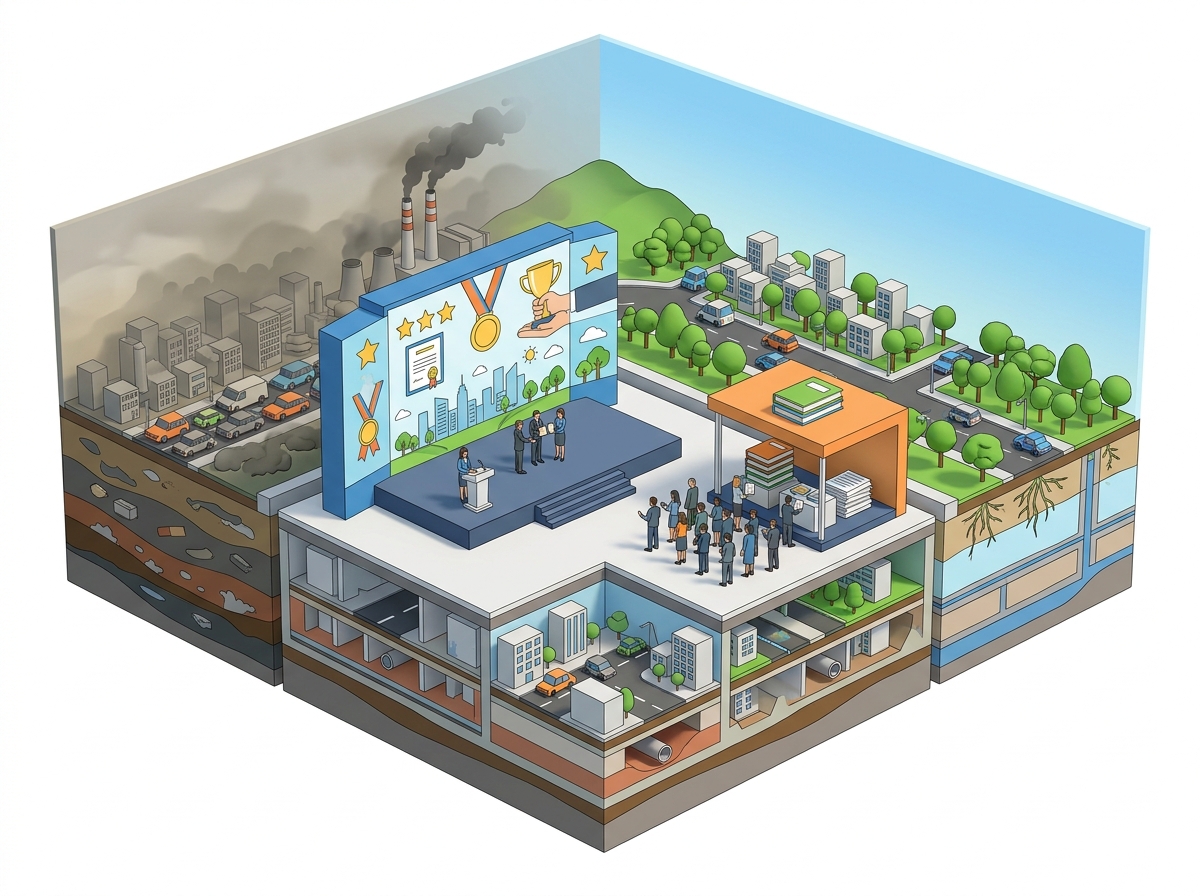
08 Sep 5th Clean Air Survey Awards: Top Cities & Wards Recognized on Clean Air Day 2026
✎ The Ministry of Environment, Forest and Climate Change (MoEFCC) organised the Clean Air Day 2026 event to felicitate cities and wards with the best air quality management practices under the fifth edition of the Swachh Vayu…
Subject Relevance — Where This Topic Fits
- GS Paper III — Environment and Ecology (Pollution Control and Sustainable Development) | GS Paper II — Governance (Institutional Mechanisms for Environmental Governance)
- Prelims: National Clean Air Programme (NCAP), National Green Tribunal (NGT), Central Pollution Control Board (CPCB), Pradhan Mantri Ujjwala Yojana (PMUY) for air quality context, National Air Quality Monitoring Programme (NAMP), Swachh Vayu Sarvekshan, National Ambient Air Quality Standards (NAAQS), National Mission for Clean Ganga (NMCG) for inter-sectoral linkages
- Essay: Sustainable Urban Development: Balancing Growth and Environmental Protection, Role of Citizens in Environmental Governance
Why is this in the news?
The Ministry of Environment, Forest and Climate Change (MoEFCC) organised the Clean Air Day 2026 event to felicitate cities and wards with the best air quality management practices under the fifth edition of the Swachh Vayu Sarvekshan Awards. The occasion also marked the release of a compendium of best management practices under the National Clean Air Programme (NCAP), underscoring the government’s commitment to multi-stakeholder, mission-mode approaches for mitigating urban air pollution.
Background
- Air pollution in India has emerged as a critical public health and environmental challenge, particularly in urban centres, where vehicular emissions, industrial activities, construction dust, and waste burning contribute significantly to ambient particulate matter (PM2.5 and PM10) and gaseous pollutants.
- The National Clean Air Programme (NCAP), launched in January 2019, is a long-term, time-bound national-level strategy to reduce particulate matter concentrations by 20–30% by 2024 (base year: 2017) across 131 non-attainment cities, which consistently fail to meet National Ambient Air Quality Standards (NAAQS).
- The National Green Tribunal (NGT), established under the National Green Tribunal Act, 2010, plays a pivotal role in adjudicating environmental disputes and ensuring compliance with pollution control norms through suo motu and complaint-based proceedings.
- The Central Pollution Control Board (CPCB) serves as the apex regulatory body for air quality monitoring, data compilation, and enforcement of environmental standards under the Air (Prevention and Control of Pollution) Act, 1981.
- The Pradhan Mantri Ujjwala Yojana (PMUY), while primarily a welfare scheme for LPG connections, indirectly contributes to reducing household air pollution and, by extension, ambient particulate levels in urban peripheries.
What is the National Clean Air Programme (NCAP)?
- NCAP is a multi-sectoral, time-bound action plan launched by the Government of India to reduce air pollution in 131 non-attainment cities, defined as those exceeding the National Ambient Air Quality Standards (NAAQS) for PM10, PM2.5, SO2, NO2, CO, NH3, and O3.
- The programme operates under the aegis of the Ministry of Environment, Forest and Climate Change (MoEFCC) and involves collaboration with state governments, urban local bodies (ULBs), and technical agencies such as CPCB and IITs.
- Key components include city-specific action plans, source apportionment studies, air quality monitoring network expansion, public awareness campaigns, and enforcement of emission standards for industries and vehicles.
- NCAP mandates the establishment of Continuous Ambient Air Quality Monitoring Stations (CAAQMS) in non-attainment cities to ensure real-time data availability and evidence-based policy formulation.
- The programme integrates with other national missions such as the Smart Cities Mission, AMRUT, and the National Mission for Clean Ganga (NMCG) to address cross-sectoral pollution sources.
- NCAP is not a standalone scheme but a framework that leverages existing legal and institutional mechanisms, including the Air Act, 1981; the Environment Protection Act, 1986; and the jurisdiction of the National Green Tribunal.
- The programme emphasises the principle of cooperative federalism, with state pollution control boards (SPCBs) and ULBs responsible for implementation, while the central government provides technical and financial support.
Key Features
| Feature | Significance |
|---|---|
| Swachh Vayu Diwas 2026 | A national observance to recognize cities and wards for exemplary air quality management, reinforcing the urgency of sustained pollution control efforts. |
| 5th Swachh Vayu Sarvekshan Awards | A competitive assessment mechanism under NCAP to incentivize urban local bodies for implementing best practices in air quality improvement. |
| National Clean Air Programme (NCAP) | A multi-stakeholder framework launched in 2019 to reduce particulate matter pollution by 20-30% by 2024, with a 2026 deadline for revised targets. |
| PRAN Portal (Portal for Regulation of Air pollution in Non-Attainment cities) | A digital monitoring tool tracking 130 non-attainment cities under NCAP, enabling real-time data analysis and policy interventions. |
| Best Management Practices Compilation | A repository of successful urban air quality management strategies to be disseminated among local bodies for replication and scaling. |
Why it Matters
Environmental Governance
- Demonstrates India’s institutional commitment to air quality management through structured assessment and recognition mechanisms under NCAP.
- Highlights the role of judicial bodies (NGT) in reinforcing environmental accountability for urban governance.
- Emphasizes the necessity of multi-level coordination between central ministries, state governments, and municipal authorities.
Urban Development
- Showcases how urban local bodies can integrate air quality objectives into city planning, waste management, and transport policies.
- Illustrates the potential for local innovation in pollution control, such as ward-level initiatives and citizen engagement models.
- Provides a benchmark for urban sustainability, linking air quality to public health outcomes and livability metrics.
Technological Integration
- PRAN Portal exemplifies the use of data-driven governance to track compliance and identify high-priority interventions.
- Encourages adoption of low-cost monitoring technologies and AI-driven predictive models for pollution hotspots.
- Promotes transparency through public dashboards, enabling citizen oversight and participatory decision-making.
Policy Framework
- NCAP’s structured approach—targets, timelines, and review mechanisms—serves as a model for other environmental governance programs.
- The awards mechanism aligns with the ‘Mission Mode’ strategy, ensuring sustained political and administrative focus.
- Reinforces the principle of ‘common but differentiated responsibilities’ among cities based on pollution severity.
Public Participation
- Awards incentivize civic engagement by recognizing citizen-led initiatives and community-driven pollution reduction efforts.
- Encourages behavioral change through awareness campaigns, aligning with the ‘Jan Andolan’ (people’s movement) paradigm.
- Demonstrates how local governance can leverage social capital to address complex environmental challenges.
Challenges
1. Multi-Source Pollution Complexity
- Air pollution in urban areas stems from vehicular emissions, industrial activities, construction dust, waste burning, and agricultural residue, requiring integrated solutions.
- Cross-sectoral coordination remains a persistent challenge, with limited alignment between transport, energy, and urban development policies.
UPSC Link: GS3: Environmental Pollution
2. Data Gaps and Monitoring Challenges
- Inadequate real-time air quality monitoring infrastructure in tier-2 and tier-3 cities hampers accurate assessment and targeted interventions.
- Disparities in monitoring capacity across states lead to uneven enforcement of air quality standards.
UPSC Link: GS3: Science & Technology
3. Institutional Capacity Constraints
- Municipal bodies often lack financial and technical resources to implement NCAP-mandated measures, such as smog towers or electric public transport.
- Weak enforcement of existing regulations (e.g., Construction & Demolition Waste Management Rules) due to limited regulatory oversight.
UPSC Link: GS2: Governance
4. Behavioral and Socio-Cultural Barriers
- Public resistance to measures like odd-even schemes, stubble burning bans, or waste segregation due to convenience or economic dependence.
- Limited awareness of long-term health impacts of air pollution, particularly in vulnerable populations.
UPSC Link: GS1: Social Issues
5. Climate-Environment Nexus
- Interlinkages between air pollution and climate change (e.g., black carbon emissions) are often underaddressed in urban policies.
- Extreme weather events (heatwaves, dust storms) exacerbate pollution levels, requiring adaptive strategies.
UPSC Link: GS3: Climate Change
6. Economic Trade-offs
- Balancing industrial growth with emission reduction targets poses challenges for policymakers, especially in industrial hubs.
- High costs of retrofitting industries with pollution control technologies may deter compliance.
UPSC Link: GS3: Economic Development
Challenges — UPSC Perspective
| Issue | Concern |
|---|---|
| Non-Attainment Cities | Cities failing to meet National Ambient Air Quality Standards (NAAQS) require intensive, time-bound interventions under NCAP. |
| Waste Management Gaps | Open burning of municipal solid waste and construction debris remains a major contributor to particulate matter pollution. |
| Vehicular Emissions | Rapid motorization outpaces adoption of cleaner fuels and electric mobility, especially in metropolitan areas. |
| Agricultural Residue Burning | Post-harvest stubble burning in Punjab, Haryana, and Uttar Pradesh significantly degrades air quality in northern India. |
| Industrial Compliance | Small and medium enterprises (SMEs) often lack resources to adopt emission control technologies, leading to regulatory arbitrage. |
| Public Awareness Deficit | Limited understanding of air quality indices (AQI) and health risks undermines citizen participation in pollution control. |
Government Initiatives — Must-Memorise for Prelims
- National Clean Air Programme (NCAP)
- PRAN Portal (Portal for Regulation of Air pollution in Non-Attainment cities)
Way Forward
- Strengthen real-time air quality monitoring networks in non-attainment and emerging pollution hotspots using IoT and satellite-based sensors.
- Expand the PRAN Portal’s functionality to include predictive analytics for pollution forecasting and scenario modeling.
- Institutionalize ward-level air quality action plans with dedicated budgets and performance-linked incentives for municipal bodies.
- Promote electric mobility and public transport expansion in cities through convergence with FAME-II and Smart Cities Mission schemes.
- Enhance stakeholder capacity through training programs for municipal officials, industrial operators, and community leaders on pollution control technologies.
- Launch targeted public awareness campaigns in regional languages, leveraging social media and grassroots organizations to drive behavioral change.
- Establish a national fund for air quality improvement, pooling resources from central, state, and private sectors for high-impact interventions.
- Integrate climate resilience into urban air quality strategies, addressing co-benefits such as reduced greenhouse gas emissions.
UPSC Value Addition
Keywords for Mains Answer-Writing
National Clean Air Programme (NCAP) · Swachh Vayu Sarvekshan 2026 · Air Quality Management in India · National Green Tribunal (NGT) · Citizen-led pollution control · Urban Local Bodies (ULBs) · PRANA Portal · Air Quality Index (AQI) · Multi-stakeholder governance · Sustainable Urban Development · Particulate Matter (PM2.5/PM10) · Clean Air International Day · Environmental Justice · Institutional Coordination for Air Quality
Constitutional & Policy Linkages
- Article 48A (DPSP) – Protection and improvement of environment and safeguarding of forests and wildlife
- Article 51A(g) – Fundamental Duty to protect and improve the natural environment
Concept Flow
Urbanization and industrialization → Increased vehicular and industrial emissions → Rise in particulate matter (PM2.5/PM10) levels → Decline in air quality → Public health impacts (respiratory diseases, cardiovascular risks) → NCAP framework launched (2019) → Targets set for 131 non-attainment cities → PRAN Portal established for monitoring → Data-driven interventions planned → Swachh Vayu Sarvekshan awards introduced → Cities/wards evaluated on air quality management practices → Best performers recognized → Peer learning and replication encouraged → Judicial oversight (NGT) reinforces accountability → Orders for stricter enforcement and compliance → Municipal bodies empowered to act → Citizen participation mobilized → Long-term outcome: Sustainable urban development with improved air quality → Health co-benefits (reduced morbidity, increased life expectancy) → Climate mitigation through reduced black carbon emissions
Prelims Practice Questions
Q1. Consider the following statements regarding the National Clean Air Programme (NCAP):
1. NCAP is a statutory framework mandated under the Air (Prevention and Control of Pollution) Act, 1981.
2. The PRANA Portal monitors air quality parameters for 130 cities under NCAP.
3. NCAP aims to achieve a 20-30% reduction in particulate matter (PM2.5 and PM10) concentrations by 2024.
How many of the above statements are correct?
- Only one
- Only two
- All
- None
Answer: All — Statement 1 is incorrect: NCAP is a non-statutory, action plan framework. Statement 2 is correct: PRANA Portal tracks air quality in 130 NCAP cities. Statement 3 is incorrect: NCAP targets a 20-30% reduction by 2024, not 2026.
Q2. Assertion (A): The National Green Tribunal (NGT) has the power to direct state governments to implement measures for air quality improvement under the Environment Protection Act, 1986.
Reason (R): The NGT derives its jurisdiction from the Constitution of India (Article 21) read with the Environment Protection Act, 1986.
Options:
A. Both A and R are true, and R is the correct explanation of A.
B. Both A and R are true, but R is NOT the correct explanation of A.
C. A is true, but R is false.
D. A is false, but R is true.
Answer: ? — A is true: NGT can direct state governments under Section 18 of the Environment Protection Act, 1986. R is true and correctly explains A, as NGT’s jurisdiction is grounded in Article 21 (right to life) and the Environment Protection Act.
Q3. Match the following initiatives with their respective objectives:
Column I (Initiative) | Column II (Objective)
———————————————–|———————————————–
A. Swachh Vayu Sarvekshan 2026 | 1. To monitor air quality parameters in 130 cities
B. PRANA Portal | 2. To rank cities based on air quality management
C. National Clean Air Programme (NCAP) | 3. To achieve 20-30% reduction in PM levels
D. Clean Air International Day | 4. To raise global awareness on air pollution
- A-2, B-1, C-3, D-4; A-1, B-2, C-3, D-4; A-3, B-1, C-2, D-4; A-4, B-2, C-1, D-3
- answer_array_indexes_to_match_columns_to_options_indexes_above_0_based_on_correct_pairing_order_exactly_as_shown_in_options_list_above
- answer_explanation_in_full_text_only_here
Answer: ? — Swachh Vayu Sarvekshan 2026 ranks cities based on air quality management (A-2). PRANA Portal monitors air quality parameters in 130 cities (B-1). NCAP aims for a 20-30% reduction in PM levels (C-3). Clean Air International Day raises global awareness (D-4).
Mains Practice Question
✍ ‘The National Clean Air Programme (NCAP) represents a paradigm shift from episodic pollution control to sustained, multi-stakeholder governance of urban air quality.’ Critically examine this statement with reference to the institutional architecture of NCAP, the role of urban local bodies, and the challenges in achieving its targets. Also assess the significance of citizen participation in this framework. (15 Marks)
Approach: MODEL-ANSWER SKELETON:
1. **Introduction (2 marks)**
– Define NCAP: A 5-year action plan launched in 2019 under the aegis of the Ministry of Environment, Forest and Climate Change (MoEFCC) to reduce particulate matter (PM2.5 and PM10) by 20-30% by 2024.
– Context: NCAP is not a statutory framework but a collaborative, mission-mode programme involving central, state, and local governments.
2. **Institutional Architecture of NCAP (4 marks)**
– **Central Level**: MoEFCC as the nodal ministry; Steering Committee chaired by Secretary (EFCC); Technical Advisory Group (TAG) for scientific inputs.
– **State Level**: State Pollution Control Boards (SPCBs) and State Action Plans (SAPs) for city-specific strategies.
– **Local Level**: Urban Local Bodies (ULBs) as implementing agencies; Swachh Vayu Sarvekshan for performance ranking.
– **Monitoring**: PRANA Portal for real-time air quality data; AQI-based reporting.
3. **Role of Urban Local Bodies (ULBs) (4 marks)**
– **Statutory Basis**: ULBs derive authority from the 74th Constitutional Amendment Act, 1992, and municipal laws (e.g., Delhi Municipal Corporation Act, 1957).
– **Functions**: Implementation of source-specific measures (e.g., road dust control, waste management, vehicular emissions control).
– **Challenges**: Limited financial autonomy, lack of technical capacity, overlapping jurisdictions with state agencies, and resistance to enforcement.
– **Incentives**: Swachh Vayu Sarvekshan awards (as seen in the 2026 awards) provide recognition and competitive motivation.
4. **Challenges in Achieving NCAP Targets (3 marks)**
– **Data Gaps**: Inconsistent monitoring infrastructure across cities; reliance on manual data collection in some areas.
– **Multi-source Pollution**: Difficulty in addressing diverse sources (vehicular, industrial, construction, biomass burning).
– **Political Economy**: Short-term electoral cycles vs. long-term pollution control; resistance from industrial lobbies.
– **Climate Variability**: Meteorological factors (e.g., stubble burning, dust storms) exacerbate pollution, requiring adaptive strategies.
5. **Citizen Participation (2 marks)**
– **Legal Basis**: Right to clean air recognized under Article 21 (right to life) and Article 48A (Directive Principles of State Policy).
– **Mechanisms**: Public awareness campaigns (e.g., ‘Clean Air International Day’), citizen science initiatives (e.g., low-cost air quality sensors), and grievance redressal through NGT.
– **Impact**: Citizen-led movements (e.g., ‘Odd-Even Scheme’ in Delhi) demonstrate potential for behavioural change, but sustainability remains a challenge.
6. **Conclusion (2 marks)**
– NCAP marks a shift toward sustained governance but faces institutional, technical, and socio-political hurdles.
– Citizen participation is critical for success, but requires institutional support, capacity building, and legal safeguards to translate into tangible outcomes.
Source: PIB (Press Information Bureau)
Generated by AanyaAi for educational purpose.
Related guides on our sites
- Best economics services coaching
- Anthropology VS PSIR
- Best PSIR optional coaching
- Best PSIR optional coaching online

- सिंहस्थ 2028: सब्जियों और फूलों की कमी रोकने की तैयारी, जानें पूरा प्लान - October 24, 2026
- India-UN Fund: A Model for South-South Cooperation in UPSC Exams - October 24, 2026
- उड़ीसा में चक्रवात खतरा: रेड अलर्ट, सरकार ने उठाए कदम - October 24, 2026

No Comments