


16 Sep Govt to Extend RoDTEP Scheme: Rs 23,000 Crore Allocation for 2026-27
✎ RoDTEP is a WTO-compliant export incentive scheme that reimburses embedded taxes and levies to enhance India’s export competitiveness, with refund rates ranging from 0.3% to 3.9% and a proposed ₹23,000 crore allocation for…
Subject Relevance — Where This Topic Fits
- GS Paper III — Economy: Trade, Balance of Payments, and Export Promotion Policies | GS Paper III — Government Budgeting and Fiscal Policy
- Prelims: Remission of Duties and Taxes on Exported Products (RoDTEP), Export promotion schemes in India, WTO-compliant export incentives, Fiscal incentives for MSMEs, Balance of Payments (BoP) management
- Essay: The role of fiscal incentives in enhancing India’s global competitiveness, Balancing trade promotion with fiscal prudence: Lessons from RoDTEP
Quick Revision: RoDTEP is a WTO-compliant export incentive scheme that reimburses embedded taxes and levies to enhance India’s export competitiveness, with refund rates ranging from 0.3% to 3.9% and a proposed ₹23,000 crore allocation for 2026-27.
Why is this in the news?
The Government of India is considering the extension of the Remission of Duties and Taxes on Exported Products (RoDTEP) scheme for an additional five years, with a proposed budgetary allocation of ₹23,000 crore for the financial year 2026-27. This decision follows the scheme’s recent six-month extension in April 2026, underscoring its critical role in mitigating export sector challenges amid global economic uncertainties, including disruptions in shipping and elevated transport costs. The proposal reflects the government’s intent to sustain export momentum, particularly for MSMEs, while ensuring compliance with multilateral trade norms.
Background
- The RoDTEP scheme was launched in January 2021 as a replacement for the Merchandise Exports from India Scheme (MEIS), which was discontinued due to non-compliance with World Trade Organization (WTO) rules on export subsidies.
- The scheme aims to reimburse exporters for embedded taxes, duties, and levies incurred during the production and distribution of goods, thereby restoring a level playing field in international markets.
- In April 2026, the scheme was extended for six months (until September 30, 2026) as part of a broader concession package to address export sector disruptions caused by geopolitical tensions and logistical challenges.
- The scheme operates under the legal framework of the Foreign Trade Policy (FTP) 2023, which emphasizes export competitiveness through fiscal measures and ease of doing business.
- India’s export sector, particularly MSMEs, faces structural challenges such as high logistics costs, regulatory complexities, and global demand volatility, necessitating targeted fiscal support.
What is the Remission of Duties and Taxes on Exported Products (RoDTEP) Scheme?
- Objective: To refund central, state, and local taxes, duties, and levies that are not covered under other export promotion schemes, thereby reducing the cost burden on exporters and enhancing price competitiveness in global markets.
- Legal Basis: Introduced under the Foreign Trade Policy (FTP) 2023, replacing the MEIS to align with WTO norms on prohibited subsidies.
- Scope of Refund: Covers embedded taxes such as electricity duty, fuel cess, mandi tax, stamp duty, and other levies incurred during the production and distribution of export goods.
- Refund Rates: Vary between 0.3% and 3.9% of the Free on Board (FOB) value of exports, depending on the sector and product category.
- Implementation Mechanism: Refunds are disbursed through a digital platform managed by the Central Board of Indirect Taxes and Customs (CBIC), ensuring transparency and efficiency.
- Target Beneficiaries: Primarily MSMEs and labor-intensive sectors such as textiles, leather, pharmaceuticals, and engineering goods, which contribute significantly to employment and export volumes.
- Compliance with WTO: Designed as a non-actionable subsidy under the WTO Agreement on Subsidies and Countervailing Measures, avoiding disputes related to prohibited export subsidies.
- Integration with Other Schemes: Complements initiatives like the Production-Linked Incentive (PLI) scheme and the Export Promotion Capital Goods (EPCG) scheme to create a holistic export ecosystem.
Key Features
| Feature | Significance |
|---|---|
| Remission of Duties and Taxes on Exported Products (RoDTEP) Scheme | A refund mechanism for central, state, and local taxes/duties not covered under other export promotion schemes, aimed at enhancing competitiveness of Indian exporters in global markets. |
| Refund Range (0.3% to 3.9%) | Provides calibrated reimbursement based on the embedded taxes in exported goods, ensuring parity with exporters from other jurisdictions. |
| Budgetary Allocation (Rs 23,000 crore for 2026-27) | Demonstrates government’s commitment to sustaining export incentives despite fiscal constraints, with a notable increase from previous years. |
| Extension for Five Years | Ensures long-term predictability for exporters, particularly MSMEs, fostering investment in export-oriented industries. |
| Concession Package (April 2026) | Temporary enhancement to mitigate disruptions caused by geopolitical conflicts and supply chain volatility, protecting export momentum. |
Why it Matters
Economic
- Enhances export competitiveness by offsetting embedded taxes, thereby improving profit margins for domestic producers.
- Supports MSMEs, which constitute a significant share of India’s export ecosystem and employment generation.
- Contributes to trade balance improvement by incentivizing higher value addition in export-oriented sectors.
- Aligns with the government’s goal of achieving a $2 trillion merchandise export target by 2030.
Fiscal
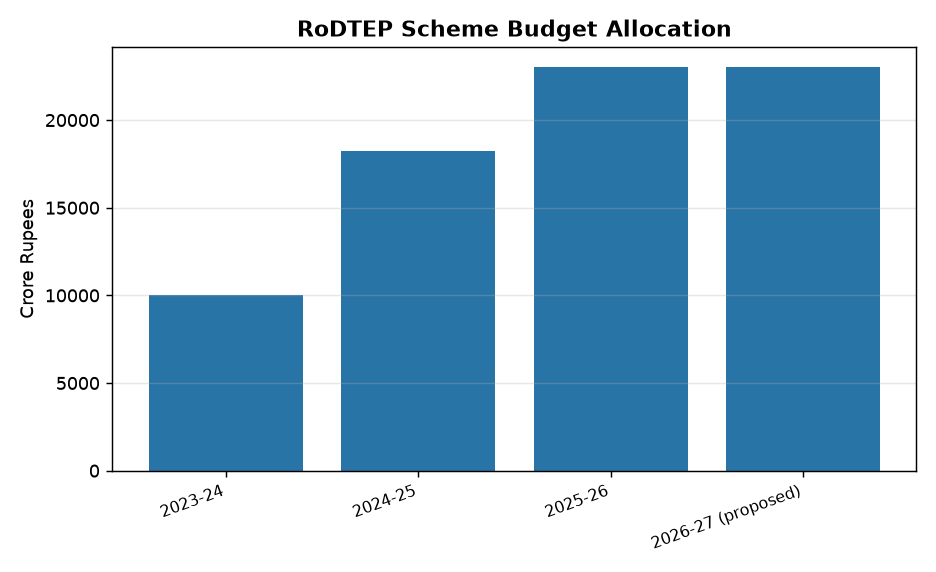
- Represents a direct fiscal outlay, with allocations rising from Rs 10,000 crore (2024-25) to Rs 23,000 crore (2026-27), reflecting prioritization of export-led growth.
- Balances trade-offs between revenue expenditure and long-term economic gains from sustained export performance.
Strategic
- Mitigates the impact of global supply chain disruptions and geopolitical tensions on Indian exporters, ensuring continuity in trade flows.
- Strengthens India’s position in global value chains by reducing cost disadvantages vis-à-vis competitors like China, Vietnam, and Bangladesh.
Sectoral
- Particularly beneficial for labor-intensive sectors such as textiles, leather, pharmaceuticals, and engineering goods, which rely heavily on export incentives.
- Encourages diversification of export baskets beyond traditional commodities, fostering resilience in the face of global demand fluctuations.
Challenges
1. Fiscal Sustainability
- High budgetary allocations (Rs 23,000 crore) may strain public finances, especially amid competing demands for social sector spending and infrastructure development.
- Risk of fiscal slippage if export growth does not commensurate with the incentive outlay, necessitating periodic reviews of the scheme’s efficacy.
UPSC Link: Fiscal Policy and Budgetary Management
2. WTO Compliance
- Ensuring that the RoDTEP scheme remains compliant with World Trade Organization (WTO) rules on subsidies, particularly post-Dispute Settlement Understanding (DSU) rulings against similar schemes.
- Risk of legal challenges if the scheme is perceived as a prohibited export subsidy under the Agreement on Subsidies and Countervailing Measures (ASCM).
UPSC Link: WTO Agreements and India’s Trade Policy
3. Implementation Efficiency
- Complexity in accurately calculating embedded taxes and duties for refunds, requiring robust IT infrastructure and inter-ministerial coordination.
- Delays in disbursement of refunds can negate the intended benefits, particularly for MSMEs with limited working capital.
UPSC Link: Government Budgeting and Expenditure Management
4. Global Trade Environment
- Volatility in global demand and trade policies (e.g., protectionist measures by major economies) may reduce the efficacy of export incentives.
- Competition from countries offering higher or more predictable export subsidies, necessitating continuous calibration of the RoDTEP framework.
UPSC Link: Globalization and its Impact on Indian Economy
5. MSME Vulnerabilities
- MSMEs often lack the financial and administrative capacity to fully utilize the scheme, leading to unequal benefits across the export ecosystem.
- Dependence on export incentives may discourage structural reforms in productivity and innovation among MSMEs.
UPSC Link: Role of MSMEs in Indian Economy
Challenges — UPSC Perspective
| Issue | Concern |
|---|---|
| Fiscal Burden | High budgetary allocations may conflict with other developmental priorities, necessitating cost-benefit analysis. |
| WTO Scrutiny | Risk of legal challenges under global trade rules, requiring careful design to avoid prohibited subsidies. |
| Implementation Lag | Delays in refund disbursement can undermine the scheme’s intended benefits for exporters. |
| Global Competition | Need to match or exceed incentives offered by competing export hubs to retain market share. |
| MSME Accessibility | Complex compliance requirements may exclude smaller firms, exacerbating inequality in the export sector. |
Government Initiatives — Must-Memorise for Prelims
- Remission of Duties and Taxes on Exported Products (RoDTEP) Scheme
Way Forward
- Conduct a comprehensive review of the RoDTEP scheme’s impact on export growth, job creation, and fiscal sustainability to inform future allocations.
- Enhance IT infrastructure and inter-ministerial coordination to streamline the calculation and disbursement of refunds, reducing delays.
- Strengthen outreach programs to improve awareness and accessibility of the scheme among MSMEs, particularly in tier-2 and tier-3 cities.
- Collaborate with industry associations to identify sector-specific bottlenecks in the export process and tailor incentives accordingly.
- Explore phased reduction of RoDTEP rates as export competitiveness improves, transitioning to a more market-driven incentive framework.
- Leverage digital platforms to create a transparent grievance redressal mechanism for exporters facing delays or disputes.
- Align the scheme with broader trade facilitation measures, such as the National Logistics Policy, to reduce transaction costs for exporters.
- Engage with WTO members to preemptively address compliance concerns and ensure the scheme’s design aligns with international trade norms.
UPSC Value Addition
Keywords for Mains Answer-Writing
RoDTEP Scheme · export promotion · WTO-compliant subsidies · Remission of Duties and Taxes on Exported Products · fiscal incentive for exporters · MSMEs and exports · direct tax refund mechanism · trade facilitation measures · export competitiveness · budgetary allocation for trade schemes · WTO Agreement on Subsidies and Countervailing Measures · export promotion councils · trade policy instruments · revenue foregone in subsidies
Concept Flow
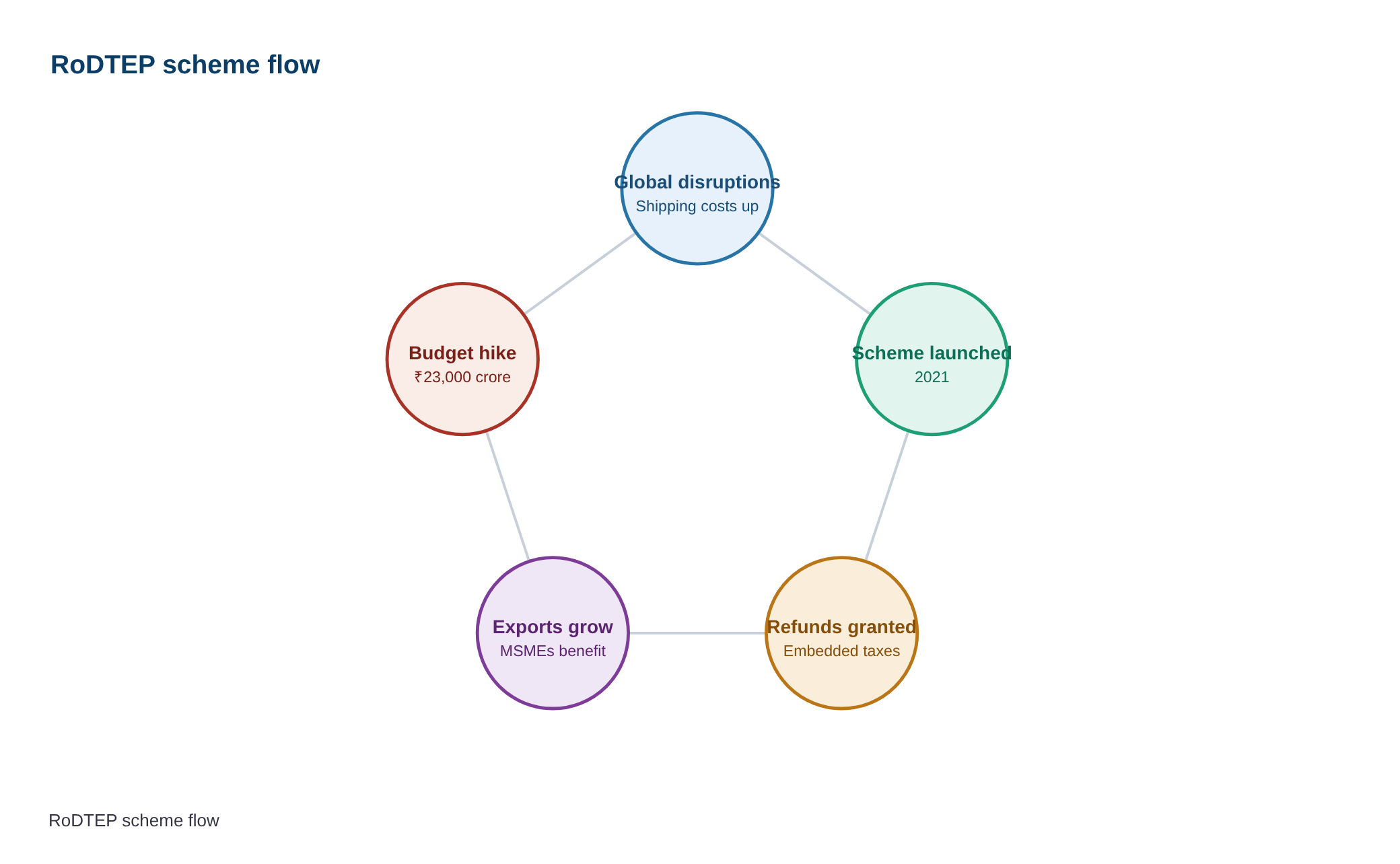
Global trade disruptions and geopolitical tensions → Increased shipping costs and export uncertainties → Government introduces/convenes RoDTEP scheme (2021) → Scheme provides refunds for embedded taxes/duties → Exporters gain competitiveness in global markets → MSMEs and labor-intensive sectors benefit → Export momentum sustains job creation → Budgetary allocations increase (Rs 10,000 crore to Rs 23,000 crore) → Scheme extended for five years (2026-27) to ensure long-term predictability.
Prelims Practice Questions
Q1. Consider the following statements regarding the Remission of Duties and Taxes on Exported Products (RoDTEP) Scheme:
1. RoDTEP provides a refund of taxes, duties, and levies paid by exporters at the central, state, and local levels.
2. The scheme was first rolled out in 2021 as a replacement for the earlier MEIS (Merchandise Exports from India Scheme).
3. Refunds under RoDTEP range from 0.3% to 3.9% of the export value.
4. The scheme is administered by the Ministry of Finance and does not involve the Ministry of Commerce.
How many of the above statements are correct?
- Only one
- Only two
- Only three
- All four
Answer: Only three — Statements 1, 2, and 3 are correct. Statement 4 is incorrect as RoDTEP is administered by the Ministry of Commerce and Industry, not the Ministry of Finance.
Q2. Assertion (A): The RoDTEP scheme is designed to offset the incidence of embedded taxes and levies that are not refunded under any other export promotion scheme.
Reason (R): The scheme aims to restore a level playing field for Indian exporters vis-à-vis their competitors in other countries by providing a refund of such taxes and duties.
Select the correct answer using the code below:
- Both A and R are true, and R is the correct explanation of A.
- Both A and R are true, but R is not the correct explanation of A.
- A is true, but R is false.
- A is false, but R is true.
Answer: Both A and R are true, and R is the correct explanation of A. — Both Assertion (A) and Reason (R) are true, and Reason (R) correctly explains Assertion (A). The scheme refunds embedded taxes and levies to ensure competitiveness.
Q3. Match the following columns related to export promotion schemes in India:
Column I (Scheme) Column II (Year of Launch)
A. Merchandise Exports from India Scheme (MEIS) 1. 2015
B. Remission of Duties and Taxes on Exported Products (RoDTEP) 2. 2021
C. Export Promotion Capital Goods (EPCG) Scheme 3. 2000
D. Duty-Free Import Authorization (DFIA) Scheme 4. 2011
Select the correct match:
- A-1, B-2, C-3, D-4
- A-4, B-2, C-1, D-3
- A-2, B-4, C-3, D-1
- A-3, B-1, C-2, D-4
Answer: A-4, B-2, C-1, D-3 — MEIS was launched in 2015, RoDTEP in 2021, EPCG in 2000, and DFIA in 2011.
Mains Practice Question
✍ Critically analyse the rationale, design, and challenges of the Remission of Duties and Taxes on Exported Products (RoDTEP) Scheme. Also, examine its compliance with the WTO Agreement on Subsidies and Countervailing Measures. (15 Marks)
Approach: MODEL-ANSWER SKELETON:
1. **Rationale and Objectives**:
– Purpose: Offset embedded taxes/duties not refunded under other schemes to restore export competitiveness.
– Target beneficiaries: MSMEs and labour-intensive sectors facing global competition.
– Context: Replacement of MEIS to align with WTO norms post-Dispute Settlement Body ruling (DS364, 2019).
2. **Design and Mechanism**:
– Refund mechanism: Reimbursement of central, state, and local taxes/duties incurred during production and distribution.
– Rate structure: Slab-based (0.3% to 3.9%) depending on sector and export intensity.
– Administration: Implemented by the Ministry of Commerce and Industry via the Department of Revenue.
– Budgetary outlay: Rs 18,232 crore (2025-26) and proposed Rs 23,000 crore (2026-27).
3. **WTO Compliance**:
– **Agreement on Subsidies and Countervailing Measures (ASCM)**: RoDTEP is classified as a ‘non-actionable subsidy’ under Article 8 of ASCM (prior to 2000) but now falls under Article 1.2 as a ‘specific subsidy’.
– **Exemptions**: Refunds for indirect taxes (e.g., VAT) are permitted under ASCM if they do not exceed the level of taxes imposed on inputs.
– **Challenges**: Potential disputes over ‘specificity’ (sectoral targeting) and ‘benefit conferred’ (whether refunds exceed actual tax incidence).
4. **Challenges and Criticisms**:
– **Implementation gaps**: Delays in refund disbursement and complex documentation requirements.
– **Sectoral disparities**: Disproportionate benefits to capital-intensive sectors vs. labour-intensive MSMEs.
– **Fiscal sustainability**: High budgetary outlay (Rs 23,000 crore) raises concerns about revenue foregone and fiscal prudence.
– **Global competition**: Inadequacy of refund rates to offset structural disadvantages (e.g., high logistics costs, energy prices).
5. **Way Forward**:
– **Streamlining processes**: Digital integration (e.g., GSTN linkages) to reduce compliance burden.
– **Targeted interventions**: Focus on high-employment sectors (e.g., textiles, leather) and MSME clusters.
– **WTO safeguards**: Ensure compliance by aligning refund rates with actual embedded tax incidence and avoiding sectoral specificity.
– **Alternative instruments**: Explore integration with Production-Linked Incentive (PLI) schemes for strategic sectors.
Balance of views: Proponents argue RoDTEP is essential for export revival post-pandemic and global trade disruptions. Critics highlight fiscal strain and WTO compliance risks, advocating phased reduction in reliance on such schemes.
Source: orissapost.com
Generated by AanyaAi for educational purpose.
Related guides on our sites
- Anthropology VS PSIR
- Best PSIR optional coaching
- Best PSIR optional coaching online
- Best PSIR optional teacher

- Govt to Extend RoDTEP Scheme: Rs 23,000 Crore Allocation for 2026-27 - September 16, 2026
- जयशंकर ने भूटान के विदेश मंत्री से द्विपक्षीय संबंधों पर वार्ता की - September 16, 2026
- पीएम आवास योजना-शहरी 2.0: 2026 तक 1 करोड़ घर, महिलाओं को मिलेगा प्राथमिकता - September 16, 2026

No Comments