


16 Feb AI and Climate Action: Forging a Resilient and Sustainable India
This article covers “Daily Current Affairs” and From AI and Climate Action: Forging a Resilient and Sustainable India
SYLLABUS MAPPING
GS- 3 – Climate change mitigation and adaptation – AI and Climate Action: Forging a Resilient and Sustainable India
FOR PRELIMS
Highlight the applications of Artificial Intelligence in environmental monitoring and conservation.
FOR MAINS
How is Artificial Intelligence helping improve climate resilience in India?
Why in the News?
India is hosting the India-AI Impact Summit 2026 (February 16–20) at Bharat Mandapam, New Delhi. This landmark event marks the first global AI summit hosted in the Global South, anchored in the three pillars of People, Planet, and Progress to leverage Artificial Intelligence (AI) for inclusive and sustainable development.
Defining AI in the Climate Context
Artificial Intelligence (AI) refers to the capability of computer systems to learn from data and make decisions or predictions. In the realm of climate action, AI particularly deep learning is utilized to analyze vast datasets for improved climate modeling, optimized renewable energy generation, precision agriculture, and enhanced disaster resilience.
Background and Context
As climate risks escalate, India has transitioned from reactive to proactive solutions, emphasizing emissions reduction and renewable energy. The integration of AI into climate strategy represents a technological shift to meet India’s Net-Zero goal by 2070, while simultaneously addressing the unique vulnerabilities of the Global South.
Ethical and Democratic Concerns
Precision in Disaster Risk Reduction (DRR): Advanced tools like the Advanced Dvorak Technique allow the India Meteorological Department (IMD) to estimate cyclone intensity with high accuracy. Comparative studies of global systems show path prediction accuracy up to 96 hours ahead within a 200-kilometer margin.
Hyper-Local Agriculture Support: The launch of the Bharat Forecasting System (BharatFS) in May 2025 provides village-level forecasts at a 6 km resolution (improving upon the previous 12 km), enabling farmers to make informed decisions via apps like Mausam gram.
Ecological Surveillance: AI-driven machine vision monitors forest boundaries to prevent human-wildlife conflict and detects illegal encroachment or felling in real-time.
Public Health & Resource Management: AI models now detect arsenic pollution in groundwater along the Ganga banks, supporting the Jal Jeevan Mission by identifying safe drinking water sources.
Key Issues and Challenges
Despite advancements, several hurdles remain:
Data Constraints: Effective AI requires high-quality “labeled data,” which is often lacking for disaster-specific assessments.
Technological Gap: While India has installed 22 Peta FLOPS of computing capacity, about 90% of this is still allocated to non-AI tasks, necessitating dedicated AI-GPU infrastructure.
Scalability in Fragile Terrains: While landslide warning systems have reached over 60 sites in Himachal Pradesh, scaling these low-cost indigenous sensors across the entire Himalayan belt remains a logistical challenge.
Governance and Institutional Aspects
Institutional Framework: The Ministry of Earth Sciences (MoES) and IMD have established dedicated AI/ML research teams and virtual centers at the Indian Institute of Tropical Meteorology (IITM) Pune.
Collaborative Ecosystem: Partnerships between IITs (Bombay, Madras, Kharagpur, Delhi), ISRO, and DRDO are driving innovations like SpADANet (damage assessment) and Reliability Ensemble Averaging (climate prediction).
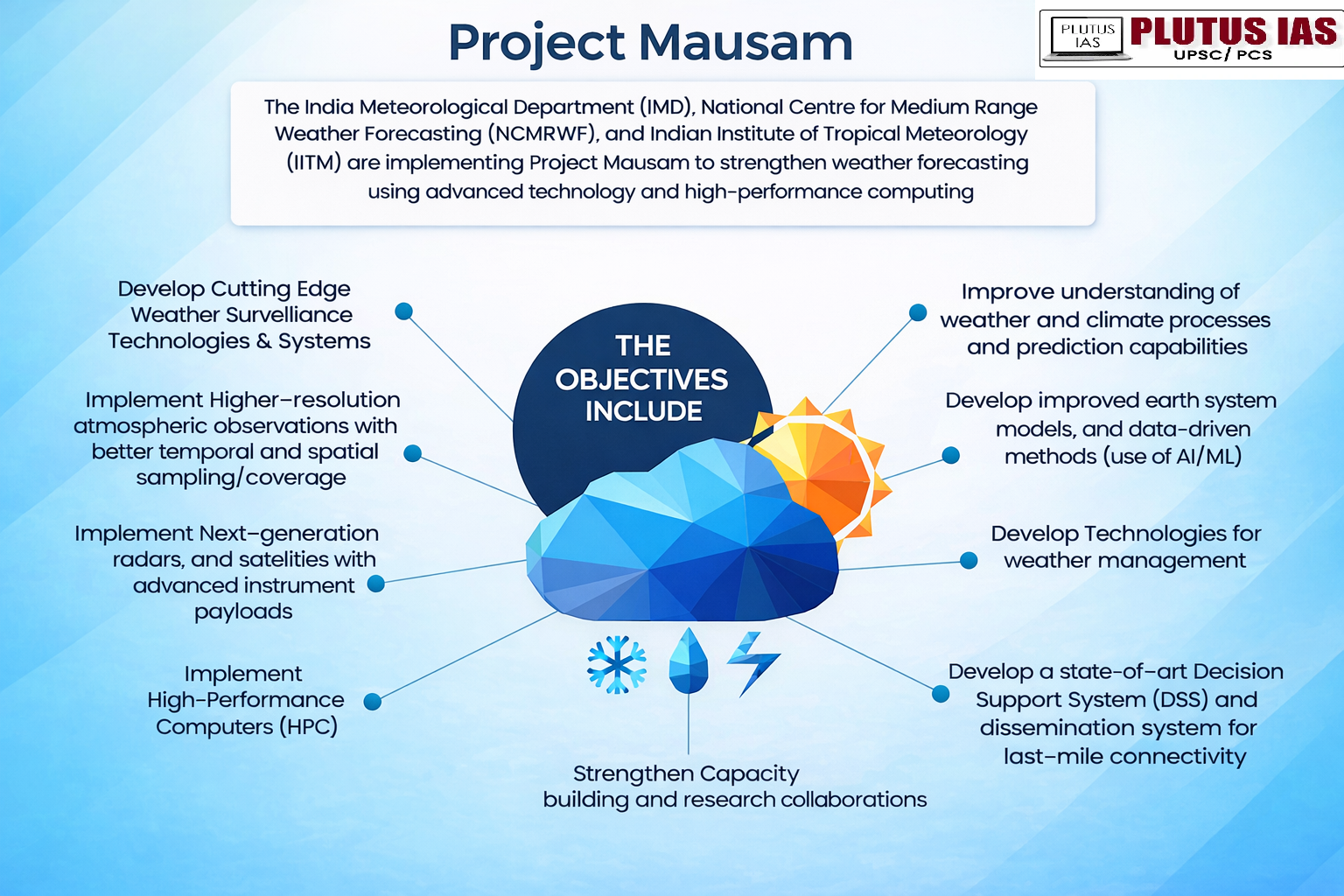
Schemes & Missions: AI innovations are being integrated into national priorities such as Mission Mausam, the Jal Jeevan Mission, and the Indian Land Data Assimilation System (ILDAS).
Economic, Social, and Environmental Impact
Economic Resilience: By providing 10-day advance rainfall predictions, AI helps minimize crop losses and infrastructure damage, protecting the livelihoods of vulnerable communities.
Environmental Conservation: AI serves as an early warning system for forest fires, critical given that human activities cause 75% of global wildfires.
Social Inclusion: Gram Panchayat-level forecasting democratizes access to high-end technology, ensuring that “last-mile” climate intelligence reaches the grassroots.
Ethical and Democratic Concerns
A primary focus of India’s AI strategy is the democratization of information. By providing high-resolution data to local bodies (Panchayats), the government ensures that technological benefits are not confined to urban centers, thereby fostering environmental justice for climate-sensitive regions.
Way Forward
Scaling Indigenous Innovation: Expand the use of low-cost sensors for landslides and floods, which are built at a fraction of the cost of imported technology.
Enhancing Computing Infrastructure: Increase the allocation of dedicated AI-GPUs within the national high-power computing grid to support complex transformer-based neural networks.
Capacity Building: Continue the annual training of scientists and local stakeholders in AI/ML fundamentals to ensure the sustainability of these systems.
Global South Leadership: Utilize the India-AI Impact Summit platform to export low-cost, high-impact AI climate solutions to other developing nations.
Conclusion
India’s integration of AI into climate action is more than a technological achievement; it is a testament to the nation’s commitment to Constitutional values (Article 48A) and Sustainable Development Goals (SDGs). By blending indigenous innovation like the Bharat Forecasting System with global partnerships, India is not only building climate resilience but also laying the foundation for an Atmanirbhar (Self-reliant) and Viksit Bharat (Developed India) by 2047. Through inclusive growth and democratic governance of technology, AI is proving to be the ultimate “force multiplier” in the fight against climate change.
Best ias coaching in delhi Best ias coaching in chandigar
Prelims question:
With reference to the use of Artificial Intelligence (AI) in climate action in India, consider the following statements:
1.The Bharat Forecasting System provides weather forecasts at village level with improved spatial resolution.
2.AI is used to detect arsenic contamination in groundwater under the Jal Jeevan Mission.
3.The Advanced Dvorak Technique is used for predicting earthquake intensity using AI.
4.AI-based machine vision can help monitor forest encroachment.
Which of the statements given above are correct?
(a) 1, 2 and 4 only
(b) 1 and 3 only
(c) 2, 3 and 4 only
(d) 1, 2, 3 and 4
Answer: (a) 1, 2 and 4 only
Mains Question:
Q. How can Artificial Intelligence strengthen disaster management and climate resilience in India? Illustrate with examples. ( 250 words, 15 marks )

- Artemis II: Humanity’s Return to Lunar Space and India’s Place in the New Moon Race - April 2, 2026
- A Missed Opportunity to Guarantee Minimum Wages - March 31, 2026
- ‘India’s Growth Claims, A Clash with Data Reality’. - March 30, 2026

No Comments