


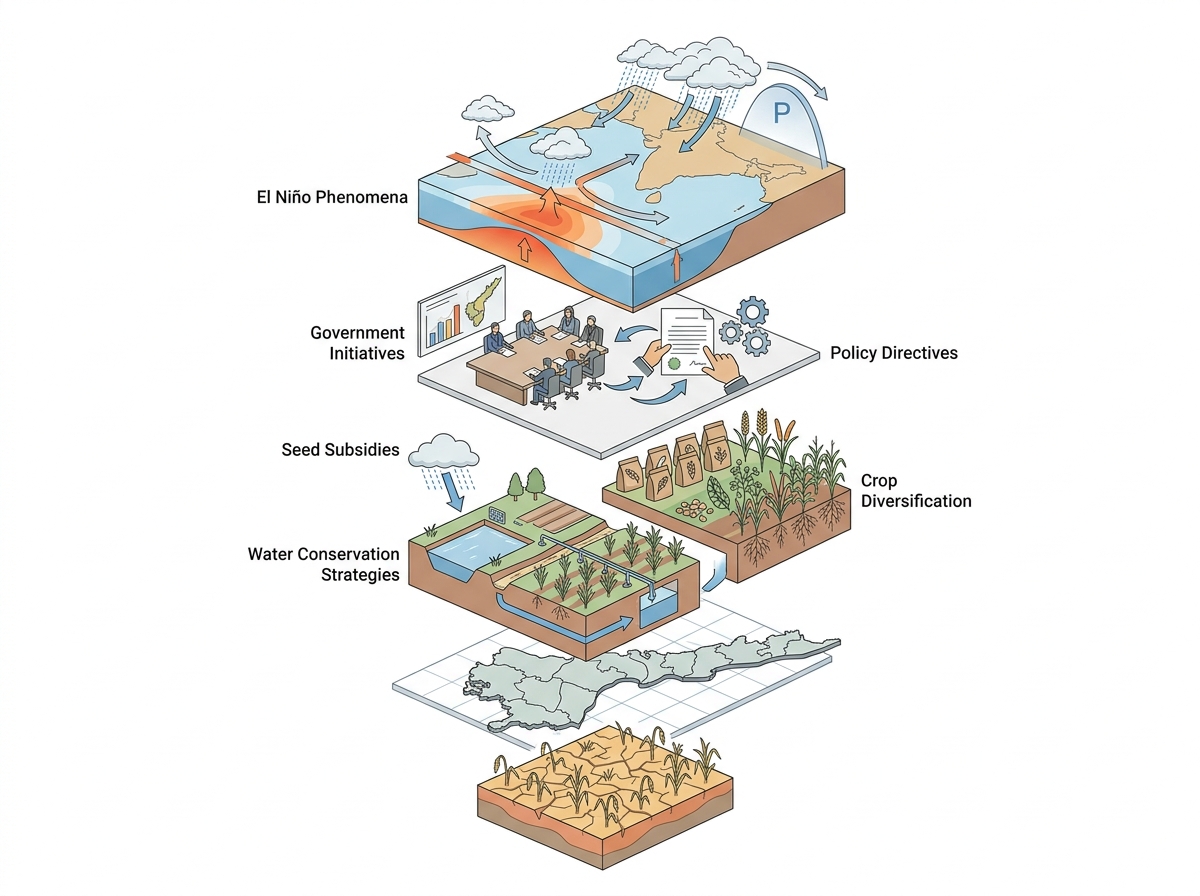
03 Sep Andhra Pradesh’s El Nino Crisis: Steps to Prevent Agricultural Drying Up
✎ El Niño-induced drought in Andhra Pradesh necessitates urgent adoption of water-efficient crops, drip irrigation, and seed subsidies, while leveraging weather-based crop insurance and multi-tiered funding mechanisms to mitigate…
Subject Relevance — Where This Topic Fits
- GS Paper III — Agriculture | GS Paper III — Environment and Disaster Management | GS Paper III — Water Resources | GS Paper III — Government Policies and Interventions for Development in Various Sectors
- Prelims: El Niño, drought mitigation, water-intensive crops, drip irrigation, seed subsidy, Andhra Pradesh Water Resources Information System (APWRIS), National Mission for Sustainable Agriculture (NMSA), Pradhan Mantri Krishi Sinchayee Yojana (PMKSY), agro-climatic zones, weather-based crop insurance
- Essay: Climate change and its impact on agricultural sustainability in India, Balancing water security and food security: Policy challenges in drought-prone regions
Quick Revision: El Niño-induced drought in Andhra Pradesh necessitates urgent adoption of water-efficient crops, drip irrigation, and seed subsidies, while leveraging weather-based crop insurance and multi-tiered funding mechanisms to mitigate agricultural and water security risks.
Why is this in the news?
The Government of Andhra Pradesh has initiated urgent measures to mitigate the adverse effects of El Niño-induced drought, including crop diversification, seed subsidies, and water conservation strategies. This proactive approach underscores the state’s commitment to preventing agricultural distress and ensuring food security amid declining monsoon rainfall, which has already reduced cultivated area coverage by 25-30%. The measures reflect a broader trend of state-level interventions in climate-resilient agriculture, aligning with national policies on sustainable water use and drought management.
Background
- El Niño is a climatic phenomenon characterised by abnormal warming of sea surface temperatures in the equatorial Pacific Ocean, leading to altered weather patterns globally, including reduced monsoon rainfall in India.
- Andhra Pradesh has received 52% less rainfall than the long-term average, ranking among the two states with the lowest rainfall in the country as of September 2026.
- As of early September 2026, only 60-65% of the state’s cultivated area has been sown, compared to the usual 90% coverage by this time of the year, indicating severe agricultural stress.
- The state government has earmarked ₹90 crore for seed subsidies and plans to distribute 90,000 kg of seeds of less-water-intensive crops to farmers.
- The Chief Minister has directed officials to visit fields, advise farmers on crop alternatives, and ensure uninterrupted drinking water supply across 14,829 habitations.
El Niño and Its Agricultural Impact in Andhra Pradesh: Policy Responses and Sustainable Solutions
- El Niño disrupts the Indian monsoon by weakening the southwest monsoon winds, leading to deficient rainfall and prolonged dry spells, particularly in peninsular India.
- Paddy, a water-intensive crop widely cultivated in Andhra Pradesh, is highly vulnerable to water scarcity, necessitating a shift to less-water-intensive alternatives such as millets, pulses, and oilseeds.
- The state government’s directive to promote drip irrigation aligns with the National Mission for Sustainable Agriculture (NMSA), which aims to enhance water-use efficiency in agriculture.
- The ₹90 crore seed subsidy scheme targets the distribution of seeds for drought-resistant crops, including varieties of millets (e.g., bajra, jowar), pulses (e.g., red gram, green gram), and oilseeds (e.g., groundnut), which require 30-50% less water than paddy.
- The government’s plan to divert water from nearby tanks through G RAM G works is a short-term measure to sustain horticultural crops and drinking water supply.
- Weather-based crop insurance, where farmers receive payouts based on deviations in weather parameters from normal, provides a financial safety net against climate-induced crop failures.
- The state’s emphasis on fodder cultivation addresses the dual challenge of water scarcity and livestock feed shortages, ensuring the viability of the dairy and livestock sectors.
Key Features
| Feature | Significance |
|---|---|
| El Niño-induced rainfall deficit (52% below normal) | Exacerbates agricultural drought conditions, reducing soil moisture and groundwater recharge, directly impacting kharif sowing and crop yields. |
| Crop diversification drive (90,000 kg seed distribution) | Promotes transition to less-water-intensive crops (e.g., millets, pulses, oilseeds), aligning with national water-use efficiency goals and reducing strain on irrigation resources. |
| ₹90 crore seed subsidy allocation | Financial incentive to offset higher input costs of alternative crops, ensuring farmer adoption without economic loss, while aligning with State’s agricultural policy priorities. |
| Drinking water security measures (14,829 habitations) | Ensures equitable access to potable water through borewells, tankers, and inter-State coordination, mitigating public health risks during drought. |
| G RAM G works for water diversion | Leverages existing irrigation infrastructure to redistribute water from surplus to deficit areas, enhancing adaptive water management in agrarian districts. |
Why it Matters
Agricultural Impact
- El Niño disrupts monsoon patterns, leading to delayed or deficient rainfall, which critically affects kharif sowing (only 60–65% coverage vs. 90% normal), threatening food security and farmer livelihoods.
- Crop diversification reduces water footprint per unit of output, aligning with India’s National Mission for Sustainable Agriculture (NMSA) objectives under the National Action Plan on Climate Change (NAPCC).
- Horticultural crops face heightened vulnerability; protective measures like drip irrigation and water diversion are essential to prevent yield losses in high-value sectors.
Economic Implications
- Drought conditions increase input costs (e.g., diesel for groundwater pumping) and reduce farm incomes, risking debt distress among small and marginal farmers.
- State expenditure on seed subsidies and water management (₹90 crore) reflects fiscal prioritisation of climate resilience, though long-term sustainability depends on resource allocation efficiency.
- Inter-State coordination for tanker procurement may incur additional costs, necessitating transparent procurement processes to prevent leakages.
Institutional Response
- Proactive governance through field visits by Ministers and officials ensures real-time assessment and farmer-centric advisory, enhancing trust in State mechanisms.
- Integration of agricultural universities in awareness campaigns leverages academic expertise to disseminate evidence-based practices (e.g., weather-based crop advisories).
- Weather-based crop insurance (Andhra Pradesh ranks 6th nationally) provides a financial safety net, though payout timelines and coverage gaps remain challenges.
Climate Resilience
- El Niño events are projected to intensify under climate change, necessitating structural shifts in water management (e.g., micro-irrigation, rainwater harvesting).
- State’s focus on fodder cultivation addresses livestock vulnerabilities, a critical yet often overlooked dimension of drought resilience in agrarian economies.
- Combined utilisation of Central, State, and G RAM G funds demonstrates multi-level governance coordination, a model for other drought-prone States.
Challenges
1. Rainfall Deficit and Sowing Delays
- 52% below-normal rainfall by early September has left 35–40% of kharif acreage fallow, risking delayed sowing and reduced crop cycles.
- Delayed monsoon onset disrupts traditional sowing calendars, particularly for paddy, which requires 1,200–1,500 mm of water per season.
UPSC Link: Geography: Monsoon variability and its agricultural impacts
2. Groundwater Depletion and Irrigation Stress
- Over-reliance on groundwater for irrigation (60% of State’s irrigation) exacerbates depletion, reducing well yields and increasing energy costs for farmers.
- El Niño amplifies irrigation stress by reducing recharge from rainfall, necessitating immediate measures to augment surface water utilisation.
UPSC Link: Environment: Groundwater governance and sustainable agriculture
3. Farmer Adoption of Alternate Crops
- Cultural and market preferences for paddy and sugarcane may hinder diversification, requiring targeted incentives and market linkages for alternative crops.
- Profitability concerns persist, as less-water-intensive crops often yield lower returns per acre, necessitating price support or procurement guarantees.
UPSC Link: Agriculture: Crop diversification and market reforms
4. Drinking Water Scarcity in Rural Habitations
- 14,829 habitations face potential water shortages, with vulnerable groups (women, children, SC/ST communities) disproportionately affected due to unequal access.
- Inter-State tanker procurement raises logistical and cost challenges, particularly in remote or hilly regions.
UPSC Link: Public Health: Water-borne diseases and WASH initiatives
5. Fodder Shortages and Livestock Vulnerability
- Reduced fodder availability due to drought threatens livestock health, a critical livelihood source for marginal farmers and landless labourers.
- Promotion of fodder cultivation requires land allocation and farmer buy-in, which may compete with food crop priorities.
UPSC Link: Agriculture: Integrated farming systems and livestock management
6. Coordination Across Government Levels
- Effective implementation demands seamless collaboration between State departments, local bodies, and Central agencies (e.g., IMD, Ministry of Agriculture).
- Delays in fund disbursement or procurement bottlenecks may undermine timely relief, necessitating robust monitoring systems.
UPSC Link: Polity: Federalism and inter-governmental coordination
Challenges — UPSC Perspective
| Issue | Concern |
|---|---|
| Delayed monsoon and rainfall deficit | Reduced soil moisture delays kharif sowing, increasing risk of crop failure and farmer distress. |
| Groundwater over-extraction | Depleting aquifers reduce well yields, raising irrigation costs and threatening long-term agricultural sustainability. |
| Market and cultural barriers to diversification | Farmers’ preference for paddy/sugarcane and lack of assured markets for millets/pulses hinder crop shift. |
| Drinking water shortages in rural areas | 14,829 habitations at risk of water scarcity, exacerbating health and hygiene challenges. |
| Fodder scarcity for livestock | Livestock health deteriorates due to reduced fodder availability, impacting rural incomes. |
| Logistical challenges in water transport | Inter-State tanker procurement and water diversion via G RAM G works face terrain and cost constraints. |
Government Initiatives — Must-Memorise for Prelims
- National Mission for Sustainable Agriculture (NMSA)
- Pradhan Mantri Krishi Sinchayee Yojana (PMKSY) – Har Khet Ko Pani
- National Food Security Mission (NFSM) – Pulses and Oilseeds
- Weather-Based Crop Insurance Scheme (WBCIS)
- Mahatma Gandhi National Rural Employment Guarantee Scheme (MGNREGS) – Water conservation works
Way Forward
- Conduct rapid ground assessments in 10 most drought-affected districts to prioritise interventions (e.g., seed distribution, irrigation support).
- Strengthen agro-meteorological advisory services by integrating IMD forecasts with local agricultural universities for real-time crop advisories.
- Expand micro-irrigation coverage (drip/sprinkler) in 50,000 acres under PMKSY-HKKP, with a focus on high-value horticultural crops.
- Establish dedicated fodder banks in each district, leveraging MGNREGS for water-harvesting structures and community participation.
- Launch a State-wide awareness campaign on climate-resilient crops, featuring success stories from progressive farmers and ICAR guidelines.
- Enhance inter-State coordination for water tanker procurement, with transparent tendering processes to ensure cost-efficiency and equity.
- Integrate weather-based insurance schemes with State relief measures to streamline compensation for affected farmers.
- Develop a drought preparedness plan for 2027, incorporating lessons from El Niño response and long-term climate projections.
UPSC Value Addition
Keywords for Mains Answer-Writing
El Niño impact on agriculture · Andhra Pradesh drought mitigation · Crop diversification strategies · Water-intensive crops vs drought-resistant crops · Drip irrigation and micro-irrigation schemes · Groundwater management and conservation · National Disaster Response Fund (NDRF) · Weather-based crop insurance · Irrigation infrastructure in India · Sustainable agricultural practices · State-level disaster management authorities · Fodder cultivation and livestock management · Inter-state water sharing and G RAM G works · Climate-resilient agriculture · Agricultural extension services
Concept Flow
El Niño disrupts Indian monsoon → Reduced rainfall (52% deficit) → Delayed kharif sowing (60–65% coverage) → Soil moisture deficit → Crop failure risk in paddy zones → State declares drought preparedness measures. → Rainfall deficit → Groundwater over-extraction for irrigation → Aquifer depletion → Increased irrigation costs → Farmer distress → State allocates ₹90 crore for seed subsidies and promotes crop diversification. → Drinking water scarcity in 14,829 habitations → Public health risks → State initiates borewell/tanker supply → Inter-State coordination required → Logistical challenges emerge. → Fodder scarcity → Livestock vulnerability → State promotes fodder cultivation → Land allocation conflicts → Need for integrated farming systems. → State’s El Niño response → Combines Central/State/G RAM G funds → Multi-level governance coordination → Model for other drought-prone States → Long-term climate resilience planning.
Prelims Practice Questions
Q1. Consider the following statements regarding El Niño and its impact on agriculture in India:
1. El Niño is associated with the warming of sea surface temperatures in the central and eastern tropical Pacific Ocean.
2. El Niño events typically lead to below-normal rainfall in India during the southwest monsoon season.
3. The India Meteorological Department (IMD) classifies El Niño as a ‘normal’ monsoon condition.
How many of the above statements are correct?
- Only one
- Only two
- All three
- None
Answer: All three — Statements 1 and 2 are correct. El Niño involves abnormal warming of Pacific waters and often results in deficient monsoon rainfall in India. Statement 3 is incorrect as IMD classifies El Niño as an ‘abnormal’ condition affecting monsoon patterns.
Q2. Assertion (A): The Government of India has established the National Disaster Response Fund (NDRF) to provide financial assistance to states during droughts.
Reason (R): The NDRF is a statutory fund under the Disaster Management Act, 2005, and is financed by contributions from the Central and State Governments.
In the context of the above two statements, which one of the following is correct?
- Both A and R are true, and R is the correct explanation of A.
- Both A and R are true, but R is not the correct explanation of A.
- A is true, but R is false.
- A is false, but R is true.
Answer: Both A and R are true, but R is not the correct explanation of A. — Both Assertion (A) and Reason (R) are true. The NDRF is indeed a statutory fund under the Disaster Management Act, 2005, and provides financial assistance to states during disasters, including droughts.
Q3. Match the following agricultural schemes with their respective objectives:
Column I (Scheme) | Column II (Objective)
—————–|——————-
A. Pradhan Mantri Krishi Sinchayee Yojana (PMKSY) | 1. Promotes micro-irrigation and water conservation
B. National Mission for Sustainable Agriculture (NMSA) | 2. Enhances irrigation coverage and efficiency
C. Rashtriya Gokul Mission | 3. Focuses on livestock development and genetic improvement
D. Soil Health Card Scheme | 4. Provides soil health assessment and nutrient management advice
Select the correct match:
- A-2, B-1, C-3, D-4
- A-1, B-2, C-3, D-4
- A-3, B-1, C-2, D-4
- A-2, B-4, C-3, D-1
Answer: A-2, B-1, C-3, D-4 — Correct matches: A-2 (PMKSY aims to enhance irrigation coverage and efficiency), B-1 (NMSA promotes sustainable agriculture including micro-irrigation), C-3 (Rashtriya Gokul Mission focuses on livestock development), D-4 (Soil Health Card Scheme provides soil health assessment).
Mains Practice Question
✍ ‘El Niño-induced drought conditions necessitate a paradigm shift from water-intensive crops to climate-resilient agricultural practices.’ Elucidate the statement with reference to Andhra Pradesh’s recent measures and the broader policy framework for drought mitigation in India. (15 Marks)
Approach: MODEL-ANSWER SKELETON:
1. **Context and El Niño Impact**: Define El Niño and its impact on monsoon rainfall in India, citing IMD data. Highlight Andhra Pradesh’s rainfall deficit (52% below normal) and its consequences on agriculture.
2. **Andhra Pradesh’s Response**:
– **Crop Diversification**: Discuss the government’s directive to shift from water-intensive crops (e.g., paddy) to less-water-intensive alternatives (e.g., millets, pulses).
– **Seed Subsidy and Distribution**: Explain the allocation of ₹90 crore for seed subsidy and distribution of 90,000 kg of drought-resistant seeds.
– **Irrigation Measures**: Outline the promotion of drip irrigation, micro-irrigation, and diversion of water from tanks via G RAM G works.
– **Fodder Cultivation**: Highlight steps to address fodder shortages through participatory programs.
3. **Policy Framework for Drought Mitigation**:
– **National Schemes**: Link to PMKSY (Pradhan Mantri Krishi Sinchayee Yojana), NMSA (National Mission for Sustainable Agriculture), and Soil Health Card Scheme.
– **Weather-Based Insurance**: Discuss the role of weather-based crop insurance (Andhra Pradesh ranks 6th nationally) and its integration with NDRF.
– **State-Level Mechanisms**: Mention the State Disaster Management Authority (SDMA) and inter-state coordination for water sharing.
4. **Challenges and Way Forward**:
– **Groundwater Depletion**: Discuss the unsustainable extraction of groundwater and the need for aquifer recharge.
– **Farmer Awareness**: Emphasize the role of agricultural extension services and university collaborations in promoting climate-resilient practices.
– **Long-Term Adaptation**: Highlight the importance of research in drought-resistant crop varieties and sustainable water management.
5. **Balanced View**: Acknowledge the limitations of short-term measures (e.g., seed subsidy) and the need for long-term structural reforms in irrigation and water governance.
Source: The Hindu
Generated by AanyaAi for educational purpose.
Related guides on our sites
- Best agriculture optional coaching
- Best geography optional coaching
- Best geography optional coaching
- Best geography optional teacher

- Andhra Pradesh’s El Nino Crisis: Steps to Prevent Agricultural Drying Up - September 3, 2026
- केरल में लिंग-अनुरूप बच्चों के मुद्दों पर ध्यान देना चाहिए: एनएचआरसी विशेष निगरानीकर्ता - September 3, 2026
- Kerala Urged to Address Gender Non-Conforming Children’s Rights: NHRC - September 3, 2026

No Comments